Kirjojen hintavertailu. Mukana 12 078 260 kirjaa ja 12 kauppaa.

Kirjahaku

Etsi kirjoja tekijän nimen, kirjan nimen tai ISBN:n perusteella.

1000 tulosta hakusanalla Conrad Mbewe

Cuentos de Joseph Conrad / Short Stories of Joseph Conrad
Joseph Conrad, una de las cotas m s altas de la literatura universal.100 aniversario de la muerte del autor.Joseph Conrad (Berdichev, Ucrania, 1857 - Canterbury, Inglaterra, 1924) abandon la navegaci n a los treinta y siete a os tras veinte de servicio en la marina mercante, se asent en Inglaterra y empez a escribir en ingl s (su tercera lengua despu s del polaco y del franc s).Esta selecci n de cuentos incorpora algunas de sus piezas m s valiosas. Una avanzadilla del progreso y La laguna , escritos en 1896, pertenecen a su primera poca. En el primero, Conrad hace un retrato hilarante --y tr gico-- de la empresa colonizadora belga, que dos a os m s tarde ampliar a en El coraz n de las tinieblas. La laguna est ambientada en la isla de Borneo y consigue recrear con una maestr a admirable el paisaje --tanto f sico como moral-- de la vida en los tr picos. Il Conde (1906), situada en N poles, surgi del encuentro con un viejo arist crata polaco y explora el complejo tema de las mentiras con las que nos enga amos a nosotros mismos a causa de la respetabilidad. Y La historia (1916), inspirada por las experiencias del autor durante la Primera Guerra Mundial, plantea una reflexi n moral que convierte este relato en uno de los m s profundos que se han escrito sobre los l mites de la responsabilidad individual en medio de una guerra.ENGLISH DESCRIPTIONJoseph Conrad, One of the Greatest Figures in World Literature100th Anniversary of the Author's DeathJoseph Conrad (Berdichev, Ukraine, 1857 - Canterbury, England, 1924) left his seafaring life at thirty-seven after twenty years in the merchant navy. He settled in England and began writing in English (his third language after Polish and French).This selection of stories includes some of his most valuable pieces. "An Outpost of Progress" and "The Lagoon," written in 1896, belong to his early period. In the former, Conrad offers a hilarious--and tragic--portrait of the Belgian colonial enterprise, which he expanded two years later in Heart of Darkness. "The Lagoon" is set in Borneo and masterfully recreates the physical and moral landscape of life in the tropics. "Il Conde" (1906), set in Naples, emerged from his encounter with an old Polish aristocrat and explores the complex theme of the lies we tell ourselves for the sake of respectability. And "The Tale" (1916), inspired by the author's experiences during World War I, offers a moral reflection that makes this story one of the deepest ever written about the limits of individual responsibility in the midst of war.
Joseph Conrad's Authorial Self – Polish and Other

Joseph Conrad's Authorial Self – Polish and Other

Wieslaw Krajka

Maria Curie-Sklodowska University Press
2018
sidottu
Joseph Conrad’s Authorial Self is organized around the category of the author with some illuminating aspects of Conrad’s Polishness as the major area of consideration. It starts with a theoretical treatment of Conrad’s authorship, continues through a focus on autobiography along with his creative process, proceeds with analyses of his ideas derived from his Polish heritage as presented in his personality and oeuvre, and moves on to biographies of the writer’s relatives. This set is followed by papers on “Amy Foster,” a short story of strong Polish resonance and a classic of émigré literature, considerations of translations of his works into Polish, and essays on central/south-central Europe and the sea.The main integrative concept of authorial self is supported by two secondary principles: delimitation by the geographical area covered: mainly Poland, but also Russia and central and south-central Europe, and the chronology of Joseph Conrad’s life and works, from influences upon Konradek in Lwów and the significance of East Carpathian poetics to juxtapositions of his oeuvre with early twentieth century authors as well as a contemporary Polish author and translations of his works. The final five papers span the whole period studied in this volume, from the first Polish translation published in 1897 to one of the most recent in 2011, from possible influences upon Conrad in his childhood and youth to the most recent reception of his works in the Balkans.This book is volume 27 of the series Conrad: Eastern and Western Perspectives, edited by Wieslaw Krajka.
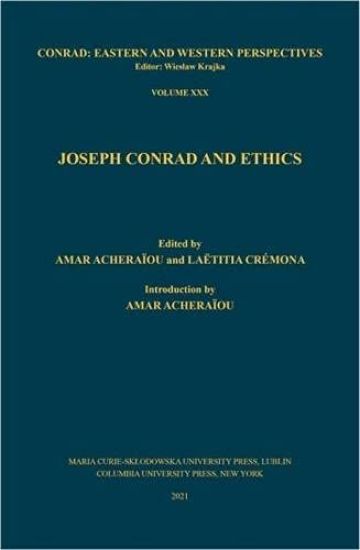
Joseph Conrad and Ethics

Joseph Conrad and Ethics

Amar Acheraiou; Laëtitia Crémona

Maria Curie-Sklodowska University Press
2022
sidottu
Joseph Conrad’s ethical perspective is one of the deepest in twentieth-century fiction, yet its study has been overlooked in recent scholarship. Joseph Conrad and Ethics is one of very few books fully devoted to ethics in Conrad’s fiction. It offers a thorough, in-depth analysis of Conrad’s ethical reflection that challenges and extends current scholarly discussions.The authors of this theoretically informed, accessible volume examine Conrad’s representation of ethics through the lens of Levinas, Derrida, Foucault, Deleuze, and Ricoeur, among others, and confront Conrad’s ethical perspective to these philosophers’ views. Through detailed studies of works like “Heart of Darkness,” The Secret Agent, Lord Jim and Under Western Eyes, they navigate the conflicted terrain of ethics and morality, highlighting the enmeshment of ethics and aesthetics, ethics and narrative, and ethics and ideology in Conrad’s fiction. The key issues they address include the ethics of storytelling and readership, ethical commitment and detachment, the ethics of uncertainty and uneasiness, and planetary ethics and ethical disillusionment. Conrad is ambivalent about ethics and this interdisciplinary volume pivots around a fundamental Conradian ethical paradox: how to account for ethical responsibility in a world not meant for ethics in the first place and, as Conrad stated, whose “aim cannot be ethical at all.” It demonstrates that Conrad adopts a planetary ethics that embraces the human condition in its universality, while he also doubts the viability of ethics itself. Via his protagonists’ moral predicaments he expresses both the necessity of ethics in human relationships and the impossibility of individual ethical fulfillment.The book is volume 30 of the series Conrad: Eastern and Western Perspectives, edited by Wieslaw Krajka. It explores a major, understudied Conradian topic – Ethics, and adds an important thematic and theoretical dimension to this series. The chapters are written by experts from various universities worldwide, in keeping with the international, cosmopolitan spirit of Eastern and Western Perspectives. The authors’ wide-ranging, original perspectives on ethics open new venues in Conrad scholarship that will greatly benefit scholars and students of Conrad, modernism, and ethics.
Joseph Conrad and Material Culture – From the Rise of the Commodity Transcendent to the Scramble for Africa
Joseph Conrad and Material Culture offers a fresh approach to Conrad’s work, especially his African fictions, by grounding its discussion in the importance of material culture and its role in shaping the literary art form in modernity. Opening with the description of a uniquely carved African tusk as both a work of art and an object of material culture, Merry M. Pawlowski traces the scenes of African life displayed on that tusk to establish the major themes of her study of selected works of Conrad’s fiction and nonfiction. These themes include the presence of transculturation in colonial Africa, the transformation of the African fetish into the commodity fetish, the exploitation of the African continent through mapping, exploration, and trade, and the rise of the transcendent commodity. Employing cartographic, materialist, psychoanalytic, and postcolonial theories as frameworks, Pawlowski offers new insights using details, liminal presences, in Conrad’s texts enhanced by key illustrations to expand those details as revelatory of the broader material culture invoked by the text. The brief mention of a Huntley and Palmers biscuit tin, the single reference to the Great Exhibition of 1851, the intriguing hint of a vile scramble for loot, are a few examples of tantalizing textual presences. Pawlowski explores the presence of material culture through teasing out gaps, silences, and hints deployed in Conrad’s works. Revealing the rich context on which Conrad drew as he wrote, this book offers an opportunity for the reader to enter Conrad’s world through envisioning the defamiliarizing spaces from which he drew inspiration for his art.This book is volume 31 of the series Conrad: Eastern and Western Perspectives, edited by Wieslaw Krajka.
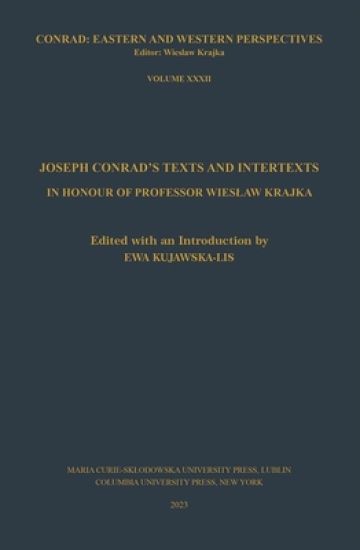
Joseph Conrad’s Texts and Intertexts

Joseph Conrad’s Texts and Intertexts

Maria Curie-Sklodowska University Press
2024
pokkari
Joseph Conrad’s Texts and Intertexts. In Honour of Professor Wieslaw Krajka is a collection of studies that examine various aspects of Joseph Conrad’s literary art, with the organizing ideas being textuality and intertextuality, both broadly understood. Intertextual relationships are perceived in terms of influence of literary, cultural, and philosophical tradition upon his oeuvre, but also affinities between and departures from the works of his predecessors (Miquel Cervantes, John Milton, post-Miltonian tradition), contemporaries (Henry James, H. G. Wells), and those who followed him (Aksel Sandemose, Premendra Mitra) and adapted his works (János Gosztonyi). Textuality is seen from the perspective of the artistic organization of his texts, but also as a means with which to identify the interpretative paths and thematic interests, in particular the social, moral, and economic issues that he tackled in his fiction. The papers apply various theoretical perspectives, ranging from Bakhtinian ethics and Lacanian criticism to Jean-François Lyotard’s philosophy and Georg Simmel’s sociology. Thematically, the essays tackle such diverse issues as escapism, femininity, the arts, illicit conduct, fidelity, secrecy, isolation, immigration, otherness, terrorism, and social equality. Each new reading unveils Conrad’s artistic genius as the authors re-evaluate both the critically acclaimed and the less known works. From this constellation of international scholarship there emerges one common trait discernible in Conrad’s works, both when they analysed on their own and in juxtaposition with those of other writers: ambivalence. This stimulates ever new interpretations and indicate Conrad’s unparalleled ability to provoke readers to constantly rediscover artistic and ethical dimensions of his oeuvre. This book is volume 32 of the series Conrad: Eastern and Western Perspectives, edited by Wieslaw Krajka.
Joseph Conrad`s Polish Soul – Realms of Memory and Self

Joseph Conrad`s Polish Soul – Realms of Memory and Self

G. W. Stephen Brodsky

Maria Curie-Sklodowska University Press
2017
sidottu
Born into a Polish szlachta (noble) family, the extraordinary modern novelist Joseph Conrad maintained, even in exile, strong ties to his Polish heritage and culture. Yet the author earned renown by writing in English, often about nautical adventures in remote parts of the world. In Joseph Conrad's Polish Soul, G. W. Stephen Brodsky seeks to reclaim the essentially Polish sensibility of Conrad's groundbreaking oeuvre. He finds in Conrad's work a distinct Polonism that plays intriguingly with selfhood, freedom, and irony. For Brodsky, Conrad's outlook and writing betray numerous contradictions. Despite the novelist's practical realism, Conrad was drawn to romance, orientalism, and the exotic. Frequently sick, he nevertheless pursued a life at sea. He despised adventurers, yet loved risk. An instinctive skepticism, conservatism, and nationalism complicated his liberalism and respect for humanity, and though he resigned himself to Poland's tragic destiny, Conrad refused to despair over the terribleness of his times. In this incomparable study, Brodsky shows how these inherent aspects of Conrad's personality inform and guide his Polonism, along with the best attributes of his fiction.
Joseph Conrad and the Voicing of Textuality

Joseph Conrad and the Voicing of Textuality

Claude Maisonnat

Maria Curie-Sklodowska University Press
2017
sidottu
Joseph Conrad and the Voicing of Textuality offers an original approach to Conrad's work rooted in linguistics and psychoanalytic theory. Claude Maisonnat provides fresh insight into the poetics of textuality by introducing the concept of textual voice, as opposed to the traditional conceptions of authorial voice and narrative voice. Understood as the main vector of poeticity in a text, textual voice is an offshoot of the Lacanian object-voice trimmed to fit a literary context. It enables the reader to uncover deeply concealed motivations and perceive unsuspected connections to the biographical background of the texts. At the same time, it offers new ways of structuring close reading and opens vistas into the mysteries of creation. Maisonnat gives insightful readings of Conrad's best-known and less widely read works while developing a theoretically rich framework to tackle the notions of style and voice in literature. This book is volume 26 of the series Conrad: Eastern and Western Perspectives, edited by Wieslaw Krajka.
Joseph Conrad and Ford Madox Ford: A Study in Collaboration
When Joseph Conrad died in 1924, Ford Madox Ford immediately published a memoir of his involvement with Conrad at which Conrad's widow took offense. The ensuing "controversy" left Ford with a lasting reputation for "unreliability" which Morey examines in detail, uncovering evidence that substantiates most of Ford's claims. Morey's judicious assessment of the literary friendship and interdependence between two remarkable writers is a much-needed addition to studies of Conrad and Ford.
Joseph Conrad's Nautical Terms: A Handbook
Unlock the secrets of Conrad's salt-laced realm Discover the meanings of "wearing ship," "kedge anchors," or the perils of "scudding under bare poles." Joseph Conrad's Nautical Terms demystifies 2,000 maritime words and phrases, revealing how Conrad used them to create his legendary narratives. Rich historical sources, clear glossary definitions, informative illustrations, and 600 detailed examples from his writing combine to decode and bring to life his nautical world. Explore his thrilling storm passages, evocative calm scenes, rigorous examinations, and remarkable journey from sailor to shipmaster--and even learn the ropes of the Beaufort wind scale. Whether you're a Conrad enthusiast, student, or sea lover, this book transforms your reading experience, making every voyage with him a deeper, more immersive adventure.
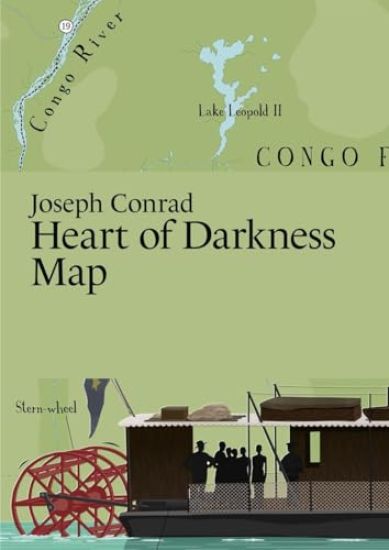
Joseph Conrad, Heart of Darkness Map

Joseph Conrad, Heart of Darkness Map

Martin Thelander

Paris Grafik
2025
muu
One side of this illustrated map depicts the Thames and its estuary, where the story begins. The other side follows Marlow’s journey up the Congo River—the very river where Conrad once worked and which inspired his novella. There’s also a map showing the colonisation of Africa from 1880 to 1914.
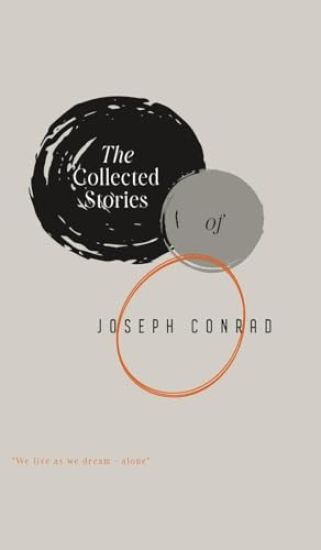
The Collected Stories of Joseph Conrad

The Collected Stories of Joseph Conrad

Joseph Conrad

Jollyjoy Books
2025
sidottu
The Collected Stories by Joseph Conrad is a powerful anthology that brings together the finest of the author's short fiction, showcasing his mastery of psychological depth and exploration of human nature. Known for his vivid descriptions and complex narratives, Conrad's stories often delve into themes of moral ambiguity, the struggle between civilization and primal instincts, and the complexities of the human soul. From tales of life at sea to stories set in exotic, foreign lands, The Collected Stories reflects Conrad's unique ability to capture the tension between personal desires and external forces. This collection is a must-read for those drawn to thought-provoking, atmospheric fiction and the works of one of the 20th century's greatest literary figures.
The Collected Stories of Joseph Conrad

The Collected Stories of Joseph Conrad

Joseph Conrad

Jollyjoy Books
2025
pokkari
The Collected Stories by Joseph Conrad is a powerful anthology that brings together the finest of the author's short fiction, showcasing his mastery of psychological depth and exploration of human nature. Known for his vivid descriptions and complex narratives, Conrad's stories often delve into themes of moral ambiguity, the struggle between civilization and primal instincts, and the complexities of the human soul. From tales of life at sea to stories set in exotic, foreign lands, The Collected Stories reflects Conrad's unique ability to capture the tension between personal desires and external forces. This collection is a must-read for those drawn to thought-provoking, atmospheric fiction and the works of one of the 20th century's greatest literary figures.
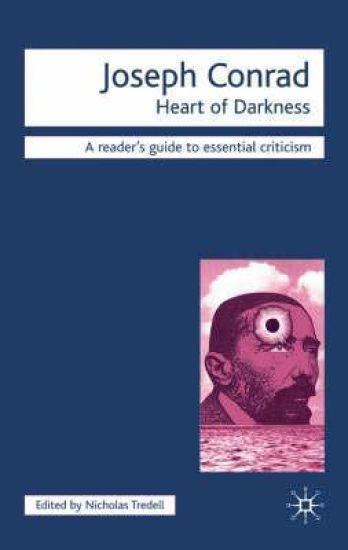
Joseph Conrad - Heart of Darkness

Joseph Conrad - Heart of Darkness

Nicolas Tredell

Icon Books Ltd
1998
nidottu
In this Readers' Guide, Nicolas Tredell introduces and sets in context the major debates about a work which has generated an impressive range of interpretations. The critics assembled here discuss Heart of Darkness in terms of myth, philosophy and politics; analyse its complex narrative technique and style; and interrogate its attitudes to Empire, its images of Africa and its representations of women. Examining secondary sources from the 1900s to the 1990s, this Guide is an indispensable resource for the study of one of Conrad's most potent works.