Kirjojen hintavertailu. Mukana 11 244 527 kirjaa ja 12 kauppaa.

Kirjahaku

Etsi kirjoja tekijän nimen, kirjan nimen tai ISBN:n perusteella.

1000 tulosta hakusanalla Doris Lessing

Mapping Courtship and Kinship in Classical Japan

Mapping Courtship and Kinship in Classical Japan

Doris Bargen

University of Hawai'i Press
2015
nidottu
Literary critiques of Murasaki Shikibu's eleventh-century The Tale of Genji have often focused on the amorous adventures of its eponymous hero. In this paradigm-shifting analysis of the Genji and other mid-Heian literature, Doris G. Bargen emphasizes the thematic importance of Japan's complex polygynous kinship system as the domain within which courtship occurs. Heian courtship, conducted mainly to form secondary marriages, was driven by power struggles of succession among lineages that focused on achieving the highest position possible at court. Thus interpreting courtship in light of genealogies is essential for comprehending the politics of interpersonal behavior in many of these texts. Bargen focuses on the genealogical maze—the literal and figurative space through which several generations of men and women in the Genji moved. She demonstrates that courtship politics sought to control kinship by strengthening genealogical lines, while secret affairs and illicit offspring produced genealogical uncertainty that could be dealt with only by reconnecting dissociated lineages or ignoring or even terminating them. The work examines in detail the literary construction of a courtship practice known as kaimami, or ""looking through a gap in the fence,"" in pre-Genji tales and diaries, and Sei Sh?nagon's famous Pillow Book. In Murasaki Shikibu's Genji, courtship takes on multigenerational complexity and is often used as a political strategy to vindicate injustices, counteract sexual transgressions, or resist the pressure of imperial succession. Bargen argues persuasively that a woman observed by a man was not wholly deprived of agency: She could choose how much to reveal or conceal as she peeked through shutters, from behind partitions, fans, and kimono sleeves, or through narrow carriage windows. That mid-Heian authors showed courtship in its innumerable forms as being influenced by the spatial considerations of the Heian capital and its environs and by the architectural details of the residences within which aristocratic women were sequestered adds a fascinating topographical dimension to courtship. In Mapping Courtship and Kinship in Classical Japan readers both familiar with and new to The Tale of Genji and its predecessors will be introduced to a wholly new interpretive lens through which to view these classic texts. In addition, the book includes charts that trace Genji characters' lineages, maps and diagrams that plot the movements of courtiers as they make their way through the capital and beyond, and color reproductions of paintings that capture the drama of courtship.
Mapping Courtship and Kinship in Classical Japan

Mapping Courtship and Kinship in Classical Japan

Doris Bargen

University of Hawai'i Press
2017
nidottu
Literary critiques of Murasaki Shikibu's eleventh-century The Tale of Genji have often focused on the amorous adventures of its eponymous hero. In this paradigm-shifting analysis of the Genji and other mid-Heian literature, Doris G. Bargen emphasizes the thematic importance of Japan's complex polygynous kinship system as the domain within which courtship occurs. Heian courtship, conducted mainly to form secondary marriages, was driven by power struggles of succession among lineages that focused on achieving the highest position possible at court. Thus interpreting courtship in light of genealogies is essential for comprehending the politics of interpersonal behavior in many of these texts. Bargen focuses on the genealogical maze—the literal and figurative space through which several generations of men and women in the Genji moved. She demonstrates that courtship politics sought to control kinship by strengthening genealogical lines, while secret affairs and illicit offspring produced genealogical uncertainty that could be dealt with only by reconnecting dissociated lineages or ignoring or even terminating them. The work examines in detail the literary construction of a courtship practice known as kaimami, or ""looking through a gap in the fence,"" in pre-Genji tales and diaries, and Sei Shonagon's famous Pillow Book. In Murasaki Shikibu's Genji, courtship takes on multigenerational complexity and is often used as a political strategy to vindicate injustices, counteract sexual transgressions, or resist the pressure of imperial succession. Bargen argues persuasively that a woman observed by a man was not wholly deprived of agency: She could choose how much to reveal or conceal as she peeked through shutters, from behind partitions, fans, and kimono sleeves, or through narrow carriage windows. That mid-Heian authors showed courtship in its innumerable forms as being influenced by the spatial considerations of the Heian capital and its environs and by the architectural details of the residences within which aristocratic women were sequestered adds a fascinating topographical dimension to courtship.In Mapping Courtship and Kinship in Classical Japan readers both familiar with and new to The Tale of Genji and its predecessors will be introduced to a wholly new interpretive lens through which to view these classic texts. In addition, the book includes charts that trace Genji characters' lineages, maps and diagrams that plot the movements of courtiers as they make their way through the capital and beyond, and color reproductions of paintings that capture the drama of courtship.
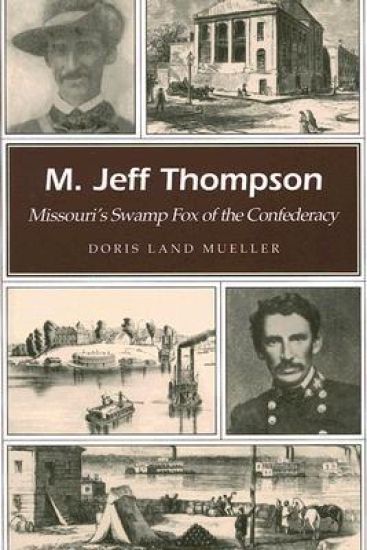
M. Jeff Thompson

M. Jeff Thompson

Doris Land Mueller

University of Missouri Press
2007
nidottu
"Doris Land Mueller offers an adventurous account of the life of Confederate Army commander Meriwether Jeff Thompson. Thompson's military exploits in the Missouri Bootheel region earned him the nicknamed "Swamp Fox" from Union General Ulysses S. Grant, while his writing earned him the nickname "Poet Laureate of the Marshes"--Provided by publisher.
Daring to Be Different

Daring to Be Different

Doris Mueller

University of Missouri Press
2010
nidottu
In the 1800s, American women were largely restricted to the private sphere. Most had no choice but to spend their lives in the home, marrying in their teens and living only as wives, mothers, and pillars of domesticity. Even as the women's movement came along midcentury, it focused more on gaining legal and political rights for women than on expanding their career opportunities. So in that time period, in which the options and expectations for women's professional lives were so limited, it is remarkable that three sisters born in the 1850s, the Owen daughters of Missouri, all achieved success and appreciation in their careers. Doris Land Mueller's Daring to Be Different tells the story of these exceptional sisters, whose contributions to their chosen fields are still noteworthy today. Mary, the oldest, followed a childhood interest in storytelling to become an internationally recognized folklorist, writing about the customs of Missouri's Native Americans, the traditions of its African American communities, and the history of St. Joseph's earliest settlers. The middle daughter, Luella, became a geologist, breaking into the 'old boys club' of the nineteenth-century scientific community; her book, Cave Regions of the Ozarks and the Black Hills, was for over fifty years the only reference to include Missouri caves and is still a valuable resource on the subject. And the youngest Owen girl, Juliette, was a talented artist who painted images of birds and studied and wrote about ornithology. An ardent conservationist, Juliette was an animal advocate during the early days of the humane movement. Through a compelling narrative driven by thorough research, Mueller showcases the different personalities of the three sisters who all eschewed marriage to pursue their callings, putting their accomplishments in context with the place and times in which they lived. With family stories, illustrations of early St. Joseph, and images of the Owen family to enrich the story, this book pays tribute to the Owen sisters' contributions to the Show-Me State. The latest addition to the Missouri Heritage Reader Series, Daring to Be Different will appeal to anyone interested in Missouri history and the early years of the women's movement.
Bareface

Bareface

Doris T. Myers

University of Missouri Press
2018
nidottu
C. S. Lewis wanted to name his last novel “Bareface.” Now Doris T. Myers’s Bareface provides a welcome study of Lewis’s last, most profound, and most skillfully written novel, Till We Have Faces. Although many claim it is his best novel, Till We Have Faces is a radical departure from the fantasy genre of Lewis’s Chronicles of Narnia and The Screwtape Letters and has been less popular than Lewis’s earlier works. In Bareface, Myers supplies background information on this difficult work and suggests reading techniques designed to make it more accessible to general readers. She also presents a fresh approach to Lewis criticism for the enjoyment of specialists. Previous studies have often treated the novel as mere myth, ignoring Lewis’s effort to present the story of Cupid and Psyche as something that could have happened. Myers emphasizes the historical background, the grounding of the characterizations in modern psychology, and the thoroughly realistic narrative presentation. She identifies key books in ancient and medieval literature, history, and philosophy that influenced Lewis’s thinking as well as pointing out a previously unnoticed affinity with William James. From this context, a clearer understanding of Till We Have Faces can emerge. Approached in this way, the work can be seen as a realistic twentieth-century novel using modernist techniques such as the unreliable narrator and the manipulation of time. The major characters fit neatly into William James’s typology of religious experience, and Orual, the narrator-heroine, also develops the kind of personal maturity described by Carl Jung. At the same time, both setting and plot provide insights into the ancient world and pre-Christian modes of thought. Organized to facilitate browsing according to the reader’s personal interests and needs, this study helps readers explore this complex and subtle novel in their own way. Containing fresh insights that even the most experienced Lewis scholar will appreciate, Bareface is an accomplishment worthy of Lewis’s lifelong contemplation.
Waterbugs and Dragonflies

Waterbugs and Dragonflies

Doris Stickney

The Pilgrim Press
1997
nidottu
Waterbugs and Dragonflies is a graceful fable written by Doris Stickney who sought a meaningful way to explain to neighborhood children the death of a five-year-old friend. The small book is beautifully illustrtated by artist Gloria Ortiz Hernandez.
Water Bugs and Dragonflies Explaining Death to Children
The Pilgrim Press is pleased to re-introduce the Looking Up series of 24-page, 5.5" by 5.5" booklets. The four best-selling titles are ideal for times that call for contemplation or prayer, whether for times of difficulty and worry or for times of joy and happiness. More in-depth than a greeting card, each booklet will help you find the right words...a caring thought...a comforting reflection to communicate compassion in extraordinary ways.
Water Bugs and Dragonflies

Water Bugs and Dragonflies

Doris Stickney

United Church Press
2022
sidottu
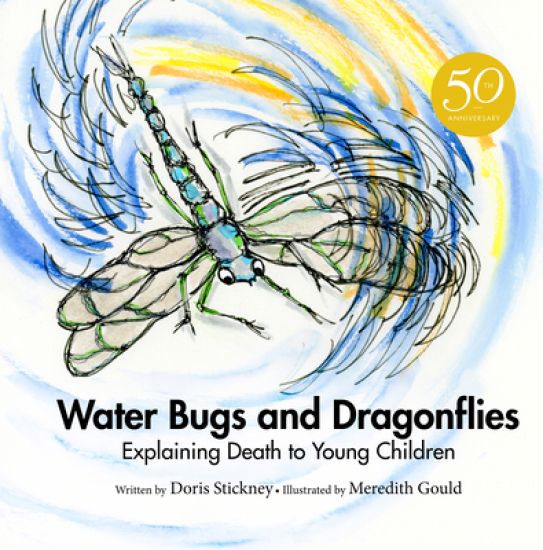
"I don't know" is an honest admission. But "I believe" gives our children confidence in a future that can be anticipated. Over fifty years ago, Doris Stickney published these words in a magazine article, after watching adults struggle to talk with children about death, following the tragic death of a neighborhood child.Celebrating the wisdom of Stickney's perspective and the story's ongoing impact, the 50th anniversary edition of Water Bugs and Dragonflies includes the original magazine article from 1970 as well as a second article she wrote about her own cancer diagnosis, which concluded: It's as simple as this: I can withdraw inside myself, pull down the shades and wait. Or I can open the curtains and see what the day promises. "Water Bugs and Dragonflies is a lovely narrative. Beautiful illustrations support the wonder and beauty of transformations found in both nature and human experience." --Catherine Maresca, Center for Children and TheologyTalking to children about death can be hard. Water Bugs and Dragonflies, a perennial bestseller, can help you to answer their questions.Doris Stickney tells the story of a small colony of water bugs living below the surface of a pond. Whenever a bug leaves the pond, those left behind are faced with the mystery of their absence. Stickney invites children into the question of their absence and offers hope for the future.
More-With-Less Cookbook

More-With-Less Cookbook

Doris Janzen Longacre

Herald Press (VA)
2003
pokkari
When first published in 1976, More-with-Less Cookbook by Doris Janzen Longacre struck a nerve with its call for every household to help solve the world food crisis. Now with more than 800,000 copies around the globe. it has become the favorite cookbook of many families. 330 Pages.
Living More with Less, 30th Anniversary Edition

Living More with Less, 30th Anniversary Edition

Doris Janzen Longacre

Herald Press (VA)
2010
nidottu
In 1980, before living simply and "green" became trendy and popular, Doris Janzen Longacre, author of the enormously popular More-with-Less Cookbook (over 900,000 sold), wrote Living More with Less, a practical guide for living in simple, sustainable, and healthy ways-ways that keep the future of the planet, and the plight of poor people, in mind.Thirty years later, Living More with Less 30th Anniversary Edition is being released as a way to celebrate and honor Longacre's foresight and vision, and to pass on her vision for simple and sustainable living to a new generation.Revised and updated by Valerie Weaver-Zercher, this 30th anniversary edition is true to author Doris' spirit of living in ways that keeps poor people, God's creation and each other in mind-and is loaded with new and practical tips in areas such as money, travel, clothing, housing, celebrations and recreation."Living More with Less 30th Anniversary Edition collects the wisdom and experience of those who live with less than a consumer culture says we need. With stories, reflections, and advice from people around the world who are making changes to their daily habits in response to climate change and global poverty, Living More with Less 30th Anniversary Edition is a vibrant collection of testimonies, old and new, of those who are discovering the joy of living with enough." --Valerie Weaver-Zercher, editorCheck out the article "Living More with Less: An Idea Whose Time Has Come Again" at Publishers WeeklyEndorsements"This book was decades ahead of its time, and is just as relevant today as it was thirty years ago . . . It is like a cookbook for life." --Shane Claiborne, author of The Irresistible Revolution, speaker, and activist"This message is even more important than it was thirty years ago . . . Herein lies sound advice for living sensibly." --Bill McKibben, author Eaarth: Making a Life on a Tough New Planet"This timely revised and updated edition is exceptionally wise, urgently necessary for the sake of saving our planet, pertinently and personally practical . . . Who could not but rave about this book " --Marva Dawn, author of Unfettered Hope; Being Well When We're Ill; and Keeping the Sabbath Wholly"Living More with Less is about a way of living rooted in the Christian faith . .. . Our planet is groaning and we desperately need the kind of thoughtful essays and tips in this book to show us the way forward." --Ron Sider, founder and president of Evangelicals for Social ActionRead the complete list of endorsements Click here for more about Living More with Less, including sample tips & ideas, additional resources and more. Click here for more about Doris Janzen Longacre, including poems, journal entries, her final sermon and more.Free downloadable study guide available here.
More-With-Less: A World Community Cookbook

More-With-Less: A World Community Cookbook

Doris Janzen Longacre

Herald Press (VA)
2016
nidottu
How we cook can change the world.With one small idea, a movement was born. The essential cookbook of simple eating and Christian compassion, More-with-Less has given generations of cooks basic, healthy recipes that are gentle on the budget and mindful of those who are hungry. This 40th anniversary edition preserves hundreds of timeless recipes and tips from Doris Janzen Longacre's bestselling cookbook and offers updates by award-winning food writer Rachel Marie Stone.If you own just one cookbook, More-with-Less is the one. Serve your household nourishing meals and inspiring stories about sharing resources and living with less. Join a community that is cooking with a conscience.The World Community Cookbook series benefits the work of Mennonite Central Committee, a worldwide ministry of relief, development, and peace. Nearly one million copies sold.Simple. Wholesome. Generous. Faithful.Key features of the 40th Anniversary edition include: Classic recipes with tips for contemporary cooksColorful photographs throughoutNew recipes featuring fresh, healthy ingredientsUpdated nutritional information and cooking techniquesInspiring stories of living joyfully and simplyRecipe labels on vegetarian and gluten-free dishes