During her lifetime, Edith Wharton was America's most popular and prolific writer. This book presents the unpublished writings of a canonical author, along with three stage-plays that open up a different field of Wharton studies. It also includes a general introduction, volume introductions, textual variants, headnotes and endnotes.
One tragic night changed sensible, proper Lady Edith Pelton's life: when her best friend fell to her death, pushed down a flight of stairs by a nefarious lord. Now, Edith dedicates her time to watching the man she thinks is responsible, while gathering information to expose other scoundrels posing as gentlemen of honor about London. When her spying is noticed by a perfect stranger, Edith finds herself with two mysteries--what happened to her friend, and how to win the heart of this brilliantly handsome lord. Triston Neville, Viscount Torrington, has been tasked with two duties for the upcoming Season: see that his sisters make the most of their debut, and avoid embroiling himself in another scandal. What he does not expect is the captivating, fair-haired beauty that literally falls into his path. When the mysterious Lady Edith suddenly disappears without a trace, Triston fears his past misdeeds may have returned to destroy his life once more. Can Triston piece together the puzzle in time to save Edith and prove that his love is nothing less than honorable?
Travel around the world on an exciting adventure with Edith and Eddie, two of Santa's elves, on a mission to bring back the secret ingredients Uncle Whisk needs to make his special Christmas cookies.
Charles Sept a Jumiege; Edith, ou le Champ d'Hastings, poemes suivis de poesies, par Ulric GuttinguerDate de l'edition originale: 1827Ce livre est la reproduction fidele d'une oeuvre publiee avant 1920 et fait partie d'une collection de livres reimprimes a la demande editee par Hachette Livre, dans le cadre d'un partenariat avec la Bibliotheque nationale de France, offrant l'opportunite d'acceder a des ouvrages anciens et souvent rares issus des fonds patrimoniaux de la BnF.Les oeuvres faisant partie de cette collection ont ete numerisees par la BnF et sont presentes sur Gallica, sa bibliotheque numerique.En entreprenant de redonner vie a ces ouvrages au travers d'une collection de livres reimprimes a la demande, nous leur donnons la possibilite de rencontrer un public elargi et participons a la transmission de connaissances et de savoirs parfois difficilement accessibles.Nous avons cherche a concilier la reproduction fidele d'un livre ancien a partir de sa version numerisee avec le souci d'un confort de lecture optimal. Nous esperons que les ouvrages de cette nouvelle collection vous apporteront entiere satisfaction.Pour plus d'informations, rendez-vous sur www.hachettebnf.fr
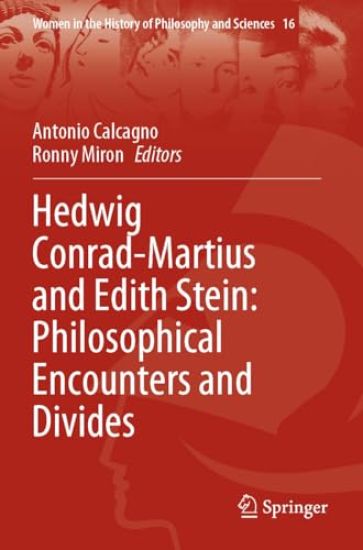
This book focuses on the unique philosophical relationship between Hedwig Conrad-Martius and Edith Stein. The two phenomenologists discussed and debated insights and ideas about the nature of the soul, phenomenology, personhood and individuality, animal life, nature, being, and God. This book brings together for the first time leading international scholars of phenomenology to explore the philosophical exchange between both Conrad-Martius and Stein. This is an important book for understanding the development of the phenomenological movement and key phenomenological ideas and methods. It provides a critical and comprehensive overview of the key issues that helped frame both phenomenologists’ philosophical trajectories. Additionally, the ideas of Conrad-Martius and Stein are mined to address contemporary questions surrounding such topics as personal identity, animal versus human personhood, contemporary atheism, and the relationship between religion and science. The book will have greatappeal to phenomenologists, philosophers, and historians of philosophy.
This book focuses on the unique philosophical relationship between Hedwig Conrad-Martius and Edith Stein. The two phenomenologists discussed and debated insights and ideas about the nature of the soul, phenomenology, personhood and individuality, animal life, nature, being, and God. This book brings together for the first time leading international scholars of phenomenology to explore the philosophical exchange between both Conrad-Martius and Stein. This is an important book for understanding the development of the phenomenological movement and key phenomenological ideas and methods. It provides a critical and comprehensive overview of the key issues that helped frame both phenomenologists’ philosophical trajectories. Additionally, the ideas of Conrad-Martius and Stein are mined to address contemporary questions surrounding such topics as personal identity, animal versus human personhood, contemporary atheism, and the relationship between religion and science. The book will have greatappeal to phenomenologists, philosophers, and historians of philosophy.
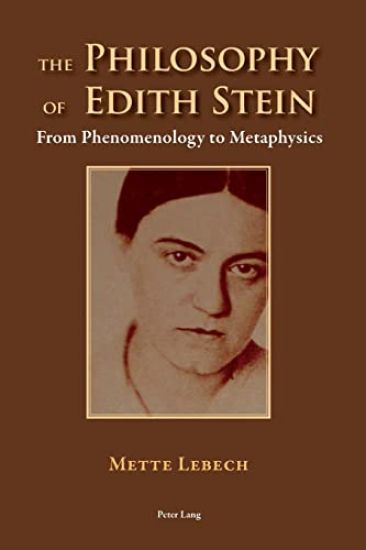
Many interested reader will have put aside a work by Edith Stein due to its seeming inaccessibility, with the awareness that there was something important there for a future occasion. This collection of essays attempts to provide an idea of what this important something might be and give a key to the reading of Stein’s various works. It is divided into two parts reflecting Stein’s development. The first part, «Phenomenology», deals with those features of Stein’s work that set it apart from that of other phenomenologists, notably Husserl. The second part is entitled «Metaphysics», although Stein the phenomenologist would, like Husserl, initially have shied away from this designation. However, as Stein gradually understood the importance of the Christian faith for completing the phenomenological project of founding the sciences, and accepted it as indispensable for a philosophical view of the whole, her «attempt at an ascent to the meaning of being» can legitimately be called metaphysics, even as it also constitutes a fundamental criticism of Aristotle and Aquinas.
Edith Stein is widely known as a historical figure, a victim of the Holocaust and a saint, but still unrecognised as a philosopher. It was philosophy, however, that constituted the core of her life. Today her complete writings are available to scholars and therefore her thinking can be properly investigated and evaluated. Who is a human person? And what is his or her dignity according to Edith Stein? Those are the two leading questions investigated in this volume. The answer is presented based on the complete writings of the 20th-c. phenomenologist and, moreover, compared to the traditional Christian understanding of human dignity present in the writings of the Church Fathers and the Doctors of the Church as well as Magisterial Documents of the Catholic Church. In the final parts of the book, the author shows how Stein's ideas are relevant today, in particular to the ongoing doctrinal and legal debates over the concept of human dignity.
Das Thema Amerika - Europa reizte amerikanische Schriftsteller immer wieder zur literarischen Gestaltung. Fur Edith Wharton ist Europa in erster Linie Frankreich, ein Land, das ihr fur drei Jahrzehnte zur zweiten Heimat wurde und in vielen ihrer Werke Bedeutung erlangte. Das Buch bezieht unveroffentlichtes Material aus der Beinecke Library in New Haven, Conn. ein und berucksichtigt die europaische und uberseeische Sekundarliteratur."