Kirjojen hintavertailu. Mukana 11 490 686 kirjaa ja 12 kauppaa.

Kirjahaku

Etsi kirjoja tekijän nimen, kirjan nimen tai ISBN:n perusteella.

1000 tulosta hakusanalla Georg P. Loczewski

Putting Our House in Order

Putting Our House in Order

John B. Shoven; George P. Shultz

WW Norton Co
2008
sidottu
Of all the issues swirling around the 2008 election, the staggering projected costs for the upkeep of America's largest entitlement programs—Social Security, Medicare, and Medicaid—loom with gathering intensity. Government revenues alone cannot solve the problem, but a solution must be found. In this book George P. Shultz and John B. Shoven take a practical—and optimistic—look at the issues at hand, offering an agenda for reform that will make these essential programs solvent. Drawing on a trove of original research, they take stock of the current situation, consider plans on offer from major thinkers in the field, and chart a course toward a system that provides income for the elderly and universal access to health care in ways that are fiscally sound. This book is a must-read for anyone looking to make an informed decision about the country's future.
Let's Bind a Book

Let's Bind a Book

Guy a. Pratt; George P. Hambrecht

Literary Licensing, LLC
2013
sidottu
Let's Bind A Book by Guy A. Pratt is a comprehensive guide to creating your own book from start to finish. The book covers various binding techniques, including saddle stitch, perfect binding, and case binding, and includes step-by-step instructions and illustrations to help readers understand each process. The author also provides advice on selecting the right materials, tools, and equipment needed for bookbinding, as well as tips for troubleshooting common issues that may arise during the process. Additionally, the book includes information on designing and printing book covers, as well as advice on marketing and selling handmade books. Whether you're a beginner or an experienced bookbinder, Let's Bind A Book is an essential resource for anyone interested in creating their own books.This scarce antiquarian book is a facsimile reprint of the old original and may contain some imperfections such as library marks and notations. Because we believe this work is culturally important, we have made it available as part of our commitment for protecting, preserving, and promoting the world's literature in affordable, high quality, modern editions, that are true to their original work.
Introduction to the Practice of Statistics

Introduction to the Practice of Statistics

David S. Moore; George P. McCabe; Bruce A. Craig

W.H.Freeman Co Ltd
2021
nidottu
Now available with Macmillan’s new online learning tool Achieve, Introduction to the Practice of Statistics, 10th edition, prepares students for the application of statistics in the real world by using current examples and encouraging exploration into data analysis and interpretation. The text enforces statistical thinking by providing learning objectives and linked exercises to help students master core statistics concepts and think beyond the calculations. Achieve for Introduction to the Practice of Statistics integrates outcome-based learning objectives and a wealth of examples with assessment in an easy-to-use interface. Students are provided with rich digital resources that solidify conceptual understanding, as well as homework problems with hints, answer-specific feedback, and a fully worked solution.
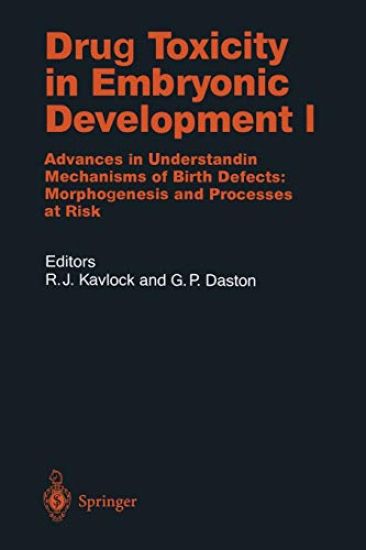
Drug Toxicity in Embryonic Development I

Drug Toxicity in Embryonic Development I

Robert J. Kavlock; George P. Daston

Springer-Verlag Berlin and Heidelberg GmbH Co. K
2012
nidottu
Having received the invitation from Springer-Verlag to produce a volume on drug-induced birth defects for the Handbook of Experimental Pharmacology, we asked ourselves what new approach could we offer that would capture the state of the science and bring a new synthesis of the information on this topic to the world's literature. We chose a three-pronged approach, centered around those particular drugs for which we have a relatively well established basis for understanding how they exert their unwanted effects on the human embryo. We then supplemented this information with a series of reviews of critical biological processes involved in the established normal developmental patterns, with emphasis on what happens to the embryo when the processes are perturbed by experimental means. Knowing that the search for mechanisms in teratology has often been inhibited by the lack of understanding of how normal development proceeds, we also included chapters describing the amazing new discoveries related to the molecular control of normal morphogenesis for several organ systems in the hope that the experimental toxicologists and molecular biologists will begin to better appreciate each others questions and progress. Several times during the last two years of developing outlines, issuing invitations, reviewing chapters, and cajoling belated contributors, we have wondered whether we made the correct decision to undertake this effort.
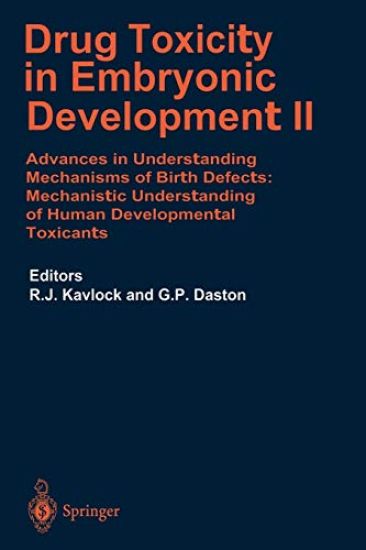
Drug Toxicity in Embryonic Development II

Drug Toxicity in Embryonic Development II

Robert J. Kavlock; George P. Daston

Springer-Verlag Berlin and Heidelberg GmbH Co. K
2011
nidottu
Having received the invitation from Springer-Verlag to produce a volume on drug-induced birth defects for the Handbook of Experimental Pharmacology, we asked ourselves what new approach could we offer that would capture the state of the science and bring a new synthesis of the information on this topic to the world's literature. We chose a three-pronged approach, centered around those particular drugs for which we have a relatively well established basis for understanding how they exert their unwanted effects on the human embryo. We then supplemented this information with a series of reviews of critical biological processes involved in the established normal developmental patterns, with emphasis on what happens to the embryo when the processes are perturbed by experimental means. Knowing that the search for mechanisms in teratology has often been inhibited by the lack of understanding of how normal development proceeds, we also included chapters describing the amazing new discoveries related to the molecular control of normal morphogenesis for several organ systems in the hope that experimental toxicologists and molecular biologists will begin to better appreciate each others questions and progress. Several times during the last two years of developing outlines, issuing invitations, reviewing chapters, and cajoling belated contributors, we have wondered whether we made the correct decision to undertake this effort.