Kirjojen hintavertailu. Mukana 12 016 292 kirjaa ja 12 kauppaa.

Kirjahaku

Etsi kirjoja tekijän nimen, kirjan nimen tai ISBN:n perusteella.

1000 tulosta hakusanalla J. Offer

J. Tolandi Dissertationes Duae, Aedeisidaemon Et Origines Judaicae...
J. Tolandi Dissertationes Duae, Aedeisidaemon Et Origines Judaicae... presents two dissertations by the influential Irish deist philosopher John Toland, written in Latin. "Aedeisidaemon" explores Toland's unique perspective on superstition and its origins, offering insights into his broader philosophical project of promoting reason and challenging traditional religious beliefs. "Origines Judaicae" delves into the historical origins of Judaism, reflecting Toland's interest in historical criticism and his desire to understand the development of religious thought. This work showcases Toland's erudition and his commitment to Enlightenment ideals. It remains a significant text for scholars of 18th-century philosophy, religious history, and the development of deism. This work has been selected by scholars as being culturally important, and is part of the knowledge base of civilization as we know it. This work was reproduced from the original artifact, and remains as true to the original work as possible. Therefore, you will see the original copyright references, library stamps (as most of these works have been housed in our most important libraries around the world), and other notations in the work. This work is in the public domain in the United States of America, and possibly other nations. Within the United States, you may freely copy and distribute this work, as no entity (individual or corporate) has a copyright on the body of the work. As a reproduction of a historical artifact, this work may contain missing or blurred pages, poor pictures, errant marks, etc. Scholars believe, and we concur, that this work is important enough to be preserved, reproduced, and made generally available to the public. We appreciate your support of the preservation process, and thank you for being an important part of keeping this knowledge alive and relevant.
J. Krishnamurti

J. Krishnamurti

Meenakshi Thapan

TAYLOR FRANCIS LTD
2022
sidottu
Teacher, thinker, writer, and speaker, J. Krishnamurti (1895–1986) was an Indian educationist, spiritual leader, and key figure in world philosophy. He raised significant questions about the state of the world, about our tendency to remain passive, conditioned, and in a state of overwhelming confusion about how we relate to the world. Through talks and writings spread over many decades and geographical locations, he articulated an unconditioned, reflective approach which emphasised self-inquiry.This volume provides an understanding of Krishnamurti’s views on the human predicament in a disintegrating world, marked by conflict, divisions, wars, and climate change. It also examines his educational thought and its enormous potential for change. Krishnamurti argued that our minds are so conditioned that we are unable to look, listen, or learn without our prior knowledge that foregrounds the role of memory and time. He highlighted the need to work with young children, with a special focus on the school as the centrepiece of his perception for psychological development and educational excellence. It is within an educational setting that Krishnamurti hoped that the seeds for individual and social change will be catalysed.An introspective look at the life and legacy of an eminent twentieth century thinker, this volume will be of great interest to students and researchers of philosophy, education, religion and spirituality, South Asia studies, modern history, and the social sciences.
J. Krishnamurti

J. Krishnamurti

Meenakshi Thapan

TAYLOR FRANCIS LTD
2022
nidottu
Teacher, thinker, writer, and speaker, J. Krishnamurti (1895–1986) was an Indian educationist, spiritual leader, and key figure in world philosophy. He raised significant questions about the state of the world, about our tendency to remain passive, conditioned, and in a state of overwhelming confusion about how we relate to the world. Through talks and writings spread over many decades and geographical locations, he articulated an unconditioned, reflective approach which emphasised self-inquiry.This volume provides an understanding of Krishnamurti’s views on the human predicament in a disintegrating world, marked by conflict, divisions, wars, and climate change. It also examines his educational thought and its enormous potential for change. Krishnamurti argued that our minds are so conditioned that we are unable to look, listen, or learn without our prior knowledge that foregrounds the role of memory and time. He highlighted the need to work with young children, with a special focus on the school as the centrepiece of his perception for psychological development and educational excellence. It is within an educational setting that Krishnamurti hoped that the seeds for individual and social change will be catalysed.An introspective look at the life and legacy of an eminent twentieth century thinker, this volume will be of great interest to students and researchers of philosophy, education, religion and spirituality, South Asia studies, modern history, and the social sciences.
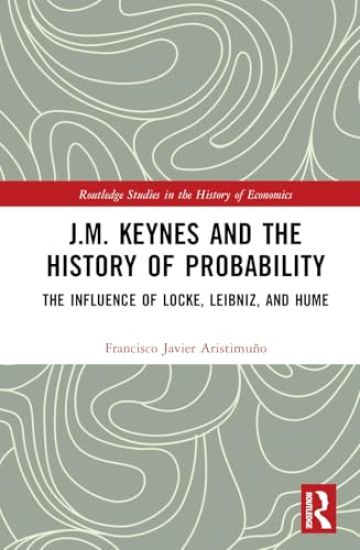
J.M. Keynes and the History of Probability

J.M. Keynes and the History of Probability

Francisco Javier Aristimuño

TAYLOR FRANCIS LTD
2025
sidottu
John Maynard Keynes is best known for his contributions to economics, yet he spent nearly two decades exploring the concept of probability. His extensive work culminated in A Treatise on Probability (1921), in which he developed a unique notion of probability that continues to divide scholars regarding its relevance to economic theory.This book delves into the connections between Keynes’s ideas on probability and those of early Enlightenment philosophers, such as Locke, Leibniz, and Hume, who worked on probability before mathematicians claimed ownership over the subject. These authors framed probability as a substitute for knowledge when it is not available. Keynes extended these ideas and engaged directly with Hume on inductive reasoning, placing his concept of probability within a broader philosophical tradition. By tracing these Enlightenment roots, this book provides deeper insight into Keynes’s understanding of probability, clarifying some of the key differences with the subjective approach due to Ramsey and De Finetti. It also summarises the aspects on which probability theory and its corresponding notion of uncertainty are crucial for Keynes’s economic thought, particularly in his General Theory of Employment, Interest and Money.This book is addressed to readers interested in the philosophy of probability and offers economists a fuller understanding of Keynes’s intellectual framework.