Kirjojen hintavertailu. Mukana 11 627 670 kirjaa ja 12 kauppaa.

Kirjahaku

Etsi kirjoja tekijän nimen, kirjan nimen tai ISBN:n perusteella.

1000 tulosta hakusanalla James M. Hutchisson

A Vision for the Aging Church – Renewing Ministry for and by Seniors

A Vision for the Aging Church – Renewing Ministry for and by Seniors

James M. Houston; Michael Parker

Inter-Varsity Press,US
2011
nidottu
Are we ready for the opportunities and challenges facing the aging church? Now is the time for the church to offer ministry to its increasing numbers of seniors and to benefit from ministry they can offer. In this book James M. Houston and Michael Parker issue an urgent call to reconceive the place and part of the elderly and seniors in the local church congregation. Confronting the idea that the aging are mostly a burden on the church, they boldly address the moral issues related to caring for them, provide examples of successful care-giving programs and challenge the church to restore broken connections across the generations. Cowritten by a noted theologian and an expert in the fields of social work and gerontology, this interdisciplinary book assesses our current cultural context and the challenges and opportunities we face. The authors show us that seniors aren't the problem. They are the solution.
Sinai and the Saints – Reading Old Covenant Laws for the New Covenant Community
What should Christians do with all the laws in the Old Testament? The Old Testament tells the story of the beginnings of God's salvation history, and it is part of the authoritative canon of Scripture affirmed by the church. But what role should the laws of the old covenant play in the lives of those living under the new covenant? Can Christians embrace the commandment to "love the Lord your God with all your heart and with all your soul and with all your strength" but ignore the laws regarding clean and unclean food? Some have suggested that Christians remain under the moral laws of the old covenant, while others have argued that some of the Old Testament laws—for example, the Ten Commandments—still apply to Christians. James Todd makes a bold claim by contending that as followers of Jesus Christ who stand under a new covenant, Christians are no longer subject to any of the Old Testament laws. Focusing on the laws of the Pentateuch, he then addresses the proper role and benefits of the Old Testament laws in the Christian life. With wit and insight, Todd helps Christians to understand how the laws given to the people of Israel at Mount Sinai should be read by those called to live as saints.
Exile: A Conversation with N. T. Wright

Exile: A Conversation with N. T. Wright

James M. Scott; N. T. Wright

Inter-Varsity Press,US
2017
sidottu
Few New Testament scholars of recent decades have set the pitch for academic discussion and debate in their field like N. T. Wright. His signature contention, that Israel's continuing exile was a pivotal issue in the emergence of Christianity, has found a central place in contemporary New Testament scholarship. Israel had grievously sinned against Yahweh and suffered the judgment of exile from its land. But even though Israel had returned, the majority of Jews of the second temple era regarded themselves in paradoxical exile under Roman rule and still awaiting their full restoration. It was this crisis of exile that reached its climax and resolution in the person and work of Jesus Christ. This, according to N. T. Wright, is the controlling narrative that shaped the thinking of Jesus and Paul. While many find this a compelling key to understanding the New Testament, critical responses also abound. This book engages a variety of scholars in conversation with Wright's thesis. The scene is set in an introduction by James M. Scott, who has made significant contributions to the debate. Then, in a programmatic essay, Wright clearly restates his thesis. Next come eleven essays from scholars such as Walter Brueggemann, Philip Alexander, Jörn Kiefer, Dorothy Peters, and Scot McKnight. They interact with Wright's thesis from various perspectives: Hebrew Bible, Septuagint, early Judaism, the Dead Sea Scrolls, and the New Testament. Hans Boersma and Ephraim Radner then engage Wright's thesis from theological perspectives. Finally, Wright offers a lively response to his interlocutors. Exile: A Conversation with N. T. Wright takes our understanding of this critical issue to a new level. It is essential reading for anyone engaged with Wright's work and the Jewish setting of Jesus and Paul.
Autonomous Vehicle Technology

Autonomous Vehicle Technology

James M. Anderson; Nidhi Kalra; Karlyn D. Stanley; Paul Sorensen; Constantine Samaras; Oluwatobi A. Oluwatola

RAND
2014
pokkari
The automotive industry appears close to substantial change engendered by self-driving technologies. This technology offers the possibility of significant benefits to social welfare saving lives; reducing crashes, congestion, fuel consumption, and pollution; increasing mobility for the disabled; and ultimately improving land use. This report is intended as a guide for state and federal policymakers on the many issues that this technology raises."
Differential Equations and Group Methods for Scientists and Engineers
Differential Equations and Group Methods for Scientists and Engineers presents a basic introduction to the technically complex area of invariant one-parameter Lie group methods and their use in solving differential equations. The book features discussions on ordinary differential equations (first, second, and higher order) in addition to partial differential equations (linear and nonlinear). Each chapter contains worked examples with several problems at the end; answers to these problems and hints on how to solve them are found at the back of the book. Students and professionals in mathematics, science, and engineering will find this book indispensable for developing a fundamental understanding of how to use invariant one-parameter group methods to solve differential equations.
Producing Patient-Centered Health Care

Producing Patient-Centered Health Care

James M. Smith

Praeger Publishers Inc
1999
sidottu
A holistic view of the factors that impact the health of a patient beyond the illness itself, this book examines what it is like to be a patient. It espouses the view that terminal illness may not be a tragedy but, an opportunity for emotional growth. The inadequacies of medical care today are discussed, from the failure of health care professionals to see the person with the disease, to the many ways in which managed-care organizations jeopardize the doctor/patient relationship.The work reviews concrete ways in which health care professionals can enhance the quality of their care, by remaining compassionate, continuing to offer patients hope (even if their condition is terminal), acknowledging and addressing patients' suffering, and counseling patients so that they can obtain the support needed. A new advocacy role for doctors is presented that enables patients to make advised decisions about their own treatment. This book encourages patients to take back their lives from the diseases that overwhelm them. It also discusses advance directives, living wills, cardiopulmonary resuscitation, and do not resuscitate orders. Information is provided to help patients assume self advocacy on end-of-life issues from an emotional perspective as well as a legal perspective.
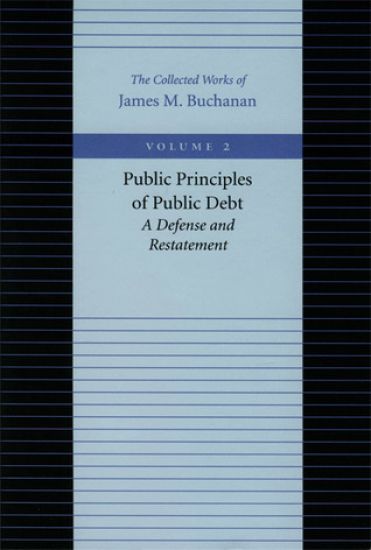
Public Principles of Public Debt -- A Defense & Restatement
One of Buchanan's most important and influential books. The radical idea he conceived was that: our reliance on public debt has amassed a sort of orthodoxy that is commonly -- and needlessly -- assumed by taxpayers, by politicians, and by economists themselves. Buchanan dismisses the nearly universal belief (which continues to this day) that the burden of debt is borne by the current generation, and he argues persuasively that public debt is shouldered in large part by generations still to come. Written in 1958, this book represents Buchanan's first published monograph, and its publication met with much controversy, confusion, and speculation in the economic community. But the book also added to Buchanan's rising stature in the early part of his career as a brilliant and original thinker. The arguments Buchanan lays out in this book had a considerable impact on much of his later work. Buchanan's object here is to establish a set of analytical claims about debt incidence. Current anxieties over implicit Social Security debt are clear indications of the rightness of Buchanan's then-revolutionary theory.
Public Principles of Public Debt -- A Defense & Restatement
One of Buchanan's most important and influential books. The radical idea he conceived was that: our reliance on public debt has amassed a sort of orthodoxy that is commonly -- and needlessly -- assumed by taxpayers, by politicians, and by economists themselves. Buchanan dismisses the nearly universal belief (which continues to this day) that the burden of debt is borne by the current generation, and he argues persuasively that public debt is shouldered in large part by generations still to come. Written in 1958, this book represents Buchanan's first published monograph, and its publication met with much controversy, confusion, and speculation in the economic community. But the book also added to Buchanan's rising stature in the early part of his career as a brilliant and original thinker. The arguments Buchanan lays out in this book had a considerable impact on much of his later work. Buchanan's object here is to establish a set of analytical claims about debt incidence. Current anxieties over implicit Social Security debt are clear indications of the rightness of Buchanan's then-revolutionary theory.
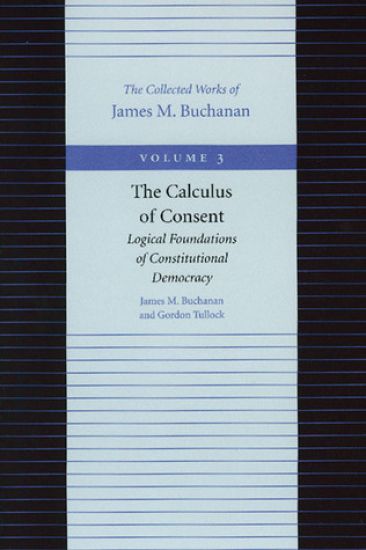
Calculus of Consent -- Logical Foundations of Constitutional Democracy
THE CALCULUS OF CONSENT was co-authored by Buchanan with Gordon Tullock, with whom Buchanan collaborated on many books and academic enterprises throughout their careers. As Robert D Tollison states in the foreword: (this book) is a radical departure from the way democracies conduct their business. The 'Calculus' is already a book for the ages. This classic work analyses the political organisation of a free society through the lens of the economic organisation of society. The authors acknowledge their unease as economists in analysing the political organisation, but they take the risk of forging into unfamiliar territory because they believe the benefits of their perspective will bear much fruit. As the authors state, their objective in this book is "to analyze the calculus of the rational individual when he is faced with questions of constitutional choice... We examine the (choice) process extensively only with reference to the problem of decision-making rules." The authors describe their approach as 'economic individualism'. They believe that economists have explored individual choice extensively in the market sector while social scientists have largely ignored the dynamics of individual decision-making in the dynamics of forming group action in the public sector. Written in the early 1960s, THE CALCULUS OF CONSENT has become a bulwark of the public choice movement for which James M Buchanan is so justly famous.
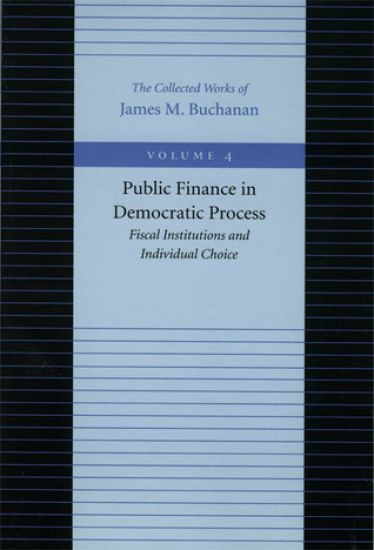
Public Finance in Democratic Process -- Fiscal Institutions & Individual Choice
A monumental work that outlines the dynamics of individual choice as it is displayed in the process of public finance. Buchanan is perhaps nowhere more clearly a disciple of the great Swedish economist Knut Wicksell than he is in the underlying principles of this seminal work. Specifically, he elaborates on these three central Wicksellian themes: analysis of market failure in the provision of public goods; the insistence on conceiving policy decisions as the outcome of political processes; and, the necessity of treating the tax and expense sides of the budget as interconnected. Echoing Wicksell's antipathy to the 'benevolent despot' model of government, Buchanan lays out in this book a starting point for modern public-choice analysis. Recognising the path breaking work he is about to begin, Buchanan opens his preface by stating, "Fiscal theory is normally discussed in a frame of reference wholly different from that adopted in this book. This dramatic shift of emphasis... requires that I consider the processes through which individual choices are transmitted, combined, and transformed into collective outcomes. Careful research in this area is in its infancy, and the necessary reliance on crude, unsophisticated models underscores the exploratory nature of the work." According to Geoffrey Brennan in the foreword, "PUBLIC FINANCE IN DEMOCRATIC PROCESS is a work more hospitable to public finance orthodoxy and could be treated as an extension (albeit an important one) of the conventional approach."
Public Finance in Democratic Process -- Fiscal Institutions & Individual Choice
A monumental work that outlines the dynamics of individual choice as it is displayed in the process of public finance. Buchanan is perhaps nowhere more clearly a disciple of the great Swedish economist Knut Wicksell than he is in the underlying principles of this seminal work. Specifically, he elaborates on these three central Wicksellian themes: analysis of market failure in the provision of public goods; the insistence on conceiving policy decisions as the outcome of political processes; and, the necessity of treating the tax and expense sides of the budget as interconnected. Echoing Wicksell's antipathy to the 'benevolent despot' model of government, Buchanan lays out in this book a starting point for modern public-choice analysis. Recognising the path breaking work he is about to begin, Buchanan opens his preface by stating, "Fiscal theory is normally discussed in a frame of reference wholly different from that adopted in this book. This dramatic shift of emphasis... requires that I consider the processes through which individual choices are transmitted, combined, and transformed into collective outcomes. Careful research in this area is in its infancy, and the necessary reliance on crude, unsophisticated models underscores the exploratory nature of the work." According to Geoffrey Brennan in the foreword, "PUBLIC FINANCE IN DEMOCRATIC PROCESS is a work more hospitable to public finance orthodoxy and could be treated as an extension (albeit an important one) of the conventional approach."
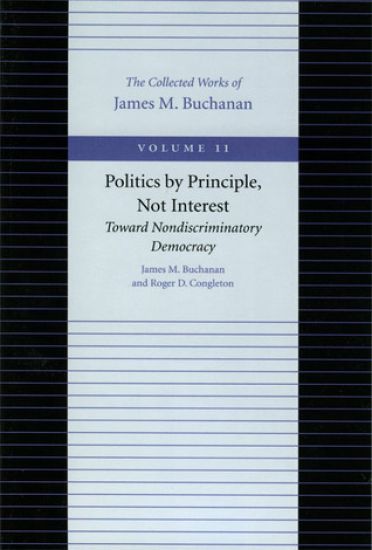
Politics by Principle, Not Interest Toward Nondiscriminatory Democracy
"Politics by principle is that which modern politics is not. What we observe is 'politics by interest', whether in the form of explicitly discriminatory treatment (rewarding or punishing) of particular groupings of citizens or of some elitist-dirigiste classification of citizens into the deserving or non-deserving on the basis of a presumed superior wisdom about what is really 'good' for us all. The proper principle for politics is that of generalization of generality." -- James M Buchanan, from the Preface. In his foreword, Hartmut Kliemt sums up the main objective of James M Buchanan and Roger Congleton's 'Politics by Principle': "Imposing constitutional constraints on majoritarian politics such that a more principled pattern might emerge must be a political aim of high priority for all who wish for free and responsible citizens to live together peacefully as political equals under the rule of general laws. Buchanan and Congleton's efforts to revive the classical liberal agenda in Politics by Principle, Not Interest are of the greatest interest in that regard. And this interest is not merely a theoretical one. "As James Buchanan notes in introducing his co-author Roger Congleton, 'Politics by Principle, Not Interest' "embodies the working out and presentation of a single idea... the extension and application of the generality principle to majoritarian politics. "After laying out the theory, Buchanan and Congleton attempt to work it out in practical political reality. Buchanan notes that "it is much easier to discuss the generality principle as an abstract ideal than it is to define the precise conditions for its satisfaction in any particular setting. "Not daunted by the difficulty of the task, the two authors succeed brilliantly in applying the generality principle to the political arena. They are interested not in laying down precise do's and don'ts for politics, but in pointing out the ideal of nondiscriminatory governance and calling for constitutional constraints on political action so it conforms more closely to the generality norm.
Indexes

Indexes

James M Buchanan

Liberty Fund Inc
2002
sidottu
This volume presents a comprehensive index to the entire series of 'The Collected Works of James M Buchanan'. Included is an annotated copy of the entire curriculum vitae, indicating in which volume in the series the various items appear and, correspondingly, those items that have been omitted. As the editors observe, "This is a series that no serious scholar of public choice theory, public economics, or contemporary political theory will want to be without. It is a series that will also appeal to the general student of liberty, for Buchanan has -- perhaps more than any other contemporary scholar -- helped us to view politics without the romantic gloss that characterises so much normative political theory and that slips unthinkingly into so much popular commentary. Buchanan has been a resolute defender of 'the ideal of a society of free and responsible individuals,' and has been a painstaking analyst of the institutional structure that might best support such a society. Buchanan stands with von Mises, Hayek, Popper, and Friedman as one of the great twentieth-century scholars of liberty."
Calculus of Consent

Calculus of Consent

James M Buchanan; Gordon Tullock; Charles Kershaw Rowle

Liberty Fund Inc
2004
sidottu
This is the second volume of Liberty Fund's "The Selected Works of Gordon Tullock", it is a reprint edition of the ground-breaking economic classic written by two of the world's preeminent economists -- Gordon Tullock and Nobel Laureate James M. Buchanan. This book is a unique blend of economics and political science that helped create significant new subfields in each discipline respectively, namely, the public choice school and constitutional political economy. Charles K. Rowley, Duncan Black Professor of Economics at George Mason University, points out in his introduction, "The Calculus of Consent" is, by a wide margin, the most widely cited publication of each coauthor and, by general agreement, their most important scientific contribution." The book is divided into four parts, each consisting of several chapters. The introduction by Professor Rowley provides a short overview of the book and identifies key insights that permeated the bounds of economics and political science and created an enduring nexus between the two sciences. Part I establishes the conceptual framework of the book's subject; part II defines the realm of social choice; part III applies the logic developed in part II to describe a range of decision-making rules, most notably, the rule of simple majority; while part IV explores the economics and ethics of democracy.
Calculus of Consent

Calculus of Consent

James M Buchanan; Gordon Tullock; Charles Kershaw Rowle

Liberty Fund Inc
2004
nidottu
This is the second volume of Liberty Fund's "The Selected Works of Gordon Tullock", it is a reprint edition of the ground-breaking economic classic written by two of the world's preeminent economists -- Gordon Tullock and Nobel Laureate James M. Buchanan. This book is a unique blend of economics and political science that helped create significant new subfields in each discipline respectively, namely, the public choice school and constitutional political economy. Charles K. Rowley, Duncan Black Professor of Economics at George Mason University, points out in his introduction, "The Calculus of Consent" is, by a wide margin, the most widely cited publication of each coauthor and, by general agreement, their most important scientific contribution." The book is divided into four parts, each consisting of several chapters. The introduction by Professor Rowley provides a short overview of the book and identifies key insights that permeated the bounds of economics and political science and created an enduring nexus between the two sciences. Part I establishes the conceptual framework of the book's subject; part II defines the realm of social choice; part III applies the logic developed in part II to describe a range of decision-making rules, most notably, the rule of simple majority; while part IV explores the economics and ethics of democracy.
Our People, Our Journey

Our People, Our Journey

James M. McClurken

Michigan State University Press
2009
pokkari
"Our People, Our Journey "is a landmark history of the Little River Band of Ottawa Indians, a Michigan tribe that has survived to the present day despite the expansionist and assimilationist policies that nearly robbed it of an identity in the late nineteenth century. In his thoroughly researched chronicle, McClurken documents in words and images every major lineage and family of the Little River Ottawas. He describes the Band's struggles to find land to call its own over several centuries, including the hardships that began with European exploration of what is now the upper Midwest. Although the Little River Ottawas were successful at integrating their economic and cultural practices with those of Europeans, they were forced to cede land in the face of American settlements. McClurken explains how the Little River Band was forced, in 1858, onto a reservation on the Pere Marquette and Manistee Rivers where they settled with a number of other Ottawa bands. However, the very treaty intended to provide the Grand River Ottawas with a permanent reservation "homeland" eventually allowed non-Indians to acquire title to nearly two-thirds of the land within the reservation by 1880.