Kirjojen hintavertailu. Mukana 11 627 220 kirjaa ja 12 kauppaa.

Kirjahaku

Etsi kirjoja tekijän nimen, kirjan nimen tai ISBN:n perusteella.

1000 tulosta hakusanalla Josef Proschek

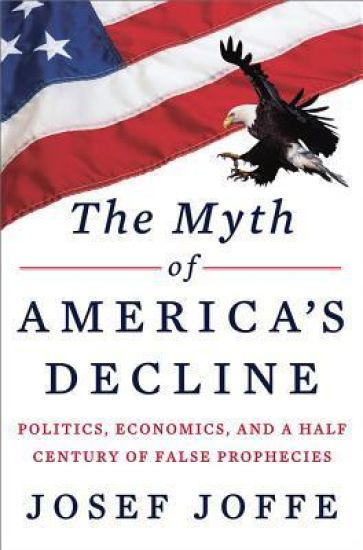
The Myth of America's Decline

The Myth of America's Decline

Josef Joffe

Liveright Publishing Corporation
2014
sidottu
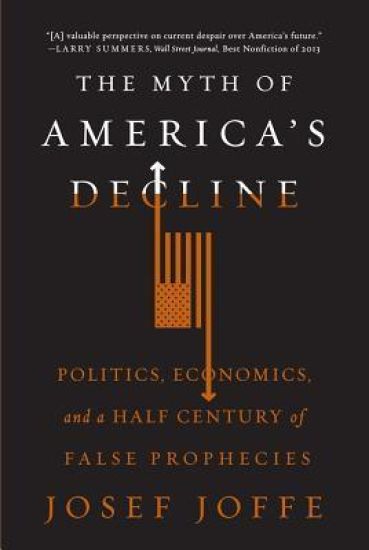
Once every decade, it is "decline time" in America. In recent years, it has been the unstoppable rise of China that has spelled "finis America." What the Chinese juggernaut is today, the Soviet Union ("We shall bury you") was in the 1950s. The Vietnam decade of the 1960s was described as America's "collective suicide attempt," while in the 1970s, the United States succumbed to Jimmy Carter's famous "malaise," as the dollar dangerously plummeted. The 1980s unquestionably belonged to a resurgent Japan, the "Rising Sun," whereas in the 1990s, Europe shone forth as an "empire by example." In the naughts, it was "Asia Rising" that became the flavor of the decade. Despite a litany of prognostications, these contenders have all fallen back, one by one. While it may be catnip for the media to play up America as a has-been, Josef Joffe, a leading German commentator and Stanford University academic, compellingly shows that Declinism is not a cold-eyed diagnosis but a device in the style of the ancient prophets: "Thou shalt perish, unless..." Gloom is a prophecy that must be believed so that it will turn out wrong. Joffe repeatedly demonstrates how the "economic miracles" that propelled the rising tide of challengers flounder against their own limits. Hardly confined to Europe alone, Declinism has also been an especially nifty career builder for American politicians, among them Kennedy, Nixon, and Reagan, who all rode into the White House by hawking "the end is near." Buttressing his argument with facts, Joffe demonstrates that America's future is sanguine. In contrast to the Carter years, the economic woes of the Obama era look more like a nasty migraine. By historical standards, the U.S. defense burden today is extraordinarily low, hence sustainable over the long haul. Immigration (plus a healthy birth rate) will not only keep the nation younger than China, Japan, Europe, and Russia but will continue to bring in the world's best and brightest. Indeed, America is the "world's Ph.D. factory" both in science and engineering, while its R&D spending dwarfs the "rising rest." Its uniquely deep and wide capital market encourages innovations and continues to turn dreams into vibrant companies. Joffe argues that it is only if America "freezes up" by enshrining privilege, closing its doors, and withdrawing from the world that it will succumb to the rigor mortis that has overwhelmed previous empires. Effortlessly mixing keen historical insights with brilliant diplomatic and economic analysis, The Myth of America's Decline becomes a remarkable reflection on our nation's standing in the world and an eye-opening account that challenges the pervasive and now tired notion that America is on the decline.
The Myth of America's Decline

The Myth of America's Decline

Josef Joffe

Liveright Publishing Corporation
2015
nidottu
America-bashing predates America: French Enlightenment philosophies claimed that the colony was doomed and one critic reported that the colony’s population was "astonishingly idiotic [and] enervated". As the United States became a superpower after the Second World War, a more virulent, politically charged form of declinism emerged amid hysteria that "the Russians are coming". It was followed by the European miracle, Japan’s "Rising Sun" and now the looming Chinese behemoth. While declinism may delight the media and gloating Europeans eager to play up America’s "has-been" status, the facts do not corroborate the contentions, as Josef Joffe demonstrates in this history of American declinism. He offers a highly provocative examination of how the US, for all its failings, continues to be a force of rejuvenation today.
Aristocrats and the Crowd in the Revolutionary Year 1848

Aristocrats and the Crowd in the Revolutionary Year 1848

Josef V. Polisensky

State University of New York Press
1980
sidottu
The Prague Uprising of 1848 was part of the powerful series of revolutions that shook practically the entire European Continent as the middle classes and urban and rural workers pressed against the rule of aristocrats and monarchs.Czech Marxist historian Josef Polisensky analyzes the general turmoil of revolutionary thought and action in Europe and then focuses on the specific case of the Prague Uprising. By using previously untouched sources-the records of hundreds of noble houses that came under the control of the Czech Archival Administration after World War II-Polisensky is able to show how those of the old social establishment fought the participants in the Uprising and temporarily restored the rule of the aristocracy.With an excellent sense for the dramatic and a thorough knowledge of place, Polisensky tells us who fought and died on the streets of Prague. With the conceptual framework of class conflict and a broad perspective on European events, he proposes reasons for the failure of the Prague Uprising in contrast to other successful revolutions.Aristocrats and the Crowd is the last of Polisensky's trilogy of studies on Czech society and revolution. In The Thirty Years' War and the European Crisis of the Seventeenth Century and Napoleon and the Heart of Europe, Polisensky explored the effects of other European conflicts on Czech society. Aristocrats and the Crowd describes, in his words, "the revolutionary springtime which eventually arrived, full of twists, in Bohemia itself."
My Search

My Search

Josef Ben-Eliezer

Plough Publishing House
2014
pokkari
In a world torn by hatred, injustice, and war, is there an answer to humanity’s quest for the good? Here is the true story of one man for whom this question was personal. Josef Ben-Eliezer was born in Germany to a Jewish family under the shadow of the Nazis. As a child he witnessed Hitler’s assault on Poland and then was forced into exile in Siberia, barely escaping with his life from starvation and disease as he made his way across southern Asia and finally arrived in the land of Israel. Faced with the horror of the Holocaust, Josef was determined to fight for the independence of his new homeland. But the inhumanity of war continued to pursue him, along with the question: Why can’t men and women live together in peace? This is a fascinating account of survival against all odds, but it is more than that: the story of one man’s search for the answers to the ultimate questions that, one way or another, face us all.
Personal Responsibility and Christian Morality

Personal Responsibility and Christian Morality

Josef Fuchs

Georgetown University Press
1983
pokkari
In this volume, Josef Fuchs has brought together 12 important essays which consider various aspects of the relationship between Christian morality and human behavior. Among the subjects he discusses are the connections between moral theology and Christian experience, the absolute character of moral norms, and the importance of ethical reflection in shaping the future of the human race.
Christian Morality

Christian Morality

Josef Fuchs

Georgetown University Press
1987
pokkari
In this third collection of his essays on Christian ethics, Josef Fuchs takes up a number of pressing questions both in fundamental and applied ethics. Several essays explore the biblical basis for establishing Christian norms and principles for ethical decision-making. These deal in detail with the nature of human conscience and the effect on it fo religious values in a pluralistic culture. The author also deals with current and pressing issues of a Christian moral life: continuity and change in moral teaching as exemplified by the debate over religious freedom; pluralism in the understanding of Christian marriage as early as the twelfth century; bioethical problems dealing with the beginning and end of human life; and the general question, is there a "Catholic" ethical moral theology?
Moral Demands and Personal Obligations

Moral Demands and Personal Obligations

Josef Fuchs

Georgetown University Press
1994
pokkari
In this collection of recent essays (1988-92), all but one previously unavailable in English, noted theologian Josef Fuchs, SJ, examines key issues in normative morality. Identifying two strains, one based on natural law and a more situational one based on the Golden Rule, he explores the need for plurality in both individual and societal ethics, and the problem of universal versus only general validity. Central ideas that Fuchs develops are the concept of innovative morality as the individual's responsible search for God's will in personal situations; and, the significance of the conscience in the face of official statements by the church's magisterium. Among the topics he considers are marriage and sexuality; the beginning and end of life; and, international solidarity and social justice.
A Possible and Desirable Pension System

A Possible and Desirable Pension System

Jósef Banyár; Jozsef Meszaros; József Mészáros

East European Monographs
2009
sidottu
Josef Banyar and Jozsef Meszaros address issues surrounding the pension systems of developed countries, as well as societies that are experiencing falling birth rates and rising life expectancies. The authors focus on Hungary because it excellently illustrates the difficulties and demographic challenges facing Central Europe as it transforms economically.
Studies in the History of the Greek Text of the Apocalypse

Studies in the History of the Greek Text of the Apocalypse

Josef Schmid

Society of Biblical Literature
2018
sidottu
Josef Schmid's landmark publication, Studien zur Geschichte des Griechischen Apokalypse-Textes, has been the standard work for understanding the Apocalypse's Greek manuscript tradition and textual history for more than sixty years. Despite the fact that most major studies on the Apocalypse of John are based on Schmid's work, the work itself has long been out of print, making it difficult for the broader scholarly community to reassess Schmid's conclusions in light of recent manuscript discoveries and technological advances. This book addresses this problem by providing a clear and accessible English translation, corrections throughout the text, updated data where necessary, and an introduction to help the reader understand Schmid's place within the history of text-critical study of the Apocalypse.
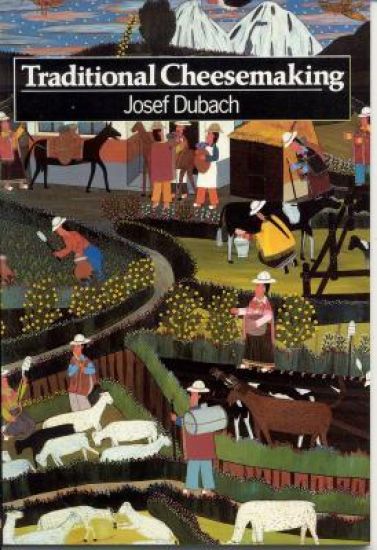
Traditional Cheesemaking

Traditional Cheesemaking

Josef Dubach

ITDG Publishing
1989
nidottu
There are many remote areas scattered throughout the world where dairy farming is a well-established occupation. Large quantities of highgrade milk can be produced in such areas but the local market cannot always absorb them, especially during peak periods. Converting milk to cheese is one method of dealing with the surplus. Cheesemaking provides an incentive for improving dairying as well as creating new jobs. It also improves the local diet and raises the standard of living generally, through a better understanding of hygiene, scientific techniques and community spirit. Using traditional cheesemaking methods, this book gives an idea of the opportunities that cheesemaking offers as a source of rural employment, and of the problems that will be encountered by anyone planning to start such a business.
Nothing To Declare

Nothing To Declare

Josef Kraus

Wexford College Press
2003
sidottu
"I reserve my 'Top Scores' for exceptional work, to give them freely would be to devalue and waste them. finally, a book worth the wait," writes Kate Fox of Heartland Reviews. "Mr. Kraus' tale of smuggler Thomas Breck is a work of literary art. His characters, plot, setting, and dialogue are all top notch." "Cleverly and artistically written. Nothing To Declare is not your ordinary mystery novel. It's a thriller with first-class traits," writes Jennie Bev, The Book Review Club. "The murder, international underworld, unsolved crime and enigmatic ambience create an unforgettable setting. A mystery novel that is a literary piece in itself."