Kirjojen hintavertailu. Mukana 12 234 308 kirjaa ja 12 kauppaa.

Kirjahaku

Etsi kirjoja tekijän nimen, kirjan nimen tai ISBN:n perusteella.

1000 tulosta hakusanalla Justin Booth

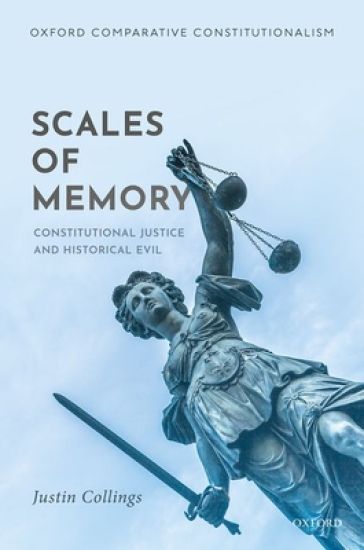
Scales of Memory

Scales of Memory

Justin Collings

Oxford University Press
2021
sidottu
Since the Second World War, constitutional justice has spread through much of the democratic world. Often it has followed in the wake of national calamity and historical evil - whether fascism or communism, colonialism or apartheid. Unsurprisingly, the memory of such evils plays a prominent role in constitutional adjudication. This book explores the relationship between constitutional interpretation and the memory of historical evil. Specifically, it examines how the constitutional courts of the United States, Germany, and South Africa have grappled, respectively, with the legacies of slavery, Nazism, and apartheid. Most courts invoke historical evil through either the parenthetical or the redemptive mode of constitutional memory. The parenthetical framework views the evil era as exceptional - a baleful aberration from an otherwise noble and worthy constitutional tradition. Parenthetical jurisprudence reaches beyond the evil era toward stable and enduring values. It sees the constitutional response to evil as restorative rather than revolutionary - a return to and reaffirmation of older traditions. The redemptive mode, by contrast, is more aggressive. Its aim is not to resume a venerable tradition but to reverse recent ills. Its animating spirit is not restoration, but antithesis. Its aim is not continuity with deeper pasts, but a redemptive future stemming from a stark, complete, and vivid rupture. This book demonstrates how, across the three jurisdictions, the parenthetical mode has often accompanied formalist and originalist approaches to constitutional interpretation, whereas the redemptive mode has accompanied realist and purposive approaches. It also shows how, within the three jurisdictions, the parenthetical mode of memory has consistently predominated in American constitutional jurisprudence; the redemptive mode in South African jurisprudence; and a hybrid, parenthetical-redemptive mode in German constitutional jurisprudence. The real-world consequences of these trends have been stark and dramatic. Memory matters, especially in constitutional interpretation.
The Right to Exclude

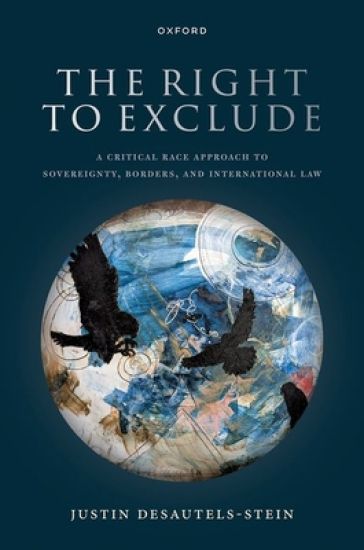
The Right to Exclude

Justin Desautels-Stein

Oxford University Press
2023
sidottu
In a world in which racism and xenophobia are endemic, what is the role of international law? To the extent international rules are thought to have any relevance at all, the typical approach characterizes international law as on the side of racial justice. Human rights instruments like the United Nations' International Convention on the Elimination of Racial Discrimination are paradigmatic, offering the world international agreements in which governments are directed to avoid racist behavior and promote antiracist action. In The Right to Exclude, Justin Desautels-Stein goes against the grain and asks whether certain rules of international law might actually produce structures of racial hierarchy, rather than work to limit them. The intellectual fulcrum for this production, Desautels-Stein argues, lies in the ideological structures of sovereignty and property, the right to exclude that is shared in those twinned precincts, and the border regimes that result. Applying critical race theory to contemporary problems of migration, nationalism, multiculturalism, decolonization, and self-determination, Desautels-Stein expounds a theory of "postracial xenophobia", a structure of racial ideology that justifies and legitimates a pragmatic account of racialized foreignness, a racial xenos.
Applied Statistics with R

Applied Statistics with R

Justin C. Touchon

Oxford University Press
2021
nidottu
The statistical analyses that students of the life-sciences are being expected to perform are becoming increasingly advanced. Whether at the undergraduate, graduate, or post-graduate level, this book provides the tools needed to properly analyze your data in an efficient, accessible, plainspoken, frank, and occasionally humorous manner, ensuring that readers come away with the knowledge of which analyses they should use and when they should use them. The book uses the statistical language R, which is the choice of ecologists worldwide and is rapidly becoming the 'go-to' stats program throughout the life-sciences. Furthermore, by using a single, real-world dataset throughout the book, readers are encouraged to become deeply familiar with an imperfect but realistic set of data. Indeed, early chapters are specifically designed to teach basic data manipulation skills and build good habits in preparation for learning more advanced analyses. This approach also demonstrates the importance of viewing data through different lenses, facilitating an easy and natural progression from linear and generalized linear models through to mixed effects versions of those same analyses. Readers will also learn advanced plotting and data-wrangling techniques, and gain an introduction to writing their own functions. Applied Statistics with R is suitable for senior undergraduate and graduate students, professional researchers, and practitioners throughout the life-sciences, whether in the fields of ecology, evolution, environmental studies, or computational biology.
Applied Statistics with R

Applied Statistics with R

Justin C. Touchon

Oxford University Press
2021
sidottu
The statistical analyses that students of the life-sciences are being expected to perform are becoming increasingly advanced. Whether at the undergraduate, graduate, or post-graduate level, this book provides the tools needed to properly analyze your data in an efficient, accessible, plainspoken, frank, and occasionally humorous manner, ensuring that readers come away with the knowledge of which analyses they should use and when they should use them. The book uses the statistical language R, which is the choice of ecologists worldwide and is rapidly becoming the 'go-to' stats program throughout the life-sciences. Furthermore, by using a single, real-world dataset throughout the book, readers are encouraged to become deeply familiar with an imperfect but realistic set of data. Indeed, early chapters are specifically designed to teach basic data manipulation skills and build good habits in preparation for learning more advanced analyses. This approach also demonstrates the importance of viewing data through different lenses, facilitating an easy and natural progression from linear and generalized linear models through to mixed effects versions of those same analyses. Readers will also learn advanced plotting and data-wrangling techniques, and gain an introduction to writing their own functions. Applied Statistics with R is suitable for senior undergraduate and graduate students, professional researchers, and practitioners throughout the life-sciences, whether in the fields of ecology, evolution, environmental studies, or computational biology.
Morality and Mathematics

Morality and Mathematics

Justin Clarke-Doane

Oxford University Press
2023
nidottu
To what extent are the subjects of our thoughts and talk real? This is the question of realism. In this book, Justin Clarke-Doane explores arguments for and against moral realism and mathematical realism, how they interact, and what they can tell us about areas of philosophical interest more generally. He argues that, contrary to widespread belief, our mathematical beliefs have no better claim to being self-evident or provable than our moral beliefs. Nor do our mathematical beliefs have better claim to being empirically justified than our moral beliefs. It is also incorrect that reflection on the "genealogy" of our moral beliefs establishes a lack of parity between the cases. In general, if one is a moral antirealist on the basis of epistemological considerations, then one ought to be a mathematical antirealist as well. And, yet, Clarke-Doane shows that moral realism and mathematical realism do not stand or fall together -- and for a surprising reason. Moral questions, insofar as they are practical, are objective in a sense that mathematical questions are not. Moreover, the sense in which they are objective can be explained only by assuming practical anti-realism. One upshot of the discussion is that the concepts of realism and objectivity, which are widely identified, are actually in tension. Another is that the objective questions in the neighborhood of questions of logic, modality, grounding, and nature are practical questions too. Practical philosophy should, therefore, take center stage.
Phases of Objects

Phases of Objects

Justin Mooney

Oxford University Press
2026
sidottu
In Phases of Objects, Justin Mooney argues that all objects should be treated like children: just as a child can cease to be a child without ceasing to exist when it grows into an adult, so can a clay statue cease to be a statue without ceasing to exist when it is squashed into an amorphous lump; a car can cease to be a car without ceasing to exist when it is crushed into a block of scrap metal; and a person can cease to be a person without ceasing to exist when a person dies and becomes a corpse. This view is called phasalism because it entails that these changes are changes in respect of properties called phase sortals, which are sort- or kind-properties that an object can instantiate temporarily. Mooney defends phasalism against the prevailing consensus in metaphysics by spelling out a phasalist metaphysics of material objects in great detail, highlighting its virtues, and defending it against objections. In the course of this defense, Mooney proposes a novel criterion of identity for material objects, a novel approach to solving coincidence puzzles about material objects, and a novel account of sameness relations. The final chapter draws out and defends some of the controversial consequences of phasalist metaphysics in the area of personal identity and personal ontology, focusing particularly on three important questions about human people: when does a human person begin to exist? When does a human person cease to exist? And what happens to a human person in brain transplant cases?
Are Dolphins Really Smart?

Are Dolphins Really Smart?

Justin Gregg

Oxford University Press
2013
sidottu
How intelligent are dolphins? Is their communication system really as complex as human language? And are they as friendly and peaceful as they are made out to be? The Western world has had an enduring love affair with dolphins since the early 1960s, with fanciful claims of their 'healing powers' and 'super intelligence'. Myths and pseudoscience abound on the subject. Justin Gregg weighs up the claims made about dolphin intelligence and separates scientific fact from fiction. He puts our knowledge about dolphin behaviour and intelligence into perspective, with comparisons to scientific studies of other animals, especially the crow family and great apes. He gives fascinating accounts of the challenges of testing what an animal with flippers and no facial expressions might be animal behaviour, Gregg challenges many of the widespread beliefs about dolphins, while also inspiring the reader with the remarkable abilities common to many of the less glamorized animals around us - such as chickens.
Are Dolphins Really Smart?

Are Dolphins Really Smart?

Justin Gregg

Oxford University Press
2015
nidottu
How intelligent are dolphins? Is their communication system really as complex as human language? And are they as friendly and peaceful as they are made out to be? The Western world has had an enduring love affair with dolphins since the early 1960s, with fanciful claims of their 'healing powers' and 'super intelligence'. Myths and pseudoscience abound on the subject. Justin Gregg weighs up the claims made about dolphin intelligence and separates scientific fact from fiction. He puts our knowledge about dolphin behaviour and intelligence into perspective, with comparisons to scientific studies of other animals, especially the crow family and great apes. He gives fascinating accounts of the challenges of testing what an animal with flippers and no facial expressions might be animal behaviour, Gregg challenges many of the widespread beliefs about dolphins, while also inspiring the reader with the remarkable abilities common to many of the less glamorized animals around us - such as chickens.
Hiring and Firing Public Officials

Hiring and Firing Public Officials

Justin Buchler

Oxford University Press Inc
2011
nidottu
Conventional theories of elections hold that an election is analogous to a consumer product market. According to the market paradigm, voters are consumers, candidates are competing firms, and an election is a market in which voters exchange votes for policy by voting for the candidates whose policies they prefer. According to this logic, a healthy democracy requires frequent competitive elections. The market analogy underlies decades of electoral theory, but in Hiring and Firing Public Officials, Justin Buchler contends that it does not capture the real nature of elections. In fact, our widespread dissatisfaction with the current state of electoral politics derives from a fundamental misunderstanding of what elections are and what purpose they serve. As Justin Buchler shows, an election is a mechanism by which voters hire and fire public officials. It is not a consumer product market--it is a single employment decision. Thus, the health of democracy depends not on regular competitive elections, but on posing a credible threat to fire public officials who do not perform their jobs well. However, the purpose of that threat is to force public officials to act as faithful public servants so that they do not have to be fired. Thus, competitive elections, by most definitions, are indicative of a failure of the democratic system.
Empire of Ideas

Empire of Ideas

Justin Hart

Oxford University Press Inc
2013
sidottu
Empire of Ideas examines the origins of the U. S. government's programs in public diplomacy and the way that those initiatives transformed the foreign policy process. Spanning the period from 1936 to 1953, the book explores how, when, and why U. S. policymakers embraced various techniques of public diplomacy, such as propaganda, educational exchanges, cultural exhibits, overseas libraries, and domestic public relations. By treating public diplomacy as part of the project for building the sort of post-colonial empire that Henry Luce and others envisioned when they spoke of an "American Century," Hart also explains how the nation's image in the world became an essential component of U. S. foreign policy. Based upon exhaustive research in official government records and the private papers of top officials in the Roosevelt and Truman administrations, including newly declassified material, Empire of Ideas lends a historical perspective to issues of tremendous contemporary relevance. At a time when U. S. officials struggle more than ever to project a positive image of America abroad, Hart's study describes the challenges faced by a previous generation of policymakers and details their successes and failures in confronting similar issues.
Introducing Ethics

Introducing Ethics

Justin McBrayer; Peter Markie

Oxford University Press, USA
2013
pokkari
Introducing Ethics: A Critical Thinking Approach with Readings combines guiding commentary and questions with a rich selection of concise, carefully edited, and accessible readings on ethical theory and contemporary moral issues. This unique introduction shows students how to do philosophy by first analyzing texts--identifying ethical positions and the arguments that support them--and then evaluating the truth of those positions and the soundness of the arguments. In doing so, it provides students with a uniquely engaging introduction to ethics that also hones their critical thinking skills. FEATURES * A unique Unit 1 gives students the conceptual tools to "do" philosophy with coverage of logic, arguments, moral reasoning, and reading and writing philosophy * Extensive coverage of the three main areas of ethics--metaethics, normative ethics, and applied ethics--addresses issues often ignored by other texts, including ethics vs. science, moral responsibility, moral vs. legal issues, torture, terrorism, and more * Unit and chapter introductions outline major themes and issues and explain why they matter * Reading questions precede the essays and focus students' studying on key points, while discussion questions follow the readings and help students move into the evaluation phase * "Argument Reconstruction Exercises" after each reading provide practice in identifying the premises and conclusions in the essays * An Instructor's Manual with Test Bank on CD is available to adopters * A Companion Website at www.oup.com/us/mcbrayer provides all the material contained on the CD along with student resources
Dante and the Limits of the Law

Dante and the Limits of the Law

Justin Steinberg

University of Chicago Press
2013
sidottu
In Dante and the Limits of the Law, Justin Steinberg offers the first comprehensive study of the legal structure crucial to Dante's Divine Comedy. Steinberg reveals how Dante imagines an afterlife dominated by elaborate laws, hierarchical jurisdictions, and rationalized punishments and rewards. Steinberg makes the compelling case that Dante deliberately exploits this highly structured legal system to explore the phenomenon of exceptions to it, introducing Dante to crucial current debates about literature's relation to law, exceptionality, and sovereignty. Examining how Dante probes the limits of the law in this juridical otherworld, Steinberg argues that exceptions were vital to the medieval legal order and that Dante's otherworld represents an ideal "system of exception." Yet Dante saw this system as threatened on earth by the dual crises of church and Empire - the abuses and overreaching of the popes and the absence of an effective Holy Roman Emperor. In his imagination of the afterlife, Steinberg shows, Dante seeks to address this gap between the universal validity of Roman law and the lack of a sovereign power to enforce it. Exploring the institutional role of disgrace, the entwined phenomena of judicial discretion and artistic freedom, medieval ideas about privilege and immunity, and the place of judgment in the poem, this is an elegantly argued book that persuasively brings to life Dante's sense of justice.
What Every Science Student Should Know

What Every Science Student Should Know

Justin L. Bauer; Yoo Jung Kim; Andrew H. Zureick; Daniel K. Lee

University of Chicago Press
2016
sidottu
"I am often amazed at how much more capability and enthusiasm for science there is among elementary school youngsters than among college students. . . . We must understand and circumvent this dangerous discouragement. No one can predict where the future leaders of science will come from."--Carl Sagan In 2012, the White House put out a call to increase the number of STEM graduates by one million. Since then, hundreds of thousands of science students have started down the path toward a STEM career. Yet, of these budding scientists, more than half of all college students planning to study science or medicine leave the field during their academic careers.What Every Science Student Should Know is the perfect personal mentor for any aspiring scientist. Like an experienced lab partner or frank advisor, the book points out the pitfalls while providing encouragement. Chapters cover the entire college experience, including choosing a major, mastering study skills, doing scientific research, finding a job, and, most important, how to foster and keep a love of science. This guide is a distillation of the authors' own experiences as recent science graduates, bolstered by years of research and interviews with successful scientists and other science students. The authorial team includes former editors-in-chief of the prestigious Dartmouth Undergraduate Journal of Science. All have weathered the ups and downs of undergrad life--and all are still pursuing STEM careers. Forthright and empowering, What Every Science Student Should Know is brimming with insider advice on how to excel as both a student and a scientist.
What Every Science Student Should Know

What Every Science Student Should Know

Justin L. Bauer; Yoo Jung Kim; Andrew H. Zureick; Daniel K. Lee

University of Chicago Press
2016
nidottu
“I am often amazed at how much more capability and enthusiasm for science there is among elementary school youngsters than among college students. . . . We must understand and circumvent this dangerous discouragement. No one can predict where the future leaders of science will come from.”—Carl Sagan In 2012, the White House put out a call to increase the number of STEM graduates by one million. Since then, hundreds of thousands of science students have started down the path toward a STEM career. Yet, of these budding scientists, more than half of all college students planning to study science or medicine leave the field during their academic careers.What Every Science Student Should Know is the perfect personal mentor for any aspiring scientist. Like an experienced lab partner or frank advisor, the book points out the pitfalls while providing encouragement. Chapters cover the entire college experience, including choosing a major, mastering study skills, doing scientific research, finding a job, and, most important, how to foster and keep a love of science. This guide is a distillation of the authors’ own experiences as recent science graduates, bolstered by years of research and interviews with successful scientists and other science students. The authorial team includes former editors-in-chief of the prestigious Dartmouth Undergraduate Journal of Science. All have weathered the ups and downs of undergrad life—and all are still pursuing STEM careers. Forthright and empowering, What Every Science Student Should Know is brimming with insider advice on how to excel as both a student and a scientist.
Dante and the Limits of the Law

Dante and the Limits of the Law

Justin Steinberg

University of Chicago Press
2016
nidottu
In Dante and the Limits of the Law, Justin Steinberg offers the first comprehensive study of the legal structure essential to Dante’s Divine Comedy. Steinberg reveals how Dante imagines an afterlife dominated by sophisticated laws, hierarchical jurisdictions, and rationalized punishments and rewards. He makes the compelling case that Dante deliberately exploits this highly structured legal system to explore the phenomenon of exceptions to it, crucially introducing Dante to current debates about literature’s relation to law, exceptionality, and sovereignty. Examining how Dante probes the limits of the law in this juridical otherworld, Steinberg argues that exceptions were vital to the medieval legal order and that Dante’s otherworld represents an ideal “system of exception.” In the real world, Dante saw this system as increasingly threatened by the dual crises of church and empire: the abuses and overreaching of the popes and the absence of an effective Holy Roman Emperor. Steinberg shows that Dante’s imagination of the afterlife seeks to address this gap between the universal validity of Roman law and the lack of a sovereign power to enforce it. Exploring the institutional role of disgrace, the entwined phenomena of judicial discretion and artistic freedom, medieval ideas about privilege and immunity, and the place of judgment in the poem, this cogently argued book brings to life Dante’s sense of justice.
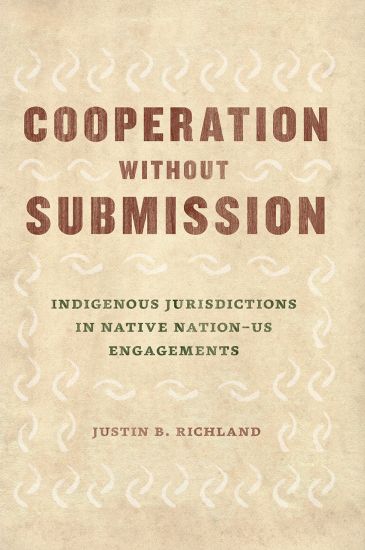
Cooperation Without Submission

Cooperation Without Submission

Justin B Richland

University of Chicago Press
2021
sidottu
It is well-known that there is a complicated relationship between Native American tribes and the US government. Relations between tribes and the government are dominated by the principle known as the “Federal-Indian Trust Relationship.” The key aspect of this principle is that the government is supposed to engage in meaningful consultations with the tribes about issues that affect them. In Cooperation without Submission, Justin B. Richland, an associate justice of the Hopi Appellate Court and ethnographer, closely examines the language employed by both tribes and government agencies in over eighty hours of meetings between the two. Richland shows how tribes conduct these meetings using language that demonstrates their commitment to nation-to-nation interdependency, while federal agents appear to approach these consultations with the assumption that federal law is supreme and ultimately authoritative. Meaning, Native American tribes see themselves as nations with some degree of independence, entitled to recognition of their sovereignty over tribal lands, while the federal government acts to limit that authority. In this vital book, Richland sheds light on the ways the tribes use their language to engage in “cooperation without submission.”
Cooperation Without Submission

Cooperation Without Submission

Justin B Richland

University of Chicago Press
2021
pokkari
It is well-known that there is a complicated relationship between Native American tribes and the US government. Relations between tribes and the government are dominated by the principle known as the “Federal-Indian Trust Relationship.” The key aspect of this principle is that the government is supposed to engage in meaningful consultations with the tribes about issues that affect them. In Cooperation without Submission, Justin B. Richland, an associate justice of the Hopi Appellate Court and ethnographer, closely examines the language employed by both tribes and government agencies in over eighty hours of meetings between the two. Richland shows how tribes conduct these meetings using language that demonstrates their commitment to nation-to-nation interdependency, while federal agents appear to approach these consultations with the assumption that federal law is supreme and ultimately authoritative. Meaning, Native American tribes see themselves as nations with some degree of independence, entitled to recognition of their sovereignty over tribal lands, while the federal government acts to limit that authority. In this vital book, Richland sheds light on the ways the tribes use their language to engage in “cooperation without submission.”
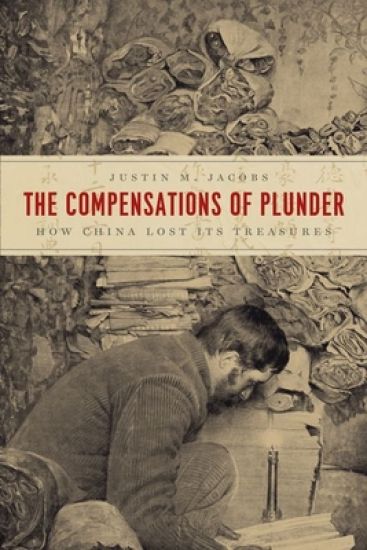
The Compensations of Plunder

The Compensations of Plunder

Justin M Jacobs

University of Chicago Press
2020
sidottu
From the 1790s until World War I, Western museums filled their shelves with art and antiquities from around the world. These objects are now widely seen as "stolen" or "plundered" from their countries of origin, and demands for their return grow louder by the day. In this pathbreaking study, Justin M. Jacobs challenges the longstanding assumption that coercion, corruption, and deceit were chiefly responsible for the exodus of cultural treasures from northwestern China. Based upon a close analysis of previously neglected archival sources in English, French, and Chinese, Jacobs finds that many local elites in China acquiesced to the removal of art and antiquities abroad, understanding their trade as currency for a cosmopolitan elite. In the decades after the 1911 Revolution, however, these antiquities went from being "diplomatic capital" to disputed icons of the emerging nation-state. A new generation of Chinese scholars began to criminalize the prior activities of archaeologists, erasing all memory of the pragmatic barter relationship that once existed in China. Recovering the voices of those local officials, scholars, and laborers who shaped the global trade in antiquities, The Compensations of Plunder brings historical grounding to a highly contentious topic in modern Chinese history and informs heated debates over cultural restitution throughout the world.
The Compensations of Plunder

The Compensations of Plunder

Justin M Jacobs

University of Chicago Press
2020
pokkari
From the 1790s until World War I, Western museums filled their shelves with art and antiquities from around the world. These objects are now widely seen as "stolen" or "plundered" from their countries of origin, and demands for their return grow louder by the day. In this pathbreaking study, Justin M. Jacobs challenges the longstanding assumption that coercion, corruption, and deceit were chiefly responsible for the exodus of cultural treasures from northwestern China. Based upon a close analysis of previously neglected archival sources in English, French, and Chinese, Jacobs finds that many local elites in China acquiesced to the removal of art and antiquities abroad, understanding their trade as currency for a cosmopolitan elite. In the decades after the 1911 Revolution, however, these antiquities went from being "diplomatic capital" to disputed icons of the emerging nation-state. A new generation of Chinese scholars began to criminalize the prior activities of archaeologists, erasing all memory of the pragmatic barter relationship that once existed in China. Recovering the voices of those local officials, scholars, and laborers who shaped the global trade in antiquities, The Compensations of Plunder brings historical grounding to a highly contentious topic in modern Chinese history and informs heated debates over cultural restitution throughout the world.
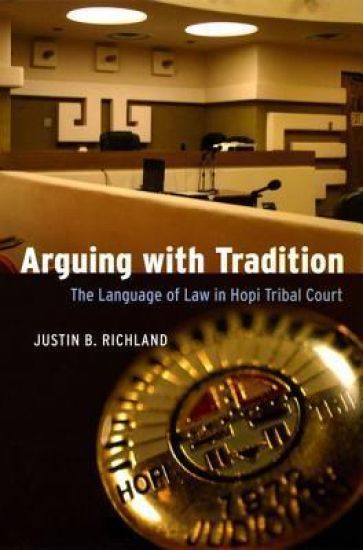
Arguing with Tradition

Arguing with Tradition

Justin B. Richland

University of Chicago Press
2008
sidottu
"Arguing with Tradition" is the first book to explore language and interaction within a contemporary Native American legal system. Grounded in Justin B. Richland's extensive field research on the Hopi Indian Nation of northeastern Arizona - on whose appellate court he now serves as Justice Pro Tempore - this innovative work explains how Hopi notions of tradition and culture shape and are shaped by the processes of Hopi jurisprudence.Like many indigenous legal institutions across North America, the Hopi Tribal Court was created in the image of Anglo-American law. But Richland shows that in recent years, Hopi jurists and litigants have called for their courts to develop a jurisprudence that better reflects Hopi culture and traditions. Providing unprecedented insights into the Hopi and English courtroom interactions through which this conflict plays out, Richland argues that tensions between the language of Anglo-style law and Hopi tradition both drive Hopi jurisprudence and make it unique. Ultimately, Richland's analyses of the language of Hopi law offer a fresh approach to the cultural politics that influence indigenous legal and governmental practices worldwide.