Kirjojen hintavertailu. Mukana 11 244 527 kirjaa ja 12 kauppaa.

Kirjahaku

Etsi kirjoja tekijän nimen, kirjan nimen tai ISBN:n perusteella.

1000 tulosta hakusanalla Keith Harding

Man and the Natural World

Man and the Natural World

Keith Thomas

Oxford University Press
1996
nidottu
Throughout the ages man has struggled with his perceived place in the natural world. The idea of humans cultivating the Earth to suit specific needs is one of the greatest points of contention in this struggle. For how would have civilization progressed, if not by the clearance of the forests, the cultivation of the soil, and the conservation of wild landscape into human settlement? Yet what of the healing powers of unexploited nature, its long-term importance in the perpetuation of human civilization, and the inherent beauty of wild scenery? At no time were these questions addressed as pointedly and with such great consequence as in England between the sixteenth and late eighteenth centuries. Between 1500 and 1800 there occurred a whole cluster of changes in the way in which men and women, at all social levels, perceived and classified the natural world around them, explains Keith Thomas. New sensibilities arose toward animals, plants, and landscape. The relationship of man to other species was redefined; and his right to exploit those species for his own advantage was sharply challenged. Man and the Natural World aims not just to explain present interest in preserving the environment and protecting the rights of animals, but to reconstruct an earlier mental world. Thomas seeks to expose the assumptions beneath the perceptions, reasonings, and feelings of the inhabitants of early modern England toward the animals, birds, vegetation, and physical landscape among which they spent their lives, often in conditions of proximity which are now difficult for us to appreciate. It was a time when a conviction of man's ascendancy over the natural world gave way to a new concern for the environment and sense of kinship with other species. Here, for example, Thomas illustrates the changing attitudes toward the woodlands. John Morton observed in 1712, In a country full of civilized inhabitants timber could not be suffered to grow. It must give way to fields and pastures, which are of more immediate use and concern to life. Shortly thereafter, in 1763, Edwin Lascelles pronounced the The beauty of a country consists chiefly in the wood. People's relationships with animals were also in the process of dramatic change as seen in their growing obsession with pet keeping. The use of human names for animals, the fact that pets were rarely eaten, though not for gastronomic reasons, and pets being included in family portraits and often fed better than the servants all demonstrated a major shift in man's position on human uniqueness. The issues raised in this fascinating work are even more alive today than they were just ten years ago. Preserving the environment, saving the rain forests, and preventing the extinction of species may seem like fairly recent concerns, however, Man and the Natural World explores how these ideas took root long ago. These issues have much to offer not only environmental activists, but historians as well, for it is impossible to disentangle what the people of the past thought about plants and animals from what they thought about themselves.
English Vocabulary Elements

English Vocabulary Elements

Keith Denning; Brett Kessler; William R. Leben

Oxford University Press Inc
2007
sidottu
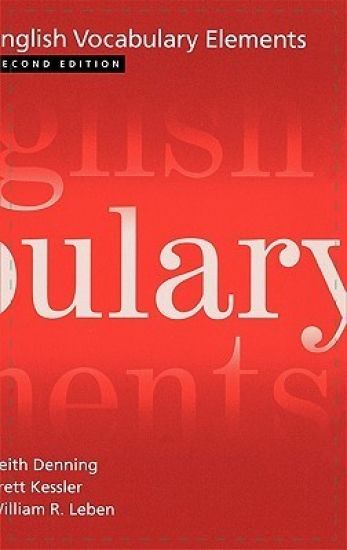
Fascination with words-their meanings, origins, pronunciation, usages-is something most of us experience at some point. This book aims both to fuel and to satisfy that fascination. The book is based on a course that each of the authors helped to develop at Stanford University over the past twenty years. The aim of the course was to help students master English vocabulary and to provide the fundamentals for pursuing an interest in English words. To this end, the book offers a detailed but introductory survey of the developments that have given English a uniquely rich vocabulary, taking into account both the changing structure of the language and the historical events that shaped the language as a whole. Anyone who believes that changes in the language are robbing it of its elegance or expressive power will see this view challenged by the developments described here. At the core of the book are a set of several hundred vocabulary elements that English borrowed, directly or indirectly, over the past fifteen hundred years, from Latin and Greek. These elements, introduced gradually chapter by chapter, provide a key to understanding the structure and meaning of much of the learned vocabulary of the language. The chapters trace the history and structure of English words from the sixth century onward, laying out the major influences that are still observable in our vocabulary today. Each chapter ends with a large number of exercises. These offer many different types of practice with the material in the text, making it possible to tailor the work to different sets of needs and interests. Upon finishing this textbook, students will be able to penetrate the structure of an enormous portion of the vocabulary of English, with or without the help of a dictionary, and to understand better how an individual word fits into the system of the language. This second edition incorporates improved and refined text as well as examples and exercises, with thorough revision of pedagogy as a result of their significant classroom-based expertise. The new edition also updates cultural references, accounts for variations in pronunciation among students, and clarifies when historical details are important or peripheral.
How Cancer Crossed the Color Line

How Cancer Crossed the Color Line

Keith Wailoo

Oxford University Press Inc
2011
sidottu
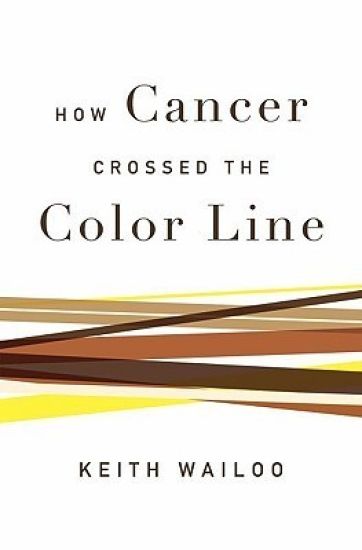
In the course of the 20th century, cancer went from being perceived as a white woman's nemesis to a "democratic disease" to a fearsome threat in communities of color. Drawing on film and fiction, on medical and epidemiological evidence, and on patients' accounts, Keith Wailoo tracks this transformation in cancer awareness, revealing how not only awareness, but cancer prevention, treatment, and survival have all been refracted through the lens of race. Spanning more than a century, the book offers a sweeping account of the forces that simultaneously defined cancer as an intensely individualized and personal experience linked to whites, often categorizing people across the color line as racial types lacking similar personal dimensions. Wailoo describes how theories of risk evolved with changes in women's roles, with African-American and new immigrant migration trends, with the growth of federal cancer surveillance, and with diagnostic advances, racial protest, and contemporary health activism. The book examines such powerful and transformative social developments as the mass black migration from rural south to urban north in the 1920s and 1930s, the World War II experience at home and on the war front, and the quest for civil rights and equality in health in the 1950s and '60s. It also explores recent controversies that illuminate the diversity of cancer challenges in America, such as the high cancer rates among privileged women in Marin County, California, the heavy toll of prostate cancer among black men, and the questions about why Vietnamese-American women's cervical cancer rates are so high. A pioneering study, How Cancer Crossed the Color Line gracefully documents how race and gender became central motifs in the birth of cancer awareness, how patterns and perceptions changed over time, and how the "war on cancer" continues to be waged along the color line.
Art, Self and Knowledge

Art, Self and Knowledge

Keith Lehrer

Oxford University Press Inc
2011
sidottu
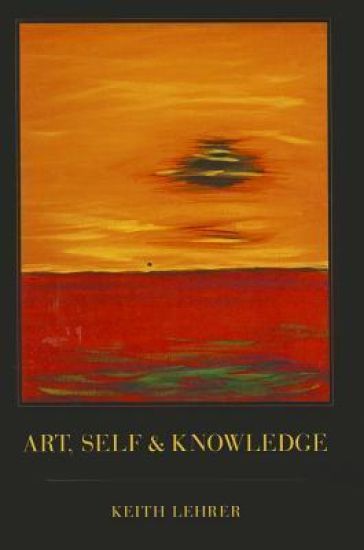
Art can provide us with a sensory experience that provokes us to reconfigure how we think about our world and ourselves. Theories of art have often sought to find some feature of art that isolates it from the rest of experience. Keith Lehrer argues, in opposition, that art is connected, not isolated, from how we think and feel, represent and react. When art directs our attention to sensory exemplars in aesthetic experience of which we become conscious in a special way, it also shows us our autonomy as we represent ourselves and our world, ourselves in our world, and our world in ourselves. This form of representation, exemplar representation, uses the exemplar as a term of representation and exhibits the nature of the content it represents in terms of itself. It shows us both what our world is like and how we represent the world thereby revealing the nature of intentionality to us. Issues of general interest in philosophy such as knowledge, autonomy, rationality and self-trust enter the book along with more specifically aesthetic issues of formalism, expressionism, representation, artistic creativity and beauty. The author goes on to demonstrate how the connection between art and broader issues of feminism, globalization, collective wisdom, and death show us the connection between art, life, politics and the self. Drawing from Hume, Reid, Goodman, Danto, Brand, Ismael and Lopes, Lehrer argues here that the artwork is a mentalized physical object engaging us philosophically with the content of exemplar experience. The exemplar representation of experience provoked by art ties art and science, mind and body, self and world, together in a dynamic loop, reconfiguring them all as it reconfigures art itself.
Art, Self and Knowledge

Art, Self and Knowledge

Keith Lehrer

Oxford University Press Inc
2011
nidottu
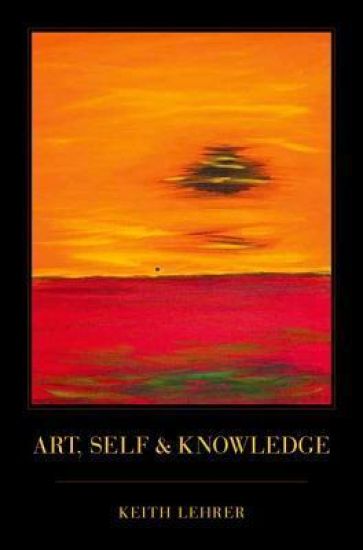
Art can provide us with a sensory experience that provokes us to reconfigure how we think about our world and ourselves. Theories of art have often sought to find some feature of art that isolates it from the rest of experience. Keith Lehrer argues, in opposition, that art is connected, not isolated, from how we think and feel, represent and react. When art directs our attention to sensory exemplars in aesthetic experience of which we become conscious in a special way, it also shows us our autonomy as we represent ourselves and our world, ourselves in our world, and our world in ourselves. This form of representation, exemplar representation, uses the exemplar as a term of representation and exhibits the nature of the content it represents in terms of itself. It shows us both what our world is like and how we represent the world thereby revealing the nature of intentionality to us. Issues of general interest in philosophy such as knowledge, autonomy, rationality and self-trust enter the book along with more specifically aesthetic issues of formalism, expressionism, representation, artistic creativity and beauty. The author goes on to demonstrate how the connection between art and broader issues of feminism, globalization, collective wisdom, and death show us the connection between art, life, politics and the self. Drawing from Hume, Reid, Goodman, Danto, Brand, Ismael and Lopes, Lehrer argues here that the artwork is a mentalized physical object engaging us philosophically with the content of exemplar experience. The exemplar representation of experience provoked by art ties art and science, mind and body, self and world, together in a dynamic loop, reconfiguring them all as it reconfigures art itself.
Decision Making and Rationality in the Modern World

Decision Making and Rationality in the Modern World

Keith E. Stanovich

Oxford University Press Inc
2009
nidottu
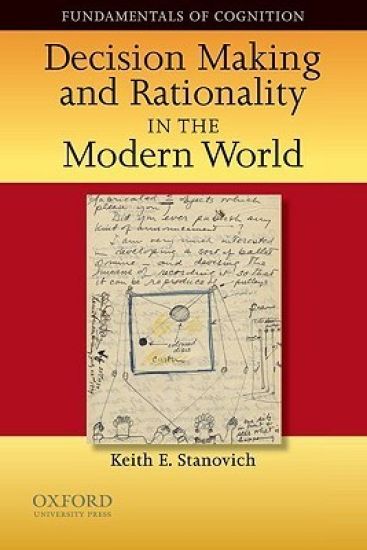
In Decision Making and Rationality in the Modern World, Keith E. Stanovich demonstrates how work in the cognitive psychology of decision making has implications for the large and theoretically contentious debates about the nature of human rationality. Written specifically for undergraduate psychology students, the book presents a very practical approach to decision making, which is too often perceived by students as an artificial set of skills used only in academia and not in the real world. Instead, Stanovich shows how good decision-making procedures support rational behavior that enables people to act most efficiently to fulfill their goals. He explains how the concept of rationality is understood in cognitive science in terms of good decision making and judgment. Books in the Fundamentals of Cognition series serve as ideal instructional resources for advanced courses in cognitive psychology. They provide an up-to-date, well-organized survey of our current understanding of the major theories of cognitive psychology. The books are concise, which allows instructors to incorporate the latest original research and readings into their courses without overburdening their students. Focused without being too advanced--and comprehensive without being too broad--these books are the perfect resource for both students and instructors.
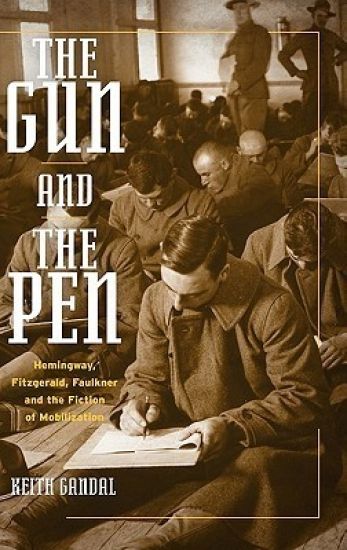
The Gun and the Pen

The Gun and the Pen

Keith Gandal

Oxford University Press Inc
2008
sidottu
Gandal contends that The Great Gatsby, The Sun Also Rises and The Sound and the Fury were all written by men who were greatly influenced by their shared frustration of not serving in the American military's colossal war effort. At the same time, these same authors also observed, among other startling developments, the Army's first egalitarian treatment of ethnic or hyphenated-Americans in regard to officer selection. The Great War mobilization shaped large-scale shifts in American life, including the meritocratic assignment of recruits to military rank based on intelligence testing, rather than Anglo-social and family background; an unprecedented military propaganda campaign aimed at fighting venereal disease and the redefinition of masculinity as chaste, chivalrous and athletic; the incarceration of tens of thousands of prostitutes as well as "promiscuous" women in an effort to police American female sexual behavior; and a dramatic but failed effort to ban sexual contact between American troops and French prostitutes. Mobilization Fiction involves a fundamental rethinking of these three novels, as well as other modernist postwar prose of the 1920s and 30s, in view of this essential history of the Great War mobilization.
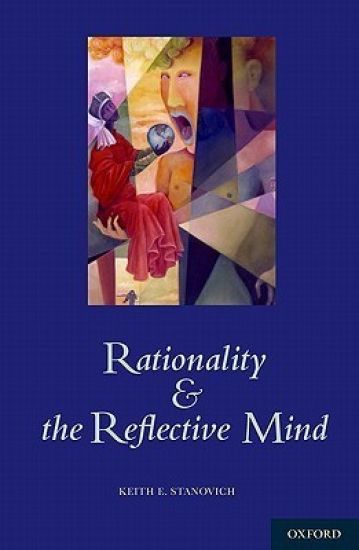
Rationality and the Reflective Mind

Rationality and the Reflective Mind

Keith Stanovich

Oxford University Press Inc
2011
sidottu
In Rationality and the Reflective Mind, Keith Stanovich attempts to resolve the Great Rationality Debate in cognitive science--the debate about how much irrationality to ascribe to human cognition. He shows how the insights of dual-process theory and evolutionary psychology can be combined to explain why humans are sometimes irrational even though they possess remarkably adaptive cognitive machinery. Stanovich argues that to fully characterize differences in rational thinking, we need to replace dual-process theories with tripartite models of cognition. Using a unique individual differences approach, he shows that the traditional second system (System 2) of dual-process theory must be further divided into the reflective mind and the algorithmic mind. Distinguishing them will allow us to better appreciate the significant differences in their key functions: The key function of the reflective mind is to detect the need to interrupt autonomous processing and to begin simulation activities, whereas that of the algorithmic mind is to sustain the processing of decoupled secondary representations in cognitive simulation. Stanovich then uses this algorithmic/reflective distinction to develop a taxonomy of cognitive errors made on tasks in the heuristics and biases literature. He presents the empirical data to show that the tendency to make these thinking errors is not highly related to intelligence. Using his tripartite model of cognition, Stanovich shows how, when both are properly defined, rationality is a more encompassing construct than intelligence, and that IQ tests fail to assess individual differences in rational thought. He then goes on to discuss the types of thinking processes that would be measured if rational thinking were to be assessed as IQ has been.
Legality's Borders

Legality's Borders

Keith Culver; Michael Giudice

Oxford University Press Inc
2010
sidottu
English-speaking jurisprudence of the last 100 years has devoted considerable attention to questions of identity and continuity. H.L.A. Hart, Joseph Raz, and many others have sought means to identify and distinguish legal from non-legal social situations, and to explain the enduring legality of those typically dynamic social situations. Focus on characterization of legality associated with the state, the most prominent legal phenomena available, has led to an analytical approach dominated by the idea of legal system and analysis of its constituent norms. Yet as far back as Hart's 1961 encounter with international law, the system-focussed approach to legality has experienced moments of self-doubt. From international law to the new legal order of the European Union, to shared governance and overlapping jurisdiction in transboundary areas, what at least appear to be instances of legality are at best weakly explained by approaches which presume the centrality of legal system as the mark and measure of social situations fully worthy of the title of legality. What next, as phenomena threaten to outstrip theory? Legality's Borders: An Essay in General Jurisprudence explains the rudiments of an inter-institutional theory of law, a theory which finds legality in the interaction between legal institutions, whose legality we characterise in terms of the kinds of norms they use rather than their content or system-membership. Prominent forms of legality such as the law-state and international law are then explained as particular forms of complex agglomeration of legal institutions, varying in form and complexity rather than sheer legality. This approach enables a fundamental shift in approach to the problems of identity and continuity of characteristically legal situations in social life: once legality is decoupled from legal system, the patterns of intense mutual reference amongst the legal institutions of the law-state can be seen as one justifiably prominent form of legality amongst others including overlapping forms of legality such as the European Union. Identity over time, on this view, is less a fixed set of characteristics than a history of intense mutual interaction of legal institutions, comparable against similar other agglomerations of legal institutions.
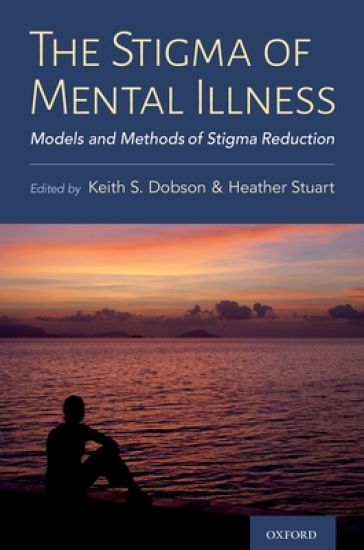
The Stigma of Mental Illness

The Stigma of Mental Illness

Keith Dobson; Heather Stuart

OXFORD UNIVERSITY PRESS INC
2022
sidottu
Stigma is one of the major barriers to care for people with mental health and related disorders. Stigma includes negative beliefs about and hostile perceptions towards others, shame and self-stigma, discriminatory practices in hiring, promotion and recognition of people who suffer from mental health challenges, and structural and organizational policies and processes that result in inequalities for people who have mental health challenges. Stigma has been recognized as a significant factor in the well-being of people with mental health and related problems and can be more debilitating than the direct effects of mental health problems themselves. The Mental Health Commission of Canada (MHCC) was established to conduct policy reviews and to promote initiatives related to mental health. The Opening Minds program of the MHCC is the largest systematic effort in Canadian history to reduce stigma related to mental illnesses. The program has adopted the systematic development, evaluation and deployment of targeted programs based on theories of change, best practices and available research evidence as a model for stigma reduction. The Stigma of Mental Illness is an important vehicle to communicate conceptual issues in the field of stigma reduction, to document the work done to date within the MHCC Opening Minds program, and to offer practical strategies to broaden the scope and utility of the work for different contexts, cultures, and countries. This volume will be a global interest, given the growing importance of stigma reduction related to mental disorders and related problems.
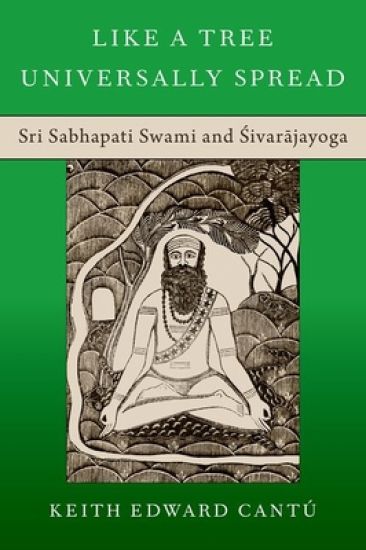
Like a Tree Universally Spread

Like a Tree Universally Spread

Keith Edward Cantú

OXFORD UNIVERSITY PRESS INC
2024
sidottu
This book examines the life of a nineteenth- to early twentieth-century Tamil yogin named Sri Sabhapati Swami (Sri Sabhapati Svami or Capapati Cuvamika?, ca. 1828-1923/4) and his unique English, Tamil, Hindi, and Bengali literature on a Sanskrit-based system of yogic meditation known as the "Rajayoga for Siva" (Tamil: civarajayokam, Sanskrit: sivarajayoga), the full experience of which is compared to being like a "tree universally spread." Its practice was based on a unique synthesis of Tamil Virasaiva and Siddhar cosmologies in the colonial period, and the yogic literature in which it is found was designed to have universal appeal across boundaries of caste, gender, and sectarian affiliation. His works, all of which are here analyzed together for the first time, are an important record in the history of yoga, print culture, and art history due to his vividly-illustrated and numbered diagrams on the yogic body with its subtle physiology. This book opens with a biographical account of Sabhapati, his editor Shrish Chandra Basu, and his students as gleaned from textual sources and the author's ethnographic field work. Sabhapati's literature in various languages is then analyzed, followed by a comprehensive exposition of his Saiva cosmology and religious theories. Sabhapati's system of Sivarajayoga and its subtle physiology is then treated in detail, followed by an analysis of Sabhapati's aesthetic integration of aural sound and visual diagrams and an evaluation of the role of "science" in the swami's literature. Sabhapati also appealed to global authors and occultists outside of South Asia, so special attention is additionally given to his encounter with the founders of the Theosophical Society and the integration of his techniques into the thelemic "Magick" of Aleister Crowley, the German translation of Bavarian theosophical novelist Franz Hartmann, and the American publication of New Thought entrepreneur William Estep. To these are appended a never-before-translated Tamil hagiography of Sabhapati's life, a lexicon in table-form that compiles some archaic variants and Roman transliterations of technical terms used in his work, and a critically-edited passage on an innovative technique of Sivarajayoga that included visualizing the yogic central channel as a lithic "pole."
Ultimate Freedom

Ultimate Freedom

Keith Lehrer

OXFORD UNIVERSITY PRESS INC
2023
sidottu
Philosopher Keith Lehrer outlines a view of freedom of choice based on a Kahneman-derived distinction between what he calls a first order system that is intuitive and immediate, and a higher order system of response, which he calls a second system of scientific analysis. Lehrer argues that freedom of choice is an expression of attention to the higher order system, and that what is often called free will is often just doing what you desire, a response that neglects consideration of other options. Freedom of choice acknowledges those options, and preference among them forms in response to the acceptance of evidence. We might suppose that in responding to beliefs that one has attended to evidence, but that is a delusion, because our higher order acceptance of evidence can be overwhelmed by the fixation created by first level belief. What is the difference between just doing what you desire because it feels good and acting on what you prefer because of scientific acceptance? Lehrer points to a form of preference that he says is the ultimate explanation of choice -- what he calls a power preference. It is a preference that loops back on to itself, a fixed-point vector, and suffices to explain choice. Lehrer's theory of such a power preference includes scientific explanation and consistently accommodates determinism. It is itself a scientific and philosophical explanation, and an ultimate principle of explanation. Lehrer terms the freedom of choice expressing that preference “ultimate freedom”-- the source of our knowledge and agency both in theory, directing what we rationally accept, and in practice directing freedom of choice.
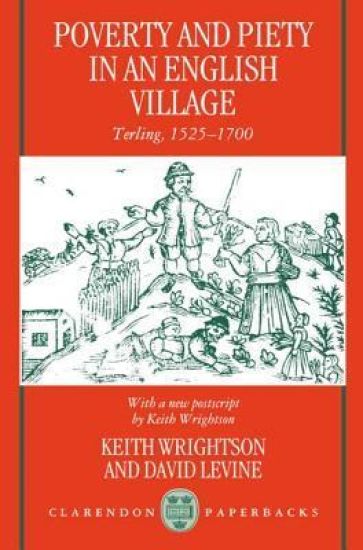
Poverty and Piety in an English Village

Poverty and Piety in an English Village

Keith Wrightson; David Levine

Clarendon Press
1995
nidottu
This classic study of a single community in early modern England has had a major influence on the interpretation of the social dynamics of the period. It opens with a chapter establishing this small Essex parish in the national context of economic and social change in the years between 1525 and 1700. Thereafter the chapters examine the economy of Terling; its demographic history; its social structure; the relationships of the villagers with the courts of the church and state; the growth of popular literacy; the impact of the reformation, and the rise in puritanism. The overall process of change is then characterized in a powerful interpretive chapter on the changing pattern of social relationships in the parish. This revised edition has a new chapter, 'Terling Revisited' which addresses the debate occasioned by the book, notably over kinship relations in early modern England, and the impact of puritanism on local society. In both cases a new interpretive synthesis is attempted and the argument of the first edition is defended, elaborated, and advanced in the light of subsequent research.
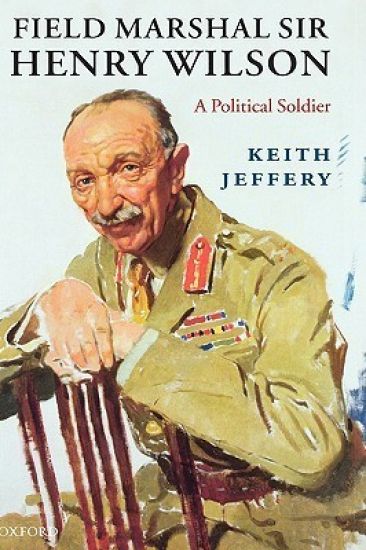
Field Marshal Sir Henry Wilson

Field Marshal Sir Henry Wilson

Keith Jeffery

Oxford University Press
2006
sidottu
Field Marshal Sir Henry Wilson, an Irishman who in June 1922 was assassinated on his doorstep in London by Irish republicans, was one of the most controversial British soldiers of the modern age. Before 1914 he did much to secure the Anglo-French alliance and was responsible for the planning which saw the British Expeditionary Force successfully despatched to France after the outbreak of war with Germany. A passionate Irish unionist, he gained a reputation as an intensely 'political' soldier, especially during the 'Curragh crisis' of 1914 when some officers resigned their commisssions rather than coerce Ulster unionists into a Home Rule Ireland. During the war he played a major role in Anglo-French liaison, and ended up as Chief of the Imperial General Staff, professional head of the army, a post he held until February 1922. After Wilson retired from the army, he became an MP and was chief security adviser to the new Northern Ireland government. As such, he became a target for nationalist Irish militants, being identified with the security policies of the Belfast regime, though wrongly with Protestant sectarian attacks on Catholics. He is remembered today in unionist Northern Ireland as a kind of founding martyr for the state. Wilson's reputation was ruined in 1927 with the publication of an official biography, which quoted extensively and injudiciously from his entertaining, indiscreet, and wildly opinionated diaries, giving the impression that he was some sort of Machiavellian monster. In this first modern biography, using a wide variety of official and private sources for the first time, Keith Jeffery reassesses Wilson's life and career and places him clearly in his social, national, and political context.
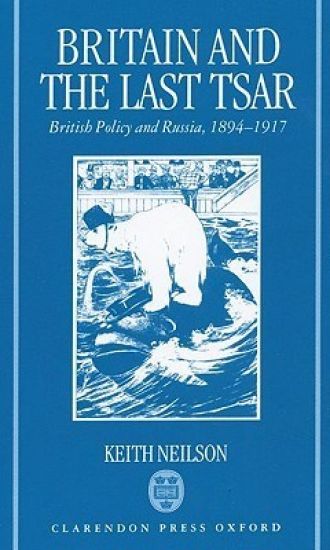
Britain and the Last Tsar

Britain and the Last Tsar

Keith Neilson

Clarendon Press
1995
sidottu
Britain and the Last Tsar is a fundamental re-interpretation of British foreign and defence policy before the First World War. The current orthodoxy asserts that the rise of an aggressive and powerful Germany forced Britain - a declining power - to abandon her traditional policy of avoiding alliances and to enter into alliance with Japan (1902), France (1904), and Russia (1907) in order to contain the German menace. In a controversial rejection of this theory, Keith Neilson argues that Britain was the pre-eminent world power in 1914 and that Russia, not Germany, was the principal long-term threat to Britain's global position. This original and important study shows that only by examining Anglo-Russian relations and eliminating an undue emphasis on Anglo-German affairs can an accurate picture of Britain's foreign and defence policy before 1914 be gained.
Nineteenth-Century Britain

Nineteenth-Century Britain

Keith Robbins

Clarendon Press
1995
nidottu
This is a study of two conflicting trends in nineteenth-century Britain: the promotion of integration and unity, and the commitment to preserve regional diversity. In the last century communications between different parts of Britain improved enormously, through the spread of railways, the penny post, newspapers, and increased affluence which enabled more people to take holidays; but this did not necessarily lead to uniformity. The Scots and the Welsh in particular were concerned to retain their own 'nationality' and culture, yet in ways which would not lead to political separation. Professor Robbins examines the various aspects which served to unite or divide the regions: the role of the church and religious beliefs, patterns of eating and drinking, the political system, commercial development, the educational system, language, literature, and music. He concludes that there was a 'British' nation which was consolidated through the century. Although not uniform in character, it held together during the supreme test of the First World War, under the political guidance of a Welshman whose first language was not English and the spiritual guidance of an Archbishop of Canterbury who was a Scot. The relationship between region and state still lies at the heart of today's concerns with local government, devolution, and the North/South divide, and this stimulation account of the making of the modern nation will appeal to all interested in British history and politics.
The Romanians, 1774-1866

The Romanians, 1774-1866

Keith Hitchins

Clarendon Press
1996
sidottu
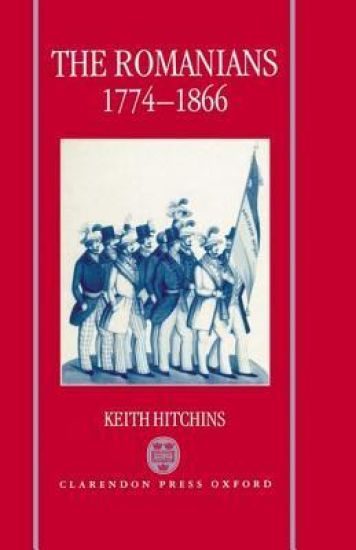
The century from the 1774 Treaty of Kuchuk Kainardji (between Russia and the Ottoman Empire) to the end of Prince Alexandru Cuza's reign in 1866 stands as a distinct era in the development of modern Romania. It marks the transition from long-established agrarian economic and social structures, and medieval political forms, to a society moulded by urban and industrial values and held together by allegiance to the nation-state. This initial period of nation-building was characterized by dramatic shifts of mentality and significant changes in economic and social life. The principal changes included: the freeing of the principalities of Moldavia and Wallachia from Ottoman Turkish dominion and their union to form the core of modern Romania; the cultivation of the idea of the ethnic nation as the foundation of community; the emergence of new ways of producing goods and doing business, notably the advance of capitalism in agriculture and industry; and the relentless advance of Western political forms, economic models and cultural acheivements. As a consequence, by the 1860s a united, and for all practical purposes, an independent Romania had come into being, and the institutions and ideologies that were to guide the countrie's development down to the Second World War were in place. In the process the Romanians had experienced a fundamental shift in their mental outlook away from the traditions of the Eastern Orthodox world towards the innovations and experiments of the West. Yet the creators of the new state could never forget that they and their countrymen remained as always at the crossroads between east and west. This original and ground-breaking work is the first attempt to treat the period 1774-1866 as a distinct stage in the evolution of modern Romania and is a fascinating analysis of the building of a European nation-state.
Rumania 1866-1947

Rumania 1866-1947

Keith Hitchins

Clarendon Press
1994
sidottu
From the mid-nineteenth century until the Second World War, the energies of Rumanian political and intellectual élites were absorbed by the building of their nation. In this comprehensive and scholarly study Keith Hitchins traces these complex processes and explores how Rumania's leaders attempted to transform the ideology of modern nationhood into strong political, economic, and social institutions and to find ways of preserving independence in an international political and economic order dominated by the great powers. As the new Rumania took shape, the threads of historical continuity remained strikingly evident: in government a strong administrative centralization prevailed, despite the maturing of parliamentary institutions and the diversity of political expression; the national economy remained beholden to agriculture, despite the steady growth of industry; and in cultural life traditional values persisted, despite the adoption of modern forms. In foreign relations the most pressing aim was to unite all Rumanians in a single state and to defend its sovereignty within an uncertain international order. In all these endeavours, the measure of achievement was the West. After the Second World War, when the Communist Party came to power, this historical continuity was broken. The experiment in nation-building gave way to a new ideology, and Rumania now turned to the Soviet political and economic model.
Self-Trust

Self-Trust

Keith Lehrer

Clarendon Press
1997
sidottu
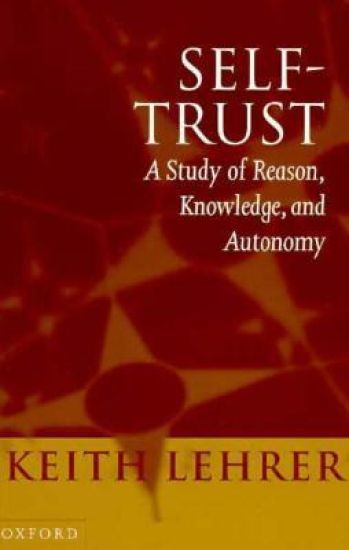
Keith Lehrer offers an original philosophical view of principal aspects of the human condition, such as reason, knowledge, wisdom, autonomy, love, consensus, and consciousness. Three unifying ideas run through the book. The first is that what is uniquely human is the capacity for metamental ascent, the ability to consider and evaluate first-order mental states (such as beliefs and desires) that arise naturally within us. A primary function of this metamental ascent is the resolution of personal and interpersonal conflict, essential to such central human goods as wisdom, autonomy, and consensus. The second unifying idea is that we have a system for such reflective evaluation which yields acceptance (in relation to beliefs) or preference (in relation to the objects of desires). The third unifying idea is that there are `keystones' of evaluation in this system: loops of trustworthiness that are themselves supported by the structure that they hold together. Self-trust is the basis of our trustworthiness, on which reason, knowledge, and wisdom are grounded.
Self-Trust

Self-Trust

Keith Lehrer

Clarendon Press
1997
nidottu
Keith Lehrer offers an original philosophical view of principal aspects of the human condition, such as reason, knowledge, wisdom, autonomy, love, consensus, and consciousness. Three unifying ideas run through the book. The first is that what is uniquely human is the capacity for metamental ascent, the ability to consider and evaluate first-order mental states (such as beliefs and desires) that arise naturally within us. A primary function of this metamental ascent is the resolution of personal and interpersonal conflict, essential to such central human goods as wisdom, autonomy, and consensus. The second unifying idea is that we have a system for such reflective evaluation which yields acceptance (in relation to beliefs) or preference (in relation to the objects of desires). The third unifying idea is that there are `keystones' of evaluation in this system: loops of trustworthiness that are themselves supported by the structure that they hold together. Self-trust is the basis of our trustworthiness, on which reason, knowledge, and wisdom are grounded.