Kirjojen hintavertailu. Mukana 12 016 292 kirjaa ja 12 kauppaa.

Kirjahaku

Etsi kirjoja tekijän nimen, kirjan nimen tai ISBN:n perusteella.

1000 tulosta hakusanalla Mari Collier

Pornography

Pornography

Mari Mikkola

Oxford University Press Inc
2019
nidottu
Debates over pornography tend to be heated and deeply polarized--as with other topics that have to do with sex, pornography cuts to the core of our values and convictions. Philosophical debates concerning pornography are fraught with difficult questions: What is pornography? What does pornography do (if anything at all)? Is the consumption of pornography a harmless private matter, or does pornography violate women's civil rights? What, if anything, should legally be done about pornography? Can there be a genuinely feminist pro-pornography stance? Answering these questions is complicated by widespread confusion over the conceptual and political commitments of different anti- and pro-pornography positions, and whether these positions are even in tension with one another. For a start, different people understand pornography differently and can easily end up talking past one another. In order to clarify the debate and make genuine philosophical headway in discussing the topic of pornography, Mari Mikkola here provides an accessible introduction to contemporary philosophical debates conducted from a feminist philosophical perspective. The starting point of the book's examination is morally neutral, and the book provides a comprehensive discussion of various philosophical positions on pornography that are found in ethics, aesthetics, feminist philosophy, political philosophy, epistemology, and social ontology. The book clarifies different stances in the debate, thus clarifying and helping readers to understand what exactly is as stake. In addition, although the book does not argue for a single outlook, it puts forward substantive philosophical views on different aspects of philosophical debates about pornography. Mikkola ultimately offers readers important methodological insights about doing philosophical work on something as ubiquitous as pornography.

Jump In!: Starter Level: Class Book

Jump In!: Starter Level: Class Book

Mari Carmen Ocete

Oxford University Press
2017
muu
Jump into Speaking! – Get your students communicating confidently in everyday English with songs, chants, routines and role plays. Create a splash! – Make English classes fun, imaginative and motivating with enchanting stories, drama activities, and catchy songs with dance routines. Leap into learning! – Students develop social and emotional skills such as cooperation, turn taking, sharing and collaboration through games and role plays. Dive into teaching! – Get the most out of your classes with easy-to-follow teaching notes and flexible resources, including puppets, flashcards, worksheets, and Classroom Presentation Tool.
Jump In!: Starter Level: Teacher's Book

Jump In!: Starter Level: Teacher's Book

Mari Carmen Ocete

Oxford University Press
2017
nidottu
Jump into Speaking! – Get your students communicating confidently in everyday English with songs, chants, routines and role plays. Create a splash! – Make English classes fun, imaginative and motivating with enchanting stories, drama activities, and catchy songs with dance routines. Leap into learning! – Students develop social and emotional skills such as cooperation, turn taking, sharing and collaboration through games and role plays. Dive into teaching! – Get the most out of your classes with easy-to-follow teaching notes and flexible resources, including puppets, flashcards, worksheets, and Classroom Presentation Tool.
Wide Angle: Level 4: Workbook

Wide Angle: Level 4: Workbook

Mari Vargo

Oxford University Press
2018
nidottu
Wide Angle is the course that helps your adult learners to uncover and master the hidden rules of English, so when it comes to communicating in the real world, they know what to say and how to say it. The Workbook offers learners additional practice for every unit of the Student Book, for homework or self-study.
Embracing the East

Embracing the East

Mari Yoshihara

Oxford University Press Inc
2003
nidottu
As exemplified by Madame Butterfly, East-West relations have often been expressed as the relations between the masculine, dominant West and the feminine, submissive East. Yet, this binary model does not account for the important role of white women in the construction of Orientalism. Mari Yoshihara's study examines a wide range of white women who were attracted to Japan and China in the late nineteenth and early twentieth century and shows how, through their engagement with Asia, these women found new forms of expression, power, and freedom that were often denied to them in other realms of their lives in America. She demonstrates how white women's attraction to Asia shaped and was shaped by a complex mix of exoticism for the foreign, admiration for the refined, desire for power and control, and love and compassion for the people of Asia. Through concrete historical narratives and careful textual analysis, she examines the ideological context for America's changing discourse about Asia and interrogates the power and appeal--as well as the problems and limitations--of American Orientalism for white women's explorations of their identities. Combining the analysis of race and gender in the United States and the study of U.S.-Asian relations, Yoshihara's work represents the transnational direction of scholarship in American Studies and U.S. history. In addition, this interdisciplinary work brings together diverse materials and approaches, including cultural history, material culture, visual arts, performance studies, and literary analysis.
Our Brains at War

Our Brains at War

Mari Fitzduff

Oxford University Press Inc
2021
sidottu
Our Brains at War: The Neuroscience of Conflict and Peacebuilding suggests that we need a radical change in how we think about war, leadership, and politics. Most of us, political scientists included, fail to appreciate the extent to which instincts and emotions, rather than logic, factor into our societal politics and international wars. Many of our physiological and genetic tendencies, of which we are mostly unaware, can all too easily fuel our antipathy towards other groups, make us choose 'strong' leaders over more mindful leaders, assist recruitment for illegal militias, and facilitate even the most gentle of us to inflict violence on others. Drawing upon the latest research from emerging areas such as behavioral genetics, biopsychology, and social and cognitive neuroscience, this book identifies the sources of compelling instincts and emotions, and how we can acknowledge and better manage them so as to develop international and societal peace more effectively.
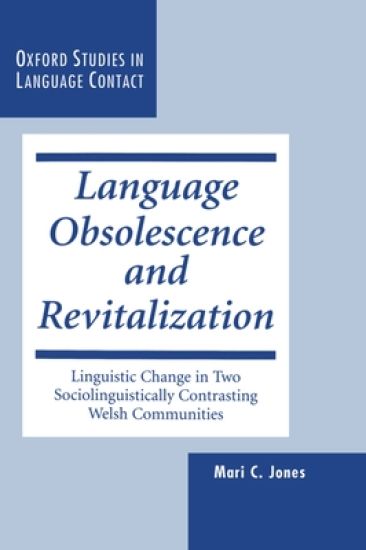
Language Obsolescence and Revitalization

Language Obsolescence and Revitalization

Mari C. Jones

Clarendon Press
1998
sidottu
The territorial contraction and speaker-reduction undergone by the Welsh language during the past few centuries has resulted in its categorization by many linguists as an obsolescent language. This study illustrates that, although it is undeniably showing some signs of decline, Welsh stands in marked contrast to many previously documented cases of language death. Against this backdrop of contraction a steady revitalization is taking place. Based upon extensive fieldwork in two sociolinguistically contrasting communities, this book is the first to examine the position and nature of contemporary Welsh with reference to both obsolescence-related developments and changes under way in the dialects. Jones focuses on immersion education, long heralded as the saviour of the language and, by examining the variety of Welsh being produced by immersion pupils, seeks to determine whether this claim is justified, or whether such pupils are in fact 'speaking immersion'. As well as discussing the recent linguistic change shown by contemporary Welsh within the language death framework, the author examines the ways in which the language has been standardized and their repercussions for language maintenance. By way of comparison these tensions and implications are also explored with reference to the other varieties of P-Celtic, namely Breton and Cornish. Series Information: Oxford Studies in Language Contact Series Editor: Professor Suzanne Romaine, Merton College, Oxford Series ISBN: 0-19-961466-0 Series Description: Most of the world's speech communities are multilingual, and contact between languages is thus an important force in the everyday lives of most people. Studies of language contact should therefore form an integral part of work in theoretical, social, and historical linguistics. This series makes available a collection of research monographs which present case studies of language contact around the world. As well as providing an indispensable source of data for the serious researcher, it contributes significantly to theoretical developments in the field.
Shifting Boundaries of the Firm

Shifting Boundaries of the Firm

Mari Sako

Oxford University Press
2006
sidottu
All firms wrestle with restructuring, involving consolidation of mergers and acquisitions on the one hand, and fragmentation through outsourcing and spin-offs on the other. Through an in-depth investigation into the organizational strategies of Japanese corporate management and union leaders in Japan, Mari Sako explores the issue of 'organizational boundaries' that arises from such restructuring. Examining the strategy and structure of both businesses and trade unions, the book draws upon empirical evidence drawn from interviews conducted at Toyota and Matsushita and their respective unions. It examines their respective strategies in coping with organizational boundaries against the backdrop of changing labour markets, and, in the process, challenges widely held notions about Japanese corporate and union structures. Mari Sako goes on to explore the implications of these relationships in other advanced industrial countries for corporate restructuring, jobs, and labour market flexibility.
The Gulf Monarchies and Climate Change: Abu Dhabi and Qatar in an Era of Natural Unsustainability
At the heart of Mari Luomi's salutary book is whether oil- and gas-dependent authoritarian monarchies can keep their natural resource use and the environment in balance. She argues that the Gulf monarchies have already reached their limits of 'natural sustainability', given that several of them are dependent on natural gas imports. Water resources are dwindling, and food import dependence is high and rising. Qatar's per capita emission of CO2 is ten times the global average. As a result of their booming economies, the Gulf monarchies' surging electricity and water demand have exerted unexpected pressures on domestic energy supply. Simultaneously, the consolidation of climate change on the international agenda has created a new uncertainty for local rulers whose survival depends on sales of oil and gas. Meanwhile domestic resource consumption, together with climate change, are putting unprecedented stress on the region's fragile desert environment. The Gulf is under stress, but so too are its states' power, wealth and ecosystems. Luomi reveals how Abu Dhabi and Qatar have responded to these new natural re- source-related pressures, particularly climate change, and how their responses are inextricably linked with elite legitimacy strategies and the 'natural unsustainability' of their political economies.
Shifting Boundaries of the Firm

Shifting Boundaries of the Firm

Mari Sako

Oxford University Press
2008
nidottu
All firms wrestle with restructuring, involving consolidation of mergers and acquisitions on the one hand, and fragmentation through outsourcing and spin-offs on the other. Through an in-depth investigation into the organizational strategies of Japanese corporate management and union leaders in Japan, Mari Sako explores the issue of 'organizational boundaries' that arises from such restructuring. Examining the strategy and structure of both businesses and trade unions, the book draws upon empirical evidence drawn from interviews conducted at Toyota and Matsushita and their respective unions. It examines their respective strategies in coping with organizational boundaries against the backdrop of changing labour markets, and, in the process, challenges widely held notions about Japanese corporate and union structures. Mari Sako goes on to explore the implications of these relationships in other advanced industrial countries for corporate restructuring, jobs, and labour market flexibility.
Concise Women's History, A

Concise Women's History, A

Mari Jo Buhle; Teresa Murphy; Jane Gerhard

Pearson
2014
nidottu
Explores the history of women and gender in the U.S. A Concise Women’s History, 1/e, explores the dynamics of power in the U.S., between women and men and among women themselves. This history spans from the first cultural contact between indigenous peoples and Europeans in the 15th century to the new globalism of the 21st century. Because it recognizes diversity as a central factor in the history of women and gender, this title explores the lives of a broad spectrum of women. Chapters explore how relationships among women were determined by differences of race, ethnicity, class, age, region, or religion.
The Summons of Love

The Summons of Love

Mari Ruti

Columbia University Press
2011
sidottu
We are conditioned to think that love heals wounds, makes us happy, and gives our lives meaning. When the opposite occurs and love causes fracturing, disenchantment, and existential turmoil, we suffer deeply, especially if we feel that love has failed us or that we have failed to experience what others seem so effortlessly to enjoy. In this eloquently argued, psychologically informed book, Mari Ruti portrays love as a much more complex, multifaceted phenomenon than we tend to appreciate-an experience that helps us encounter the depths of human existence. Love's ruptures are as important as its triumphs, and sometimes love succeeds because it fails. At the heart of Ruti's argument is a meditation on interpersonal ethics that acknowledges the inherent opacity of human interiority and the difficulty of taking responsibility for what we cannot fully understand. Yet the fact that humans are often irrational in love does not absolve us of ethical accountability. In Ruti's view, we must work harder to map the unconscious patterns motivating our romantic behavior. As opposed to popular spiritual approaches urging us to live fully in the now, Ruti treats the past as a living component of the present. Only when we catch ourselves at those moments when the past speaks in the present can we keep ourselves from hurting the ones we love. Equally important, Ruti emphasizes transcending our individual histories of pain, an act that allows us to face the unconscious demons that dictate our relational choices. Written with substance and compassion, The Summons of Love restores the enlivening and transformative possibilities of romance.
The Call of Character

The Call of Character

Mari Ruti

Columbia University Press
2013
sidottu
Should we feel inadequate when we fail to be healthy, balanced, and well-adjusted? Is it realistic or even desirable to strive for such an existential equilibrium? Condemning our current cultural obsession with cheerfulness and "positive thinking," Mari Ruti calls for a resurrection of character that honors our more eccentric frequencies and argues that sometimes a tormented and anxiety-ridden life can also be rewarding. Ruti critiques the search for personal meaning and pragmatic attempts to normalize human beings' unruly and idiosyncratic natures. Exposing the tragic banality of a happy life commonly lived, she instead emphasizes the advantages of a lopsided life rich in passion and fortitude. She also shows what matters is not our ability to evade existential uncertainty but our courage to meet adversity in such a way that we do not become irrevocably broken. We are in danger of losing the capacity to cope with complexity, ambiguity, melancholia, disorientation, and disappointment, Ruti warns, leaving us feeling less "real" and less connected and unable to process a full range of emotions. Heeding the call of our character means acknowledging the marginalized, chaotic aspects of our being, and it is precisely these creative qualities that make us inimitable and irreplaceable.
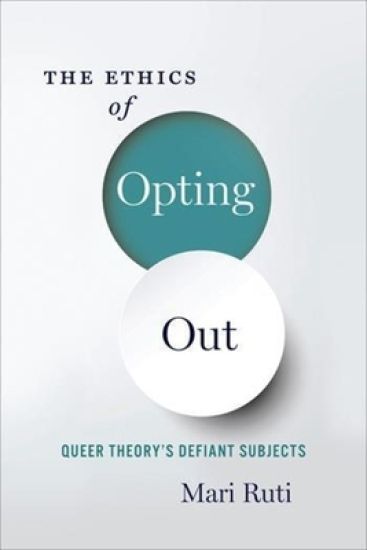
The Ethics of Opting Out

The Ethics of Opting Out

Mari Ruti

Columbia University Press
2017
sidottu
In The Ethics of Opting Out, Mari Ruti provides an accessible yet theoretically rigorous account of the ideological divisions that have animated queer theory during the last decade, paying particular attention to the field's rejection of dominant neoliberal narratives of success, cheerfulness, and self-actualization. More specifically, she focuses on queer negativity in the work of Lee Edelman, Jack Halberstam, and Lynne Huffer, and on the rhetoric of bad feelings found in the work of Sara Ahmed, Lauren Berlant, David Eng, Heather Love, and Jose Munoz. Ruti highlights the ways in which queer theory's desire to opt out of normative society rewrites ethical theory and practice in genuinely innovative ways at the same time as she resists turning antinormativity into a new norm. This wide-ranging and thoughtful book maps the parameters of contemporary queer theory in order to rethink the foundational assumptions of the field.
The Ethics of Opting Out

The Ethics of Opting Out

Mari Ruti

Columbia University Press
2017
pokkari
In The Ethics of Opting Out, Mari Ruti provides an accessible yet theoretically rigorous account of the ideological divisions that have animated queer theory during the last decade, paying particular attention to the field's rejection of dominant neoliberal narratives of success, cheerfulness, and self-actualization. More specifically, she focuses on queer negativity in the work of Lee Edelman, Jack Halberstam, and Lynne Huffer, and on the rhetoric of bad feelings found in the work of Sara Ahmed, Lauren Berlant, David Eng, Heather Love, and Jose Munoz. Ruti highlights the ways in which queer theory's desire to opt out of normative society rewrites ethical theory and practice in genuinely innovative ways at the same time as she resists turning antinormativity into a new norm. This wide-ranging and thoughtful book maps the parameters of contemporary queer theory in order to rethink the foundational assumptions of the field.
Penis Envy and Other Bad Feelings

Penis Envy and Other Bad Feelings

Mari Ruti

Columbia University Press
2018
sidottu
Mari Ruti combines theoretical reflection, cultural critique, feminist politics, and personal experience to analyze the prevalence of bad feelings in contemporary everyday life. Proceeding from a playful engagement with Freud’s idea of penis envy, Ruti’s autotheoretical commentary fans out to a broader consideration of neoliberal pragmatism. She focuses on the emphasis on good performance, high productivity, constant self-improvement, and relentless cheerfulness that characterizes present-day Western society. Revealing the treacherousness of our fantasies of the good life, particularly the idea that our efforts will eventually be rewarded—that things will eventually get better—Ruti demystifies the false hope that often causes us to tolerate an unbearable present.Theoretically rigorous and lucidly written, Penis Envy and Other Bad Feelings is a trenchant critique of contemporary gender relations. Refuting the idea that we live in a postfeminist world where gender inequalities have been transcended, Ruti describes how neoliberal heteropatriarchy has transformed itself in subtle and stealthy, and therefore all the more insidious, ways. Mobilizing Michel Foucault’s concept of biopolitics, Jacques Lacan’s account of desire, and Lauren Berlant’s notion of cruel optimism, she analyzes the rationalization of intimacy, the persistence of gender stereotypes, and the pornification of heterosexual culture. Ruti shines a spotlight on the depression, anxiety, frustration, and disenchantment that frequently lie beneath our society’s sugarcoated mythologies of self-fulfillment, romantic satisfaction, and professional success, speaking to all who are concerned about the emotional costs of the pressure-cooker ethos of our age.
Penis Envy and Other Bad Feelings

Penis Envy and Other Bad Feelings

Mari Ruti

Columbia University Press
2021
pokkari
Mari Ruti combines theoretical reflection, cultural critique, feminist politics, and personal experience to analyze the prevalence of bad feelings in contemporary everyday life. Proceeding from a playful engagement with Freud’s idea of penis envy, Ruti’s autotheoretical commentary fans out to a broader consideration of neoliberal pragmatism. She focuses on the emphasis on good performance, high productivity, constant self-improvement, and relentless cheerfulness that characterizes present-day Western society. Revealing the treacherousness of our fantasies of the good life, particularly the idea that our efforts will eventually be rewarded—that things will eventually get better—Ruti demystifies the false hope that often causes us to tolerate an unbearable present.Theoretically rigorous and lucidly written, Penis Envy and Other Bad Feelings is a trenchant critique of contemporary gender relations. Refuting the idea that we live in a postfeminist world where gender inequalities have been transcended, Ruti describes how neoliberal heteropatriarchy has transformed itself in subtle and stealthy, and therefore all the more insidious, ways. Mobilizing Michel Foucault’s concept of biopolitics, Jacques Lacan’s account of desire, and Lauren Berlant’s notion of cruel optimism, she analyzes the rationalization of intimacy, the persistence of gender stereotypes, and the pornification of heterosexual culture. Ruti shines a spotlight on the depression, anxiety, frustration, and disenchantment that frequently lie beneath our society’s sugarcoated mythologies of self-fulfillment, romantic satisfaction, and professional success, speaking to all who are concerned about the emotional costs of the pressure-cooker ethos of our age.
The Creative Self

The Creative Self

Mari Ruti; Gail M. Newman

Columbia University Press
2025
sidottu
“Be the best you can be!” Practically from the moment we are born, we are taught to optimize our lives—to devote ourselves to increasing our productivity and efficiency, which, we are told, will make us happier and more successful. The imperative of constant self-improvement, however, drains us dry even as it promises to build us up.The Creative Self delves into the hegemony of neoliberal self-optimization and turns to psychoanalysis in search of an alternative. In paired chapters, Mari Ruti and Gail M. Newman examine the works of the psychoanalysts Marion Milner and Donald W. Winnicott. They provide deeply personal accounts of how these thinkers resonate with day-to-day life, exploring modes of selfhood that subtly but profoundly resist the lure and escape the trap of competitive individualism. Milner urges us to relinquish the ego in the face of loss and lack, and Winnicott asks us to accept the paradoxes of the self instead of demanding their resolution. Together, their insights help us flourish where neoliberal self-improvement would stifle us. Combining the intellectual, the personal, and the political from two perspectives that converge and diverge in striking ways, this book offers an antidote to transactional individualism and envisions forms of creative living beyond its confines.