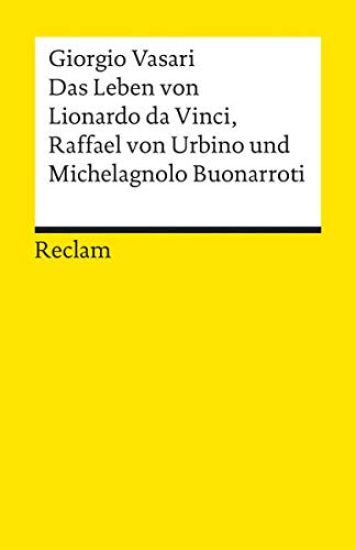
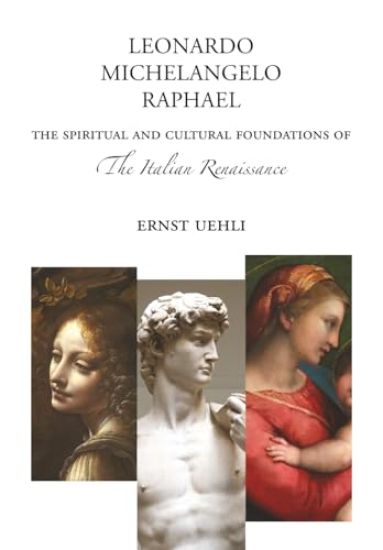
The Italian Renaissance was a period in history from the 14th to the 17th centuries, known for the development of a culture that spread across Europe and marked the transition from the Middle Ages to modernity. In this insightful text, Ernst Uehli examines the spiritual impulses that led to the Renaissance and the significance of three personalities who define it: Leonardo da Vinci, Michelangelo and Rafael. The book is rich with over 130 full colour illustrations illuminating the powerful change in consciousness that took place. This revealing examination is a must read for any history or art history teacher, as well as for anyone interested in the evolution of consciousness in human development.
Caravaggio's art is subjected to a political interpretation that draws on Erasmus's writings to explain his paintings. According to Erasmus's Philosophia christiana, in contrast to Gabriele Paleotti's Discorso intorno alle immagini sacre e profane of 1582, the sacred is best expressed through the profane. The divine is hidden beneath the cloak of the ugly and the vulgar. Numerous interpretations refer to the dissimulation of anti-Catholic content in Caravaggio's paintings and the tradition of Pasquino. As poems from Marino's Galeria show, the talking statue represents much more than a symbol of defamation; it symbolizes political resistance and hidden opposition to oppression by the Catholic Church. Caravaggios Kunst wird einer politischen Lekt re unterzogen, die zur Erkl rung seiner Gem lde auf die bilderskeptischen Schriften von Erasmus zur ckgreift. Folgt man dessen Philosophia christiana, wird im Unterschied zu Gabriele Paleottis Discorso intorno alle immagini sacre e profane von 1582 das Heilige am besten durch das Profane zum Ausdruck gebracht. Unter dem Mantel des Niederen, H sslichen und Vulg ren verbirgt sich das G ttliche. In zahlreichen Interpretationen wird auf die Dissimulation antikatholischer Inhalte sowie die Tradition des Pasquino verwiesen. Wie Gedichte aus Marinos Galeria zeigen, stellt die sprechende Statue weit mehr als nur ein Sinnbild der Schm hung dar, vielmehr symbolisiert sie den politischen Widerstand und die verborgene Opposition gegen ber der Unterdr ckung durch die katholische Kirche.
*Includes pictures of important people and places, as well as the artists' most famous works. *Discusses the relationships between the artists. *Includes a Bibliography on each artist for further reading. It would be hard to determine which field Leonardo had the greatest influence in. His "Mona Lisa" and "The Last Supper" are among the most famous paintings of all time, standing up against even Michelangelo's work. But even if he was not the age's greatest artist, Leonardo may have conducted his most influential work was done in other fields. His emphasis on the importance of Nature would influence Enlightened philosophers centuries later, and he sketched speculative designs for gadgets like helicopters that would take another 4 centuries to create. It's possible that Michelangelo is the most famous artist in history, but it's also possible that he's an underrated artist. The vast influence of his career is reflected by the fact that he is not only known for his own art but has also come to embody an entire epoch of Western art. Along with Leonardo da Vinci, there are no other artists who so fully capture the spirit of scientific and artistic discovery that characterized art during the late 15th and early 16th centuries. Moreover, Michelangelo's career is distinguished from that of his peers through his seamless ability to work within different art forms, receiving acclaim regardless of the medium. After first rising to fame as a sculptor, he also painted and served as an architect, and since his death, Michelangelo has also become decorated for his prolific output as a poet. The diversity and high standard of his work, no matter the medium, make it difficult to even arrive at a most famous work. Raffaello Sanzio da Urbino, known across the world simply by the name Raphael, stands as one of the main pillars of the High Renaissance, an iconic example of the balance between spirituality and Humanistic inquiry that characterized the time period. Although he lived just 37 years, his career produced an amazingly rich output, and he completed more works than many artists do over careers spanning twice the length. At the same time, Raphael's art combined central tropes associated with the Renaissance while remaining remarkably original. Vincent van Gogh is undoubtedly one of the most famous artists of all time, and though the critical establishment may not consider him the greatest artist who ever lived, there may be no artist with whom the public has a greater familiarity. Unfortunately, a great deal of that familiarity comes from the circumstances leading up to his death, and the manner in which they have been linked to his painting career. In 1882, Vincent would hauntingly and somewhat prophetically write to his brother Theo, "What am I in the eyes of most people - a nonentity, an eccentric, or an unpleasant person - somebody who has no position in society and will never have; in short, the lowest of the low. All right, then - even if that were absolutely true, then I should one day like to show by my work what such an eccentric, such a nobody, has in his heart." In their biography of Pablo Picasso, Hans Ludwig and Chris Jaffe note that "for him, art was always adventure: 'To find is the thing.'" Indeed, there is perhaps no artist who produced more art than Picasso, whose enormous oeuvre (which spanned most of his 91-year life) contained a countless number of paintings and drawings. Picasso also worked in other mediums as well, notably sculpture and lithography, and his constant experimentation with form makes him a useful case study through which to chart the growth of Modernism as an artistic movement and many of the artistic trends that would dominate the 20th century.
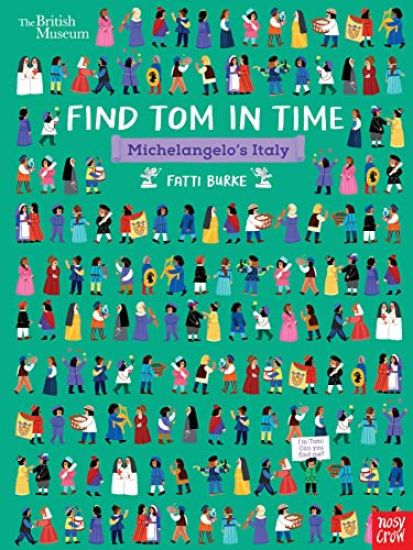
A brilliantly fun search-and-find puzzle book for children from 6+, developed in consultation with the British Museum. Tom's not only lost in time, he's lost his cat, too!
A brilliantly fun search-and-find puzzle book for children from 6+, developed in consultation with the British Museum. Tom's not only lost in time, he's lost his cat, too!