Kirjojen hintavertailu. Mukana 12 016 292 kirjaa ja 12 kauppaa.

Kirjahaku

Etsi kirjoja tekijän nimen, kirjan nimen tai ISBN:n perusteella.

1000 tulosta hakusanalla Robyn Blake

Family Narratives and the Development of an Autobiographical Self
Stories are central to our world. We form our families, our communities, and our nations through stories. It is through stories of our everyday experiences that each of us constructs an autobiographical self, a narrative identity, that confers a sense of coherence and meaning to our individual lives. In this volume, Robyn Fivush describes how this deeply personal autobiographical self is socially and culturally constructed. Family Narratives and the Development of an Autobiographical Self demonstrates that, through participating in family reminiscing, in which adults help children learn the forms and functions of talking about the past, young children come to understand and evaluate their experiences, and create a sense of self defined through individual and family stories that provide an anchor for understanding self, others, and the world. Fivush draws on three decades of research, from her own lab and from others, to demonstrate the critical role that family stories and family storytelling play in child development and outcome. This volume is essential reading for students and researchers interested in psychology, human development, and family studies.
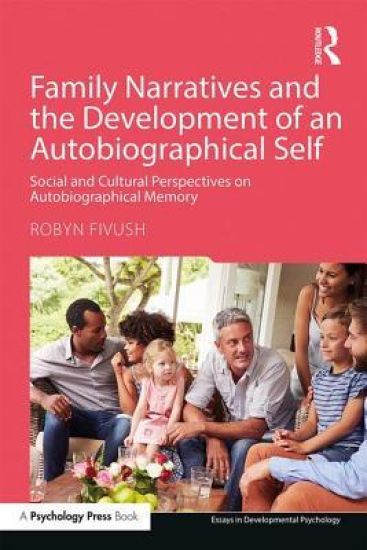
Family Narratives and the Development of an Autobiographical Self
Stories are central to our world. We form our families, our communities, and our nations through stories. It is through stories of our everyday experiences that each of us constructs an autobiographical self, a narrative identity, that confers a sense of coherence and meaning to our individual lives. In this volume, Robyn Fivush describes how this deeply personal autobiographical self is socially and culturally constructed. Family Narratives and the Development of an Autobiographical Self demonstrates that, through participating in family reminiscing, in which adults help children learn the forms and functions of talking about the past, young children come to understand and evaluate their experiences, and create a sense of self defined through individual and family stories that provide an anchor for understanding self, others, and the world. Fivush draws on three decades of research, from her own lab and from others, to demonstrate the critical role that family stories and family storytelling play in child development and outcome. This volume is essential reading for students and researchers interested in psychology, human development, and family studies.
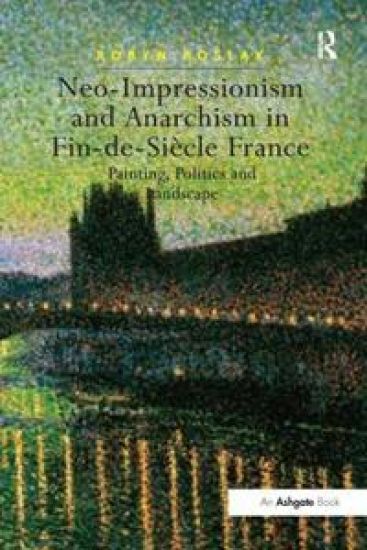
Neo-Impressionism and Anarchism in Fin-de-Siècle France
In Neo-Impressionism and Anarchism in Fin-de-Siècle France, Robyn Roslak examines for the first time the close relationship between neo-impressionist landscapes and cityscapes and the anarchist sympathies of the movement's artists. She focuses in particular on paintings produced between 1886 and 1905 by Paul Signac and Maximilien Luce, the neo-impressionists whose fidelity to anarchism, to the art of landscape and to a belief in the social potential of art was strongest. Although the neo-impressionists are best known for their rational and scientific technique, they also heeded the era's call for art surpassing the mundane realities of everyday life. By tempering their modern subjects with a decorative style, they hoped to lead their viewers toward moral and social improvement. Roslak's ground-breaking analysis shows how the anarchist theories of Elisée Reclus, Pierre Kropotkin and Jean Grave both inspired and coincided with these ideals. Anarchism attracted the neo-impressionists because its standards for social justice were grounded, like neo-impressionism itself, in scientific exactitude and aesthetic idealism. Anarchists claimed humanity would reach its highest level of social and moral development only in the presence of a decorative variety of nature, and called upon progressive thinkers to help create and maintain such environments. The neo-impressionists, who primarily painted decorative landscapes, therefore discovered in anarchism a political theory consistent with their belief that decorative harmony should be the basis for socially responsible art.
Jean-Luc Marion

Jean-Luc Marion

Robyn Horner

Routledge
2017
sidottu
Jean-Luc Marion is one of the leading Catholic thinkers of our time: a formidable authority on Descartes and a major scholar in the philosophy of religion. This book presents a concise, accessible, and engaging introduction to the theology of Jean-Luc Marion. Described as one of the leading thinkers of his generation, Marion's take on the postmodern is richly enhanced by his expertise in patristic and mystical theology, phenomenology, and modern philosophy. In this first introduction to Marion's thought, Robyn Horner provides the essential background to Marion's work, as well as analysing the most significant themes for contemporary theology. This book serves as an ideal starting point for students of theology and philosophy, as well as for those seeking to further their knowledge of cutting-edge thinking in contemporary theology.
Skype: Bodies, Screens, Space

Skype: Bodies, Screens, Space

Robyn Longhurst

Routledge
2018
nidottu
Despite the popularity of Skype with video many of us are still figuring out how to ‘do’ it. Interviews reveal that we can now run the programme but we are less certain about how to ‘perform’ in front of the webcam. Seeing ourselves in the box on the side can feel strange. We are not quite sure which bits of our bodies to display on the screen, how much to move around the room, or move the device around the room. Is it acceptable to use Skype with video at a funeral, in crowded spaces or while in bed? This book addresses how people are emotionally and affectually connecting with others audio-synchronously on the screen in a variety of different spatial contexts. Topics include Skype with video being used by grandparents to connect with grandchildren, friends and family using it for special occasions, and partners using it for romance and sex. Theories addressing bodies, gender, queerness, phenomenology and orientation inform the research. It concludes that while Skype does not offer some kind of utopian future, it does open up possibilities for existing power relations to be filtered through new lines of sight/site which are shaping what bodies can do and where.
Enhancing Classroom-based Talk

Enhancing Classroom-based Talk

Robyn M. Gillies

Routledge
2015
sidottu
Enhancing Classroom-based Talk provides an overview of the major research and theoretical perspectives that underpin the development of classroom-based talk. It outlines specific dialogic strategies and elaborates on the key role that teachers play in promoting interactions, challenging thinking and scaffolding the learning of students.While it is important to know how different dialogic approaches can enhance students’ interactions and learning and the effects they have on students’ social, emotional and cognitive development, it is also important to understand how students’ interactions promote understanding and learning during small group discussions. Throughout the book, teachers will be shown how to embed different dialogic approaches in their classrooms to promote discourse, with chapters covering: Interest in classroom-based talk The teacher’s role in promoting dialogue in the classroom Dialogic approaches to teaching Strategies to promote students’ interactions, thinking and learning Help seeking and help giving behaviours Creating environments that promote classroom-based talkEnhancing Classroom-based Talk will be a valuable asset to all those concerned with promoting classroom-based talk, as well as postgraduate students, teachers and academics who are regularly called upon to assist in developing classroom interventions that provide for the academic and social needs of students.
Enhancing Classroom-based Talk

Enhancing Classroom-based Talk

Robyn M. Gillies

Routledge
2015
nidottu
Enhancing Classroom-based Talk provides an overview of the major research and theoretical perspectives that underpin the development of classroom-based talk. It outlines specific dialogic strategies and elaborates on the key role that teachers play in promoting interactions, challenging thinking and scaffolding the learning of students.While it is important to know how different dialogic approaches can enhance students’ interactions and learning and the effects they have on students’ social, emotional and cognitive development, it is also important to understand how students’ interactions promote understanding and learning during small group discussions. Throughout the book, teachers will be shown how to embed different dialogic approaches in their classrooms to promote discourse, with chapters covering: Interest in classroom-based talk The teacher’s role in promoting dialogue in the classroom Dialogic approaches to teaching Strategies to promote students’ interactions, thinking and learning Help seeking and help giving behaviours Creating environments that promote classroom-based talkEnhancing Classroom-based Talk will be a valuable asset to all those concerned with promoting classroom-based talk, as well as postgraduate students, teachers and academics who are regularly called upon to assist in developing classroom interventions that provide for the academic and social needs of students.
Regional Development in Australia

Regional Development in Australia

Robyn Eversole

Routledge
2015
sidottu
In Australia, regions are not just geographic locations, they are also cultural ideas. Being regional means being located outside the nation’s capital cities and in the periphery of its centres of power and influence. Regional development in Australia is thus significantly different than its European or American counterparts. However, surprisingly little has been written about the unique dynamics of development in Australia's regions; this book has been written to fill this gap. In recent decades the Australian government has made repeated policy efforts to achieve sustainable development in its non-metropolitan areas. Over the same period, those who live and work outside the nation’s capital cities have come to identify as regional Australians. This book takes an anthropological approach to understanding the particularities of regional development in Australia. It draws upon rich, on-the-ground observations of towns, industries, universities, development organisations, and communities across different settings to provide an in-depth understanding of the subject. This book will be of interest to researchers and practitioners concerned with regional development and policy.
Anthropology for Development

Anthropology for Development

Robyn Eversole

Routledge
2017
sidottu
Anthropology for Development: From Theory to Practice connects cross-cultural social theory with the concerns of development policy and practice. It introduces the reader to a set of key ideas from the field of anthropology of development, and shows how these insights can be applied to solve real-world development dilemmas.This single, accessibly written volume clearly explains key concepts from anthropology and draws them into a framework to address some of the important challenges facing development policy and practice in the twenty-first century: poverty, participation, sustainability and innovation. It discusses classic critical and ethnographic texts and more recent anthropological work, using rich case studies across a range of country contexts to provide an introduction to the field not available elsewhere. The examples presented are designed to help development professionals reframe their practice with attention to social and cultural variables as well as understand why mainstream approaches to reducing poverty, raising productivity, delivering social services and grappling with environmental risks often fail.This book will prove invaluable to undergraduate and postgraduate students who are professionals-in-training in development studies programs around the world. It will also help development professionals work effectively and inclusively across cultures, tap into previously invisible resources, and turn current development challenges into opportunities.
Anthropology for Development

Anthropology for Development

Robyn Eversole

Routledge
2017
nidottu
Anthropology for Development: From Theory to Practice connects cross-cultural social theory with the concerns of development policy and practice. It introduces the reader to a set of key ideas from the field of anthropology of development, and shows how these insights can be applied to solve real-world development dilemmas.This single, accessibly written volume clearly explains key concepts from anthropology and draws them into a framework to address some of the important challenges facing development policy and practice in the twenty-first century: poverty, participation, sustainability and innovation. It discusses classic critical and ethnographic texts and more recent anthropological work, using rich case studies across a range of country contexts to provide an introduction to the field not available elsewhere. The examples presented are designed to help development professionals reframe their practice with attention to social and cultural variables as well as understand why mainstream approaches to reducing poverty, raising productivity, delivering social services and grappling with environmental risks often fail.This book will prove invaluable to undergraduate and postgraduate students who are professionals-in-training in development studies programs around the world. It will also help development professionals work effectively and inclusively across cultures, tap into previously invisible resources, and turn current development challenges into opportunities.
Reflective Practice in Education Made Real
Would you like to use reflective practice and feedback in your teaching to improve learning and teaching outcomes for you and your learners? Reflective Practice in Education Made Real is written from first hand experience, is research informed and practice focused and highlights the strengths of reflective practice whilst debunking some myths that surround the concept. It has been written for teachers and teacher educators and includes successful reflective practice and feedback strategies for practice; reflective tools to integrate, adapt and modify your teaching; examples of effective reflective practices and creative and innovative ways to introduce reflection with students.
Reflective Practice in Education Made Real
Would you like to use reflective practice and feedback in your teaching to improve learning and teaching outcomes for you and your learners? Reflective Practice in Education Made Real is written from first hand experience, is research informed and practice focused and highlights the strengths of reflective practice whilst debunking some myths that surround the concept. It has been written for teachers and teacher educators and includes successful reflective practice and feedback strategies for practice; reflective tools to integrate, adapt and modify your teaching; examples of effective reflective practices and creative and innovative ways to introduce reflection with students.
Reconstructing Communicating

Reconstructing Communicating

Robyn Penman

Routledge
2016
nidottu
In this innovative and potentially controversial book, Penman examines the future of communication as a discipline. She foresees a time in which communicating is conceived as a social construction process, in the anticipation that this will allow a genuine practical response to contemporary social problems. The book sets out a map toward accomplishing that future--laying the foundations for a different way of conceiving of communication, enabling direct action, rather than just theorizing about it. It begins with a history illustrating how the communication discipline has arrived to where it is today and then goes on to demonstrate Penman's conception of communication. Reconstructing Communicating is an exploration of what it means to inquire into communicating; to treat communicating as the essential problematic of concern; and to recognize that we construct our reality in our communicating. In undertaking this exploration, the author pursues a central theme of what constitutes good communicating and good communication research. Arguments throughout this book provide a radical departure from mainstream communication studies and especially from the rationalist's quest for truth and scientific knowledge. A way of acting in good faith is offered, both with the process of communicating and with the participants in it, that generates practical understandings for constructing new futures. Designed for communication scholars and graduate students primarily in organizational communication, public relations, and communication theory, this book will also interest those in management and business as it deals with practical communication issues.
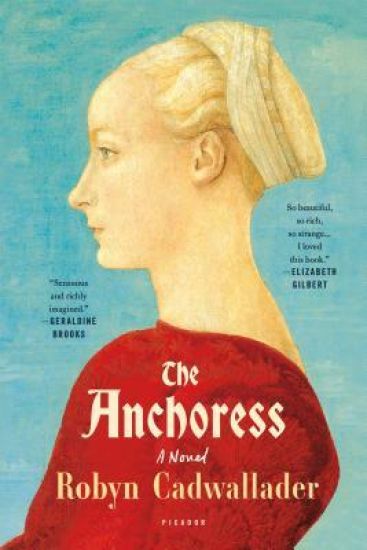
The Anchoress

The Anchoress

Robyn Cadwallader

Picador USA
2016
nidottu
"The book that the whole literary world can't stop talking about." --Marie Claire (Australia)"A considerable achievement." --Sarah Dunant, The New York Times Book Review England, 1255: Sarah is only seventeen when she chooses to become an anchoress, a holy woman shut away in a small cell, measuring seven by nine paces, at the side of the village church. Fleeing the grief of losing a much-loved sister as well as the pressure to marry, she decides to renounce the world--with all its dangers, desires, and temptations--and commit herself to a life of prayer. But when she starts hearing the voice of the previous anchoress whispering to her, seemingly from the stones themselves, it soon becomes clear that even the thick, unforgiving walls of Sarah's cell cannot protect her as well as she had thought. An absorbing story of faith, desire, shame, fear, and the human need for connection, The Anchoress by Robyn Cadwallader is a haunting and compelling novel: both quietly heartbreaking and thrillingly unpredictable.
You'll Leave This World With Your Butt Sewn Shut
Death - it’s a living! From the fascinating to the funny and even the oddly comforting, this book offers hundreds of facts to satisfy readers’ morbid curiosity about what happens after they die. This peek behind the curtain of the death-care industry answers all the questions you don’t know how to ask (and more a few you never thought to). We all end up on the mortician’s table eventually. With You’ll Leave This World with Your Butt Sewn Shut, at least you’ll know what to pack! Sample trivia: Medical implants (e.g. hip replacements) get upcycled into car parts and stop signs - We all die with our mouths open; they have to be wired shut - Morticians will bury your loved one in funny socks if you ask them to
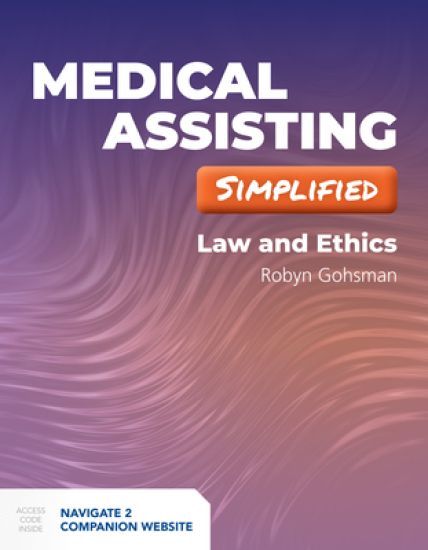
Medical Assisting Simplified: Law and Ethics

Medical Assisting Simplified: Law and Ethics

Robyn Gohsman

Jones and Bartlett Publishers, Inc
2020
nidottu
This new addition to the Medical Assisting Simplified series is the first law and ethics textbook tailored specifically to medical assisting students. A host character guides students through the material in an enjoyable, readable, and extremely practical manner that makes teaching and lea