Kirjojen hintavertailu. Mukana 12 016 292 kirjaa ja 12 kauppaa.

Kirjahaku

Etsi kirjoja tekijän nimen, kirjan nimen tai ISBN:n perusteella.

1000 tulosta hakusanalla Will Cook

Will Pope Francis or a Successor Call a Vatican III Council?

Will Pope Francis or a Successor Call a Vatican III Council?

John Raymaker; Gerald Grudzen

Hamilton Books
2020
nidottu
In 2008, the authors wrote Steps toward Vatican III which explored developments occurring in the Catholic Church including its teachings on social justice, interreligious dialogue, and Small Christian Communities. This update of Steps explores how Pope Francis has developed such themes in original ways in his encyclicals and in his use of synodal consultations. For example, in his Encyclical Laudato Si, the pope seeks to lead us into the mysteries of the universe, of creatures, and the harmony of creation. It helps us reflect on the universal communion of nature. Calling for a global ecological policy and a cooperative approach, the pope warns us that unless we respect nature, the entire planet and humanity will face drastic consequences. In his meetings with economists and entrepreneurs, the pope has proposed a pact for renewing the economy to counteract the asocial aspects of modern business practices. He has discussed some of the most complex problems in today's world--from safeguarding the environment to courageously committing oneself to rethink the economic paradigms of our time. Young people, in particular, have responded with enthusiasm to Pope Francis’ initiatives. The book notes how some "traditional" Catholics have opposed the pope, but it argues that, in fact, the pope is more traditional than his critics for he insists on going back to Jesus' own teachings. The new ongoing crises such as the breakdown and rise of new ideologies, terrorism, massive advances in the sciences and in technology, as well as fundamental shifts in gender relations are further factors considered in the book. Indeed, the world is now radically different from the world of the early 1960’s when Vatican II Council was held. Due to these many radical changes, the book suggests the need for a Vatican III which would consolidate the Church’s global outreach on every continent.
Will the Juvenile Court System Survive?
The year 1999 marks the 100th anniversary of the juvenile court. At the time of its creation, the juvenile court was heralded as one of the greatest advancements in the cause for children. While few will argue with the fact that the juvenile court has been a constructive force in promoting the welfare of children, the court has also been the subject of ongoing and increasingly sever criticism. The problems and abuses that plagued the juvenile court eventually reached the United States Supreme Court, whose decisions transformed the juvenile court from a social welfare institution into a court of law for young people.''Now, the juvenile court is faced with legislative policy changes resulting in a loss of jurisdiction over serious, chronic, and in particular, violent delinquent acts. The juvenile courtÆs centennial arrives at a time when the voices calling for its abolition are getting louder and gaining support.''Will the Juvenile Court System Survive?, a special issue of THE ANNALS, features articles written by some of the countryÆs leading juvenile justice policymakers, practitioners, researchers and child advocates. Articles in this issue cover a diverse range of topics:''''''· Young women and the juvenile justice system''· The role of the juvenile court in childrenÆs mental health''+ The future of youth corrections''+ Reassessing the need for a separate juvenile justice court''As the turn of the century approaches, scholars and practitioners are asking the questions of whether the juvenile court will survive. This special issue features valuable discussions and debates on all aspects of the juvenile court and its future in the United States.
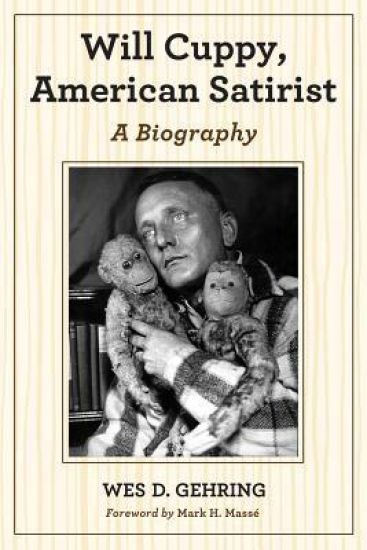
Will Cuppy, American Satirist

Will Cuppy, American Satirist

Wes D. Gehring

McFarland Co Inc
2013
pokkari
Back in the golden age of humor books (late 1920s-early 1950s), when wits of the pantheon like Robert Benchley, James Thurber, and S.J. Perelman were producing their signature works, there was another singular satirist who more than held his own with such fast company: Will Cuppy (1884-1949). This factual funnyman's metier is dark comedy that flirts with nihilism. His agenda is baldly stated in such classic Cuppy book titles as How to Be a Hermit (1929), How to Tell Your Friends from the Apes (1931), and The Decline and Fall of Practically Everybody (1950). This biography doubles as a critical study of a satirist whose shish-kebabing of humanity was often done through the veiled anthropomorphic use of animals. For a biographer, Will Cuppy represents a treasure trove of possibilities. He was a great humorist, and most of his best work is still in print, but until now he has never been the subject of a book-length study. His mesmerizingly complex and eccentric private life almost trumps the comic accomplishments of his public persona.
Will the Real Pakistani Woman Please Stand Up?
This series of absorbing case studies focuses on the portrayal of Pakistani women in the global media. Analyzing Hollywood films, British documentaries, newspapers and mainstream U.S. magazines, the book traces sensational female figures of Pakistan--all of whom have been subject to patriarchal violence--highlighting the imagery of exploitation and eroticism. The author addresses questions of spectatorship and fetishism in the age of globalization and the racial and imperial politics of liberal feminism.
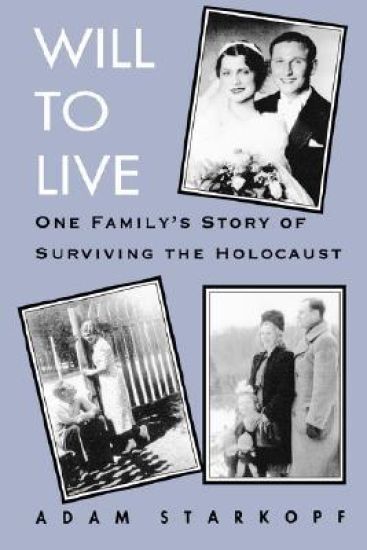
Will to Live

Will to Live

Adam Starkopf

State University of New York Press
1995
pokkari
Rhe story of a Jewish family's survival in Nazi-occupied Poland by assuming "Aryan" identities.This story of a Jewish family's survival in Nazi-occupied Poland by assuming "Aryan" identities shows the Starkopf family's courage and tremendous will to live. The book documents their journey from Warsaw to the immediate vicinity of one of the most frightful places on earth-the Treblinka death camp. The Starkopfs survive on false papers and false identities as they witness the tragedy of millions.
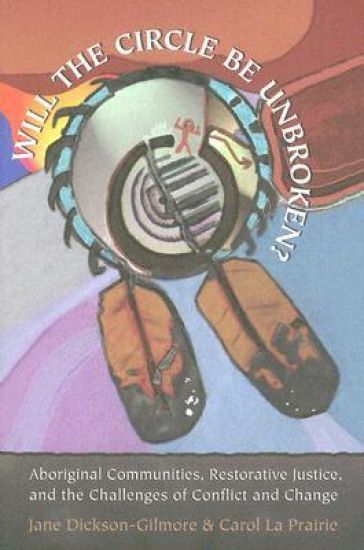
'Will the Circle Be Unbroken?'

'Will the Circle Be Unbroken?'

Jane Dickson-Gilmore; Carol La Prairie

University of Toronto Press
2005
pokkari
Embraced with zeal by a wide array of activists and policymakers, the restorative justice movement has made promises to reduce the disproportionate rates of Aboriginal involvement in crime and the criminal justice system and to offer a healing model suitable to Aboriginal communities. Such promises should be the focus of considerable critical analysis and evaluation, yet this kind of scrutiny has largely been absent. 'Will the Circle be Unbroken?' explores and confronts the potential and pitfalls of restorative justice, offering a much-needed critical perspective.Drawing on their shared experiences working with Aboriginal communities, Jane Dickson-Gilmore and Carol LaPrairie examine the outcomes of restorative justice projects, paying special attention to such prominent programs as conferencing, sentencing circles, and healing circles. They also look to Aboriginal justice reforms in other countries, comparing and contrasting Canadian reforms with the restorative efforts in New Zealand, Australia, and the United States.'Will the Circle be Unbroken?' provides a comprehensive overview of the critical issues in Aboriginal and restorative justice, placing these in the context of community. It examines the essential role of community in furthering both Aboriginal and non-Aboriginal aspirations for restorative justice.
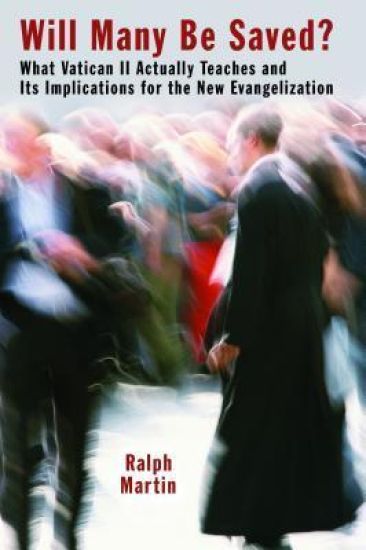
Will Many be Saved?

Will Many be Saved?

Dr Ralph Martin

William B Eerdmans Publishing Co
2012
nidottu
The question of whether and how people who have not had the chance to hear the gospel can be saved goes back to the beginnings of Christian reflection. It has also become a much-debated topic in current theology. In Will Many Be Saved? Ralph Martin focuses primarily on the history of debate and the development of responses to this question within the Roman Catholic Church, but much of Martin's discussion is also relevant to the wider debate happening in many churches around the world. In particular, Martin analyzes the Dogmatic Constitution on the Church, the document from the Second Vatican Council that directly relates to this question. Contrary to popular opinion, Martin argues that according to this text, the conditions under which people who have not heard the gospel can be saved are very often, in fact, not fulfilled, with strong implications for evangelization.
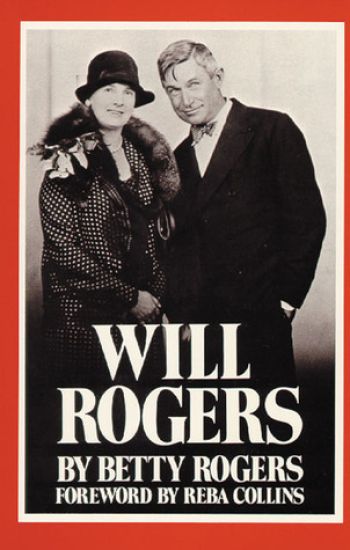
Will Rogers

Will Rogers

Betty Rogers

University of Oklahoma Press
1979
nidottu
Of the many books written about Will Rogers, none can have the immediacy, firsthand knowledge, and personal perspective of this account by his wife, Betty Blake Rogers. Her story is of Will Rogers, from wayward youth to international celebrity.Will was born in 1879 in the Cherokee nation of Indian Territory, near what is now Oologah, and died in 1935 with Wiley Post in an airplane crash in Alaska. The period witnessed the passing of the frontier and the arrival of the air age, and Will Rogers became a unique part and interpreter of it all.""The book offers a 'unique insight' into the Oklahoma cowboy who became a worldwide celebrity. Betty Rogers understood Will as no one else could, and her book amplifies the importance of a homegrown philosopher who captured the spirit of the American experience. Cowboy, showman, homespun pundit-Will left his mark in many ways, each of which is carefully developed in the book's twenty-two chapters. Most notable, however, is Mrs. Rogers's treatment of her husband's character. Behind the facade lay a complex man who, despite his lack of formal education, had a grasp of modern psychology and world politics. Equally at home with cowboys and presidents, Will accepted both as human beings engaged in the larger arena of life, whether in the wide open spaces of Oklahoma or the confines of Washington....For those who would know Will Rogers in a familiar way, there is no better book than this reprint."" Arizona and the West.""The best of all the books on the best of all the homespun philosophers as seen through the eyes of his wife."" Midwest Book Review.""Folksy, detailed and loving, it offers a timeless glimpse at a real American hero of his time-and ours."" American Way.
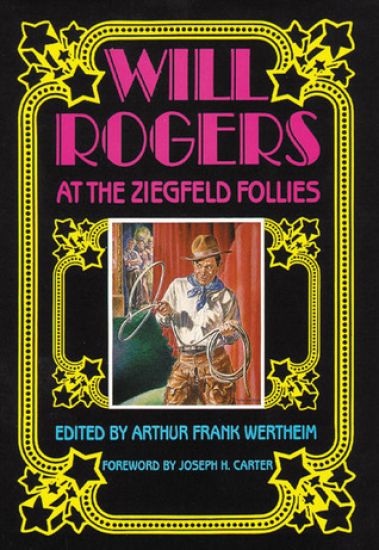
Will Rogers at the Ziegfeld Follies

Will Rogers at the Ziegfeld Follies

Arthur Frank Wertheim

University of Oklahoma Press
1992
sidottu
Will Rogers and Florenz Ziegfeld are two magic names in show business. Today Rogers is considered America's most beloved humorist, while Ziegfeld is recognized as the most flamboyant impresario in the history of the American musical theatre.Rogers was one of Ziegfeld's greatest comedy stars, performing in six editions of the Follies from 1916 to 1925. ""Ziggy gave me my start,"" he once said. It was on the Follies stage that he began to joke extensively about current events and to poke fun at celebrities.Will Rogers at the Ziegfeld Follies features the humorist's writings and poignant observations on society during World War I and the Roaring Twenties. Included in this unique collection are two of Rogers' most popular books, The Cowboy Philosopher on the Peace Conference and The Cowboy Philosopher on Prohibition. In selections from his weekly articles and The Illiterate Digest, Rogers lampoons the leading figures of the day, from Henry Ford and William Jennings Bryan to Presidents Wilson, Harding, and Coolidge.In these pages the reader will discover how the Follies brought national fame to Rogers and led him to new careers as a newspaper columnist, film star, radio performer, and popular speaker. His extraorginarily versatile talent is demonstrated by his first syndicated newspaper column, comic routines from his Victor phonograph recordings, a speech to the American Bankers' Association, and many other witty pieces that are still very relevant to our own time.Included here are Rogers writings that have never been published: selections from the entertainer's gag book, notes, and correspondence. In a fascinating exchange of telegrams and letters, the book brings to life the rare friendship between Rogers and Ziegfeld. It also spotlights Will's relationship with two other famous Ziegfeld comedians, Eddie Cantor and W.C. Fields.As the only book dealing with Will Rogers on the stage, this volume fills an important gap in the life story of the humorist. Will Rogers at the Ziegfeld Follies recreates an exciting era when audiences laughed at the homespun humor of this legendary national figure-one of the most popular and influential Americans of the twentieth century.
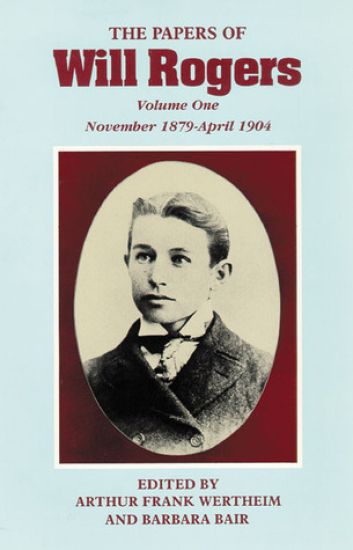
The Papers of Will Rogers

The Papers of Will Rogers

Will Rogers

University of Oklahoma Press
1996
sidottu
Horses, friends, ragtime music, and steer roping-those were the interests of the youthful Will Rogers as he came of age in the Indian Territory and traveled to the Southern Hemisphere in this first of six definitive volumes of The Papers of Will Rogers.By separating fact from legend and unveiling new knowledge via extensive archival research, this documentary history represents a unique contribution to Rogers scholarship and to studies of the Cherokee Nation West. Using many previously unpublished letters and photographs-together with introductions, notes, and biographies of his friends and relatives-volume one illuminates Rogers's complex relationship with his father, his Cherokee heritage, his early education, first encounters with his future wife, Betty Blake, his voyage to Argentina, and his fledging years in Wild West shows and circuses in South Africa, New Zealand, and Australia.Coorespondence, performance reviews, and rare newspaper documents spotlight the singular experiences that shaped the young Rogers within the context of his family, his ethnic background, and historical events. No other book describes so provocatively and authentically the genesis of America's most beloved and influential humorist.
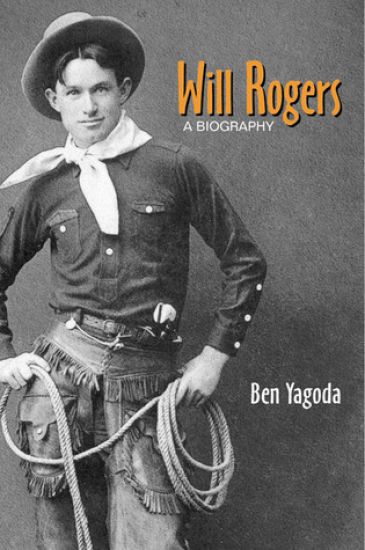
Will Rogers

Will Rogers

Ben Yagoda

University of Oklahoma Press
2000
nidottu
Will Rogers was a true American icon. His newspaper column was read daily by 40 million people, and as radio entertainer, lecturer, movies star, and homespun sage, he was one of our most popular entertainers.
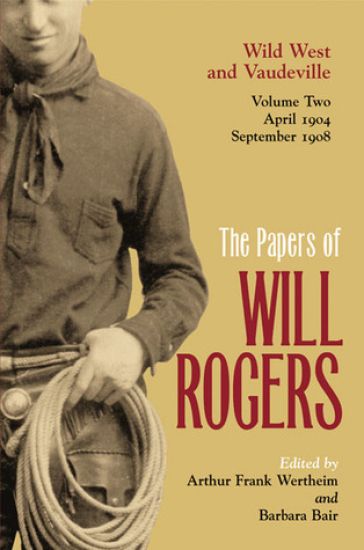
The Papers of Will Rogers

The Papers of Will Rogers

Will Rogers

University of Oklahoma Press
2000
sidottu
The stage career of Will Rogers, one of America's most influential humorists, began to take shape during the years covered by this documentary history, the second volume in The Papers of Will Rogers. Between 1904 and 1908, Rogers made the transition from Wild West shows to the vaudeville stage. During these early years, he developed and polished his act, blending his homespun humor with his cowboy skills of roping and horseback riding to the delight of his audience. At the same time he began courting Betty Blake, his future wife. Their on-again, off-again relationship matured as Rogers was realizing his goal of making a career in show business.Along with Rogers's personal correspondence, Arthur Frank Wertheim and Barbara Bair present theater programs, performance reviews, and newspaper clippings, all providing detailed snapshots of vaudeville at the beginning of the twentieth century. Much of this material, gleaned from private collections, interviews, and theater-arts collections in New York City and across the country, has never before been published in any form.
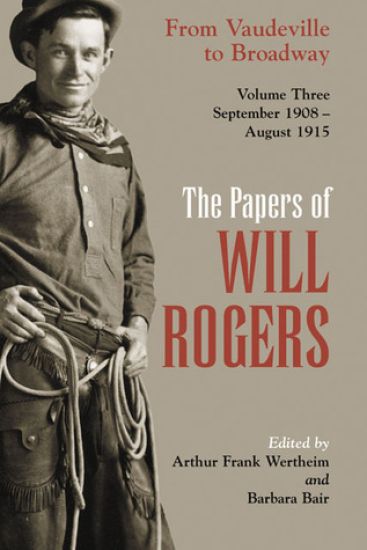
The Papers of Will Rogers

The Papers of Will Rogers

Will Rogers

University of Oklahoma Press
2001
sidottu
This third volume of The Papers of Will Rogers documents the evolution of Rogers's vaudeville career as well as the newlywed life of Will and Betty Blake Rogers and the birth of their children. During these years, the Rogerses moved to New York City, and after many years of performing with Buck McKee and horse Teddy, Rogers began a solo act in vaudeville as a talking, roping cowboy. He appeared on the same playbill with such performers as Fred Stone, Eddie Cantor, and Houdini, and his stage career expanded to include an appearance in the Broadway musical comedy ""The Wall Street Girl."" Volume Three ends with Rogers's successful transition from vaudeville to Broadway, on the brink of his breakthrough as a star of the Ziegfeld Follies.
The Papers of Will Rogers

The Papers of Will Rogers

Will Rogers

University of Oklahoma Press
2005
sidottu
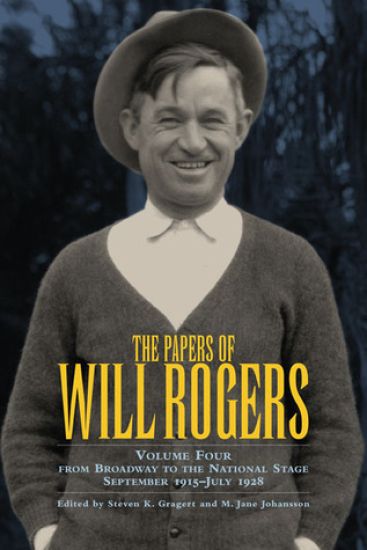
In the early years of his performing career, Will Rogers was a vaudeville performer of limited prominence. Around the age of thirty-five, however, this Oklahoma cowboy philosopher shed his role as local stage entertainer and moved toward fame as a Broadway star and nationally beloved humorist. This documentary history, volume four in the definitive five-volume Papers of Will Rogers, reveals Rogers's personal and professional transformation during what may have been the most productive period of his diverse career. Between 1915 and 1928 - the years covered by this volume - Rogers developed his unique monologues of topical humor, sampled the relatively new medium of radio, and pursued a career in silent films. He also tried his voice in sound recordings, witnessed his work as a writer reach millions of readers of daily newspapers, became one of the most sought-after speakers on the dinner circuit, and embarked on a three-year tour of the nation's lecture halls. In addition to Rogers's personal correspondence with family members and friends, editors Steven K. Gragert and M. Jane Johansson present more than one hundred letters and telegrams to and from people Rogers touched both inside and outside public life, including prominent figures in politics, show business, literature, industry, government, publishing, and the arts. Much of this material, gleaned from private collections, interviews, manuscripts, and sound recordings, has never before been published.