Kirjojen hintavertailu. Mukana 12 255 102 kirjaa ja 12 kauppaa.

Kirjahaku

Etsi kirjoja tekijän nimen, kirjan nimen tai ISBN:n perusteella.

1000 tulosta hakusanalla Adrian Mitchell

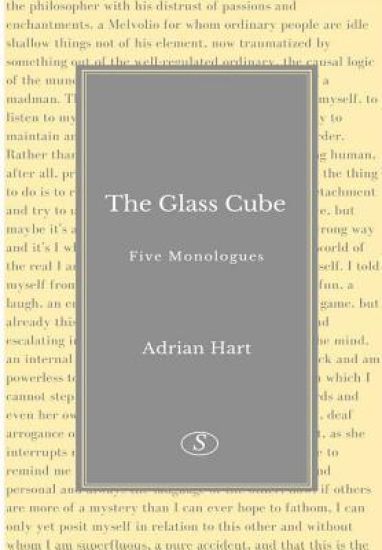
The Glass Cube

The Glass Cube

Adrian Hart

Lulu.com
2018
sidottu
These five monologues stage the narrator's unending, private engagement with the Other and the Self. In turns both comic and serious, fiction verges into philosophy and philosophy into fiction, order into disorder and disorder into order.
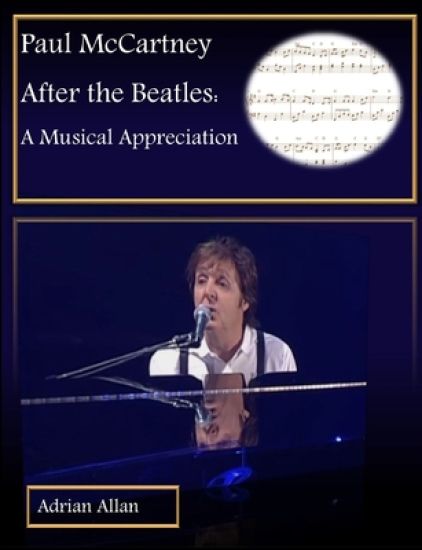
Paul McCartney After the Beatles: A Musical Appreciation
This is a musical analysis of Paul McCartney from 1970 to today. It is aimed at students of popular music theory; educators; musicians; and aspiring songwriters. It will also appeal to the general Beatles and McCartney fan who wishes to understand music on a deeper level - A beginner's guide to music theory and glossary are provided. Eighty of McCartney's post-Beatles songs are discussed in the format of short, but accessible essays. For each song, full details are provided concerning date of release; place of recording; instrumentation; and key signature. The description for each song details the musical techniques that McCartney uses, such as chord patterns; structure; use of instruments; vocal harmony; tonality; and key changes. In addition, every chapter details his life and work in each decade. A conclusion identifies the main characteristics of McCartney's style. The appendix details every recording location used. An invaluable guide to the music of the world's most successful songwriter.
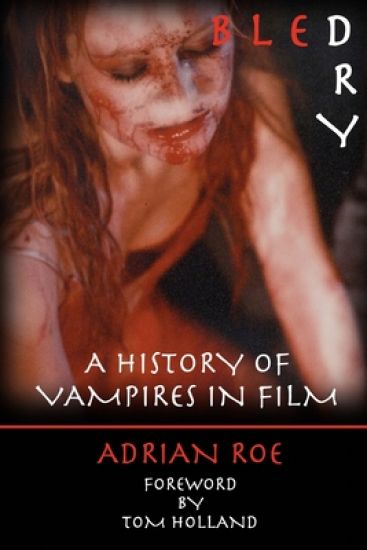
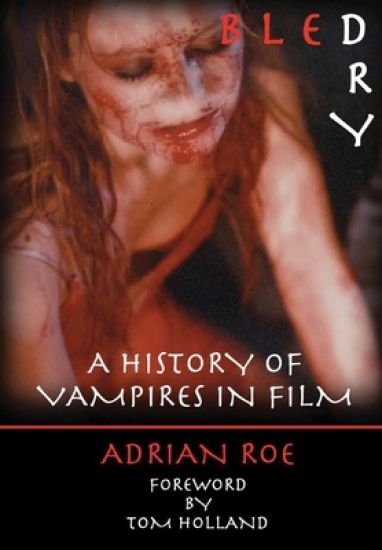
Bled Dry: A History Of Vampires In Film
Vampire films have not only enthralled and terrified audiences for decades, they also represent one of the oldest subgenres within the world of horror.A subgenre that exhibits a rich tapestry of depth and history like no other, and a creature that has managed to evolve and survive for over one hundred years on film. The vampire represents a primal fear within all of us, a fear that both captivates and terrifies. Sometimes flawed, these cursed immortals were once just like us, and this is perhaps the true appeal after so much time. The shapeshifter can enter the perceived safety of our existence through skilled manipulation and deceit, while offering the victim something they will find hard to resist and eventually succumb to.They are arguably the most skilled and intelligent of all horror villains, and it is of no surprise that they have managed to hold our attention for decades.
Bled Dry: A History Of Vampires In Film
Vampire films have not only enthralled and terrified audiences for decades, they also represent one of the oldest subgenres within the world of horror. A subgenre that exhibits a rich tapestry of depth and history like no other, and a creature that has managed to evolve and survive for over one hundred years on film. The vampire represents a primal fear within all of us, a fear that both captivates and terrifies. Sometimes flawed, these cursed immortals were once just like us, and this is perhaps the true appeal after so much time. The shapeshifter can enter the perceived safety of our existence through skilled manipulation and deceit, while offering the victim something they will find hard to resist and eventually succumb to. They are arguably the most skilled and intelligent of all horror villains, and it is of no surprise that they have managed to hold our attention for decades.
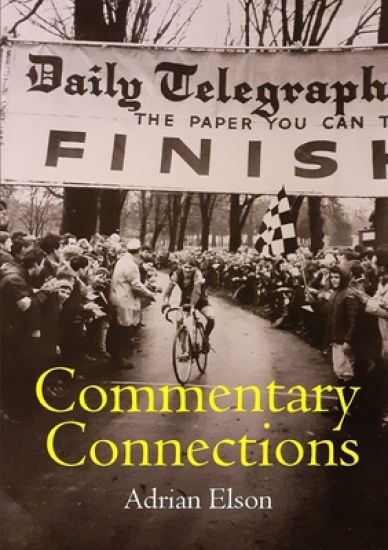
Commentary Connections

Commentary Connections

Adrian Elson

Lulu.com
2020
nidottu
Adrian Elson has been involved in the sport of Cyclo-Cross for over fifty years. During that time he's been a competitor; a commentator and he has also written about the discipline.In 'Commentary Connections' he profiles and interviews seven top riders - who have all had a unique impact on his life.Ranging from an innocent schoolboy crush, to a 'near' death experience, he also seeks to probe beneath the surface of each of his subjects as they discuss their careers in their own words. It includes perhaps the greatest amount of text ever dedicated to the great John Atkins.Finally, having been a commentator for nearly ten years, he writes about a debut that involved 'Roger Hammond,' a tv appearance and his very first National Championships.All the proceeds of the book will go to 'CRY' in memory of Charlie Craig.
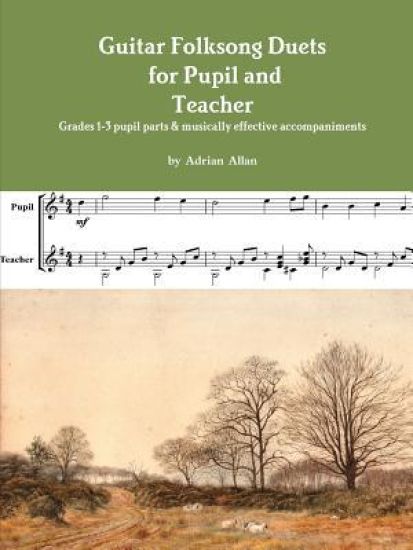
Guitar Folksong Duets for Pupil and Teacher
A collection of 19 folksong duets for teacher and pupil. The pupil parts are early grade and in the first positions. The teacher parts are musically effective and interesting to play. Includes: Danny Boy, Down by the Sally Gardens, Ye Banks and Braes, The Lincolnshire Poacher, Bonny Mary of Argyle, Cockles and Mussels, An Eriskay Love Lilt, The Bluebells of Scotland, Men of Harlech, My Love is like a Red, Red Rose, On the Banks of Cairnie Burn, The Oak and the Ash, Allan Water, The Boar's Head Carol, Land of My Fathers, Drink to Me Only, The Leaving of Liverpool, Henry Martin, Annie Laurie.
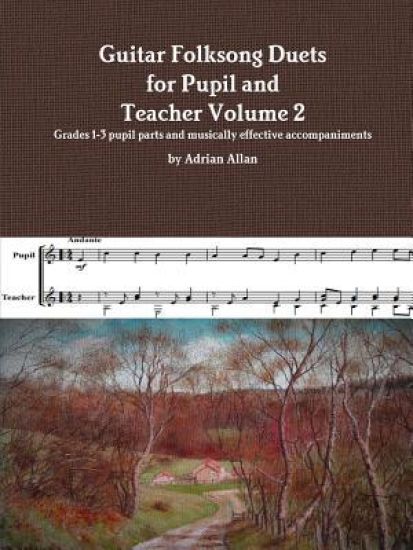
Guitar Folksong Duets for Pupil and Teacher Volume 2
A second selection of guitar duets for pupil and teacher. The pupil parts are all in the low positions, and are grade 1-3. The teacher parts are musically interesting. Included in this volume: A Basque Lullaby; Beyond the Mountains; Early One Morning; Fishermen's Evening Song; Geordie; Golden Fish Swimming In the Lake; Goodnight; I Know Where I'm Going; I'm Seventeen Come Sunday; I Would Soothe You; Poor Old Horse; Robin Redbreast; Megan's Fair Daughter; O Vermeland; Santa Lucia; Shoes of Shining Leather; Shule Aroon; The Old Home; There Came a Little Stranger; The Lorelei; The Life That's Free; The Minstrel Boy; Will Ye Go, Lassie; Will Ye No' Come Back Again; Where the Gentian Blows
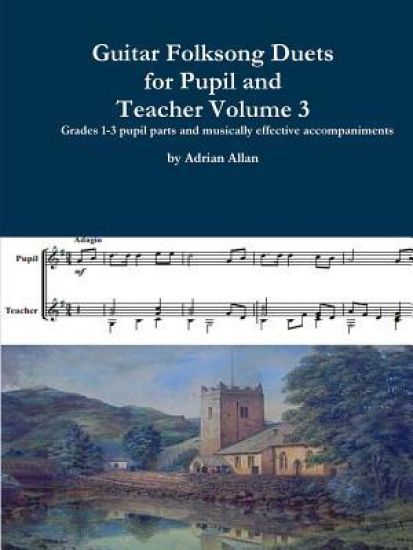
Guitar Folksong Duets for Pupil and Teacher Volume 3
A third collection of duets for pupil and teacher. Songs have been chosen from around the world. Included in this volume: Blow Away The Morning Dew; Blow The Wind Southerly; Carol; Go To Sleep; Grass So Green; If You Want To Write To Me; Kaiyeu Nanu; Kum By Ya; Kum Bachur Atzel; Look Mr Cuckoo; Mwana Wange; Mother Volga; Old Dan Tucker; Sakura; Suliram; The Colorado Trail; The Four Marys; The Maid Of Leko; The Mountains Of Mourne; The Old Soldier; The Seeds Of Love; The Trees They Do Grow High; When Johnny Comes Marching Home; Whistle, Daughter, Whistle, Wondrous Love.
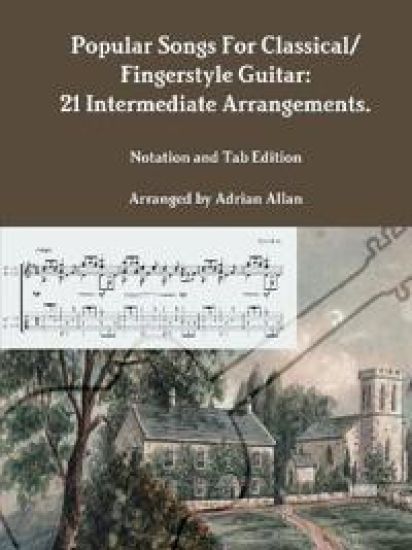
Popular Songs For Classical/ Fingerstyle Guitar
A collection of 21 intermediate arrangements for the classical or fingerstyle guitar in notation and tablature. The pieces are from the categories of Stephen Foster Songs; Folk Songs; Parlour Songs and arrangements of classical themes. The pieces included are My Old Kentucky Home; Beautiful Dreamer; Jeanie With The Light Brown Hair; Hard Times Come Again No More; Gentle Annie; Allan Water; The Lark In The Clear Air; David Of The White Rock; Believe Me, If All Those Endearing Young Charms; The Skye Boat Song; Annie Laurie; Deep River; At Dawning; I Love You Truly; Kiss Me Again; My Wild Irish Rose; Love's Old Sweet Song; Chanson De Matin; I Vow To Thee My Country (Jupiter/ The Planets); Waltz From Coppelia; Waltz From Swan Lake. Notes about all of the songs are included in a detailed introduction.
Claiming Sacred Ground

Claiming Sacred Ground

Adrian J. Ivakhiv

Indiana University Press
2001
sidottu
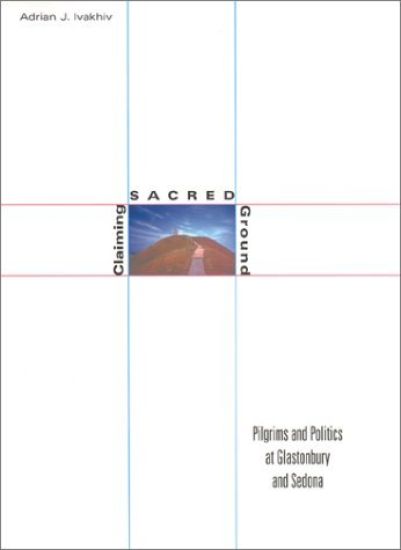
Claiming Sacred Ground Pilgrims and Politics at Glastonbury and Sedona Adrian J. Ivakhiv A study of people and politics at two New Age spiritual sites. In this richly textured account, Adrian Ivakhiv focuses on the activities of pilgrim-migrants to Glastonbury, England and Sedona, Arizona. He discusses their efforts to encounter and experience the spirit or energy of the land and to mark out its significance by investing it with sacred meanings. Their endeavors are presented against a broad canvas of cultural and environmental struggles associated with the incorporation of such geographically marginal places into an expanding global cultural economy. Ivakhiv sees these contested and "heterotopic" landscapes as the nexus of a complex web of interestes and longings: from millennial anxieties and nostalgic re-imaginings of history and prehistory; to real-estate power grabs; contending religious visions; and the free play of ideas from science, pseudo-science, and popular culture. Looming over all this is the nonhuman life of these landscapes, an"otherness" that alternately reveals and conceals itself behind a pagenant of beliefs, images, and place-myths. A significant contribution to scholarship on alternative spirituality, sacred space, and the politics of natural landscapes, Claiming Sacred Ground will interest scholars and students of environmental and cultural studies, and the sociology of religious movements and pilgrimage. Non-specialist readers will be stimulated by the cultural, ecological, and spiritual dimensions of extraordinary natural landscapes. Adrian Ivakhiv teaches in the Faculty of Environmental Studies at York University in Toronto, and is President of the Environmental Studies Association of Canada. April 2001 384 pages, 24 b&w photos, 2 figs., 9 maps, 6 1/8 x 9 1/4, index, append. cloth 0-253-33899-9$37.40 s / £28.50 Contents IDEPARTURES 1Power and Desire in Earth's Tangled Web 2Reimagining Earth 3Orchestrating Sacred Space IIGlastonbury 4Stage, Props, and Players of Avalon 5Many Glastonburys: Place-Myths and Contested Spaces IIISEDONA 6Red Rocks to Real Estate 7New Agers, Vortexes, and the Sacred Landscape IVARRIVALS 8Practices of Place: Nature and Heterotopia Beyond the New Age
The Debate on Higher Education

The Debate on Higher Education

Adrian Seville; James Tooly; James Tooley

Institute of Economic Affairs
1997
nidottu
With higher education in the UK at a critical juncture in its history, two leading commentators offer new perspectives on the fundamentals of this on-going debate. Seville examines the implications of 'modularity' , while Tooley presents a comprehensive critique of government intervention in the university system, questioning whether the state has to be involved at all.
Rock, Bone, and Ruin

Rock, Bone, and Ruin

Adrian Currie

MIT Press
2018
sidottu
An argument that we should be optimistic about the capacity of "methodologically omnivorous" geologists, paleontologists, and archaeologists to uncover truths about the deep past.The "historical sciences"-geology, paleontology, and archaeology-have made extraordinary progress in advancing our understanding of the deep past. How has this been possible, given that the evidence they have to work with offers mere traces of the past? In Rock, Bone, and Ruin, Adrian Currie explains that these scientists are "methodological omnivores," with a variety of strategies and techniques at their disposal, and that this gives us every reason to be optimistic about their capacity to uncover truths about prehistory. Creative and opportunistic paleontologists, for example, discovered and described a new species of prehistoric duck-billed platypus from a single fossilized tooth. Examining the complex reasoning processes of historical science, Currie also considers philosophical and scientific reflection on the relationship between past and present, the nature of evidence, contingency, and scientific progress.Currie draws on varied examples from across the historical sciences, from Mayan ritual sacrifice to giant Mesozoic fleas to Mars's mysterious watery past, to develop an account of the nature of, and resources available to, historical science. He presents two major case studies: the emerging explanation of sauropod size, and the "snowball earth" hypothesis that accounts for signs of glaciation in Neoproterozoic tropics. He develops the Ripple Model of Evidence to analyze "unlucky circumstances" in scientific investigation; examines and refutes arguments for pessimism about the capacity of the historical sciences, defending the role of analogy and arguing that simulations have an experiment-like function. Currie argues for a creative, open-ended approach, "empirically grounded" speculation.
Linguistics

Linguistics

Adrian Akmajian; Ann K. Farmer; Lee Bickmore; Richard A. Demers; Robert M. Harnish

MIT Press
2017
pokkari
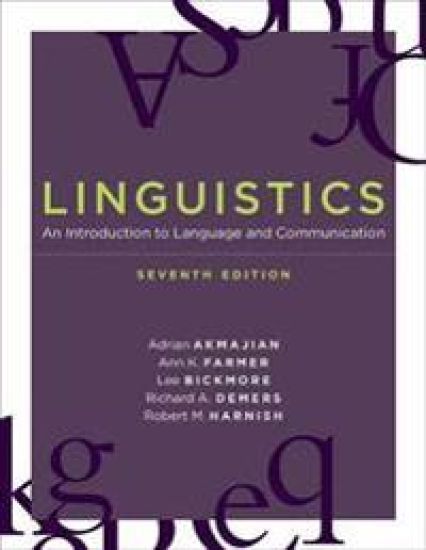
The latest edition of a popular introductory linguistics text, now including a section on computational linguistics, new non-English examples, quizzes for each chapter, and additional special topics.This popular introductory linguistics text is unique for its integration of themes. Rather than treat morphology, phonetics, phonology, syntax, and semantics as completely separate fields, the book shows how they interact. The authors provide a sound introduction to linguistic methodology, focusing on a set of linguistic concepts that are among the most fundamental within the field. By studying the topics in detail, students can get a feeling for how work in different areas of linguistics is done.As in the last edition, part I covers the structural and interpretive parts of language-morphology, phonetics, phonology, syntax, semantics, variation, and change. Part II covers use and context of language and includes chapters on pragmatics, psychology of language, language acquisition, and language and the brain. This seventh edition has been extensively revised and updated; new material includes a chapter on computational linguistics (available in digital form and updated regularly to reflect the latest research in a rapidly developing field), more non-English examples, and a wide range of exercises, quizzes, and special topics. The seventh edition of Linguistics includes access to a new, web-based eCourse and enhanced eTextbook. The content from the former print supplement A Linguistics Workbook is now available in this online eCourse as interactive exercises. The eCourse is available via the Rent eTextbook link at http://mitpress.mit.edu/linguistics7, and may be used on its own for self-study or integrated with instructor-led learning management systems.The eCourse is a comprehensive, web-based eLearning solution. There is nothing to download or install; it is accessible through any modern web browser and most mobile devices. It features a singular new tool for building syntax trees, an IPA keyboard, a combination of auto-graded and essay questions, and classroom management tools. The enhanced eTextbook includes videos and flashcards and allows bookmarking, note-taking, highlighting, and annotation sharing.Access to the eCourse is free with the purchase of a new textbook or e-book. New print copies of this book include a card affixed to the inside back cover with a unique access code for the eTextbook. If you purchased an e-book, you may obtain a unique access code by emailing [email protected] or calling 617-253-2889 or 800-207-8354 (toll-free in the U.S. and Canada). If you have a used copy of this book, you may purchase a digitally delivered access code separately via the Rent eTextbook link at http://mitpress.mit.edu/linguistics7.
Machine Learners

Machine Learners

Adrian Mackenzie

MIT Press
2017
pokkari
If machine learning transforms the nature of knowledge, does it also transform the practice of critical thought?Machine learning-programming computers to learn from data-has spread across scientific disciplines, media, entertainment, and government. Medical research, autonomous vehicles, credit transaction processing, computer gaming, recommendation systems, finance, surveillance, and robotics use machine learning. Machine learning devices (sometimes understood as scientific models, sometimes as operational algorithms) anchor the field of data science. They have also become mundane mechanisms deeply embedded in a variety of systems and gadgets. In contexts from the everyday to the esoteric, machine learning is said to transform the nature of knowledge. In this book, Adrian Mackenzie investigates whether machine learning also transforms the practice of critical thinking.Mackenzie focuses on machine learners-either humans and machines or human-machine relations-situated among settings, data, and devices. The settings range from fMRI to Facebook; the data anything from cat images to DNA sequences; the devices include neural networks, support vector machines, and decision trees. He examines specific learning algorithms-writing code and writing about code-and develops an archaeology of operations that, following Foucault, views machine learning as a form of knowledge production and a strategy of power. Exploring layers of abstraction, data infrastructures, coding practices, diagrams, mathematical formalisms, and the social organization of machine learning, Mackenzie traces the mostly invisible architecture of one of the central zones of contemporary technological cultures.Mackenzie's account of machine learning locates places in which a sense of agency can take root. His archaeology of the operational formation of machine learning does not unearth the footprint of a strategic monolith but reveals the local tributaries of force that feed into the generalization and plurality of the field.
A New History of the Future in 100 Objects
Imagining the history of the twenty-first century through its artifacts, from silent messaging systems to artificial worlds on asteroids.In the year 2082, a curator looks back at the twenty-first century, offering a history of the era through a series of objects and artifacts. He reminisces about the power of connectivity, which was reinforced by such technologies as silent messaging—wearable computers that relay subvocal communication; recalls the Fourth Great Awakening, when a regimen of pills could make someone virtuous; and notes disapprovingly the use of locked interrogation, which delivers “enhanced interrogation” simulations via virtual reality. The unnamed curator quotes from a self-help guide to making friends with “posthumans,” describes the establishment of artificial worlds on asteroids, and recounts pro-democracy movements in epistocratic states. In A New History of the Future in 100 Objects, Adrian Hon constructs a possible future by imagining the things it might leave in its wake.Many of these things are just an update or two away: improved ankle monitors, for example, and deliverbots. Others may be the logical conclusions of current trends—“downvote” networks that identify and erase undesirables, and Glyphish, an emoticon-based language that supersedes the written word. More benign are Braid Collective, which provides financial support for artists, and Rechartered Cities, which invites immigrants to revitalize urban areas hollowed out by changing demographics. With this engaging and ingenious work, Hon leads the way into an imagined future while offering readers a new perspective on the present.
Rock, Bone, and Ruin

Rock, Bone, and Ruin

Adrian Currie

MIT PRESS LTD
2024
pokkari
An argument that we should be optimistic about the capacity of "methodologically omnivorous" geologists, paleontologists, and archaeologists to uncover truths about the deep past. The "historical sciences"--geology, paleontology, and archaeology--have made extraordinary progress in advancing our understanding of the deep past. How has this been possible, given that the evidence they have to work with offers mere traces of the past? In Rock, Bone, and Ruin, Adrian Currie explains that these scientists are "methodological omnivores," with a variety of strategies and techniques at their disposal, and that this gives us every reason to be optimistic about their capacity to uncover truths about prehistory. Creative and opportunistic paleontologists, for example, discovered and described a new species of prehistoric duck-billed platypus from a single fossilized tooth. Examining the complex reasoning processes of historical science, Currie also considers philosophical and scientific reflection on the relationship between past and present, the nature of evidence, contingency, and scientific progress.Currie draws on varied examples from across the historical sciences, from Mayan ritual sacrifice to giant Mesozoic fleas to Mars's mysterious watery past, to develop an account of the nature of, and resources available to, historical science. He presents two major case studies: the emerging explanation of sauropod size, and the "snowball earth" hypothesis that accounts for signs of glaciation in Neoproterozoic tropics. He develops the Ripple Model of Evidence to analyze "unlucky circumstances" in scientific investigation; examines and refutes arguments for pessimism about the capacity of the historical sciences, defending the role of analogy and arguing that simulations have an experiment-like function. Currie argues for a creative, open-ended approach, "empirically grounded" speculation.
Food System Intermediaries

Food System Intermediaries

Adrian Hearn

MIT PRESS LTD
2025
nidottu
A cutting-edge analysis of food systems sustainability, including COVID's impact on current food systems, in up-to-date case studies of community farms in Australia, Brazil, Cuba, and China. What does expanding agribusiness--and community resistance to it--reveal about the influence of global trends on local livelihoods, and conversely, the influence of food traditions on international networks? In Food System Intermediaries, anthropologist Adrian Hearn examines how small farmers and their allies are defending their lands and livelihoods from expanding commodity plantations. At the heart of these encounters are food system intermediaries: people who carefully articulate food traditions to forge consensus among otherwise disconnected community producers, local governments, and urban customers. Their efforts to bring these groups together must contend with alternative portrayals of food circulated by more powerful corporate and government actors. The book offers case studies of urban farms in Melbourne, S o Paulo, Rio de Janeiro, Beijing, and Havana to demonstrate how intermediaries are building alliances to cultivate more sustainable food systems, particularly as China's impact on global agriculture deepens.