Kirjahaku
Etsi kirjoja tekijän nimen, kirjan nimen tai ISBN:n perusteella.
1000 tulosta hakusanalla Allan Sinclair
Strength of Beams Under Transverse Loads. by Prof. W. Allan ...
William Allan
University of Michigan Library
2006
pokkari
![The Poetical Works of Edgar Allan Poe, With original Memoir. Illustrated by F. R. Pickersgill, R.A., John Tenniel, Birket Foster, Felix Darlay [And Others]](/covers/9781425533175.jpg)
The Poetical Works of Edgar Allan Poe, With original Memoir. Illustrated by F. R. Pickersgill, R.A., John Tenniel, Birket Foster, Felix Darlay [And Others]
Edgar Allan Poe
University of Michigan Library
2006
pokkari
This book, "Edgar Allan Poe", by Edmund Clarence Stedman, is a replication of a book originally published before 1916. It has been restored by human beings, page by page, so that you may enjoy it in a form as close to the original as possible. This book was created using print-on-demand technology. Thank you for supporting classic literature.


Edgar Allan Poe: Amateur Psychologist is the "first and foremost" major source of information dedicated to the theme of Poe and psychopathology. Its introduction, conclusion, chapters, and appendices highlight and employ the best insights from earlier and current scholars, but this text goes beyond them in its analysis of Poe’s relation to mainstream psychology and its rival system, phrenology. His knowledge of this subject matter is far broader and deeper than Poe specialists have hitherto supposed; his method—contrary to the "Poe myth" according to which an alcoholic, drug-addicted, tormented artist wrote to exorcise his own pathologies—was to research mental illnesses for the sake of scientific precision and verisimilitude. We also come to appreciate the interrelatedness of the psychopathologies he illustrates and other "knowledge frames," characteristic themes, featured in his tales, such as the occult, symbology, chromatography, the "cult of sensibility," Neoplatonism, and Transcendentalist epistemology. While locating Poe firmly within the science and pseudoscience of his time, Edgar Allan Poe: Amateur Psychologist simultaneously looks back from the 1830s and 40s (when Poe’s literary career was at its height) to theories and possible sources of information from the late eighteenth century, as well as forward to the twentieth and twenty-first centuries to demonstrate how Poe’s theories of mind, and his depiction of psychological illnesses, occasionally anticipate modern insights and therapies. The book will be of interest not only to Poe scholars but also to students, teachers, and any intelligent reader interested in psychology, psychotherapy, and the history of ideas.
Edgar Allan Poe as Amateur Psychologist
PETER LANG PUBLISHING INC
2021
sidottu
Locating Poe firmly within his Zeitgeist vis-à-vis the science and pseudoscience of the early nineteenth century, Edgar Allan Poe as Amateur Psychologist: A Companion Anthology simultaneously looks back from the 1830s and 1840s (when his literary career was at its height) to eighteenth-century theories and sources of information on mental illness, as well as forward to our own time to demonstrate how Poe’s dramatizations of psychological diseases occasionally anticipate modern nosological classifications and twenty-first-century forensic research. This interdisciplinary collection is a companion to its predecessor, Zimmerman’s Edgar Allan Poe: Amateur Psychologist (Peter Lang, 2019); it gathers the most important essays by authors—Hungerford, Stauffer, Stern, Bynum, Cleman, Hester and Segir, Phillips, Shackelford, Scheckel, Lloyd-Smith, Whipple, Butler, Uba, Walker, Zimmerman—who employ historicist and history-of-ideas methodologies. Topics include Poe’s use of and eventual disillusionment with phrenology; his attitude toward the controversial “moral treatment” of the insane as well as the “insanity defense” and its connection with the new theory of “moral insanity”; the possible sources of his knowledge of theories of mind, psychopathology and related therapies; his evolution as an amateur psychologist; the connection between physiological sickness and mental distress (the psychosomatic); and the ways in which the psychological profiles of his homicidal characters look forward to modern serial killers. This companion anthology represents a significant addition to Poe scholarship and will be of interest not only to Poe specialists but also to students, teachers, and any intelligent reader interested in the history of ideas and the intersection between literature and “mental philosophy.”
Weird Tales 354 (Special Edgar Allan Poe Issue)
Edgar Allan Poe; Richard Howard
Wildside Press
2017
pokkari
The life of American writer Edgar Allan Poe was characterized by a dramatic series of successes and failures, breakdowns and recoveries, personal gains and hopes dashed through, despite which he created some of the finest literature the world has ever known. Over time his works have influenced such major creative forces as the French poets Charles
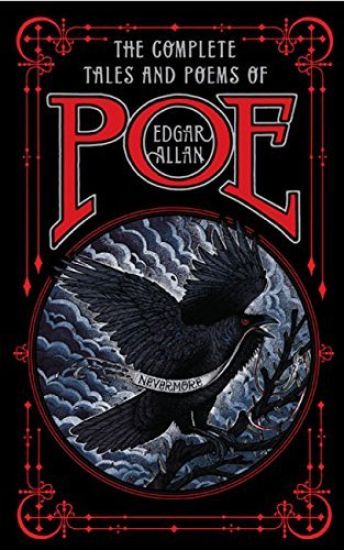
Complete Tales and Poems of Edgar Allan Poe (BarnesNoble Collectible Editions)
Edgar Allan Poe
Barnes Noble
2015
sidottu
Edgar Allan Poe is credited with having pioneered the short story, having perfected the tale of psychological horror, and having revolutionised modern poetics. The Complete Tales and Poems of Edgar is part of BarnesNoble's Leatherbound Classics. This omnibus edition collects all of Poe's fiction and poetry in a single volume.
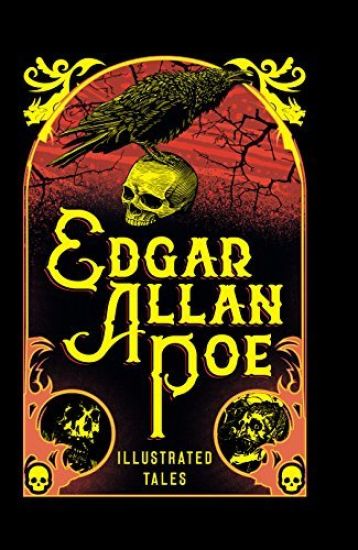
Sprung from the shadowed recesses of Edgar Allan Poe’s imagination, these nineteen tales of mystery and the macabre testify to the brilliance of their author’s dark genius. Included are such enduring classics as "The Tell-Tale Heart," "The Fall; of the House of Usher," "The Black Cat," "The Masque of the Red Death," and "The Cask of Amontillado." Each story is colorfully illustrated by the classic artwork of Harry Clarke, in whom Poe found one of his most sensitive and sympathetic interpreters.
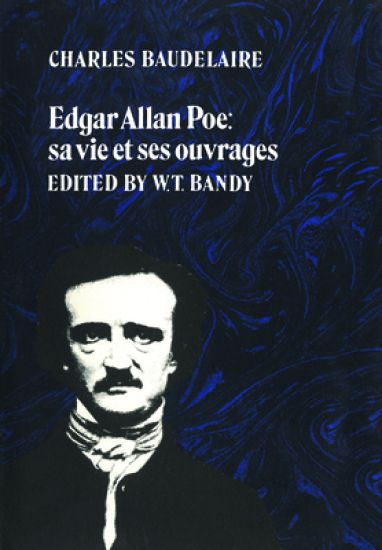
The earliest foreign study of the life and works of Edgar Allan Poe, the text presented in this volume is something of a landmark in the history of comparative literature. Baudelaire’s first and longest essay on Poe was published in the Revue de Paris is 1852; it was revised and abridged for use as the preface of the first volume of his translation of Poe’s tales, Histoires extraordinaires. This study was significant especially in the area of Franco-American literary relations because it was the basis of not only the French attitude toward Poe, but of his reputation throughout Europe-one might almost say, throughout the world. The essay on Poe has never been the subject of a separate publication. This edition reveals for the first time the sources of information used by Baudelaire. It shows that a considerable part of the study was translated literally from articles by John M. Daniel and John R. Thompson in the Southern Literary Messenger (1849–50). Previous editions vary widely in excellence because almost all suffered from the mistaken belief that Baudelaire was acquainted with the American edition of Poe’s works when he wrote the 1852 essay and that it was largely based on Rufus Griswold’s Memoir contained in that edition. This led to the commentary and notes that were unconsciously misleading and in many cases false. The introduction to this edition presents a complete and accurate account of the genesis of Baudelaire’s essay, with supporting documents showing his indebtedness to American, French, and British sources. It enables the reader to distinguish clearly between what Baudelaire himself knew or thought about Poe and what he borrowed from other writers.