Kirjojen hintavertailu. Mukana 12 250 753 kirjaa ja 12 kauppaa.

Kirjahaku

Etsi kirjoja tekijän nimen, kirjan nimen tai ISBN:n perusteella.

1000 tulosta hakusanalla David J. Fitzpatrick

Educating Citizens

Educating Citizens

David J. Ferrero; Charles Venegoni

Brookings Institution
2004
nidottu
"The United States is in the midst of historic experiments with publicly funded choice in K-12 education, experiments that recently received a ""green light"" from the Supreme Court. Other nations have long experience with the funding and regulation of nonpublic schools, including religious schools. This book asks what U.S. policymakers, public officials, and citizens can learn from these experiences. In particular, how do other countries regulate or structure publicly funded educational choice with an eye toward civic values—looking not only for improvements in test scores, but also in tolerance, civic cohesion, and democratic values such as integration across the lines of class, religion, and race?The experience of Europe and Canada with school choice is both extensive and varied. In England and Wales, public school choice is widespread, as parents play a significant role in selecting the school their children will attend. In the Netherlands and much of Belgium, a majority of students attend religious schools at government expense. In Canada, France, and Germany, state-financed school choice is limited to circumstances that serve particular social and governmental needs. In Italy, school choice has just recently arrived on the policy agenda. In spite of the diversity of national experiences, in all of these countries choice is regulated by the government in significant and varied ways to promote civic values. In several of these countries, school choice policy itself appears to have played an important role in promoting social cohesion and integration. This book presents a wealth of experience designed to aid policymakers and citizens as they consider historic changes in American public education policy."
John Dryden

John Dryden

David J. Latt; Samuel Holt Monk

University of Minnesota Press
1976
nidottu
John Dryden was first published in 1976. Minnesota Archive Editions uses digital technology to make long-unavailable books once again accessible, and are published unaltered from the original University of Minnesota Press editions.This annotated bibliography represents a comprehensive updating of Samuel Holt Monk's earlier work, also published by the University of Minnesota Press, John Dryden: A List of Critical Studies Published from 1895 to 1948 (out of print). Since the publication of that earlier bibliography, the number of studies devoted to Dryden has more than tripled, and thus this new bibliography is essential for scholars of Dryden or related aspects of seventeenth- and eighteenth-century English literature. This volume contains four times as many entries as the earlier volume, and there is an extensive introduction by Professor Latt which surveys the historical shifts in critical opinion of Dryden. The new volume incorporates all of the listings contained in the first one.The entries include works that focus directly on Dryden, those that discuss Dryden's works in the context of other writers, and those that investigate material of general importance to Dryden studies. Dissertations from American, German, English, and French universities are included.Complete bibliographic information is provided for virtually every entry. The listings are grouped in nine categories, and there is an additional section which covers festschriften and other collections of essays. Works of exceptional value and those which develop new points of view are so designated. The publishing history of each item is included along with the standard bibliographic information. The index includes topical as well as author entries.
Triangulations

Triangulations

David J. Vázquez

University of Minnesota Press
2011
nidottu
Just as mariners use triangulation, mapping an imaginary triangle between two known positions and an unknown location, so, David J. VÁzquez contends, Latino authors in late twentieth-century America employ the coordinates of familiar ideas of self to find their way to new, complex identities. Through this metaphor, VÁzquez reveals how Latino autobiographical texts, written after the rise of cultural nationalism in the 1960s, challenge mainstream notions of individual identity and national belonging in the United States.In a traditional autobiographical work, the protagonist frequently opts out of his or her community. In the works that VÁzquez analyzes in Triangulations, protagonists instead opt in to collective groups-often for the express political purpose of redefining that collective. Reading texts by authors such as Ernesto Galarza, JesÚs ColÓn, Piri Thomas, Oscar “Zeta” Acosta, Judith Ortiz Cofer, John Rechy, Julia Alvarez, and Sandra Cisneros, VÁzquez engages debates about the relationship between literature and social movements, the role of cultural nationalism in projects for social justice, the gender and sexual problematics of 1960s cultural nationalist groups, the possibilities for interethnic coalitions, and the interpretation of autobiography. In the process, Triangulations considers the potential for cultural nationalism as a productive force for aggrieved communities of color in their struggles for equality.
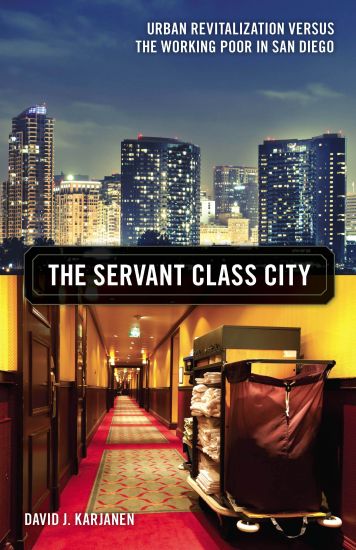
The Servant Class City

The Servant Class City

David J. Karjanen

University of Minnesota Press
2016
nidottu
San Diego, California, is frequently viewed as a model for American urban revitalization. It looks like a success story, with blight and poverty replaced by high-rises and jobs. But David J. Karjanen shows that the much-touted job opportunities for poor people have been concentrated in low-paying service work as the cost of living in San Diego has soared. The Servant Class City documents how, over a period of three decades, San Diegos urban transformation actually eroded the economic standing of the citys working poor. Karjanen demonstrates that urban policy in San Diego, which has been devoted to increasing tourism, has fostered the creation of jobs that do not actually provide either livable wages or paths to upward mobility. Marshaling a wealth of heretofore uncollected data, he challenges the presumption that decades-long stagnation of job mobility in the united states is a result of insufficient worker training or a skills mismatch,or is attributable to various personal qualities of the urban poor. Karjanen interweaves profiles of people with a compelling presentation of data. Each chapter addresses a significant topic: hospitality industry jobs, retail work, informal employment, fringe banking,and economic barriers to mobility. In revealing the true story of the poverty trapsthat are associated with low-wage jobs in the service economy, The Servant Class City complicates the rosy picture of life in an American tourist boomtown.
Concentration Fluctuations and Averaging Time in Vapor Clouds

Concentration Fluctuations and Averaging Time in Vapor Clouds

David J. Wilson

American Institute of Chemical Engineers
1995
sidottu
This book contributes to more reliable and realistic predictions by focusing on sampling times from a few seconds to a few hours. Its objectives include developing clear definitions of statistical terms, such as plume sampling time, concentration averaging time, receptor exposure time, and other terms often confused with each other or incorrectly specified in hazard assessments; identifying and quantifying situations for which there is no adequate knowledge to predict concentration fluctuations in the near-field, close to sources, and far downwind where dispersion is dominated by atmospheric turbulence; identifying areas where further information is required to define concentration variability statistics; and formulating an operation model for concentration fluctuations based on the current state of knowledge of dispersion processes.
King

King

David J. Hally

The University of Alabama Press
2008
muu
At the time of Spanish contact in A.D. 1540, the Mississippian inhabitants of the great valley in north-western Georgia and adjacent portions of Alabama and Tennessee were organized into a number of chiefdoms distributed along the Coosa and Tennessee rivers and their major tributaries. The administrative centers of these polities were large settlements with one or more platform mounds and a plaza. Each had a large resident population, but most polity members lived in a half dozen or so towns located within a day's walk of the center. This book is about one such town, located on the Coosa River in Georgia and known to archaeologists as the King site.Excavations of two-thirds of the 5.1-acre King site reveal a detailed picture of the town's domestic and public architecture and overall settlement plan. Intensive analysis of architectural features, especially of domestic structures, enables a better understanding of the variation in structure size, compass orientation, construction stages, and symbolic cosmological associations; the identification of multi-family households; and the position of individual structures within the town's occupation sequence or life history. Comparison of domestic architecture and burials reveals considerable variation between households in house size, shell bead wealth, and prominence of adult members.One household is pre-eminent in all these characteristics and may represent the household of the town chief or his matrilineal extended family. Analysis of public architectural features has revealed the existence of a large meeting house with likely historical connections to 18th-century Creek town houses; a probable cosmological basis for the town's physical layout; and an impressive stockade-and-ditch defensive perimeter.The King site represents a nearly ideal opportunity to identify the kinds of status positions that were held by individual inhabitants; analyze individual households and investigate the roles they played in King site society; reconstruct the community that existed at King, including size, life history, symbolic associations, and integrative mechanisms; and place King in the larger regional political system. With excavations dating back to 1973, and supported in part by the National Endowment for the Humanities and the National Geographic Society, this is social archaeology at its best.
Deterrence, Arms Control, and Disarmament

Deterrence, Arms Control, and Disarmament

David J. Singer

University Press of America
1984
nidottu
In this volume, originally published by Ohio State University Press in 1962, the author discusses the serious strategic gap between those responsible for deterrence and those responsible for disarmament in both the Soviet Union and the United States. Even when there is effective communication, their policies are often inconsistent, erratic, and incompatible. The purpose of this study is to offer a model of strategic decision-making through which we may understand how these irrational policies emerge and how they might be modified.
Fundamental Anthropology

Fundamental Anthropology

David J. Parent

University Press of America
1985
sidottu
Michael Landmann, one of the prominent philosophers and scholars of our time, died in Haifa, Israel on January 25, 1984 at the age of seventy. He has enriched contemporary philosophy through his numerous writings whose principal theme was man's place in the world, or 'philosophical anthropology,' summarized as the conception of man as an individual with knowledge of his place within a historical tradition; man is therefore an expression of subjective and objective spirit at the same time. I
Fundamental Anthropology

Fundamental Anthropology

David J. Parent

University Press of America
1985
nidottu
Michael Landmann, one of the prominent philosophers and scholars of our time, died in Haifa, Israel on January 25, 1984 at the age of seventy. He has enriched contemporary philosophy through his numerous writings whose principal theme was man's place in the world, or 'philosophical anthropology,' summarized as the conception of man as an individual with knowledge of his place within a historical tradition; man is therefore an expression of subjective and objective spirit at the same time. I
Medicine Looks at the Humanities

Medicine Looks at the Humanities

David J. Newell; Ira W. Gabrielson

University Press of America
1987
sidottu
This unique collection of writings by physicians and other health care providers looks at various topics in the arts and humanities, showing a side of the medical profession rarely seen. In this reversal of the usual practice of humanists looking at medicine, the writers here discuss such areas as 'The Physician as Creative Reader,' 'Religion in the Life of the Physician,' 'The Surgeon as Sculptor,' 'The Physician in the Arms Race,' among others.
The Spirit of International Law

The Spirit of International Law

David J. Bederman

University of Georgia Press
2006
pokkari
As our society becomes more global, international law is taking on an increasingly significant role, not only in world politics but also in the affairs of a striking array of individuals, enterprises, and institutions. In this comprehensive study, David J. Bederman focuses on international law as a current, practical means of regulating and influencing international behavior. He shows it to be a system unique in its nature—nonterritorial but secular, cosmopolitan, and traditional. Part intellectual history and part contemporary review, The Spirit of International Law ranges across the series of cyclical processes and dialectics in international law over the past five centuries to assess its current prospects as a viable legal system.After addressing philosophical concerns about authority and obligation in international law, Bederman considers the sources and methods of international lawmaking. Topics include key legal actors in the international system, the permissible scope of international legal regulation (what Bederman calls the "subjects and objects" of the discipline), the primitive character of international law and its ability to remain coherent, and the essential values of international legal order (and possible tensions among those values). Bederman then measures the extent to which the rules of international law are formal or pragmatic, conservative or progressive, and ignored or enforced. Finally, he reflects on whether cynicism or enthusiasm is the proper attitude to govern our thoughts on international law.Throughout his study, Bederman highlights some of the canonical documents of international law: those arising from famous cases (decisions by both international and domestic tribunals), significant treaties, important diplomatic correspondence, and serious international incidents. Distilling the essence of international law, this volume is a lively, broad, thematic summation of its structure, characteristics, and main features.
From Maverick to Mainstream

From Maverick to Mainstream

David J. Langum; Howard P. Walthall

University of Georgia Press
2010
sidottu
Founded in 1847 in Lebanon, Tennessee, the Cumberland School of Law holds a unique place in the history of American legal education. As the premier law school in the South in the nineteenth century, Cumberland trained two United States Supreme Court justices, nine senators, a secretary of state, and scores of other federal and state judges, representatives, and governors.Cumberland is among the oldest law schools in the southeast and is the first law school to have been sold outright from one university to another, passing from Cumberland University to Birmingham, Alabama's Howard College (now Samford University) in 1961. This book is a comprehensive narrative analysis of the school's pedagogical and social history in the context of legal education throughout the South and the nation.
From Maverick to Mainstream

From Maverick to Mainstream

David J. Langum; Howard P. Walthall

University of Georgia Press
2010
pokkari
Founded in 1847 in Lebanon, Tennessee, the Cumberland School of Law holds a unique place in the history of American legal education. As the premier law school in the South in the nineteenth century, Cumberland trained two United States Supreme Court justices, nine senators, a secretary of state, and scores of other federal and state judges, representatives, and governors.Cumberland is among the oldest law schools in the southeast and is the first law school to have been sold outright from one university to another, passing from Cumberland University to Birmingham, Alabama's Howard College (now Samford University) in 1961. This book is a comprehensive narrative analysis of the school's pedagogical and social history in the context of legal education throughout the South and the nation.
The Spirit of International Law

The Spirit of International Law

David J. Bederman

University of Georgia Press
2017
sidottu
As our society becomes more global, international law is taking on an increasingly significant role, not only in world politics but also in the affairs of a striking array of individuals, enterprises, and institutions. In this comprehensive study, David J. Bederman focuses on international law as a current, practical means of regulating and influencing international behavior. He shows it to be a system unique in its nature—nonterritorial but secular, cosmopolitan, and traditional. Part intellectual history and part contemporary review, The Spirit of International Law ranges across the series of cyclical processes and dialectics in international law over the past five centuries to assess its current prospects as a viable legal system.After addressing philosophical concerns about authority and obligation in international law, Bederman considers the sources and methods of international lawmaking. Topics include key legal actors in the international system, the permissible scope of international legal regulation (what Bederman calls the "subjects and objects" of the discipline), the primitive character of international law and its ability to remain coherent, and the essential values of international legal order (and possible tensions among those values). Bederman then measures the extent to which the rules of international law are formal or pragmatic, conservative or progressive, and ignored or enforced. Finally, he reflects on whether cynicism or enthusiasm is the proper attitude to govern our thoughts on international law.Throughout his study, Bederman highlights some of the canonical documents of international law: those arising from famous cases (decisions by both international and domestic tribunals), significant treaties, important diplomatic correspondence, and serious international incidents. Distilling the essence of international law, this volume is a lively, broad, thematic summation of its structure, characteristics, and main features.

Urban Narratives

Urban Narratives

David J. Connor

Peter Lang Publishing Inc
2007
nidottu
Urban Narratives foregrounds previously silenced voices of young people of color who are labeled disabled. Overrepresented in special education classes, yet underrepresented in educational research, these students - the largest group within segregated special education classes - share their perceptions of the world and their place within it. Eight 'portraits in progress' consisting of their own words and framed by their poetry and drawings, reveal compelling insights about life inside and out of the American urban education system. The book uses an intersectional analysis to examine how power circulates in society throughout and among historical, cultural, institutional, and interpersonal domains, impacting social, academic, and economic opportunities for individuals, and expanding or circumscribing their worlds.
Flash Effect

Flash Effect

David J. Tietge

Ohio University Press
2002
sidottu
The ways science and technology are portrayed in advertising, in the news, in our politics, and in the culture at large inform the way we respond to these particular facts of life. The better we are at recognizing the rhetorical intentions of the purveyors of information and promoters of mass culture, the more adept we become at responding intelligently to them. Flash Effect, a startling book by David J. Tietge, documents the manner in which those at the highest levels of our political and cultural institutions conflated the rhetoric of science and technology with the rhetorics of religion and patriotism to express their policies for governance at the onset of the Cold War and to explain them to the American public. Professor Tietge details our cultural attitudes about science in the early years of the Cold War, when on the heels of a great technological victory Americans were faced with the possibility of destruction by the very weapons that had saved them. In Flash Effect we learn how, by symbolizing the scientist as both a father figure and a savior—and by celebrating the technological objects of his labor—the campaign to promote science took hold in the American consciousness. The products of that attitude are with us today more than ever.
Flash Effect

Flash Effect

David J. Tietge

Ohio University Press
2002
pokkari
The ways science and technology are portrayed in advertising, in the news, in our politics, and in the culture at large inform the way we respond to these particular facts of life. The better we are at recognizing the rhetorical intentions of the purveyors of information and promoters of mass culture, the more adept we become at responding intelligently to them. Flash Effect, a startling book by David J. Tietge, documents the manner in which those at the highest levels of our political and cultural institutions conflated the rhetoric of science and technology with the rhetorics of religion and patriotism to express their policies for governance at the onset of the Cold War and to explain them to the American public. Professor Tietge details our cultural attitudes about science in the early years of the Cold War, when on the heels of a great technological victory Americans were faced with the possibility of destruction by the very weapons that had saved them. In Flash Effect we learn how, by symbolizing the scientist as both a father figure and a savior—and by celebrating the technological objects of his labor—the campaign to promote science took hold in the American consciousness. The products of that attitude are with us today more than ever.
Classifying Spaces of Sporadic Groups

Classifying Spaces of Sporadic Groups

David J. Benson; Stephen D. Smith

Amer Mathematical Society
2008
sidottu
For each of the 26 sporadic finite simple groups, the authors construct a 2-completed classifying space using a homotopy decomposition in terms of classifying spaces of suitable 2-local subgroups. This construction leads to an additive decomposition of the mod 2 group cohomology. The authors also summarize the current status of knowledge in the literature about the ring structure of the mod 2 cohomology of sporadic simple groups.