No-one, least of all Steve Davis and Kavus Torabi themselves, expected the six-time former World Snooker champion and a British-Iranian underground rock musician to become one of the most trusted brands in British alternative music. In their weekly radio shows and as two-thirds of The Utopia Strong, they set out to do exactly that. Part sonic memoir, part Socratic dialogue, part gonzo mission to the heart of what makes music truly psychedelic, Medical Grade Music takes us from the snooker halls of Plumstead to the wildest shores of Plymouth's '90s thrash scene in the first work of joint autobiography to trace the evolution of a life-changing friendship through the discographies of Gentle Giant, Voivod and a host of deviant psychedelic avatars.
Want to improve your musical skills or enjoy the music you listen to even more? This book is for you Learn from some of the world's most masterful musicians sharing musical secrets and lyrics from the Light Plane's music school. Appearing in this book are a wide range of music legends from centuries ago and more recently. Musical Masters here to inspire you include Elvis, Prince, Nat King Cole, Ella Fitzgerald, Jimi Hendrix, Janis Joplin, Buddy Holly, June Carter Cash, Sammy Davis Jr., and David Bowie. Also hear from classical composers such as Mozart, Brahms, Chopin, Tchaikovsky, and Beethoven.
Shaped by Japanese Music is an in-depth analysis of the musical world of an individual performer, composer, and teacher. Using an ethnographic approach, this study situates musical analysis in the context of its creation, demonstrating that traditional Japanese music is hardly an archaic song form frozen in the present, but an active sociocultural system that has been reproduced in Japan from the seventeenth century to the present day. The dynamics of this cultural system unfold in the musical experiences of Kikuoka Hiroaki, the leader of a school of nagauta music, who struggled to modernize the art form while trying to maintain the qualities he believed to be fundamental to the tradition. Through the focus on Kikuoka's school, readers will become familiar with conflicts in the recent history of this music, traditional Japanese teaching methods, and the technique of modern composition within a traditional form. Underlying all of these different analyses is the concept of kata (form), a Japanese aesthetic that helps shape musical forms as well as the behaviour of musicians.
"The Guerilla Guide to the Music Business" is chatty and informal, and it's full of useful, hard-earned advice telling you how to get ahead in the music business. Through interviews with industry experts in the US and the UK, "The Guerilla Guide" gives priceless tips on every aspect of gigging - from rehearsals to foreign tours. It takes you through the process of recording, from home-made demos to releasing your own finished product and radio promotion. "The Guerilla Guide to the Music Business" also explains what managers, publishers, PR people, accountants, and lawyers can do for you, and when and why you will need their services. It's a book that will help you enjoy what you do, avoid too many pitfalls, and maybe even help you have a hit or two along the way.
This work has been selected by scholars as being culturally important and is part of the knowledge base of civilization as we know it.This work is in the public domain in the United States of America, and possibly other nations. Within the United States, you may freely copy and distribute this work, as no entity (individual or corporate) has a copyright on the body of the work.Scholars believe, and we concur, that this work is important enough to be preserved, reproduced, and made generally available to the public. To ensure a quality reading experience, this work has been proofread and republished using a format that seamlessly blends the original graphical elements with text in an easy-to-read typeface.We appreciate your support of the preservation process, and thank you for being an important part of keeping this knowledge alive and relevant.
Shaped by Japanese Music is an in-depth analysis of the musical world of an individual performer, composer, and teacher. Using an ethnographic approach, this study situates musical analysis in the context of its creation, demonstrating that traditional Japanese music is hardly an archaic song form frozen in the present, but an active sociocultural system that has been reproduced in Japan from the seventeenth century to the present day. The dynamics of this cultural system unfold in the musical experiences of Kikuoka Hiroaki, the leader of a school of nagauta music, who struggled to modernize the art form while trying to maintain the qualities he believed to be fundamental to the tradition. Through the focus on Kikuoka's school, readers will become familiar with conflicts in the recent history of this music, traditional Japanese teaching methods, and the technique of modern composition within a traditional form. Underlying all of these different analyses is the concept of kata (form), a Japanese aesthetic that helps shape musical forms as well as the behaviour of musicians.
The sounds of late ’70s and ’80s east coast avant-garde jazz, soul, and punk rock are well documented, but in Nothing but the Music Thulani Davis gives us something beyond, delivering a collection of synesthetic, transportive documentary poems that breathe anecdotal and impressionistic life into a sonic-social history about which most can only speculate. Davis’ verse takes free flight with its muses, scatting and leaping off the page and the shoulders of the musicians, nightclubs, and choreographers she chronicles in these poems. Her odes both to recorded music and its sacred spaces of spirited encounter are at once a paean to ephemeral flashes of embodied experience and a work of preservation. Davis remembers to remember the raw feelings, smoke, dawn drunks, and impulsive energy of her moment, without forgetting its inscription into a broader political urgency. Written between 1974 and 1992, these poems are the most anthologized pieces of Davis’ work, having appeared in numerous collections of writing on black music, here finally assembled for the first time. Nothing but the Music is further proof of Davis’ place as a crucial figure, alongside poets Jayne Cortez, Sonia Sanchez, and Ntozake Shange, in the cultural landscape surrounding the Black Arts Movement. Featured musicians and dancers include Cecil Taylor, the Art Ensemble of Chicago, Bad Brains, Henry Threadgill, Thelonious Monk, The Revolutionary Ensemble, The Commodores, MFSB, Dianne McIntyre, Ishmael Houston-Jones, and many more in performances at historic venues such as The Five Spot, The Village Vanguard, The Apollo, Storyville, and Club Harlem. With a foreword by Jessica Hagedorn and an introduction by Tobi Haslett. Thulani Davis (b. 1949) is an interdisciplinary artist and scholar whose work includes works of poetry, theater, journalism, history, and film. Her engagement with African American life, culture, and history is distinguished by poetic economy, passionate musicality, and an investigative concern for justice. While a student at Barnard College, the Virginia native was “schooled” for her first spoken word performance by Gylan Kain and Felipe Luciano of the Original Last Poets, jumpstarting a life of performance that would have her put words to music by Cecil Taylor, Joseph Jarman, Juju, Arthur Blythe, Miya Masaoka, David Murray, Henry Threadgill, Tania León, and others. Living in San Francisco in the ‘70s, she joined the Third World Artists Collective, collaborated with Ntozake Shange, and worked for the San Francisco Sun-Reporter, reporting on stories such as the Soledad Brothers trial and the Angela Davis case before returning to New York and continuing to incite radical political thought as a reporter and critic for the Village Voice for over a decade. This experience as a journalist blazes through her historical fiction and her other writing, breathing anecdotal life into the experiences of actors of American history who have remained unnamed as a result of bondage and other unjust erasures. Davis has collaborated with her cousin, composer Anthony Davis, writing the libretti for the operas X, The Life and Times of Malcolm X and Amistad, and wrote the scripts for the films Paid in Full and Maker of Saints, as well as several award-winning PBS documentaries. In 1993, her writing for Aretha Franklin’s Queen of Soul – The Atlantic Recordings made her the first woman to win a Grammy for liner notes, and her bibliography additionally includes My Confederate Kinfolk, novels 1959 and Maker of Saints, and several works of poetry. She is an ordained Buddhist priest in the Jodo Shinshu sect, founded the Brooklyn Buddhist Association with her husband Joseph Jarman, and is currently an Assistant Professor in the Department of Afro-American Studies and a Nellie Y. McKay Fellow at the University of Wisconsin. Davis continues to explore the relationship between music and language as well as the ways we define being American and deal with race with her forthcoming book The Emancipation Circuit: Black Activism Forging a Culture of Freedom (Duke University Press) and poetry collection Nothing but the Music: Documentaries from Nightclubs, Lofts, Dance Halls & A Tailor’s Shop in Dakar (Blank Forms Editions). Poet, novelist, playwright, and performer Jessica Hagedorn was born and raised in the Philippines and came to the United States in her early teens. She is the editor of numerous anthologies and author of several books including Dogeaters, winner of the American Book Award and a finalist for the National Book Award. In the seventies and early eighties, she collaborated with Thulani Davis on multimedia performance pieces presented at downtown venues such as The Public Theater and The Kitchen. Critic and essayist Tobi Haslett has written about art, film, and literature for n+1, the New Yorker, Artforum, the Village Voice, and elsewhere.
Becoming an Orchestral Musician takes you on a journey into the musical profession. It is the first comprehensive guide for professional musicians on how to succeed in joining an orchestra or ensemble, and how to survive as an orchestral musician. Such crucial topics as how to obtain the right tuition, music college versus university, auditioning, nerves, the secrets of ensemble playing and intonation, conductors, the mechanics of the orchestra, performing philosophies and strategies for survival are covered in separate sections. The matter of how to explore and adapt one's musical psyche, the pitfalls of a career in music and the highs and lows of performing are also discussed. The history, mythology and science of music-making and numerous anecdotes provide a vivid background. It is essential reading for all orchestral musicians, including players of every instrument, whether at college or university or during their career, whether full-time or part-time, and whether professional or amateur, and also for the parents of budding instrumentalists. There are probably more orchestras and ensembles in the length and the breadth of Britain today than ever before.With the renewed recognition in schools of the importance of music, the competition among younger musicians has become intense. Schools and colleges need to be well informed about career guidance for their students. Richard Davis's book will give the answers to many of the questions those students will be asking. It has been warmly welcomed by his colleagues in the BBC Philharmonic, and by other musicians, too. Twenty of them have been interviewed by him specially for it on their experiences and on advice they would like to give to younger musicians on many different themes. They include principals and rank and file players, soloists, academics, music critics, fixers, chamber musicians and people involved in management.
Studies in Musical History is an unchanged, high-quality reprint of the original edition of 1887. Hansebooks is editor of the literature on different topic areas such as research and science, travel and expeditions, cooking and nutrition, medicine, and other genres. As a publisher we focus on the preservation of historical literature. Many works of historical writers and scientists are available today as antiques only. Hansebooks newly publishes these books and contributes to the preservation of literature which has become rare and historical knowledge for the future.
"I have a habit of properly scrutinizing books; however, I found this book extra packed and had to take quite a long time examining its issues. I must say, this is one of the most involving, thought-provoking, and bold writing I have come across in a long, long while." Rev. Dr. Tom Bright-Davies About the book -Are you a young music minister seeking information? -Are you seeking a comprehensive guide on the music minister? -Are you wondering how to fulfil your calling as a music minister? -Do you want to experience the power of God in your ministration? -Do you want to avoid common mistakes in your ministry? -Do you know how to select songs for worship? This book offers the best available guide to young music ministers and those seeking to improve their music ministry. It presents a holistic view of the ministry and helps ministers adopt best practices and avoid the pitfalls associated with the office. Leslie Pobee is a music minister with a strong passion for promoting quality music in the body of Christ. He has rich local and international experience with an outstanding record of ministry. Leslie's music ministry began over 20 years ago and has had the privilege to grow from one level of anointing to another. He has served in many choirs, music teams, and praise teams in Ghana, the Netherlands, England, and the US, including Kingdom Business; MPU Praise Team; the Chosen Vessels Choir; the Music Team of ITC Christian Fellowship; and the Music Team of On Eagles Winds Church; Spiritual Flames. He is currently serving as a music minister and the youth ministry coordinator at ICGC Life Temple, Plainfield, Illinois. Leslie has composed over 50 songs, recorded an album, "Sing unto Yahweh", and currently working on several new singles. Leslie is a Geographical Information Systems (GIS) Specialist/Data Scientist by profession. He is married with three children.
It is the first of a series of books about a fun, loving and curious monkey named Melody and her friends. This book teaches the musical alphabet by using music as the teaching source. It is a great resource that is repeatable for any child at any age or developmental level. It is a stepping stone for life-long learning through more educational tools. Deborah has practiced music therapy for over two and a half decades with multiple populations. Her expertise in working with special needs, underprivileged and the very young have given her a unique approach to empower them which brings joy as well as educational and developmental results.
Music and Transcendence explores the ways in which music relates to transcendence by bringing together the disciplines of musicology, philosophy and theology, thereby uncovering congruencies between them that have often been obscured. Music has the capacity to take one outside of oneself and place one in relation to that which is ’other’. This ’other’ can be conceived in an ’absolute’ sense, insofar as music can be thought to place the self in relation to a divine ’other’ beyond the human frame of existence. However, the ’other’ can equally well be conceived in an ’immanent’ (or secular) sense, as music is a human activity that relates to other cultural practices. Music here places the self in relation to other people and to the world more generally, shaping how the world is understood, without any reference to a God or gods. The book examines how music has not only played a significant role in many philosophical and theological accounts of the nature of existence and the self, but also provides a valuable resource for the creation of meaning on a day-to-day basis.
As an artist or musician, there is always room to grow as a performer or a brand or a curator of ideas. As the Entertainment industry continues to evolve due to the growth of technology and streaming service, the direct-to-fan market is the most competitive and yet the most over-saturated market. Learn, first-hand, from independent artist and Grammy-Nominated performer Ashley T mar what it's like to remain humble in a brutal business. Ms. T mar consistently works and raises an educational bar as to the true sustainability in entertainment. Ms. Davis gives us personal, valuable and practical lessons from the heart of a performer who has seen fellow peers be fired and hired from opportunities due to the lack of knowledge in how to handle one's business.
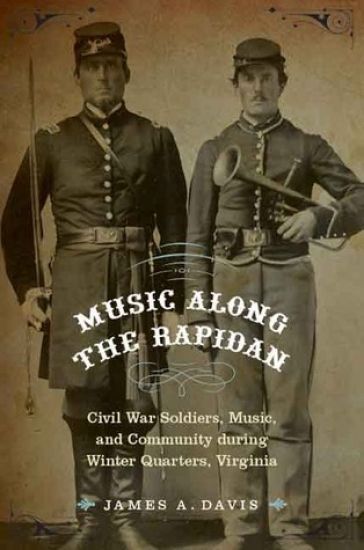
In December 1863, Civil War soldiers took refuge from the dismal conditions of war and weather. They made their winter quarters in the Piedmont region of central Virginia: the Union’s Army of the Potomac in Culpeper County and the Confederacy’s Army of Northern Virginia in neighboring Orange County. For the next six months the opposing soldiers eyed each other warily across the Rapidan River. In Music Along the Rapidan James A. Davis examines the role of music in defining the social communities that emerged during this winter encampment. Music was an essential part of each soldier’s personal identity, and Davis considers how music became a means of controlling the acoustic and social cacophony of war that surrounded every soldier nearby. Music also became a touchstone for colliding communities during the encampment-the communities of enlisted men and officers or Northerners and Southerners on the one hand and the shared communities occupied by both soldier and civilian on the other. The music enabled them to define their relationships and their environment, emotionally, socially, and audibly.