Kirjojen hintavertailu. Mukana 12 016 292 kirjaa ja 12 kauppaa.

Kirjahaku

Etsi kirjoja tekijän nimen, kirjan nimen tai ISBN:n perusteella.

1000 tulosta hakusanalla Goethe

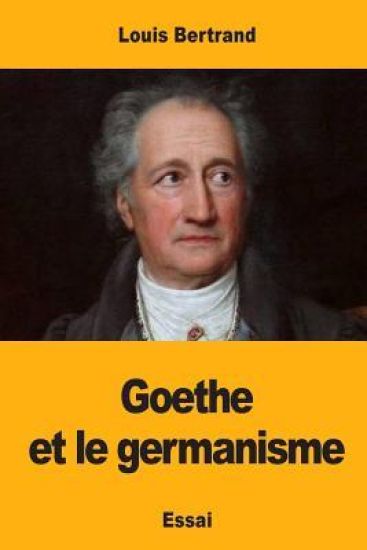
Goethe et le germanisme

Goethe et le germanisme

Louis Bertrand

Createspace Independent Publishing Platform
2017
nidottu
" ... Le moment est venu, ou jamais, d' couter le dieu lui-m me plut t que les bavardages de ses hi rophantes et de ses sacristains. J'ai donc relu Faust, que je n'avais pas ouvert depuis plus de trente ans. Je l'ai lu comme un livre qui vient de para tre, y cherchant un int r t tout actuel, et je n'ai pas t d u. Eternelle jeunesse des chefs-d'oeuvre: celui-ci m'a sembl crit d'hier. Cela vient sans doute aussi de ce que ces livres, si riches de substance et si en avance sur leur temps, ont besoin de longues ann es pour manifester tout leur contenu et trouver enfin leur vrai public. C'est peut- tre aujourd'hui seulement que le po me de Goethe est arriv maturit compl te dans les esprits et que, dans l'ordre des faits, il d veloppe ses ultimes cons quences. Je l'ai lu enfin, - je n'essaie pas de le dissimuler, - avec les yeux et les pr occupations d'un Fran ais de 1915. En face de l'Allemand, quel qu'il soit, nous sommes tous, cette heure, sur le pied de guerre. Cela ne nous emp che point d' tre justes envers notre ennemi. Pour l'instant, ce n'est pas son g nie en lui-m me que nous avons consid rer, c'est ce par quoi ce g nie nous menace dans notre pens e, dans notre me, dans notre tre le plus intime. Si je lis Faust, aujourd'hui, c'est l'Allemand, c'est- -dire l'ennemi de ma race, qui m'y int ressera par-dessus tout. Et ainsi, j'ai t amen y chercher les origines du germanisme, tel que les arm es du Kaiser nous le traduisent, en ce moment, coups de canon..."
Goethe Yearbook 7

Goethe Yearbook 7

Camden House Inc
1994
sidottu
A publication of the Goethe Society of North America, carrying Goethe criticism (and studies of his contemporaries); extensive book review section. The Goethe Yearbook is a publication of the Goethe Society of North America, which was founded in 1980 to promote the study of Goethe and his contemporaries. Originally conceived as a vehicle for Goethe criticism in Englishduring the Cold War political tensions, when the most prestigious Goethe publication, the Goethe Jahrbuch, was not available to most Western scholars, the Yearbook subsequently gained the respect of the international community, and has published articles, in both English and German, by scholars from around the world; it is unique among other periodicals devoted to the 'Goethezeit' for its extensive book review section.
Goethe Yearbook 8

Goethe Yearbook 8

Camden House Inc
1997
sidottu
Latest volume in series devoted to Goethe criticism (and studies of his contemporaries), with an extensive book review section. The Goethe Yearbook is published by the Goethe Society of North America, founded in 1980 to promote the study of Johann Wolfang von Goethe and his contemporaries, the so-called 'Goethezeit'. Originally conceived as a vehicle to present original English-language Goethe scholarship during the period of Cold War political tensions, when the most prestigious Goethe publication, the Goethe Jahrbuch, was not open to most Western scholars, the Goethe Yearbook has quickly become established in the international community, publishing articles in both English and German from academics around the world; it includes an extensive book review section.
Goethe Yearbook 9

Goethe Yearbook 9

Camden House Inc
1999
sidottu
The Goethe Yearbook, first published in 1982, is a publication of the Goethe Society of North America, and is dedicated to Goethe scholarship in North America. It aims above all to encourage and publish original English-language contributions to the understanding of Goethe and the Goethezeit while also welcoming contributions from scholars around the world. Volume 9 of the Goethe Yearbook provides cutting-edge literary criticism on works by Goethe and his contemporaries. Editor Thomas Saine has demonstrated in this respected series that he is especially interested in new critical directions and solid research. The book review section is important for all scholars of 18th-century literature.
Goethe Yearbook 10

Goethe Yearbook 10

Camden House Inc
2001
sidottu
New readings of a number of Goethe's works, book reviews, and a listing of North American Goethe dissertations 1989-1999. The Goethe Yearbook, first published in 1982, is a publication of the Goethe Society of North America and is dedicated to North American Goethe scholarship. It aims above all to encourage and publish original English-language contributions to the understanding of Goethe and other authors of the Goethezeit, while also welcoming contributions from scholars around the world. The book review section seeks likewise to evaluate a wide selection ofrecent publications on the period, and is important for all scholars of 18th-century literature. The contributions in volume 10 offer new readings of several of Goethe's works (in particular Götz von Berlichingen, Faust, Italienische Reise, and the Wilhelm Meister novels), new perspectives on Goethe as a writer, and new understanding of Goethe's literary/cultural legacy. A supplement continues the listing of North American Goethe dissertations thathas been a feature of previous volumes to include the period 1989 to 1999, updating this unique bibliographical resource. Thomas P. Saine of the University of California, Irvine, has edited all the volumes of the Goethe Yearbook to date. Volume 10 was edited with the assistance of Simon J. Richter of the University of Pennsylvania, who will assume the editorship with volume 11. Ellis Dye of Macalester College is book review editor.
Goethe Yearbook 12

Goethe Yearbook 12

Camden House Inc
2004
sidottu
Volume 12 is dedicated to founding editor Thomas P. Saine, and includes essays on Goethe's novels, plays, and poems, the Ilmpark, Bach, Ossian, Goethe reception, and Schiller. The Goethe Yearbook, first published in 1982, is a publication of the Goethe Society of North America and is dedicated to North American Goethe scholarship. It aims above all to encourage and publish original English-language contributions to the understanding of Goethe and other authors of the Goethezeit, while also welcoming contributions from scholars around the world. The book review section seeks likewise to evaluate a wide selection ofrecent publications on the period, and is important for all scholars of 18th-century literature. Volume 12 honors founding editor Thomas P. Saine with contributions from prominent scholars such as Ehrhard Bahr, Benjamin Bennett, Dieter Borchmeyer, Jane Brown, Jill Kowalik, Ruth Kluger, Meredith Lee, John McCarthy, Jeff Sammons, Helmut Schneider, Hans Vaget, and more. The volume includes essays on Goethe's novels, plays, and poems, the Ilmpark, Bach, Ossian, Goethe reception, and Schiller. Simon J. Richter is associate professor of German and Comparative Literature at the University of Pennsylvania. Book review editor Martha B. Helfer is associate professor of German at the University of Utah.
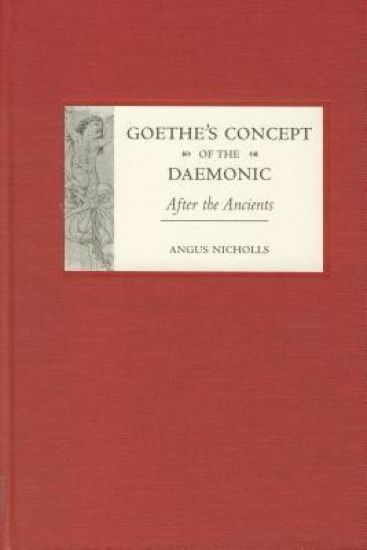
Goethe's Concept of the Daemonic

Goethe's Concept of the Daemonic

Angus Nicholls

Camden House Inc
2006
sidottu
The first book to examine Goethe's writings on the daemonic in relation to both Classical philosophy and German Idealism. For Plato, the daemonic is a sensibility that brings individuals into contact with divine knowledge; Socrates was also inspired by a "divine voice" known as his "daimonion." Goethe was introduced to this ancient concept by Hamannand Herder, who associated it with the aesthetic category of genius. This book shows how the young Goethe depicted the idea of daemonic genius in works of the Storm and Stress period, before exploring the daemonic in a series of later poetic and autobiographical works. Reading Goethe's works on the daemonic through theorists such as Lukács, Benjamin, Gadamer, Adorno, and Blumenberg, Nicholls contends that they contain arguments concerning reason, nature, and subjectivity that are central to both European Romanticism and the Enlightenment. Angus Nicholls is Claussen-Simon Foundation Research Lecturer in German and Comparative Literature at the Centre for Anglo-German Cultural Relations in the Department of German, Queen Mary, University of London.
Goethe Yearbook 13

Goethe Yearbook 13

Camden House Inc
2005
sidottu
Essays on the Wilhelm Meister novels, Faust, Goethe's early plays, Schiller's Räuber and on Goethe's thought in relation to current debates on cosmopolitanism and postcoloniality. The Goethe Yearbook, first published in 1982, is a publication of the Goethe Society of North America and is dedicated to North American Goethe Scholarship. It aims above all to encourage and publish original English-language contributions to the understanding of Goethe and other authors of the Goethezeit, while also welcoming contributions from scholars around the world. This year's volume features a cluster of exceptional essays thatshed new light on Goethe's Wilhelm Meister novels and Faust, as well as fascinating articles on the early play Das Jahrmarktsfest zu Plundersweilen and the poem "Ilmenau," Schiller's Die Räuber, and anessay that places Goethe's thought in relation to current debates about cosmopolitanism and postcoloniality. Engaging reviews of recent publications in Goethe studies round out the volume. Contributors include Eric Denton, Matt Erlin, Jaimey Fisher, Ingrid Rieger, Rainer Kawa, David Barry, Stephanie Dawson, and John Pizer. Simon J. Richter is Professor of German at the University of Pennsylvania. Book review editor Martha B. Helfer is Professor of German at Rutgers University.
Goethe Yearbook 15

Goethe Yearbook 15

Camden House Inc
2008
sidottu
New, interdisciplinary essays on an array of topics ranging from Goethe and mineralogy to theories of masculinity around 1800. The Goethe Yearbook, first published in 1982, is a publication of the Goethe Society of North America and is dedicated to North American Goethe Scholarship. It aims above all to encourage and publish original English-language contributions to the understanding of Goethe and other authors of the Goethezeit, while also welcoming contributions from scholars around the world. Goethe Yearbook 15 features an array of interdisciplinary essays,among them articles on Goethe and such topics as architecture, mineralogy, theatrical improvisation, and Ulrich von Hutten. Readers will also find two astute and erudite interpretations of key poems, Alexis und Dora and Urworte. Orphisch, as well as a compelling exploration of the legal, social, and economic issues pertaining to the question: "Why Did Goethe Marry When He Did?" An interpretation of Goethe's Elective Affinities, two essays on Schiller's plays, and an incisive analysis by Peter Uwe Hohendahl titled "The New Man: Theories of Masculinity Around 1800" round out the volume. Contributors: Ehrhard Bahr, Yasser Derwiche Djazaerly, Robert Germany, Albert E. Gurganus, Peter Uwe Hohendahl, Jocelyn Hollnad, Borge Kristiansen, Elizabeth Powers, Daniel Purdy, Peter J. Schwartz, and Christoph Schweitzer Simon J. Richter is Professor of German at the University ofPennsylvania, and Daniel Purdy is Associate Professor of German at Pennsylvania State University. Book review editor Martha B. Helfer is Professor of German at Rutgers University.
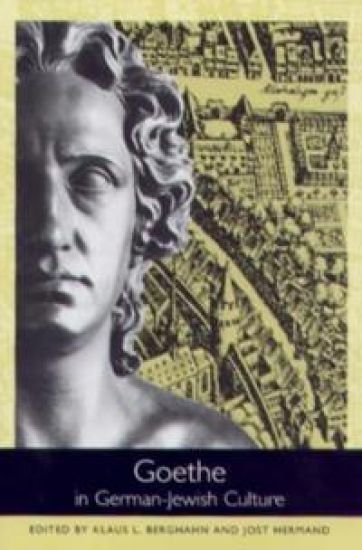
Goethe in German-Jewish Culture
New essays examining Goethe's relationship to the Jews, and the contribution of Jewish scholars to the fame of the greatest German writer. The success of Daniel Goldhagen's Hitler's Willing Executioners(1997) and the heated debates that followed its publication exposed once again Germany's long tradition of anti-Semitism as a major cause of the Holocaust. Goldhagen, like many before him, drew a direct and irresistible line from Luther's pamphlets against the Jews to Hitler's attempted annihilation of European Jewry. This collection of new essays examines the thesis of a universal anti-Semitism in Germany by focussing on its greatest author, Goethe, and seeing to what extent some scholars are justified in accusing him of anti-Semitism. It places the reception of Goethe's works in a broader historical context: his relationship to Judaism and the Jews; the reception of his works by the Jewish elite in Germany, the reception of the 'Goethe cult' by Jewish scholars; and the Jewish contribution to Goethe scholarship. The last section of the volume treats the Jewish contribution to Goethe's fame and to Goethe philology since the 19th century, and the exodus of many Jewish authors and scholars after 1933, when they took their beloved Goethe into exile. When a few of them returned to Germany after 1945, it was to a country that had lost Goethe's most devoted audience, the German Jews. KLAUS L. BERGHAHN and JOST HERMAND are professors of German at the University of Wisconsin-Madison.
Goethe Yearbook 14

Goethe Yearbook 14

Camden House Inc
2007
sidottu
Focuses on childhood in the Age of Goethe, in addition to various other topics and works. The Goethe Yearbook, first published in 1982, is a publication of the Goethe Society of North America and is dedicated to North American Goethe Scholarship. It aims above all to encourage and publish original English-language contributions to the understanding of Goethe and other authors of the Goethezeit, while also welcoming contributions from scholars around the world. Volume 14 features a special section on childhood in the Age of Goethe,co-edited with Anthony Krupp. In addition, readers will find two essays illuminating Goethe's Triumph der Empfindsamkeit, an inspired reading of Das Märchen against the background of Goethe's critique of Newtonian science, a careful analysis of the daemonic in the poem "Mächtiges Überraschen," and essays on Egmont and Wilhelm Meisters Wanderjahre. Contributors: Kelly Barry, Paul Fleming, Edgar Landgraf, Liliane Weissberg,Angus Nicholls, Robin A. Clouser Simon J. Richter is Professor of German at the University of Pennsylvania, and book review editor Martha B. Helfer is Professor of German at Rutgers University. Anthony Krupp is Assistant Professor of German at the University of Miami.
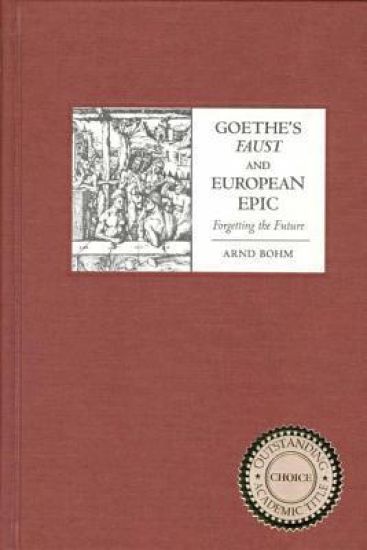
Goethe's Faust and European Epic

Goethe's Faust and European Epic

Arnd Bohm

Camden House Inc
2007
sidottu
A reassessment of genre that fills a major gap in Goethe's oeuvre and initiates a radically new reading of Faust. Goethe has long been enshrined as the greatest German poet, but his admirers have always been uneasy with the idea that he did not produce a great epic poem. A master in all the other genres and modes, it has been felt, should have done so. Arnd Bohm proposes that Goethe did compose an epic poem, which has been hidden in plain view: Faust. Goethe saw that the Faust legends provided the stuff for a national epic: a German hero, a villain (Mephistopheles), a quest (to know all things), a sublime conflict (good versus evil), a love story (via Helen of Troy), and elasticity (all human knowledge could be accommodated by the plot). Bohm reveals the care with which Goethe draws upon such sources as Tasso, Ariosto, Dante, and Vergil. In the microcosm of the "Auerbachs Keller" episode Faust has the opportunity to find "what holds the world together in its essence" and to end his quest happily, but he fails. He forgets the future because he cannot remember what epic teaches. His course ends tragically, bringing him back to the origin of epic, as he replicates the Trojans' mistake of presuming to cheat the gods. Arnd Bohm isAssociate Professor of English at Carleton University, Ottawa.
Goethe Yearbook 16

Goethe Yearbook 16

Camden House Inc
2009
sidottu
Groundbreaking essays highlighting Goethe's relevance to contemporary theoretical debates and Goethe criticism of recent decades. The Goethe Yearbook, first published in 1982, is a publication of the Goethe Society of North America and is dedicated to North American Goethe Scholarship. It aims above all to encourage and publish original English-language contributions to the understanding of Goethe and other authors of the Goethezeit, while also welcoming contributions from scholars around the world. Goethe Yearbook 16 presents innovative interpretations by young scholars of Goethe's most prominent works. A special section on 20th-century theory, co-edited by Angus Nicholls, demonstrates the poet's importance within areas of contemporary debate such as postcolonial criticism and Heideggerian phenomenology. The volume includes Judith Ryan's 2007 Presidential Address to the Goethe Society on the aphorisms in Die Wahlverwandtschaften and the Wanderjahre, as well as essays on aspects of Hermann und Dorothea, Iphigenie, Wilhelm Meisters Lehrjahre, and Prometheus. Readers will also find a surprising interpretation of Schiller on subjectivity and military strategy, and a feminist archival history of the Hamburg actress Charlotte Ackermann. Contributors: Volker C. Dörr, Mary Helen Dupree, Ellis Dye, Bernd Hamacher, Katrin Kohl, Michael Mandelartz, Jan Mieszkowski, Angus Nicholls, Charlton Payne, Mattias Pirholt, Myriam Richter, Judith Ryan, and Christian Weber. Daniel Purdy is Associate Professor of German at Pennsylvania State University. Book review editor Catriona MacLeod is Associate Professor of German at the University of Pennsylvania.
Goethe Yearbook 17

Goethe Yearbook 17

Camden House Inc
2010
sidottu
New articles on topics spanning the Age of Goethe, with a special section of fresh views of Goethe's Faust. The Goethe Yearbook is a publication of the Goethe Society of North America, publishing original English-language contributions to the understanding of Goethe and other authors of the Goethezeit, while also welcomingcontributions from scholars around the world. Goethe Yearbook 17 covers the full range of the era, from Karl Guthke's essay on the early Lessing to Peter Höyng's on Grillparzer. Notable is a special section, co-editedby Clark Muenzer and Karin Schutjer, that samples some of the exciting new work presented at the Goethe Society conference in November 2008: 200 years after the publication of Faust I, eight essays offer fresh views of this epic masterpiece, often through novel and surprising connections. Authors link for example Faust's final ascension and the circulation of weather, verse forms in the drama and the performance of national identity, the fate of Gretchen and the occult politics of Francis Bacon. Other papers explore epistemological structures and taxonomies at work in Goethe's prose, essays, and scientific writings. Contributors: Frederick Amrine, Johannes Anderegg, Matthew Bell, Benjamin Bennett, Gerrit Brüning, Christian Clement, Pamela Currie, Ulrich Gaier, Karl Guthke, Stefan Hajduk, Peter Höyng, Clark Muenzer, Andrew Piper, Herb Rowland, Heather Sullivan, Chad Wellmon, Ellwood Wiggins, Markus Wilczek. Daniel Purdy is Associate Professor of German at Pennsylvania State University. Book review editor Catriona MacLeod is Associate Professor of German at the University of Pennsylvania.
Goethe Yearbook 18

Goethe Yearbook 18

Camden House Inc
2011
sidottu
New essays on topics spanning the Age of Goethe, with a special section of fresh views of Goethe and Idealism. The Goethe Yearbook is a publication of the Goethe Society of North America, publishing original English-language contributions to the understanding of Goethe and other authors of the Goethezeit, while also welcomingcontributions from scholars around the world. Volume 18 features a special section on Goethe and Idealism, edited by Elizabeth Millán and John H. Smith and including essays on Goethe and Spinoza; Goethe's notions of intuition and intuitive judgment; Novalis, Goethe, and Romantic science; Goethe and Humboldt's presentation of nature; Hegel's Faust; Goethe contra Hegel on the end of art; Goethean morphology and Hegelian science; and Goethe andphilosophies of religion. There are also essays on fraternity in Goethe, Margarete-Ariadne as Faust's labyrinth, Schiller's Geisterseher, and Martin Walser's Goethe novel Ein liebender Mann, and a review essay on recent books on money and materiality in German culture heads the book review section. Contributors: Frederick Amrine, Brady Bowen, Jeffrey Champlin, Adrian Del Caro, Stefani Engelstein, Luke Fischer, Gail Hart, Gunnar Hindrichs, Jens Kruse, Horst Lange, Elizabeth Millán, Dalia Nassar, John H. Smith. Daniel Purdy is Associate Professor of German at Pennsylvania State University. Book review editor Catriona MacLeod is Associate Professorof German at the University of Pennsylvania.
Goethe Yearbook 19

Goethe Yearbook 19

Camden House Inc
2012
sidottu
New essays on diverse topics from the Age of Goethe, with a special section on Goethe scholarship's role in the establishment of Germanistik. The Goethe Yearbook is a publication of the Goethe Society of North America, encouraging North American Goethe scholarship by publishing original English-language contributions to the understanding of Goethe and other authors of the Goethezeit while also welcoming contributions from scholars around the world. Volume 19 of the Goethe Yearbook continues to investigate the connection between Goethe's scientific theories and his aesthetics, with essays on his optics and his plant morphology. A special section examines the central role that Goethe philology has had in establishing practices that shaped the history of Germanistik as a whole. The yearbookalso includes essays on legal history and the novella, Goethe Lieder, esoteric mysticism in Wilhelm Meisters Lehrjahre, and Werther's sexual pathology. The volume also includes three essays re-examining Goethe's aesthetics in the context of the history of deconstruction, as well as the customary book review section. Contributors: Beate Allert, Frauke Berndt, Sean Franzel, Stefan Hajduk, Bernd Hamacher, Jeffrey L. High, Francien Markx, Lavinia Meier-Ewert, Ansgar Mohnkern, Rüdiger Nutt-Kofoth, Edward T. Potter, Chenxi Tang, Robert Walter. Daniel Purdy is Associate Professor of German at Pennsylvania State University. Book review editor Catriona MacLeod is Associate Professor of German at the University of Pennsylvania.
Goethe Yearbook 20

Goethe Yearbook 20

Camden House Inc
2013
sidottu
A new crop of essays on topics in the literature of Goethe and the Goethezeit, with a special section providing innovative readings of Goethe's lyric poetry. The Goethe Yearbook is a publication of the Goethe Society of North America, encouraging North American Goethe scholarship by publishing original English-language contributions to the understanding of Goethe and other authors of the Goethezeit while also welcoming contributions from scholars around the world. Volume 20 contains a special section on Goethe's lyric poetry with contributions from leading scholars. The essays incorporate a range of new methodologies that provide innovative readings of Goethe's most important poems, including contributions by Benjamin Bennett on Faust and Daniel Wilson on the West-östliche Divan. The volume also includesessays on Götz von Berlichingen, the Sturm-und-Drang sublime, the Nibelungenlied's place within Weltliteratur, as well as an examination of Schiller's notion of freedom. Contributors: Constantin Behler, Benjamin Bennett, Frauke Berndt, Fritz Breithaupt, Hannah Vandegrift Eldridge, Andrew Erwin, Patrick Fortmann, Edgar Landgraf, Horst Lange, Charlotte Lee, Claudia Maienborn, Joseph D. O'Neil, Elizabeth Powers, Christian P. Weber, W. Daniel Wilson. Daniel Purdy is Associate Professor of German at Pennsylvania State University. Book review editor Catriona MacLeod is Associate Professor of German at the University of Pennsylvania.
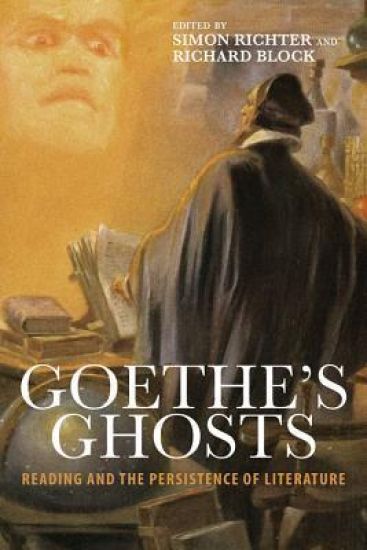
Goethe's Ghosts

Goethe's Ghosts

Camden House Inc
2013
sidottu
New essays from leading Goethe scholars providing testimony to the continuing, even renewed, relevance of Goethe for literary studies today. Invoking Goethe's name has become fashionable again. With new methods and technologies of reading threatening to render literature virtual and insubstantial, we have the sense that "Goethe's ghosts" - the otherwise neglected voices and traditions that, finding their most trenchant expression in Goethe, inform the Western storehouse of literature - can show us long-forgotten dimensions of literature. Inspired by the distinguished Goethe scholar Jane Brown,whose life's work has called attention to the allegorical modes haunting the mimetic forms that dominate modern literature, the contributors to this volume take a rich variety of approaches to Goethe: cultural studies, history ofthe book, semiotics, deconstruction, colonial studies, feminism, childhood studies, and eco-criticism. The persistence, omnipresence, and modalities of the "ghosts" they find suggest that more than influence or standards is at issue here. The stubborn reappearance of these revenants testifies to more fundamental issues concerning the status of literature and the task of the reader. As the contributors demonstrate, these questions acquire renewed urgency inwriters as diverse as Hegel, Adorno, Benn, Droste-Hülshoff, and Nietzsche. Each of the essays testifies to the enduring salience and presence of Goethe. Contributors: Helmut Ammerlahn, Benjamin Bennett, Dieter Borchmeyer, Franz-Josef Deiters, Richard T. Gray, Martha B. Helfer, Meredith Lee, Clark Muenzer, Andrew Piper, Jürgen Schröder, Peter J. Schwartz, Patricia Anne Simpson, Robert Deam Tobin, David E. Wellbery, Sabine Wilke. SimonRichter is Professor of German Literature at the University of Pennsylvania. Richard Block is Associate Professor of German at the University of Washington.
Goethe Yearbook 21

Goethe Yearbook 21

Camden House Inc
2014
sidottu
New essays on topics in the literature of Goethe and the Goethezeit, including contributions by both eminent scholars and new voices. The Goethe Yearbook is a publication of the Goethe Society of North America, encouraging North American Goethe scholarship by publishing original English-language contributions to the understanding of Goethe and other authors of the Goethezeit while also welcoming contributions from scholars around the world. Volume 21 contains eleven articles, including contributions by leading scholars David Wellbery and Katharina Mommsen; innovative work on the reception of Goethe's works around 1900, on women writers, and on Goethe's contemporary Albrecht von Haller; theoretically sophisticated interpretations, including articles on concepts of space in Alexis and Doraand on notions of sacrifice in Faust; and interdisciplinary pieces ranging from a discussion of contemporary psychological and medical theories of ill humor in relation to Goethe's Werther and an economic reading ofGoethe's Faust to an analysis of illustrations of Goethe's works. The review section collects responses by eminent scholars to a wide swath of recent books on Goethe and his age, both in German and English. Contributors: Liesl Allingham, William H. Carter, Sarah Vandegrift Eldridge, John B. Lyon, Waltraud Maierhofer, Catherine Minter, Katharina Mommsen, David Pan, Michael Saman, Leif Weatherby, David E. Wellbery. Adrian Daub is Associate Professor of German at Stanford. Elisabeth Krimmer is Professor of German at the University of California Davis. Book review editor Birgit Tautz is Associate Professor of German at Bowdoin College.
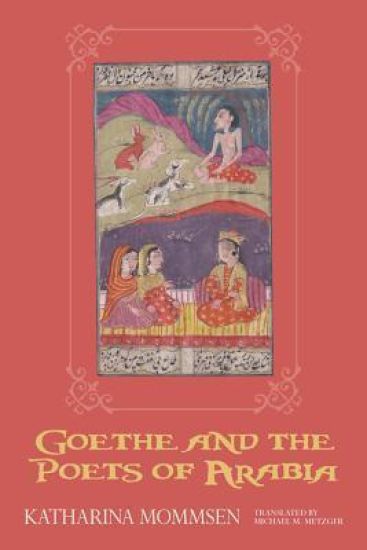
Goethe and the Poets of Arabia

Goethe and the Poets of Arabia

Katharina Mommsen

Camden House Inc
2014
sidottu
A comprehensive account of Goethe's relationship to Arabian culture, mediated by his interest in certain poets and texts and by his highly nuanced attitude toward Islam. Abundant evidence bears witness to Johann Wolfgang Goethe's lifelong predilection for the literature, religion, and culture of ancient Arabia. Scholars have hardly yet touched upon Goethe's relationship to Arabic literature. His remarkable West-östlicher Divan suggested that his interest in the "Orient" was limited to the Persian poet Hafez, his chief model for the collection, and to the culture of Persia. Yet significant aspects of this work and others stem from pre-Islamic and Islamic traditions of Arabian literature. This study examines comprehensively Goethe's relationship to Arabian culture, mediated primarily by his interest in certain poets and texts and by his highly nuanced attitude toward Muhammad, the Qur'an, and Islam. Katharina Mommsen has explored exhaustively Goethe's opinions about Arab poets and their sources, the numerous traces of Arabic poetry that entered his works, and thegrounds for his ambivalent affinity for Islam and its Prophet. Extensive textual evidence reveals how throughout his life Goethe's temperament determined his interest in particular Arabian poets and was in turn modulated by them.The study also opens new perspectives on Goethe's biography, especially in the early nineteenth century when he was writing the Divan. Katharina Mommsen's studies of Goethe, including Goethe und die Moallakat, Goethe und 1001 Nacht, and numerous articles on Goethe and Islam, are recognized internationally. She is Professor Emerita of German at Stanford University. Michael M. Metzger is Professor Emeritus of German at the University at Buffalo.