Kirjojen hintavertailu. Mukana 11 627 067 kirjaa ja 12 kauppaa.

Kirjahaku

Etsi kirjoja tekijän nimen, kirjan nimen tai ISBN:n perusteella.

1000 tulosta hakusanalla James Perry

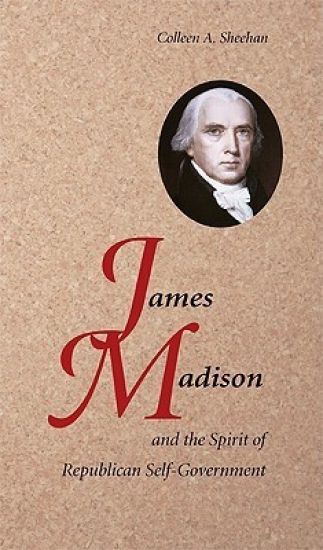
James Madison and the Spirit of Republican Self-Government

James Madison and the Spirit of Republican Self-Government

Colleen A. Sheehan

Cambridge University Press
2009
pokkari
In a study that combines an in-depth examination of Madison's National Gazette essays of 1791–2 with a study of The Federalist, Colleen Sheehan traces the evolution of Madison's conception of the politics of communication and public opinion throughout the Founding period, demonstrating how 'the sovereign public' would form and rule in America. Contrary to those scholars who claim that Madison dispensed with the need to form an active and virtuous citizenry, Sheehan argues that Madison's vision for the new nation was informed by the idea of republican self-government, whose manifestation he sought to bring about in the spirit and way of life of the American people. Madison's story is 'the story of an idea' - the idea of America.
The Scientific Letters and Papers of James Clerk Maxwell 3 Volume Paperback Set (5 physical parts)
Originally published between 1990 and 2002 this set is now available in paperback for the first time. This is a comprehensive edition of Maxwell's manuscript papers, published in a virtually complete form. Maxwell's work was of central importance in establishing and developing the major themes of the physics of the nineteenth century. His theory of the electromagnetic field and the electromagnetic theory of light, and his development of statistical molecular theory, have established his special place in the history of physics. His fecundity of imagination and the sophistication of his examination of the foundation of physics give particular interest and importance to his writings. This edition includes Maxwell's letters to William Thomson (Lord Kelvin), Michael Faraday, George Gabriel Stokes, Lord Rayleigh, Peter Guthrie Tait, and many other physicists, mathematicians and scholars. These letters, together with numerous drafts of his published scientific papers and reports on papers submitted to the Royal Society, illuminate his scientific thought, providing a unique perspective on classical physics at a crucial stage in its development.
James and Jude

James and Jude

II Brosend

Cambridge University Press
2004
sidottu
This commentary focuses exclusively on the two letters written by the 'brothers of the Lord', James and Jude. Each letter is discussed on its own merits, and interpreted as having been written early in the life of the Church - it is posited that the letter of James may be one of the oldest Christian writings as well as an early witness to the teachings of Jesus. Particular attention is devoted to understanding the social worlds of James and Jude and to interpreting the significance of their message for our day. Of special interest is the focus on the 'ideological texture' of James, in particular on James' working out of the ethical implications of the teachings of Jesus on poverty and wealth.
James Joyce, Sexuality and Social Purity

James Joyce, Sexuality and Social Purity

Katherine Mullin

Cambridge University Press
2003
sidottu
In James Joyce, Sexuality and Social Purity, Katherine Mullin offers a richly detailed account of Joyce's lifelong battle against censorship. Through prodigious archival research, Mullin shows Joyce responding to Edwardian ideologies of social purity by accentuating the 'contentious' or 'offensive' elements in his work. The censorious ambitions of the social purity movement, Mullin claims, feed directly into Joyce's writing. Paradoxically, his art becomes dependent on the very forces that seek to constrain and neutralize its revolutionary force. Acutely conscious of the dangers censorship presented to publication, Mullin shows Joyce revenging himself by energetically ridiculing purity campaigns throughout his fiction. Ulysses, A Portrait of the Artist as a Young Man and Dubliners all meticulously subvert purity discourse, as Joyce pastiches both the vice crusaders themselves and the imperilled 'Young Persons' they sought to protect. This important book will change the way Joyce is read and offers crucial insights into the sexual politics of Modernism.
James Joyce and the Problem of Psychoanalysis

James Joyce and the Problem of Psychoanalysis

Luke Thurston

Cambridge University Press
2004
sidottu
From its very beginning, psychoanalysis sought to incorporate the aesthetic into its domain. Despite Joyce's deliberate attempt in his writing to resist this powerful hermeneutic, his work has been confronted by a long tradition of psychoanalytic readings. Luke Thurston argues that this very antagonism holds the key to how psychoanalytic thinking can still open up new avenues in Joycean criticism and literary theory. In particular, Thurston shows that Jacques Lacan's response to Joyce goes beyond the 'application' of theory: rather than diagnosing Joyce's writing or claiming to have deciphered its riddles, Lacan seeks to understand how it can entail an unreadable signature, a unique act of social transgression that defies translation into discourse. Thurston imaginatively builds on Lacan's work to illuminate Joyce's place in a wide-ranging literary genealogy that includes Shakespeare, Hogg, Stevenson and Wilde. This study should be essential reading for all students of Joyce, literary theory and psychoanalysis.
James Joyce and the Act of Reception

James Joyce and the Act of Reception

John Nash

Cambridge University Press
2006
sidottu
James Joyce and the Act of Reception is a detailed account of Joyce's own engagement with the reception of his work. It shows how Joyce's writing, from the earliest fiction to Finnegans Wake, addresses the social conditions of reading (particularly in Ireland). Most notably, it echoes and transforms the responses of some of Joyce's actual readers, from family and friends to key figures such as Eglinton and Yeats. This study argues that the famous 'unreadable' quality of Joyce's writing is a crucial feature of its historical significance. Not only does Joyce engage with the cultural contexts in which he was read but, by inscribing versions of his own contemporary reception within his writing, he determines that his later readers read through the responses of earlier ones. In its focus on the local and contemporary act of reception, Joyce's work is seen to challenge critical accounts of both modernism and deconstruction.
James Joyce in Context

James Joyce in Context

Cambridge University Press
2009
sidottu
This collection of original, cohesive and concise essays charts the vital contextual backgrounds to Joyce's life and writing. The volume begins with a chronology of Joyce's publishing history, an analysis of his various biographies and a study of his many published and unpublished letters. It goes on to examine how his works were received in the main twentieth-century critical and theoretical schools. Most importantly, it places Joyce within multiple Irish, British and European contexts, providing a lively sense of the varied and changing world in which he lived, which formed him, and from which he wrote. The essays collectively show how Joyce was rooted in his times, how he is both a product and a critic of his multiple contexts, and how important he remains to the world of literature, criticism and culture.
James and Jude

James and Jude

II Brosend

Cambridge University Press
2004
pokkari
This is the first commentary to focus exclusively on the two letters written by the ‘brothers of the Lord’, James and Jude. Each letter is discussed on its own merits, and interpreted as having been written early in the life of the Church - it is posited that the letter of James may be one of the oldest Christian writings as well as an early witness to the teachings of Jesus. Particular attention is devoted to understanding the social worlds of James and Jude and to interpreting the significance of their message for our day. Of special interest is the focus on the ‘ideological texture’ of James, in particular on James’ working out of the ethical implications of the teachings of Jesus on poverty and wealth.
James Fitzjames Stephen

James Fitzjames Stephen

K. J. M. Smith

Cambridge University Press
2002
pokkari
In this important study Dr Smith uses a wide range of primary materials to provide the first modern comprehensive examination of the work, writings and ideas of James Fitzjames Stephen. Stephen’s broad rationalist/utilitarian ethical and intellectual stance manifested itself most prominently in law and social and political philosophy. Stephen’s turn of mind led him to perceive the substance of literature and religious orthodoxy as of complementary interest and relevance to the social and political mores of Victorian England, making him one of Dickens’ and Cardinal Newman’s most formidable and trenchant critics. Dr Smith’s account is the first to set Stephen’s life and thought in its proper Victorian context, and marks a significant addition to the growing literature on the intellectual history of nineteenth-century England.
James Madison and the Spirit of Republican Self-Government

James Madison and the Spirit of Republican Self-Government

Colleen A. Sheehan

Cambridge University Press
2009
sidottu
In a study that combines an in-depth examination of Madison's National Gazette essays of 1791–2 with a study of The Federalist, Colleen Sheehan traces the evolution of Madison's conception of the politics of communication and public opinion throughout the Founding period, demonstrating how 'the sovereign public' would form and rule in America. Contrary to those scholars who claim that Madison dispensed with the need to form an active and virtuous citizenry, Sheehan argues that Madison's vision for the new nation was informed by the idea of republican self-government, whose manifestation he sought to bring about in the spirit and way of life of the American people. Madison's story is 'the story of an idea' - the idea of America.