Kirjojen hintavertailu. Mukana 12 595 353 kirjaa ja 12 kauppaa.

Kirjahaku

Etsi kirjoja tekijän nimen, kirjan nimen tai ISBN:n perusteella.

1000 tulosta hakusanalla Jeremiah Bascom Reeves

The Life and Witness of Jeremiah

The Life and Witness of Jeremiah

Larry R Helyer

Cascade Books
2019
pokkari
The Life and Witness of Jeremiah introduces the general reader to the Hebrew prophet Jeremiah. As such it provides an overall sketch of his life and times and serves as a portal into his thought world. Jeremiah is among the most eloquent and passionate prophets in the Hebrew Bible. For readers who enjoy evocative poetry and harrowing accounts of near-death experiences, Jeremiah merits careful reading. One of the primary purposes in writing this book is to assist the reader in negotiating its anthology format and disorderly arrangement. To this end, the author provides in six chapters a thematic and topical approach to important aspects of Jeremiah's career and message that speak powerfully to our own day. In other words, this book focuses on applied theology. How does what Jeremiah said then relate to readers now? The book of Jeremiah is remarkably relevant, especially in its interface between faith and politics. The author also approaches this exposition of Jeremiah from a biblical theology perspective by connecting his preaching with the canon of sacred Scripture. A major concern is to place Jeremiah's prophecy within the broader context of redemptive history.
For I Know the Thoughts: Jeremiah 29:11

For I Know the Thoughts: Jeremiah 29:11

Christopher D. Gomez

Createspace Independent Publishing Platform
2017
nidottu
A promise to remember is made easy with this Daily Promise Journal. Blank lines where you can quickly jot down whatever comes to your mind. The 7 x 10 size is perfect for carrying in a bag or purse and yet sill provides ample space for writing.Each of the crisp, white, lightly lined pages and a soft glossy cover is attractive and durable. Promise Journals with this Bible verse makes a great gift for everyone.Consider giving one for: Mothers Day GiftsFathers Day GiftsGraduation GiftsHoliday GiftsThank You Gifts
When Did Caesar Become a Salad and Jeremiah a Bullfrog?
Just a quick glance at the table of contents will tell you that this isn't your standard inspirational book. Consider these chapter titles: "It's a Dog-Eat-Dog World and Cats Are Waiting Tables,""I Need a Rocky Mountain High Because I've Reached a Barry Manilow,"and "If the Incredible Edible Roadkill Bill Passes, Will There Really Be a Fork in the Road?" Martin Babb moves beyond such extraordinary titles to address the ordinary issues we all face on a daily basis -- surviving trials, loving others, parenting, developing a servant's heart, and a variety of other down-to-earth topics. With each life-affirming lesson, he plants whimsical seeds intended to nurture serious reflection. When Did Caesar Become a Salad and Jeremiah a Bullfrog will give you a reason to smile and something to chew on with its unconventional collection of bite-sized essays.
Portrait of a Serial Killer Jeremiah 2

Portrait of a Serial Killer Jeremiah 2

Niki Jilvontae

Independently Published
2019
nidottu
Audiences were left in awe after the trial of Jeremiah the Silent Killer was revealed in Portrait of a Serial Killer 1. They heard Prosecutor Eric Lundy unfold the grisly stories of over 300 murders. Now in Portrait of a Serial Killer 2, you get to look into the mind of the cold-blooded killer Come on this eerie, bloody, murderous ride as newly escaped Jeremiah seeks revenge "To fully understand me is to look into the dark corners of the mind of Satan himself I am the executioner... America's worst nightmare and my fun has just begun "- Jeremiah
Portrait of a Serial Killer JEREMIAH

Portrait of a Serial Killer JEREMIAH

Niki Jilvontae

Independently Published
2019
nidottu
Not everyone needs a reason to kill... sometimes people are born with evil in them. Meet Jeremiah Lewis, pegged the Silent Killer with over 100 "proven" murders under his belt. Get ready to enter the mind of a Serial Killer... Brace yourself ..."When I was 5 and I saw the fear in my first victim's eyes... I knew this was what I was destined to do. I found joy in watching the life leave the poor animal's body. I found peace... I found myself I am Jeremiah & this is the Portrait of a Serial Killer "
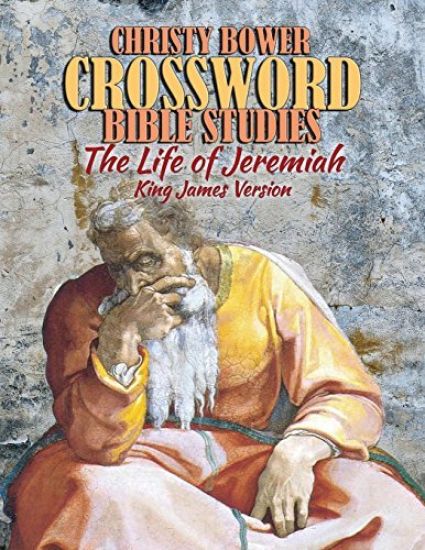
Crossword Bible Studies - The Life of Jeremiah

Crossword Bible Studies - The Life of Jeremiah

Christy Bower

Createspace Independent Publishing Platform
2018
pokkari
Jeremiah saw Judah and Jerusalem fall to the conquering Babylonians. His unpopular message urging the king to surrender to Babylon landed him in prison more than once. Through his affliction, he poured out his heart to God, being honest about his doubts, fears, and frustrations. For this reason, some scholars refer to Jeremiah as "the weeping prophet." With Crossword Bible Studies, you'll find the answer to every clue in the words of the Bible. Each clue contains a quote from the King James Version of the Bible and at the end of the clue is the verse reference. If you don't know the answer, look up the verse and fill in the blank to complete your puzzle. These reproducible puzzles are challenging enough for adults, but simple enough for kids because of the fill-in-the-blank format. As you work through the puzzles, don't forget to look up from the details of words and phrases to identify the larger context of what is happening and why. Whether you're looking for crosswords for adults or reproducible Bible puzzles for your church or school, Crossword Bible Studies will meet the need. Consider giving a copy of this reproducible book to your church because Bible crossword puzzles make fun take-home papers. Let's review: Reproducible crossword puzzles King James Version (1611) Each clue cites the verse reference 35-45 clues for each puzzle Fill-in-the-blank clue format Suitable for ages 8 to 108 CONTENTSJeremiah's Call (Jeremiah 1)Jeremiah's Anguish over the Destruction of His People (Jeremiah 4)Jeremiah Speaks at the Temple (Jeremiah 7)Jeremiah Weeps for God to Heal His People (Jeremiah 8)A Plot against Jeremiah (Jeremiah 11:18-23)Jeremiah Questions God's Justice (Jeremiah 12)Jeremiah's Linen Loincloth (Jeremiah 13:1-11)God Forbids Jeremiah to Intercede (Jeremiah 14)Jeremiah's Complaint (Jeremiah 15)God Forbids Jeremiah to Marry, Mourn, or Celebrate (Jeremiah 16)Jeremiah's Prayer of Confidence (Jeremiah 17:5-18)The Potter's Shop and a Plot against Jeremiah (Jeremiah 18)Jeremiah's Shattered Jar (Jeremiah 19)Jeremiah Confronts Pashur and Complains to God (Jeremiah 20)Jeremiah's Message: Surrender to Babylon (Jeremiah 21)Jeremiah's Vision of Figs (Jeremiah 24)Jeremiah Foretells 70 Years of Captivity (Jeremiah 25:1-13)Jeremiah's Escape from Death (Jeremiah 26)Jeremiah Wears a Yoke on His Neck (Jeremiah 27)Jeremiah Condemns Hananiah as a False Prophet (Jeremiah 28)Jeremiah Writes a Letter to the Exiles (Jeremiah 29)Jeremiah Writes God's Promise of Restoration (Jeremiah 30)Jeremiah Purchases Land as a Sign of Future Restoration (Jeremiah 32)Jeremiah in Confinement (Jeremiah 33)Jeremiah's Warning to King Zedekiah (Jeremiah 34)Jeremiah Dictates Messages (Jeremiah 36)King Zedekiah Summons Jeremiah (Jeremiah 37)Jeremiah in a Cistern (Jeremiah 38)After the Fall of Jerusalem, Jeremiah Remains (Jeremiah 39)Babylonians Release Jeremiah (Jeremiah 40:1-6)Jeremiah Warns the Remnant to Remain in Judah (Jeremiah 42)Jeremiah Is Taken to Egypt against His Will (Jeremiah 43-44)Bonus Puzzle: The Book of JeremiahBonus Puzzle: The Book of Lamentations
Commentary on the Book of Jeremiah
The historical placement of Jeremiah's early ministry: Jeremiah became a Prophet and began to prophesy in the 13th year of the reign of Josiah, which was 5 years after Josiah "began to seek after the God of David his father" (2 Chron. 34:3). This first 4 years of seeking the LORD and 1 year of purging the Land, which transpired before Jeremiah became a Prophet, is relevant to the Tribulation Period. My reader, Josiah was not alone.
Japheth ben Ali's Book of Jeremiah

Japheth ben Ali's Book of Jeremiah

Joshua A. Sabih

Equinox Publishing Ltd
2009
sidottu
This volume deals with three themes: medieval Judaism, Arabic and Hebrew sociolinguistics, and Arabic Bible translation. Within Medieval Judaism, the Karaite Jews became a prosperous community under the banners of Islam. One of the most salient signs of the Karaite community's strength and internal cohesion was the extensive scientific contribution that it made to the fields of Biblical studies, Hebrew philology and philosophy. This book presents for the first time a critical edition of one of the works of the leading Karaite scholars in biblical exegeses and translation, Japheth ben Ali's Judaeo-Arabic translation of the "Book of Jeremiah", drawing on five medieval manuscripts. As the majority of Karaite works, including Bible manuscripts, are in Judaeo-Arabic, relatively few of them have been published. A number of the Karaite Bible manuscripts were written in Arabic script, resulting in their being neglected by scholars, despite the significance of these manuscripts to the history of medieval Judaism and Bible textual Studies. The author of this volume focuses on some of the most important issues in the field of sociolinguistics, namely language-contact, diglossia and the status of both Arabic and Hebrew in the medieval Jewish literary system. Equally important is the issue of the script-in-use (Hebrew or Arabic), which was a major subject of debate among the Rabbinates and the Karaites. Indeed, the language and the script used in these manuscripts will help us re-evaluate the established theories about the language-situation and literary systems in medieval Islamic and Jewish societies. The value of translating the Hebrew Bible into Arabic was unparalleled in medieval inter-religious scholarship. For Muslim scholars it was their only access to the Jewish Bible. The contribution of the Karaites to this field is enormous, and this work offers us a unique window into the Karaite theory of Biblical hermeneutics.
Prophecy in the Book of Jeremiah
This volume contains the proceedings of a Symposium “Prophecy in the Book of Jeremiah”, arranged by the Edinburgh Prophecy Network in the School of Divinity at the University of Edinburgh, 11–12 May 2007. Prophetic studies are undergoing radical changes at the moment, following the breakdown of a methodological consensus in humanities and biblical studies. One of the challenges today concerns the question how to deal with history in a “post-modern” age. The French Annales School and narrative theory have contributed toward changing the intellectual climate of biblical studies dramatically. Whereas the “historical Jeremiah” was formerly believed to be hidden under countless additions and interpretations, and changed beyond recognition, it was still assumed that it would be possible to recover the “real” prophet with the tools of historical critical methods. However, according to a majority of scholars today, the recovery of the historical Jeremiah is no longer possible. For this reason, we have to seek new and multimethodological approaches to the study of prophecy, including diachronic and synchronic methods. The Meeting in Edinburgh in 2007 gathered specialists in prophetic studies from Denmark, Finland, Germany, the Netherlands, United Kingdom and the USA, focusing on different aspects of the prophet Jeremiah. Prophetic texts from the whole Hebrew Bible and ancient Near Eastern prophecy are taken into consideration.
Water Imagery in the Book of Jeremiah
What role does water imagery play in the Book of Jeremiah (MT)? Water imagery, with its complex manifestations—presence of water, drought, and tears—plays a central role in the Book of Jeremiah (JerMT). It provides unity and structure to this Book. This monograph conducts a close reading of all direct and indirect occurrences of water imagery to demonstrate its literary function. It also adopts B. Harshav’s theory of metaphor and frames of reference as a fundamental methodological tool. Harshav’s approach allows for an analysis of water imagery in both its metaphorical and literal meanings. This perspective enables the study to interpret the related images in light of Israel’s real-life experience of atmospheric phenomena, including rain, wind, and drought. It reveals how images within the text interact, evolve, transform, and sometimes contrast with one another. The interplay between the water frame and the covenant frame illustrates how JerMT reinterprets Israel’s history—from the crisis and break of the covenant to its promised restoration. In addition to the detailed examination of the literary function of water imagery, this study also highlights the social, ecological, and theological messages of JerMT.
The Relationship between MT and LXX in Jeremiah 39(46):1-41(48):3 and 52
In this work, James Frohlich analyzes the Septuagint translation technique in Jeremiah 39(46)-41(48):3 and 52 in order to determine if the large-scale differences between MT and LXX in these chapters were caused by the LXX translator. Since the Hebrew text of Jeremiah 52 largely parallels that of 2 Kings 24:18-25:30, and Jeremiah 39(46)-41(48):3 has various parallels with 2 Kgs 25:22-26, the author also focuses on the differences between the Septuagint translations in these parallel texts. Along with a study of translation technique, he also considers the nature of the MT pluses and analyzes the agreements and disagreements between Jeremiah 39(46)-41(48):3 and 52 MT/LXX with the parallel text in 2 Kings 24:18-25:30 MT/LXX. James Frohlich concludes that the large-scale differences between MT and LXX in Jeremiah 39-41:3 and 52 are due to a divergent Hebrew Vorlage used by the Septuagint translator.
Punning in Odd or Elegant Constructions in Jeremiah
Ancient Near Eastern scribes from Egypt to Mesopotamia, including Israelite scribes of the Hebrew Bible, create infelicitous or symmetric elements in their textual production. By their form, these elements communicate beyond the textual and semantic levels for rhetorical and literary purposes. "Meta-textual semantics" is a widespread scribal device in the ancient world, and ancient audiences and exegetes (e.g., rabbinic, medieval Jewish and Christian exegetes, and Masoretes) properly appreciated it, but it is underappreciated in modern interpretations of the Hebrew Bible. Using Prov 1:1-7 as a paradigm, Josiah D. Peeler explores elements in Hebrew Jeremiah usually considered secondary because of their odd or well-formed nature, to demonstrate that they exemplify a contextual theme.