Kirjojen hintavertailu. Mukana 12 016 292 kirjaa ja 12 kauppaa.

Kirjahaku

Etsi kirjoja tekijän nimen, kirjan nimen tai ISBN:n perusteella.

1000 tulosta hakusanalla Levin Boris

Swinburne's Apollo

Swinburne's Apollo

Yisrael Levin

Ashgate Publishing Limited
2013
sidottu
Focusing on Algernon Charles Swinburne's poems on Apollo, Yisrael Levin calls for a re-examination of the poet's place in Victorian studies in light of his contributions to nineteenth-century intellectual history. Swinburne's Apollonian poetry, Levin argues, shows the poet's active participation in late-Victorian debates about the nature and function of faith in an age of changing religious attitudes. Levin traces the shifts that took place in Swinburne's conception of Apollo over a period of four decades, from Swinburne's attempt to define Apollo as an alternative to the Judeo-Christian deity to Swinburne's formation of a theological system revolving around Apollo and finally to the ways in which Swinburne's view of Apollo led to his agnostic view of spirituality. Even though Swinburne had lost his faith and rejected institutional religion by his early twenties, he retained a distinct interest in spiritual issues and paid careful attention to developments in religious thought. Levin persuasively shows that Swinburne was not simply a poet provocateur who enjoyed controversy but failed to provide valid cultural commentary, but was rather a profound thinker whose insights into nineteenth-century spirituality are expressed throughout his Apollonian poetry.
A Gallery of Mirrors

A Gallery of Mirrors

Harry Levin

AldineTransaction
2011
nidottu
The essays in this classic volume range from broad concerns with critical theory and aesthetic formulation to specific analysis of forms and texts. Levin discusses such matters as the symbolic interpretation of literature, the development of literary criticism during the past half-century, European attitudes toward contemporary American writers, and re-evaluations of Joyce, Proust, Balzac, Cervantes, Melville, and Hemingway. Because Levin is both a learned scholar and imaginative critic, there is no comparable book that offers the wit, taste, and learning one finds in these pages. His historical and comparative approaches to literary theory enable Levin to place a given work precisely by relating it to other works and manifestations of culture. World literature is not the province of this work. But Levin views it as the horizon against which our own traditions may be measured. Just as anthropologists discover similar processes working through diverse cultures, so through can we glean understanding of common patterns through the analysis of world literature, our own peculiarly specialized branch of the science of man. The effect of convention, in shaping the extent to which literature may be conceived as an institution, has been widely discussed. A Gallery of Mirrors raises theoretical questions that touch the methodology of humanistic scholarship, with regard to other disciplines, and the status of art, with regard to other modes of knowledge. With changing schools of critical thought, Levin relies considerably on semantics as a precision instrument for defining concepts in the terms of those for whom they were most meaningful.
The Code

The Code

Don Levin

Authorhouse
2006
nidottu
A young US Army lieutenant, from a long and distinguished family line of soldiers, stationed in the Federal Republic of Germany, faces court martial charges of murder and of being involved in a black marketing operation that reach the higher echelons of the Division command. Rather than trusting his fate to a military lawyer, the family reaches across the sea to the United States, and retains the services of former Army officer turned civilian attorney "Colt" Donaldson. With links to unsolved murders in Vietnam and Korea, as well as insights into the CIA, the White House, and the inner workings of the officer corps, Colt must battle command influence and the subtleties of military justice, as well as a gang of ruthless criminals to refute the burden of proof that the Government has established, and fight the Code to secure his client's freedom.
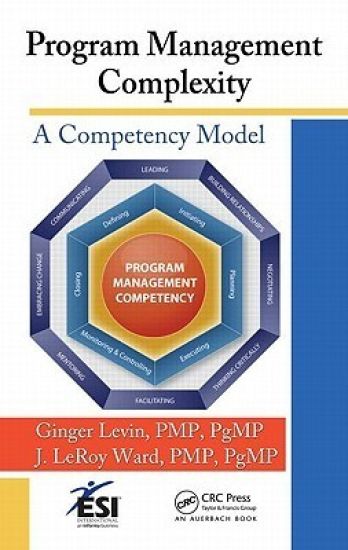
Program Management Complexity

Program Management Complexity

Ginger Levin; J. LeRoy Ward

Taylor Francis Inc
2011
sidottu
Although complexity is a phenomenon that confounds and challenges program managers across industry sectors, there is little information available that identifies the set of competencies managers need to complete their program successfully and deliver the benefits desired by stakeholders. Program Management Complexity: A Competency Model fills this void. Written by two of the first professionals to obtain the Program Management Professional (PgMP®) certification from the Project Management Institute (PMI), this book begins with a literature review of program and project management complexity. Next, it presents a competency model, based on the authors’ seven decades of collective experience in the field, which follows the framework of PMI's model for project managers. Useful for corporate and government organizations, universities, executives, PMO directors and human resources professionals who need to determine program management training needs, this unique model is divided into performance competencies and personal competencies. The performance competencies are organized according to the six domains of program management, while the eight personal competencies are based on research plus a survey of PgMPs® worldwide. After presenting the model, along with detailed plans and guidelines for its implementation in a real-world setting, the book presents three questionnaires designed to help organizations, existing program managers, and aspiring program managers assess their own development plans. Supplying you with the insight to recognize the elements of complexity during the defining and initiating stages, this book includes detailed guidelines to help you recruit, train, and develop program managers capable of delivering stated program benefits, services, and results.Check out a video of Ginger Levin discussing her book:http://www.youtube.com/watch?v=A6YPwEhYDlc
The Violence of Hate

The Violence of Hate

Jack Levin; Jim Nolan

Rowman Littlefield
2016
nidottu
The Violence of Hate, Fourth Edition presents a systematic introduction to issues related to the sociology and social psychology of hate and violence as they target people who are different in socially significant ways. It offers an integrated perspective on the causes and consequences of hate-motivated violence and the reasons we have not always been effective in stopping it. Not only do the authors address the experiences of racial, ethnic, and religious groups under attack, but also those who are victimized because of their sexual orientation, gender, gender-identity, age, or disability status. In addition, they include a chapter dedicated solely to the exploration of hate crimes, an evolving legal concept and public policy domain, as well as a chapter in which they suggest approaches that may be effectively applied collectively to the reduction of hate violence. As in earlier versions of The Violence of Hate, Levin and Nolan take the position that support for hate-motivated violence originates not in the ranting and raving of a few bigoted extremists at the margins of society but in the tacit approval of ordinary, even decent, people who are located squarely in the mainstream. Updates to the Fourth Edition: ·Chapter 1: New discussions of structural and cultural factors illustrated by the racial conflicts in Ferguson Missouri, New York City, and Baltimore. New presentation of the recent ADL survey indicating degree of bigotry in more than 100 countries. New discussion of how threatening situations inspire increases in hate violence against a range of vulnerable groups. ·Chapter 2: New chapter on hate violence around the world involving the experiences of Roma in Europe, sexual orientation and gender identity violence, and anti-Semitic and anti-Islamic violence in European countries. Includes discussions of violent responses to anti-Mohammed cartoons in Europe and North America, sectarian violence in Northern Ireland and the Middle East, and police versus the black community in the United States. ·Chapter 3: Updated discussion of issues related to reporting hate incidents and collecting hate crime data. Expanded presentation of hate crime laws at the federal and state levels. New discussions of the problems associated with policing hate and the role of social media in spreading hate. ·Chapter 4: New section on mass murder in the name of hate, including the Sikh Temple massacre outside of Milwaukee, the Charleston Black Church massacre, Baumhammer’s killing spree targeting immigrants, Jews, and non-whites in the Pittsburgh area, Taylor’s killing spree targeting whites, and black church burnings in the 1990s and 2015. New discussion of thrill hate crimes against the homeless, people with disabilities, and gays. Features: ·Uses a single conceptual framework to explore racism in American society, and the historical occurrence of anti-Semitism, with special emphasis on Nazi Germany. ·The experiences of other groups, such as Armenians massacred in 1915 and gay students victimized by violence, are also examined to provide a broad comparative perspective. ·Shows the economic and psychological benefits of hate, making it an expected, even rational, behavior. ·Examines the evolution of hate crime legislation in the United States and the impact of this legislation on the institutions of law and criminal justice. ·Shows how prejudice and hate can be addressed locally, but have an impact globally. ·The final chapter argues that respect for differences requires rebellious and even deviant behavior.