Kirjojen hintavertailu. Mukana 11 244 527 kirjaa ja 12 kauppaa.

Kirjahaku

Etsi kirjoja tekijän nimen, kirjan nimen tai ISBN:n perusteella.

1000 tulosta hakusanalla Neil Root

Questioning Sovereignty

Questioning Sovereignty

Neil MacCormick

Oxford University Press
1999
sidottu
This is a book about the transformation of sovereignty in the United Kingdom and the European Union, about the transition from 'sovereign states' to 'post-sovereign states', about devolution and nationalism and the future of the British union. It applies the institutional theory of law to a general inquiry into the relations of law and state, and to the question of the character of a Rechtsstaat or state under the rule of law. This clears the ground for a historical/analytical review of the United Kingdom as union state, and of the Benthamite or Diceyan view of its constitution, grounded in the idea of sovereignty. Can that sovereignty survive diffusion of power within the British state? Or can it survive the development of the European Union and the supremacy in it of European Community law? Was there a revolution in 1972, when Parliament enacted the European Communities Act, or later, when the House of Lords held that subsequent Acts of Parliament should be 'disapplied' when they conflict with Community law? The potential for conflict between member state constitutions and European legal order is no less in other member states - Germany, France, Ireland and the others. Indeed the issue is perhaps whether in the long run constitutional conflicts are inevitable. This leads on into a consideration of pluralistic as against monistic accounts of legal order viewed as a whole, and finally to a review of the concept of sovereignty, and of the possibility that there really could be a new order of post-sovereign states within a non-sovereign confederal union in Europe. If so, what becomes of democracy, and how can the democratic deficit in Europe be redeemed? The existing constitution of the 'European Commonwealth' is reviewed critically as an example of a mixed constitution and an argument is proposed about the value or values attaching to democracy and to subsidiarity in this vast commonwealth. Connected to subsidiarity is the issue of contemporary politics of identity all over Europe and beyond. MacCormick puts forward a carefully argued case for a moderate and liberal form of nationalism that sets universal but non-absolute principles of self-determination. The case is finally pressed home in relation to the relations of Scotland to the other countries of the British Isles, and an argument put for the idea of mutual independence within a Council of the Isles and the European Union.
Practical Reason in Law and Morality

Practical Reason in Law and Morality

Neil MacCormick

Oxford University Press
2008
sidottu
The concept of practical reason is central to contemporary thought on ethics and the philosophy of law - acting well means acting for good reasons. Explaining this requires several stages. How do reasons relate to actions at all, as incentives and in explanations? What are values, how do they relate to human nature, and how do they enter practical reasoning? How do the concepts of 'right and wrong' fit in, and in what way do they involve questions of mutual trust among human beings? How does our moral freedom - our freedom to form our own moral commitments - relate to our responsibilities to each other? How is this final question transposed into law and legal commitments? This book explores these questions, vital to understanding the nature of law and morality. It presents a clear account of practical reason, valuable to students of moral philosophy and jurisprudence at undergraduate or postgraduate levels. For more advanced scholars it also offers a reinterpretation of Kant's views on moral autonomy and Smith's on self-command, marrying Smith's 'moral sentiments' to Kant's 'categorical imperative' in a novel way. The book concludes and underpins the author's Law, State and Practical Reason series. Taken together the books offer an overarching theory of the nature of law and legal reason, the role of the State, and the nature of moral reason and judgement.
Rhetoric and The Rule of Law

Rhetoric and The Rule of Law

Neil MacCormick

Oxford University Press
2005
sidottu
Is legal reasoning rationally persuasive, working within a discernible structure and using recognisable kinds of arguments? Does it belong to rhetoric in this sense, or to the domain of the merely 'rhetorical' in an adversative sense? Is there any reasonable certainty about legal outcomes in dispute-situations? If not, what becomes of the Rule of Law? Neil MacCormick's book tackles these questions in establishing an overall theory of legal reasoning which shows the essential part 'legal syllogism' plays in reasoning aimed at the application of law, while acknowledging that simple deductive reasoning, though always necessary, is very rarely sufficient to justify a decision. There are always problems of relevancy, classification or interpretation in relation to both facts and law. In justifying conclusions about such problems, reasoning has to be universalistic and yet fully sensitive to the particulars of specific cases. How is this possible? Is legal justification at this level consequentialist in character or principled and right-based? Both normative coherence and narrative coherence have a part to play in justification, and in accounting for the validity of arguments by analogy. Looking at such long-discussed subjects as precedent and analogy and the interpretative character of the reasoning involved, Neil MacCormick expands upon his celebrated Legal Reasoning and Legal Theory (OUP 1978 and 1994) and restates his 'institutional theory of law'.
Internal Factors in Russian Foreign Policy

Internal Factors in Russian Foreign Policy

Neil Malcolm; Alex Pravda; Roy Allison; Margot Light

Oxford University Press
1996
sidottu
After the turmoil following the collapse of Soviet power, post-Communist Russia has emerged as an assertively independent force in international affairs. Meanwhile, an intense debate has been underway in Moscow about Russia's national interests and foreign policy priorities. Domestic political conflicts and the close ties with former Soviet partner states have made internal factors particularly particularly important in shaping Russian foreign policy. Internal Factors in Russian Foreign Policy is the first systematic analysis of the domestic political forces which condition the international behaviour of the new Russian state. Four leading specialists examine in turn the areas of foreign policy thinking and debate, how policy is made, the public politics of foreign policy and the role of the military. They explore the changing domestic alignments associated with recent shifts in Russian foreign policy, focusing on the roles played by institutions such as the Security Council and the legislature, by military groupings and by emerging economic interests. The authors throw new light on the domestic foundations of Moscow's more assertive and sef-reliant stance.
Maintaining Nuclear Stability in South Asia

Maintaining Nuclear Stability in South Asia

Neil Joeck

Oxford University Press Inc
2005
nidottu
Argues that, while nuclear weapons and ballistic missiles cast a shadow over Indo-Pakistani relations, they do not create strategic stability. He asserts that the development of command and control mechanisms would enhance stability, but that diplomatic steps focused on missiles must also be considered. Improved command and control and diplomatic engagement will provide some insurance that nuclear weapons are not used in any future conflict.
Twenty First Century Science: Biology for GCSE Combined Science Student Book

Twenty First Century Science: Biology for GCSE Combined Science Student Book

Neil Ingram; Alistair Moore; Gary Skinner; Mark Winterbottom

Oxford University Press
2016
nidottu
Please note this book is suitable for any student studying: Exam board: OCR Level: GCSE (9-1) Subject: Biology First teaching: September 2016 First exams: June 2018 Twenty First Century Science is a motivating and engaging way to study science at GCSE. These resources will prepare students both for progression to further study of science and to be scientifically minded and informed citizens. The Twenty First Century Science suite will: - Develop students' abilities to critically evaluate data and information, by examining evidence and the arguments that link evidence to conclusions - Link science to issues relevant to all students and to the experiences of everyday life - Develop students' understanding of the concepts and models that scientists use to explain the world - Develop students' hands-on scientific skills and their understanding of experimental work in developing scientific explanations - Built on research and evidence-based principles, these Twenty First Century Science resources have been developed alongside the specifications, with close collaboration between OCR, the University of York Science Education Group, and Oxford University Press. Student Books feature: - Content fully matched to the 2016 specifications, presented in interesting and engaging contexts - Differentiation for all abilities in the form of Higher and Foundation books - Integrated maths support throughout - Exam preparation and practical support throughout summary and review questions, worked examples, and plenty of practice and synoptic questions.
Twenty First Century Science:: GCSE Biology Student Book

Twenty First Century Science:: GCSE Biology Student Book

Neil Ingram; Alistair Moore; Gary Skinner; Mark Winterbottom

Oxford University Press
2016
nidottu
Please note this book is suitable for any student studying: Exam board: OCR Level: GCSE (9-1) Subject: Biology First teaching: September 2016 First exams: June 2018 Twenty First Century Science is a motivating and engaging way to study science at GCSE. These resources will prepare students both for progression to further study of science and to be scientifically minded and informed citizens. The Twenty First Century Science suite will: - Develop students' abilities to critically evaluate data and information, by examining evidence and the arguments that link evidence to conclusions - Link science to issues relevant to all students and to the experiences of everyday life - Develop students' understanding of the concepts and models that scientists use to explain the world - Develop students' hands-on scientific skills and their understanding of experimental work in developing scientific explanations. Built on research and evidence-based principles, these Twenty First Century Science resources have been developed alongside the specifications, with close collaboration between OCR, the University of York Science Education Group, and Oxford University Press. Student Books feature: - Content fully matched to the new 2016 OCR Twenty First Century Science GCSE Science (9-1) specifications, presented in interesting and engaging contexts - Differentiation for all abilities in the form of Higher and Foundation books - Integrated maths support throughout - Exam preparation and practical support throughout - Summary and review questions, worked examples, and plenty of practice and synoptic questions.
Intervention in Contemporary World Politics

Intervention in Contemporary World Politics

Neil Macfarlane

Oxford University Press Inc
2005
nidottu
Examines multilateral interventions in civil conflicts and the evolution of the role of such interventions in world politics. It focuses primarily on the Cold War and post-Cold War eras and the differences between them. It contests the notion that there is an emerging norm of humanitarian intervention in international politics, arguing that political interests remain essential to the practice of intervention.
Financial Market Complexity

Financial Market Complexity

Neil F. Johnson; Paul Jefferies; Pak Ming Hui

Oxford University Press
2003
sidottu
Financial markets are a fascinating example of 'complexity in action': a real-world complex system whose evolution is dictated by the decisions of crowds of traders who are continually trying to win in a vast global 'game'. This book draws on recent ideas from the highly-topical science of complexity and complex systems, to address the following questions: how do financial markets behave? Why do financial markets behave in the way that they do? What can we do to minimize risk, given this behavior? Standard finance theory is built around several seemingly innocuous assumptions about market dynamics. This book shows how these assumptions can give misleading answers to crucially important practical problems such as minimizing financial risk, coping with extreme events such as crashes or drawdowns, and pricing derivatives. After discussing the background to the concept of complexity and the structure of financial markets in Chapter 1, Chapter 2 examines the assumptions upon which standard finance theory is built. Reality sets in whith Chapter 3, where data from two seemingly different markets are analyzed and certain universal features uncovered which cannot be explained within standard finance theory. Chapters 4 and 5 mark a significant departure from the philosophy of standard finance theory, being concerned with exploring microscopic models of markets which are faithful to real market microstructure yet, which also reproduce real-world features. Chapter 6 moves to the practical problem of how to quantify and hedge risk in real world markets. Chapter 7 discusses deterministic descriptions of market dynamics, incorporating the topics of chaos and the all-important phenomenon of market crashes.
The Metaphor of Mental Illness

The Metaphor of Mental Illness

Neil Pickering

Oxford University Press
2005
nidottu
Despite the currency of the notion of mental illness, its legal and medical legitimacy, and the panoply of psychiatry and other mental health services which claim to treat it, there are those who take the radical sceptical line that mental illness is a fabrication. This is a book which takes this sceptical line seriously - perhaps more seriously than almost any other book not written by sceptics themselves. 'The Metaphor of Mental Illness' is a revaluation of the traditional philosophical disputes about the existence and nature of mental illness. Sceptics and apologists have generally focused on the legitimacy of extending illness from the physical to the mental, by means of the likeness argument. This says that claimed mental illnesses, from ADHD to schizophrenia, really are illnesses providing they are sufficiently similar to agreed physical illnesses. This book proposes that this argument is flawed: the likenesses to which the argument appeals appear when these examples have been categorised as illnesses, rather than the categorisation being evidenced by or derived from the likenesses. The categorisation of ADHD, schizophrenia, and so on, as illnesses is a matter of metaphor: an imaginative shift into the illness category. The book puts forward a new view of and resolution of the issues, to which it carefully guides the reader. It is a book which engages with many contemporary issues and styles of analysis, but is accessible to anyone not familiar with these. It is full of examples, both historical and modern. It is a book both for the postgraduate student coming to grips with the issues for the first time, for the researcher who is interested in a new approach to the issues, and for mental health workers such as psychiatrists who are interested in the fundamental assumptions of their field of work.
Living and dying with dementia

Living and dying with dementia

Neil Small; Katherine Froggatt; Murna Downs

Oxford University Press
2007
nidottu
Improvements in health care in the 21st century mean people are living longer, but with the paradox that chronic illness is increasingly prevalent. Dementia, a term used to describe various different brain disorders that involve a loss of brain function that is usually progressive and eventually severe, is a condition associated with an ageing population and is becoming increasingly common. Worldwide there are approximately 24 million people with dementia, expected to rise to 81 million by 2040. Inevitably, people living with dementia will die, but their needs at the end of life are not well known. This book describes what might be achieved if the values and best practice of both dementia care and palliative care are brought together, to achieve quality end of life care for this specific group of patients. It explores what is known about the experience of dying with dementia, using a narrative approach, and develops a model that draws together a 'person-centred' approach to care. The book examines the possibilities and the challenges faced when trying to improve quality of life for people with dementia, and presents examples of good practice from across the world.
Global Production Networks

Global Production Networks

Neil M. Coe; Henry Wai-chung Yeung

Oxford University Press
2015
sidottu
Accelerating processes of economic globalization have fundamentally reshaped the organization of the global economy towards much greater integration and functional interdependence through cross-border economic activity. In this interconnected world system, a new form of economic organization has emerged: Global Production Networks (GPNs). This brings together a wide array of economic actors, most notably capitalist firms, state institutions, labour unions, consumers and non-government organizations, in the transnational production of economic value. National and sub-national economic development in this highly interdependent global economy can no longer be conceived of, and understood within, the distinct territorial boundaries of individual countries and regions. Instead, global production networks are organizational platforms through which actors in these different national or regional economies compete and cooperate for a larger share of the creation, transformation, and capture of value through transnational economic activity. They are also vehicles for transferring the value captured between different places. This book ultimately aims to develop a theory of global production networks that explains economic development in the interconnected global economy. While primarily theoretical in nature, it is well grounded in cutting-edge empirical work in the parallel and highly impactful strands of social science literature on the changing organization of the global economy relating to global commodity chains (GCC), global value chains (GVC), and global production networks (GPN).
Global Production Networks

Global Production Networks

Neil M. Coe; Henry Wai-chung Yeung

Oxford University Press
2015
nidottu
Accelerating processes of economic globalization have fundamentally reshaped the organization of the global economy towards much greater integration and functional interdependence through cross-border economic activity. In this interconnected world system, a new form of economic organization has emerged: Global Production Networks (GPNs). This brings together a wide array of economic actors, most notably capitalist firms, state institutions, labour unions, consumers and non-government organizations, in the transnational production of economic value. National and sub-national economic development in this highly interdependent global economy can no longer be conceived of, and understood within, the distinct territorial boundaries of individual countries and regions. Instead, global production networks are organizational platforms through which actors in these different national or regional economies compete and cooperate for a larger share of the creation, transformation, and capture of value through transnational economic activity. They are also vehicles for transferring the value captured between different places. This book ultimately aims to develop a theory of global production networks that explains economic development in the interconnected global economy. While primarily theoretical in nature, it is well grounded in cutting-edge empirical work in the parallel and highly impactful strands of social science literature on the changing organization of the global economy relating to global commodity chains (GCC), global value chains (GVC), and global production networks (GPN).
Common: The Development of Literary Culture in Sixteenth-Century England
This volume explores the development of literary culture in sixteenth-century England as a whole and seeks to explain the relationship between the Reformation and the literary renaissance of the Elizabethan period. Its central theme is the 'common' in its double sense of something shared and something base, and it argues that making common the work of God is at the heart of the English Reformation just as making common the literature of antiquity and of early modern Europe is at the heart of the English Renaissance. Its central question is 'why was the Renaissance in England so late?' That question is addressed in terms of the relationship between Humanism and Protestantism and the tensions between democracy and the imagination which persist throughout the century. Part One establishes a social dimension for literary culture in the period by exploring the associations of 'commonwealth' and related terms. It addresses the role of Greek in the period before and during the Reformation in disturbing the old binary of elite Latin and common English. It also argues that the Reformation principle of making common is coupled with a hostility towards fiction, which has the effect of closing down the humanist renaissance of the earlier decades. Part Two presents translation as the link between Reformation and Renaissance, and the final part discusses the Elizabethan literary renaissance and deals in turn with poetry, short prose fiction, and the drama written for the common stage.
Consciousness and Moral Responsibility

Consciousness and Moral Responsibility

Neil Levy

Oxford University Press
2014
sidottu
Neil Levy presents an original theory of freedom and responsibility. Cognitive neuroscience and psychology provide a great deal of evidence that our actions are often shaped by information of which we are not conscious; some psychologists have concluded that we are actually conscious of very few of the facts we respond to. But most people seem to assume that we need to be conscious of the facts we respond to in order to be responsible for what we do. Some thinkers have argued that this naïve assumption is wrong, and we need not be conscious of these facts to be responsible, while others think it is correct and therefore we are never responsible. Levy argues that both views are wrong. He sets out and defends a particular account of consciousness--the global workspace view--and argues this account entails that consciousness plays an especially important role in action. We exercise sufficient control over the moral significance of our acts to be responsible for them only when we are conscious of the facts that give to our actions their moral character. Further, our actions are expressive of who we are as moral agents only when we are conscious of these same facts. There are therefore good reasons to think that the naïve assumption, that consciousness is needed for moral responsibility, is in fact true. Levy suggests that this entails that people are responsible less often than we might have thought, but the consciousness condition does not entail that we are never morally responsible.
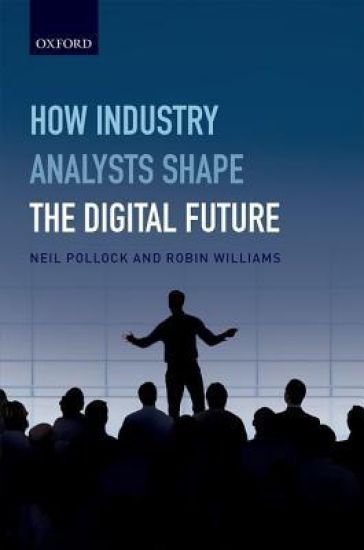
How Industry Analysts Shape the Digital Future

How Industry Analysts Shape the Digital Future

Neil Pollock; Robin Williams

Oxford University Press
2016
sidottu
Industry analysts are in the business of shaping the technological and economic future. They attempt to 'predict' what will become the next big thing; to spot new emerging trends and paradigms; to decide which hi-tech products will win out over others and to figure out which technology vendors can deliver on their promises. In just a few short years, they have developed a surprising degree of authority over technological innovation. Yet we know very little, if anything about them. This book seeks to explain how this was achieved and on what this authority rests. Who are the experts who increasingly command the attention of vendor and user communities? What is the nature of this new form of technical and business knowledge? How Industry Analysts Shape the Digital Future offers the first book length study into this rarely scrutinized form of business expertise. Contributions to this volume show how, from a small group of mainly North American players which arose in the 1970s, Gartner Inc. has emerged as clear leader of a $6 billion industry that involves several hundred firms worldwide. Through interviews and observation of Gartner Inc. and other industry analyst firms, the book explores how these firms create their predictions, market classifications and rankings, as well as with how these outputs are assessed and consumed. The book asks why many social scientists have ignored the proliferation of these new forms of management and technical expertise. In some cases scholars have 'deflated' this kind of business acumen, portraying it as arbitrary knowledge whose methods and content do not deserve enquiry. The valuable exception here has been the path-breaking work on the 'performativity' of economic, financial or accounting knowledge. Drawing upon recent performativity arguments, the book argues the case for a Sociology of Business Knowledge.
Treasure Neverland

Treasure Neverland

Neil Rennie

Oxford University Press
2016
nidottu
Treasure Neverland is about factual and fictional pirates. Swashbuckling eighteenth-century pirates were the ideal pirates of all time and tales of their exploits are still popular today. Most people have heard of Blackbeard and Captain Kidd even though they lived about three hundred years ago, but most have also heard of other pirates, such as Long John Silver and Captain Hook, even though these pirates never lived at all, except in literature. The differences between these two types of pirates - real and imaginary - are not quite as stark as we might think as the real, historical pirates are themselves somewhat legendary, somewhat fictional, belonging on the page and the stage rather than on the high seas. Based on extensive research of fascninating primary material, including testimonials, narratives, legal statements, colonial and mercantile records, Neil Rennie describes the ascertainable facts of real eighteenth-century pirate lives and then investigates how such facts were subsequently transformed artistically, by writers like Defoe and Stevenson, into realistic and fantastic fictions of various kinds: historical novels, popular melodramas, boyish adventures, Hollywood films. Rennie's aim is to watch, in other words, the long dissolve from Captain Kidd to Johnny Depp. There are surprisingly few scholarly studies of the factual pirates - properly analysing the basic manuscript sources and separating those documents from popular legends - and there are even fewer literary-historical studies of the whole crew of fictional pirates, although those imaginary pirates form a distinct and coherent literary tradition. Treasure Neverland is a study of this Scots-American literary tradition and also of the interrelations between the factual and fictional pirates - pirates who are intimately related, as the nineteenth-century writings about fictional pirates began with the eighteenth-century writings about supposedly real pirates. 'What I want is the best book about the Buccaneers', wrote Stevenson when he began Treasure Island in 1881. What he received, rightly, was indeed the best book: the sensational and unreliable History of the Pyrates (1724).
Death and Tenses

Death and Tenses

Neil Kenny

Oxford University Press
2015
sidottu
In what tense should we refer to the dead? The question has long been asked, from Cicero to Julian Barnes. Answering it is partly a matter of grammar and stylistic convention. But the hesitation, annoyance, even distress that can be caused by the 'wrong' tense suggests that more may be at stake--our very relation to the dead. This book, the first to test that hypothesis, investigates how tenses were used in sixteenth- and early seventeenth-century France (especially in French but also in Latin) to refer to dead friends, lovers, family members, enemies, colleagues, writers, officials, kings and queens of recent times, but also to those who had died long before, whether Christ, the saints, or the ancient Greeks and Romans who posthumously filled the minds of Renaissance humanists. Did tenses refer to the dead in ways that contributed to granting them differing degrees of presence (and absence)? Did tenses communicate dimensions of posthumous presence (and absence) that partly eluded more concept-based affirmations? The investigation ranges from funerary and devotional writing to Eucharistic theology, from poetry to humanist paratexts, from Rabelais's prose fiction to Montaigne's Essais. Primarily a work of literary and cultural history, it also draws on early modern grammatical thought and on modern linguistics (with its concept of aspect and its questioning of 'tense'), while arguing that neither can fully explain the phenomena studied. The book briefly compares early modern usage with tendencies in modern French and English in the West, asking whether changes in belief about posthumous survival have been accompanied by changes in tense-use.
Legal Reasoning and Legal Theory

Legal Reasoning and Legal Theory

Neil MacCormick

Clarendon Press
1994
nidottu
What makes an argument in a law case good or bad? Can legal decisions be justified by purely rational argument or are they ultimately determined by more subjective influences? These questions are central to the study of jurisprudence, and are thoroughly and critically examined in Legal Reasoning and Legal Theory, now with a new and up-to-date foreword. Its clarity of explanation and argument make this classic legal text readily accessible to lawyers, philosophers, and any general reader interested in legal processes, human reasoning, or practical logic.
Core Logic

Core Logic

Neil Tennant

Oxford University Press
2017
sidottu
Neil Tennant presents an original logical system with unusual philosophical, proof-theoretic, metalogical, computational, and revision-theoretic virtues. Core Logic, which lies deep inside Classical Logic, best formalizes rigorous mathematical reasoning. It captures constructive relevant reasoning. And the classical extension of Core Logic handles non-constructive reasoning. These core systems fix all the mistakes that make standard systems harbor counterintuitive irrelevancies. Conclusions reached by means of core proof are relevant to the premises used. These are the first systems that ensure both relevance and adequacy for the formalization of all mathematical and scientific reasoning. They are also the first systems to ensure that one can make deductive progress with potential logical strengthening by chaining proofs together: one will prove, if not the conclusion sought, then (even better!) the inconsistency of one's accumulated premises. So Core Logic provides transitivity of deduction with potential epistemic gain. Because of its clarity about the true internal structure of proofs, Core Logic affords advantages also for the automation of deduction and our appreciation of the paradoxes.