Kirjojen hintavertailu. Mukana 11 342 296 kirjaa ja 12 kauppaa.

Kirjahaku

Etsi kirjoja tekijän nimen, kirjan nimen tai ISBN:n perusteella.

747 tulosta hakusanalla Cherokee Randolph

The Nefarious Triangle of Love

The Nefarious Triangle of Love

Cherokee Grey

Lulu.com
2024
pokkari
Yanira found that one of a kind, love of your life, couple of forevers kind of love with Kaeo. He was everything she had dreamed of and more. But this amazing love came with a dark side that may be more than she bargained for. Would she be able to navigate the nefarious twists and turns designed to derail her happily ever after? Or would their love conquer all?
I'll Never Eat a Squirrel... Again and Other Short Stories
I'll Never Eat A Squirrel... Again is a collection of humorous short stories. With honesty, insight and wit, the author writes about the endeavors and enjoyments of being a housewife, mother, and daughter. Everyone can identify with the down-to-earth life experiences shared in these stories. They are a pleasing reminder of everyday encounters with family, friends, and strangers. This book is sure to make you smile and brighten your day.
Picking up the Pieces

Picking up the Pieces

Cherokee McAlpine

EBL Books
2022
pokkari
Take a journey of healing. Throughout this book, poems involving mental health, love, pain, happiness, faith, self-harm, suicide, and death, tell the story of a young girl, into early adulthood, working through her trauma and mental health.
Cherokees of the Old South

Cherokees of the Old South

Henry Thompson Malone

University of Georgia Press
2010
pokkari
First published in 1956, this book traces the progress of the Cherokee people, beginning with their native social and political establishments, and gradually unfurling to include their assimilation into “white civilization.” Henry Thompson Malone deals mainly with the social developments of the Cherokees, analyzing the processes by which they became one of the most civilized Native American tribes. He discusses the work of missionaries, changes in social customs, government, education, language, and the bilingual newspaper The Cherokee Phoenix. The book explains how the Cherokees developed their own hybrid culture in the mountainous areas of the South by inevitably following in the white man’s footsteps while simultaneously holding onto the influences of their ancestors.
The Cherokees

The Cherokees

David Narrett

HARVARD UNIVERSITY PRESS
2025
sidottu
A sweeping new history reveals how the Cherokees became a nation as they navigated a century and a half of intertribal conflicts and colonial expansion that threatened their way of life.For more than 150 years between their first encounters with the English in the 1670s and forced removal along the Trail of Tears, the Cherokees negotiated mounting pressures. As their world was convulsed by the spread of European diseases, competition for guns, furs, and deerskins, and imperial powers’ unrelenting pursuit of “savage” allies, Cherokee communities responded by creating new solidarities. At the dawn of the eighteenth century, the idea of unity among the widely dispersed Cherokees would scarcely have occurred to their leaders. A century later, chiefs would declare unequivocally that they stood for the whole Cherokee nation.Steps toward national unity were partially a response to the exigencies of war. But while armed conflict was frequent, David Narrett shows that the bonds of Cherokee peoplehood were forged primarily through efforts to maintain peace and secure their livelihoods. The Cherokees—both men and women—were remarkably skillful diplomats who practiced peacemaking as a distinctive spiritual art in which adversaries would reconcile through a mutual and symbolic forgetting of wrongs inflicted on one another. Pragmatic and purposeful, Cherokees adeptly managed relationships with colonials and Indigenous rivals, seeking to preserve their independence and living space and to maximize advantages from trade.Rich in detail and insight, and told through captivating personal stories, The Cherokees offers a portrait of the perseverance that built a nation. Amid an onslaught of struggle and change, the Cherokees became a people who survived against all odds.
The Cherokees

The Cherokees

Russell Thornton

University of Nebraska Press
1992
pokkari
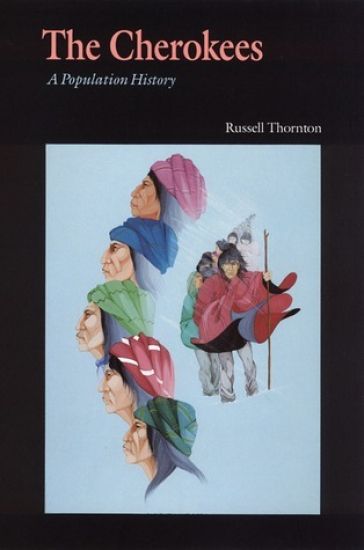
The Cherokees: A Population History is the first full-length demographic study of an American Indian group from the protohistorical period to the present. Thornton shows the effects of disease, warfare, genocide, miscegenation, removal and relocation, and destruction of traditional lifeways on the Cherokees. He discusses their mysterious origins, their first contact with Europeans (prob-ably in 1540), and their fluctuation in population during the eighteenth century, when the Old World brought them smallpox. The toll taken by massive relocations in the following century, most notably the removal of the Cherokees from the Southeast to In-dian Territory, and by warfare, predating the American Revolution and including the Civil War, also enters into Thornton's calculations. He goes on to measure the resurgence of the Cherokees in the twentieth century, focusing on such population centers as North Carolina, Oklahoma, and California.
African Cherokees in Indian Territory

African Cherokees in Indian Territory

Naylor Celia E.

The University of North Carolina Press
2008
nidottu
This book describes acculturation and resistance in the Cherokee Nation.Forcibly removed from their homes in the late 1830s, Cherokee, Creek, Choctaw, and Chickasaw Indians brought their African-descended slaves with them along the Trail of Tears and resettled in Indian Territory, present-day Oklahoma. Celia E. Naylor vividly charts the experiences of enslaved and free African Cherokees from the Trail of Tears to Oklahoma's entry into the Union in 1907. Carefully extracting the voices of former slaves from interviews and mining a range of sources in Oklahoma, she creates an engaging narrative of the composite lives of African Cherokees. Naylor explores how slaves connected with Indian communities not only through Indian customs - language, clothing, and food - but also through bonds of kinship.Examining this intricate and emotionally charged history, Naylor demonstrates that the ""red over black"" relationship was no more benign than ""white over black."" She presents new angles to traditional understandings of slave resistance and counters previous romanticized ideas of slavery in the Cherokee Nation. She also challenges contemporary racial and cultural conceptions of African-descended people in the United States. Naylor reveals how black Cherokee identities evolved reflecting complex notions about race, culture, ""blood,"" kinship, and nationality. Indeed, Cherokee freedpeople's struggle for recognition and equal rights that began in the nineteenth century continues even today in Oklahoma.
The Cherokees and Christianity, 1794–1870

The Cherokees and Christianity, 1794–1870

William G. McLoughlin

University of Georgia Press
2008
pokkari
In The Cherokees and Christianity, William G. McLoughlin examines how the process of religious acculturation worked within the Cherokee Nation during the nineteenth century. More concerned with Cherokee "Christianization" than Cherokee "civilization," these eleven essays cover the various stages of cultural confrontation with Christian imperialism.The first section of the book explores the reactions of the Cherokee to the inevitable clash between Christian missionaries and their own religious leaders, as well as their many and varied responses to slavery. In part two, McLoughlin explores the crucial problem of racism that divided the southern part of North America into red, white and black long before 1776 and considers the ways in which the Cherokees either adapted Christianity to their own needs or rejected it as inimical to their identity.
Snowbird Cherokees

Snowbird Cherokees

Sharlotte Neely; Gilliam Jackson; Trey Adcock

University of Georgia Press
2021
nidottu
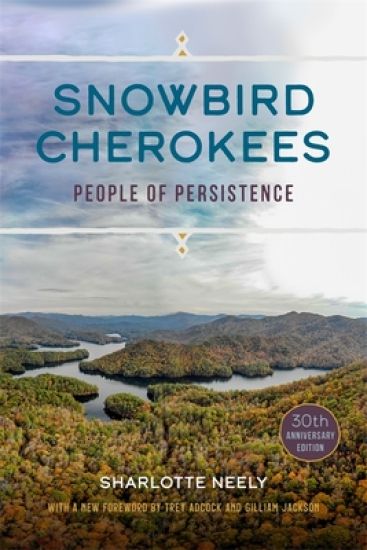
Originally published in 1991, Snowbird Cherokees has since inspired a documentary of the same name and remains the only ethnographic study of Snowbird, North Carolina, a remote mountain community of Cherokees who are regarded as simultaneously the most traditional and the most adaptive members of the entire tribe. Through historical research, contemporary fieldwork, and situational analysis, Sharlotte Neely explains the Snowbird paradox and portrays the inhabitants’ daily lives and culture. At the core of her study are detailed examinations of two expressions of Snowbird cultural self-awareness: its ongoing struggle for fair political representation on the tribal council and its yearly Trail of Tears Singing, a gathering point for all North Carolina and Oklahoma Cherokees concerned with cultural conservation. As Gilliam Jackson, a Snowbird Cherokee himself, reflects in the new foreword, Snowbird Cherokees remains a “crucial portrait” of the Snowbird community when the “vast majority of residents spoke the ? ? ? dialect.” In Jackson’s estimation, only fifty-three fluent speakers remain in ? ? ?.