Kirjojen hintavertailu. Mukana 11 699 587 kirjaa ja 12 kauppaa.

Kirjahaku

Etsi kirjoja tekijän nimen, kirjan nimen tai ISBN:n perusteella.

1000 tulosta hakusanalla Edward Carson

The Life, Letters and Literary Remains of Edward Bulwer, Lord Lytton

The Life, Letters and Literary Remains of Edward Bulwer, Lord Lytton

Edward Robert Bulwer Lytton

Cambridge University Press
2014
pokkari
One of the most popular writers of his age, outsold only by Dickens, Edward George Bulwer Lytton (1803–73), first Baron Lytton, is notable for coining the phrases 'the great unwashed' and 'the pen is mightier than the sword', although his work is largely forgotten today. G. K. Chesterton's appraisal was that 'you could not have the Victorian Age without him'. Lytton requested that his son Edward Robert (1831–91), first Earl of Lytton, complete his autobiography. Complemented by letters and previously unpublished material - the better to flesh out the story of a prolific literary life - it appeared in two volumes in 1883. In his preface, Edward Robert writes that his main purpose is 'to illustrate my father's works by his life, and his life by his works'. Volume 2 completes the biographical narrative, including details of Lytton's later political life, correspondence with Disraeli and others, and work left unfinished.
Miscellaneous Works of Edward Gibbon, Esquire

Miscellaneous Works of Edward Gibbon, Esquire

Edward Gibbon

Cambridge University Press
2014
pokkari
On the death of Edward Gibbon (1737–94), his unpublished papers were left to his friend John Baker Holroyd, first earl of Sheffield, who published them in two volumes in 1796. Gibbon had written six manuscript accounts of his own life, and, according to Sheffield, had always intended to publish his autobiography in his lifetime. The memoir as edited by Sheffield begins with Gibbon's family history, and taking in his education, travels, and career as a historian, finishes with his anxiety over the future of Europe in 1788. Sheffield then continues the story until Gibbon's death through his correspondence, providing a linking narrative, and this, together with 210 other letters to and from Gibbon, takes up Volume 1. His great work, The History of the Decline and Fall of the Roman Empire, is also reissued (in the 1896–1900 edition by J. B. Bury) in the Cambridge Library Collection.
Miscellaneous Works of Edward Gibbon, Esquire

Miscellaneous Works of Edward Gibbon, Esquire

Edward Gibbon

Cambridge University Press
2014
pokkari
On the death of Edward Gibbon (1737–94), his unpublished papers were left to his friend John Baker Holroyd, first earl of Sheffield, who published them in two volumes in 1796. Volume 2 contains abstracts from Gibbon's reading, with his reflections on what he read, and extracts from his journal (sometimes in French, with a parallel translation), short pieces on various aspects of Roman history, an outline of his planned history of the world from the ninth to the end of the fifteenth century, literary criticism, a history of the House of Brunswick (ancestors of the Hanoverian British royal family), and a riposte to a criticism of his own great work, The History of the Decline and Fall of the Roman Empire, which is also reissued (in the 1896–1900 edition by J. B. Bury) in the Cambridge Library Collection.
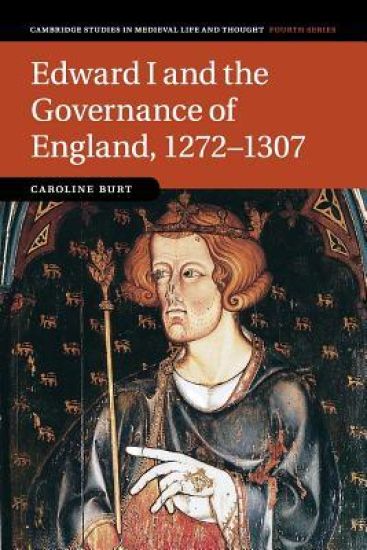
Edward I and the Governance of England, 1272–1307

Edward I and the Governance of England, 1272–1307

Caroline Burt

Cambridge University Press
2017
pokkari
This important exploration of the reign of Edward I – one of England's most lionised, feared and successful monarchs – presents his kingship in a radical new light. Through detailed case studies of Shropshire, Warwickshire and Kent, Caroline Burt examines how Edward's governance at a national level was reflected in different localities. She employs novel methodology to measure levels of disorder and the effects of government action, and uncovers a remarkably sophisticated approach to governance. This study combines an empirical examination of government with an understanding of developing political ideas and ideological motivation, and contributes towards a greater understanding of the development of local government and politics in England in the thirteenth and fourteenth centuries. Edward emerges as a king with a coherent set of ideas about the governance of his realm, both intellectually and practically, whose achievements were even more remarkable than has previously been recognised.