Kirjojen hintavertailu. Mukana 11 699 587 kirjaa ja 12 kauppaa.

Kirjahaku

Etsi kirjoja tekijän nimen, kirjan nimen tai ISBN:n perusteella.

1000 tulosta hakusanalla Frederick Locker

Mr. Midshipman Easy, By Frederick Marryat A NOVEL: Captain Frederick Marryat

Mr. Midshipman Easy, By Frederick Marryat A NOVEL: Captain Frederick Marryat

Frederick Marryat

Createspace Independent Publishing Platform
2016
nidottu
Mr. Midshipman Easy is an 1836 novel by Frederick Marryat, a retired captain in the Royal Navy. The novel is set during the Napoleonic Wars, in which Marryat himself served with distinction.Easy is the son of foolish parents, who spoiled him. His father, in particular, regards himself as a philosopher, with a firm belief in the "rights of man, equality, and all that; how every person was born to inherit his share of the earth, a right at present only admitted to a certain length that is, about six feet, for we all inherit our graves, and are allowed to take possession without dispute. But no one would listen to Mr Easy's philosophy. The women would not acknowledge the rights of men, whom they declared always to be in the wrong; and, as the gentlemen who visited Mr Easy were all men of property, they could not perceive the advantages of sharing with those who had none. However, they allowed him to discuss the question, while they discussed his port wine. The wine was good, if the arguments were not, and we must take things as we find them in this world." By the time he is a teenager Easy has adopted his father's point of view, to the point where he no longer believes in private property. Easy joins the navy, which his father believes to be the best example of an equal society, and Easy becomes friendly with a lower deck seaman named Mesty (Mephistopheles Faust), an escaped slave, who had been a prince in Africa. Mesty is sympathetic to Easy's philosophizing, which seems to offer him a way up from his lowly job of "boiling kettle for de young gentlemen"; but once Mesty is promoted to ship's corporal and put in charge of discipline, he changes his mind: "...now I tink a good deal lately, and by all de power, I tink equality all stuff." "All stuff, Mesty, why? you used to think otherwise." "Yes, Massa Easy, but den I boil de kettle for all young gentleman. Now dat I ship's corporal and hab cane, I tink so no longer." In some way Mesty is the real hero of the novel, as he pulls Easy out of several scrapes the impulsive 17-year-old gets himself into as he cruises the Mediterranean on several British ships. Easy becomes a competent officer, in spite of his notions. Easy's mother dies, and he returns home to find his father is completely mad. Easy senior has developed an apparatus for reducing or enlarging phrenological bumps on the skull, but as he attempts to reduce his own benevolence bump, the machine kills him. Easy throws out the criminal servants his father has employed and puts the estate to rights, demanding back rents from the tenants, and evicting those who will not pay. Using his new-found wealth, he formally quits the navy, rigs out his own privateering vessel, and returns to Sicily to claim his bride Agnes. As he is a wealthy gentleman now, no longer a junior midshipman, her family cannot refuse him, and he and Agnes live happily ever after...
The Phantom Ship (1839), by Frederick Marryat (Gothic novel ): Captain Frederick Marryat

The Phantom Ship (1839), by Frederick Marryat (Gothic novel ): Captain Frederick Marryat

Frederick Marryat

Createspace Independent Publishing Platform
2016
nidottu
The Phantom Ship (1839) is a Gothic novel by Frederick Marryat which explores the legend of the Flying Dutchman and, in one chapter, features a werewolf.The plot concerns the quest of Philip Vanderdecken of Terneuzen in the Netherlands to save his father - who has been doomed to sail for eternity as the Captain of the Bewitched Phantom Ship, after he made a rash oath to heaven and slew one of the crew whilst attempting to sail round the Cape of Good Hope. Vanderdecken learns upon his mother's death that there exists a way by which his father's disturbed spirit may be laid to rest, and vows to live at sea until he has spoken with his father face to face and accomplished this purpose. Vanderdecken sails around the world in a number of ships, in the employ of the Dutch East India Company, so that he can redeem his father by presenting him with the relic of the Holy Cross he wears round his neck. His quest, however, brings him into conflict with earthly and unearthly powers as the sight of the Flying Dutchman brings doom to all who encounter her. Themes--The legend of the Flying Dutchman forms the background to the story and makes regular appearances throughout the novel, while Marryat adds many other supernatural details. He introduces as the heroine, Amine, the daughter of one Mynheer Poots, a miser. Having Arab blood in her veins, she possesses some of the secrets of Arabian magic, but her incautious use of her magic arts brings her into the dungeons of the Inquisition at Goa.Likewise, there is Schrifter, the demon pilot; and Krantz, with a tale of horrors in the Harz mountains;atrocious monks; and ghosts that will not be drowned. The reviews for the novel were generally poor. The Athenaeum thought that the work "falls sadly short of the racy marine stories by which the author won his first fame". In particular, it noted that Marryat "dashes off scenes of portent and terror with the same familiar and slip-shod style ... and the result is a feebleness of effect, not to be found in his other novels."Likewise in referring to the book, The Dublin Review thought that the "falling off in his last novel ... is very considerable", and stated that "a string of extravagant adventures, carelessly put together, and heavily told, deaden curiosity, -the Flying Dutchman makes his appearance as regularly as a packetboat, and becomes at last almost as tiresome." In recent times S.T. Joshi has called the novel "an aesthetic disaster - appallingly prolix, and written in a stiff, cumbersome style that reads like a bad translation from a foreign language
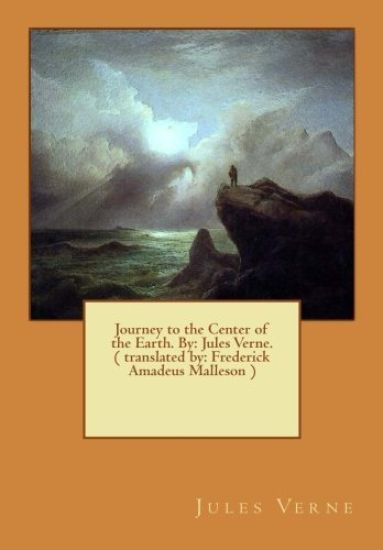
Journey to the Center of the Earth. By: Jules Verne. ( translated by: Frederick Amadeus Malleson ): novel

Journey to the Center of the Earth. By: Jules Verne. ( translated by: Frederick Amadeus Malleson ): novel

Frederick Amadeus Malleson; Jules Verne

Createspace Independent Publishing Platform
2016
nidottu
Jules Gabriel Verne was born on 8 February 1828 on le Feydeau, a small artificial island on the Loire River within the town of Nantes, in No. 4 Rue de Clisson, the house of his maternal grandmother Dame Sophie Allotte de la Fuÿe. His parents were Pierre Verne, an attorney originally from Provins, and Sophie Allote de la Fuÿe, a Nantes woman from a local family of navigators and shipowners, of distant Scottish descent. In 1829, the Verne family moved some hundred meters away to No. 2 Quai Jean-Bart, where Verne's brother Paul was born the same year. Three sisters, Anna, Mathilde, and Marie, would follow (in 1836, 1839, and 1842, respectively). In 1834, at the age of six, Verne was sent to boarding school at 5 Place du Bouffay in Nantes. The teacher, Mme Sambin, was the widow of a naval captain who had disappeared some 30 years before. Mme Sambin often told the students that her husband was a shipwrecked castaway and that he would eventually return like Robinson Crusoe from his desert island paradise. 9] The theme of the Robinsonade would stay with Verne throughout his life and appear in many of his novels, including The Mysterious Island (1874), Second Fatherland (1900), and The School for Robinsons (1882).
Letters of the Empress Frederick

Letters of the Empress Frederick

Frederick Ponsonby

Createspace Independent Publishing Platform
2016
nidottu
LETTERS OF THE EMPRESS FREDERICK, a selection of correspondence from the Empress to her mother, Queen Victoria, was published in 1928. The former Princess Royal of England, who married Prince Frederick William of Prussia in 1858, had never been popular in court circles in Germany because of her liberal influence on her husband and was known behind her back as 'die Engl nderin'. When Emperor Frederick III ascended the throne in March 1888, he was fatally stricken with cancer and died after a reign of three months. Their eldest so, who became Emperor William II, the 'Kaiser Bill' of the First World War, had no respect for their ideals. Sir Frederick Ponsonby, her godson, was entrusted with the safe keeping of her letters shortly before her death in 1901, and he took them back to England. His purpose in publishing them, in his words, was 'to allow the Empress's own words to provide the answer to those cruel and slanderous accusations from which her memory has suffered'. This new edition includes the complete text, a Foreword by John Van der Kiste, and additional illustrations.