Kirjojen hintavertailu. Mukana 12 016 292 kirjaa ja 12 kauppaa.

Kirjahaku

Etsi kirjoja tekijän nimen, kirjan nimen tai ISBN:n perusteella.

1000 tulosta hakusanalla Goethe

Goethe Yearbook 22

Goethe Yearbook 22

Camden House Inc
2015
sidottu
Cutting-edge scholarly articles on diverse aspects of Goethe and the Goethezeit, featuring in this volume a special section on environmentalism. The Goethe Yearbook is a publication of the Goethe Society of North America, encouraging North American Goethe scholarship by publishing original English-language contributions to the understanding of Goethe and other authors of the Goethezeit while also welcoming contributions from scholars around the world. Volume 22 features a special section on environmentalism, edited by Dalia Nassar and Luke Fischer, with contributions on: the metaphor of music in Goethe's scientific work and its influence on Deleuze, Merleau-Ponty, Uexküll, and Zuckerkandl (Frederick Amrine); his conceptualization of modern civilization in Faust (Gernot Böhme); a non-anthropocentricvision of nature in his writings on the intermaxillary bone (Ryan Feigenbaum); his geopoetics of granite (Jason Groves); the historical antecedents of biosemiotics in "Die Metamorphose der Pflanzen" (Kate Rigby); and the conceptof the "Dark Pastoral" in Werther (Heather I. Sullivan). In addition, there are articles on Goethe as a spiritual predecessor of phenomenology (Iris Hennigfeld); concepts of the "hermaphrodite" in contributions to theEncyclopédie by Louis de Jaucourt and Albrecht von Haller (Stephanie Hilger); on Goethe's poem "Nähe des Geliebten" (David Hill); on the link between commerce and culture in West-östlicher Divan (Daniel Purdy); on Goethe's thoughts on collecting and museums (Helmut Schneider); and on intrigues in the works of J. M. R. Lenz (Inge Stephan). Contributors: Frederick Amrine, Gernot Böhme, Ryan Feigenbaum, Luke Fischer, Jason Groves, Iris Hennigfeld, Stephanie M. Hilger, David Hill, Dalia Nassar, Daniel Purdy, Kate Rigby, Helmut J. Schneider, Inge Stephan, Heather I. Sullivan. Adrian Daub is Associate Professor of German at Stanford. Elisabeth Krimmeris Professor of German at the University of California Davis. Book review editor Birgit Tautz is Associate Professor of German at Bowdoin College.
Goethe Yearbook 23

Goethe Yearbook 23

Camden House Inc
2016
sidottu
Cutting-edge scholarly articles on diverse aspects of Goethe and the Goethezeit, featuring in this volume a special section on Goethe and visual culture. The Goethe Yearbook is a publication of the Goethe Society of North America, encouraging North American Goethe scholarship by publishing original English-language contributions to the understanding of Goethe and other authors of the Goethezeit while also welcoming contributions from scholars around the world. Volume 23 features a special section on visual culture with contributions on the visual aesthetics of Goethe's 1815 production ofProserpina (Bersier); on the Farbenlehre (Lande); on Tableaux Vivants in Goethe's Die Wahlverwandtschaften (Solanki); on the relationship between Goethe and C. G. Carus and their respective views on the representation of nature in art and science (Allert); and on visual and verbal bricolage in Clemens Brentano's Gockel, Hinkel und Gackeleia (MacLeod). There are also articles on Goethe and ancient mystery religions (Amrine); on Goethe's fairy-tale aesthetics (Brown); on the concept of neutrality (Holland); on the concept of the mathematical infinite (Smith); on virginity and maternity in Werther (Nossett); on the Classical aesthetics of Schlegel'sLucinde (ter Horst); and on motherless creations in Faust (Nielsen). Contributors: Beate Allert, Frederick Amrine, Gabrielle Bersier, Jane K. Brown, Jocelyn Holland, Joel B. Lande, Catriona MacLeod, WendyC. Nielsen, Lauren Nossett, John H. Smith, Tanvi Solanki, Eleanor ter Horst. Adrian Daub is Associate Professor of German at Stanford. Elisabeth Krimmer is Professor of German at the University of California Davis. Bookreview editor Birgit Tautz is Associate Professor of German at Bowdoin College.
Goethe Yearbook 24

Goethe Yearbook 24

Camden House Inc
2017
sidottu
Cutting-edge scholarly articles on diverse aspects of Goethe and his age, featuring in this volume a special section on the poetics of space in the Goethezeit. The Goethe Yearbook is a publication of the Goethe Society of North America, encouraging North American Goethe scholarship by publishing original English-language contributions to the understanding of Goethe and other authors of the Goethezeit while also welcoming contributions from scholars around the world. Volume 24 features a special section titled "The Poetics of Space in the Goethezeit," co-edited by John Lyon and Elliott Schreiber, with contributions on blind spots in Goethe's Elective Affinities; on the topography and topoi of Goethe's autobiographical childhood; on disorientation and the subterranean in Novalis; on selfhood, sovereignty, and public space in Die italienische Reise and Dichtung und Wahrheit; on Goethe's theater of anamnesis in Wilhelm Meisters Lehrjahre; and on spatial mobilization in Kleist's Berliner Abendblätter. There are also articles on the horror of coming home in Caroline de la Motte Fouqué's "Der Abtrünnige" and on Friedrich Heinrich Jacobi's Eduard Allwills Papiere. Contributors: Colin Benert, Stephanie Galasso, Tove Holmes, Edgar Landgraf, Sara Luly, John B. Lyon, Anthony Mahler, Monika Nenon, Joseph O'Neil, Elliott Schreiber, Inge Stephan, Gabriel Trop, Christian P. Weber. Adrian Daub is Associate Professor of German at Stanford. Elisabeth Krimmer is Professor of German at the University of California Davis. Book review editor Birgit Tautz is Associate Professor of German at Bowdoin College.
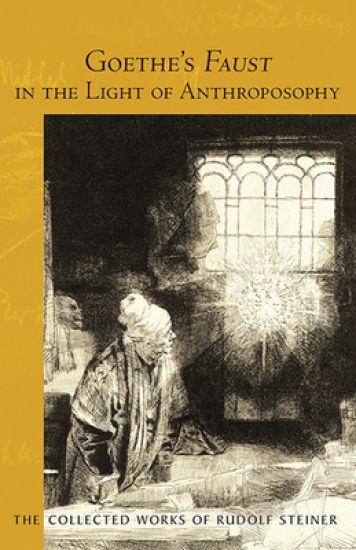
Goethe's Faust in the Light of Anthroposophy

Goethe's Faust in the Light of Anthroposophy

Rudolf Steiner

SteinerBooks, Inc
2016
nidottu
By late 1916, Rudolf Steiner had become an important interpreter of Goethe and frequently discussed Faust probably Goethe s greatest work from the perspective of anthroposophic Spiritual Science. Although Steiner s readings are unconventional and unsystematic, his insights into the text are penetrating and prescient, opening scholarly avenues not discovered or pursued by others until decades later and, in some cases, still await fuller elaboration. Steiner s account is completely unlike those of his contemporaries, including those Goethean scholars he most admired. His approach is not a philological construction of the ideal text, a positivistic account of the biographical genesis of the work or influences on Goethe, an intellectual and historical recasting of the drama as implied philosophical argument, or a view of the tale through the lens of an especially refined sensibility. Steiner s discussions veer into each of these arenas, but, invariably, he steers back to his original course, stressing the least realistic, least historical, and least romantic aspects of Goethe. Steiner contributed to the scholarship on Faust by, above all, opening new aesthetic perspectives; by revealing the centrality of Greek Mystery religion within the archetypal unconscious of Faust; by showing the duality of evil latent within Goethe s text; and by exploring an alchemical transformation of consciousness. In this volume, Steiner anticipates the best of Goethe s Faust by helping us to see the Neoplatonic Faust, the Hermetic Faust, the archetypal Faust in short, the esoteric Faust."
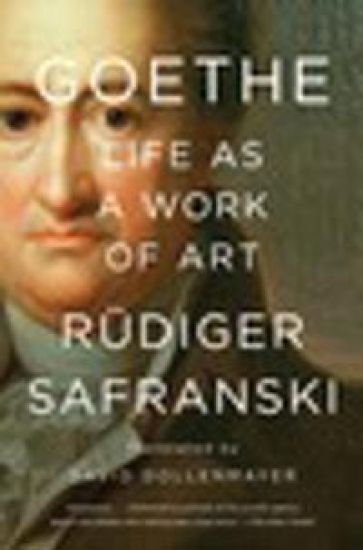
Goethe: Life as a Work of Art

Goethe: Life as a Work of Art

Rüdiger Safranski

Liveright Publishing Corporation
2019
nidottu
Here, Rüdiger Safranski sets his sights on the writer considered the Shakespeare of German literature. Goethe (1749–1832) awakened a burgeoning German nation and the European continent with his electrifying novel The Sorrows of Young Werther. Safranski scoured Goethe’s oeuvre, relying on primary sources as well as his correspondence with contemporaries and their comments to one another, to produce an illuminating portrait of the avatar of the Romantic era. Set against the cultural and political turmoil of Europe in the late eighteenth and early nineteenth centuries, Goethe, who intersected with almost every great figure of his age, is thrillingly re-created here. As Safranski shows, Goethe’s greatest creation, even in comparison to his masterpiece Faust, was his own life.
Goethe Yearbook 25

Goethe Yearbook 25

Camden House Inc
2018
sidottu
Cutting-edge scholarly articles on diverse aspects of Goethe and the Goethezeit, featuring in this volume a special section on acoustics around 1800. The Goethe Yearbook is a publication of the Goethe Society of North America, encouraging North American Goethe scholarship by publishing original English-language contributions to the understanding of Goethe and other authors of the Goethezeit while also welcoming contributions from scholars around the world. Volume 25 features a special section on acoustics around 1800, edited by Mary Helen Dupree, which includes, among others, contributionson sound and listening in Ludwig Tieck's Der blonde Eckbert (Robert Ryder) and on the role of the tympanum in Herder's aesthetic theory (Tyler Whitney). The volume also contains essays on Goethe and stage sequels(Matthew Birkhold), on figures of armament in eighteenth-century German drama (Susanne Fuchs), on the dialectics of Bildung in Wilhelm Meister (Galia Benziman), on the Gothic motif in Goethe's Faust and "Von deutscher Baukunst" (Jessica Resvick), on Goethe and Salomon Maimon (Jason Yonover), on Goethe's "Novelle" (Ehrhard Bahr), and on Schiller's Bürger critique (Hans Richard Brittnacher). Contributors: Ehrhard Bahr, Galia Benziman, Matthew H. Birkhold, Hans Richard Brittnacher, Linda Dietrick, Mary Helen Dupree, Susanne Fuchs, Deva Kemmis, Jessica C. Resvick, Robert Ryder, Patricia Anne Simpson, Chenxi Tang, Tyler Whitney, Jason Yonover, Chunjie Zhang. Adrian Daub is Associate Professor of German at Stanford University. Elisabeth Krimmer is Professor of German at the University of California Davis.
Goethe Yearbook 26

Goethe Yearbook 26

Camden House Inc
2019
sidottu
This year's volume is highlighted by a special section on Goethe's narrative events in addition to a range of other articles from emerging and established scholars. The Goethe Yearbook is a publication of the Goethe Society of North America, encouraging North American Goethe scholarship by publishing original English-language contributions to the understanding of Goethe and other authors of the Goethezeit while also welcoming contributions from scholars around the world. Volume 26 features a special section on Goethe's narrative events, with contributions on "Narrating (against) the Uncanny: Goethe's "Ballade" vs. Hoffmann's Der Sandmann," "The Absence of Events in Die Wahlverwandtschaften," and "Countering Catastrophe: Goethe's Novelle in the Aftershock of Kleist." This issue also showcases work presented atthe 2017 Atkins Goethe Conference (Re-Orientations around Goethe), including contributions by Eva Geulen on morphology and W. Daniel Wilson on the Goethe Society of Weimar in the Third Reich. In addition there are articles by emerging and established scholars on Klopstock, Schiller, Goethe and objects, dark green ecology, and texts of the Goethezeit and beyond through the lens of world literature. Book reviews conclude the volume. Contributors: Lisa Marie Anderson, Thomas O. Beebee, Fritz Breithaupt, Christopher Chiasson, Patrick Fortmann, Sean Franzel, Eva Geulen, Willi Goetschel, Stefan Hajduk, Samuel Heidepriem, Bryan Klausmeyer, Lea Pao, Elizabeth Powers, James Shinkle, Heather I. Sullivan, Christian P. Weber, W. Daniel Wilson, Karin A. Wurst. The Goethe Yearbook is edited, beginning with this volume, by Patricia Anne Simpson, Professor of German and Chairperson of Modern Languages at the University of Nebraska-Lincoln, and Birgit Tautz, George Taylor Files Professor of Modern Languages at Bowdoin College. Book Review Editor is Sean Franzel, Associate Professor of German at the University ofMissouri-Columbia.
Goethe Yearbook 27

Goethe Yearbook 27

Camden House Inc
2020
sidottu
A new Forum section focuses on the impact of Digital Humanities on Goethe scholarship and on eighteenth-century German Studies, alongside articles on a diverse range of authors and topics. The Goethe Yearbook is a publication of the Goethe Society of North America, showcasing North American and international scholarship on Goethe and other authors and aspects of the Goethezeit. Volume 27 features the yearbook's first Forum, a discussion of the impact of Digital Humanities (DH) and "computational criticism" on Goethe scholarship and eighteenth-century German Studies more broadly. For this launch, invited contributors were askedto consider the canon in comparison to "the great unread" (Margaret Cohen): the vast expanse of uncanonized texts. The contributions evince approaches that go beyond the established binary of scholarly methods vs. data sciences; they also explore DH as a way of navigating the gendered fault lines of canon formation. Beyond the Forum, there are articles on Goethe's self-marketing, on several of his major works, and on pivotal topics in them (orientation, der Gang, and transgression); on nascent anthropology, on Creativity Studies, and on other eighteenth-century figures (Rahel Levin Varnhagen, Karl Phillip Moritz). A newly discovered text by August von Kotzebue, sample entries fromthe prodigious work in progress Lexikon of Philosophical Concepts, and the customary book review section round out the volume. Richard B. Apgar, Constanze Baum, Jane K. Brown, Matt Erlin, Renata Fuchs, Matthew Handelman, Katrin Henzel, Stefan Höppner, Julie Koser, James Manalad, Clark Muenzer, Maike Oergel, Andrew Piper, Mattias Pirholt, Michael Saman, Renata Schellenberg, Helmut J. Schneider, Oliver Simons, Leif Weatherby, George S. Williamson, Karin A. Wurst. Patricia Anne Simpson is Professor of German at the University of Nebraska-Lincoln. Birgit Tautz is George Taylor Files Professor of Modern Languages at Bowdoin College. Book review editor Sean Franzel is Associate Professor of German at the University of Missouri-Columbia.
Goethe Yearbook 28

Goethe Yearbook 28

Camden House Inc
2021
sidottu
This volume's Forum section focuses on new directions in eighteenth-century German studies, alongside articles on a diverse range of topics concerning Goethe and the literature and arts of his age. The Goethe Yearbook is a publication of the Goethe Society of North America, showcasing North American and international scholarship on Goethe and other authors and aspects of the Goethezeit. Volume 28 features articles on several of Goethe's signature works (Xenien, Wahlverwandtschaften, Faust), unified by their innovative approaches. It also includes a Forum section seeking to prompt discussion of new directions in eighteenth-century German studies. An essay documenting Goethe's engagement with China and another on Goethe's legacy in post-WWII Argentina emphasize these new directions. Other essays highlight Goethe's inter-arts approaches (music,theater, collecting); interdisciplinary intersections of eighteenth-century literary studies with gender and social history; media theory; and renewed emphasis on materialism. The latter is the focus of a recently convened collaboration on early nineteenth-century inventories presented in this volume. The customary book review section rounds out the volume.
Goethe Yearbook 29

Goethe Yearbook 29

BOYDELL BREWER LTD
2022
sidottu
Volume 29 features articles on Anton Reiser; the legacies of German romanticism; Goethe's morphology and computational analysis; Goethe commemorations in Argentina; and Goethe's Weltliteratur in the context of trade with China, along with two special sections and the book review. Volume 29 features articles on Anton Reiser; the legacies and myths of German romanticism; Goethe's morphology as antecedent to computational analysis; on Goethe commemorations in Argentina; and a reconsideration of Goethe's Weltliteratur in the context of Handelsverkehr (trade) with China. Additionally, volume 29 features two special sections. The first commemorates an anniversary, Hölderlin's 250th birthday, with work devoted to "Reading and Exhibiting," compiled by Meike Werner. The other special section, on movement and edited by Heidi Schlipphacke, further explores research featured at MLA 2021 and revisits many questions of sentimentalism, visuality, and narration that are at the core of canon formation and eighteenth-century thresholds of modernity. As always, the book review section, edited by Sean Franzel, concludes the volume.
Goethe Yearbook 30

Goethe Yearbook 30

BOYDELL BREWER LTD
2023
sidottu
The Goethe Yearbook is a publication of the Goethe Society of North America, showcasing North American and international scholarship on Goethe and other authors and aspects of the late eighteenth and early nineteenth centuries. Volume 30 seeks to prompt discussion of new directions in eighteenth-century scholarship with special sections on Enlightenment legacies of race and on the robust scholarship that rethinks the eighteenth-century body beyond the human organism. Beyond the two special sections there are articles on Wieland's Alceste, several essays on sex and gender (e.g., on Goethe's Werther; on gender, genre, and authorship in La Roche and Goethe; and on continued gender bias in scholarship on the German eighteenth century), a co-authored article on Goethe's Roman elegies, and an article on performativity and gestures in Kleist. The customary book review section rounds out the volume.
Goethe Yearbook 31

Goethe Yearbook 31

BOYDELL BREWER LTD
2024
sidottu
This year's volume features a special forum on imperialism and race as well as articles and book reviews concerning Goethe and other writers of his age. This year's volume features a special forum section that stems from the discussions of the Goethe Society's virtual reading group on "Race and Imperialism in 18th-and 19th-Century Literature and Philosophy." Individual members of the reading group contribute essays that combine scholarship with personal reflections on their engagement with issues of race and imperialism over the course of their academic careers. The volume also presents several more traditionally scholarly articles that offer new approaches to and interpretations of texts by Goethe and other writers and thinkers of the period. Elizabeth Powers reads Goethe's methods of reworking text and life in autobiography, drama, and poetry. Alberto Merzari examines Goethe's and Hegel's differing engagements with the Persian poet Galal al-Din Rumi as a way of exploring the differences in their philosophical thought. Malte Meyer takes up Jochen Berg's drama Im Taurerland as a rewriting of Goethe that engages with questions of cultural imperialism, female agency, and sexuality. And Brian Tucker reads the acoustic dimensions of Eichendorff's poetry to develop a more complex understanding of the poet's relationship to Romanticism. These articles highlight the breadth of scholarship on the Age of Goethe and how differing approaches-detailed close readings, comparative studies, and more-explore its continued relevance. The volume concludes with book reviews reflecting the diversity of recent scholarship in eighteenth- and early nineteenth-century German studies. Edited by Sarah Vandegrift Eldridge and Eleanor Ter Horst. Contributors: Frederick Amrine, Claire Baldwin, Matthew Childs, Sally Hatch Gray, Joseph A. Haydt, Peter Höyng, Steven R. Huff, Waltraud Maierhofer, Catriona MacLeod, Alberto Merzari, Jennifer Mensch, Malte Meyer, Carl Niekerk, Michael Olson, Saurabh Pal, Elizabeth Powers, Daniel Purdy, Michael Saman, Patricia Anne Simpson, Margaret Strair, Michael Swellander, Brian Tucker, Christian P. Weber, David E. Wellbery.
Goethe Yearbook 32

Goethe Yearbook 32

BOYDELL BREWER LTD
2025
sidottu
This year's volume features special sections on gambling in the Age of Goethe and on Goethe and music, as well as book reviews, a translation of Lenz's "Zerbin" and other essays on the period. The Goethe Yearbook is a publication of the Goethe Society of North America, showcasing North American and international scholarship on Goethe and other authors and aspects of German literature and culture of the late eighteenth and early nineteenth centuries. In volume 32, Joanna Raisbeck analyzes two recently discovered sonnets by Karoline von Günderrode, uncovering an a priori pessimism that anticipates nineteenth-century thinkers. This is followed by Brian Donarski's scholarly introduction to and translation of Lenz's Zerbin, or Recent Philosophy-the first time this text has appeared in English. Ethan Blass reads surprising similarities in staging and visual language between Goethe's Die natürliche Tochter and Hitchcock's film Marnie, arguing that Goethe's theatrical innovations are protocinematic. The next four articles, by Claire Baldwin, Austen Hinkley, Jürgen Overhoff, and William H. Carter, offer an exploration of the theme "Gambling in the Age of Goethe." These essays touch on both canonical and forgotten figures to illuminate a rich discourse around chance, coincidence, risk management, and play that connects with key aspects of historical discourse and literary representation in the eighteenth and early nineteenth centuries. The final two pieces, by Jonathan Guez and Matthew Poon, treat musical responses to Goethe's works by Franz Schubert and Robert Schumann. A collection of book reviews that offer a comprehensive view of new work in the wider field closes the volume.
Goethe au siège de Mayence

Goethe au siège de Mayence

Alfred Mézières

Createspace Independent Publishing Platform
2018
nidottu
... C'est ce qui donne tant de prix la relation que Goethe nous a laiss e de la campagne de France. Peu de chapitres de notre histoire ont t crits dans de meilleures conditions de sinc rit . La qualit d'Allemand et de volontaire au service de la Prusse d fend l'auteur contre le soup on de nous tre trop favorable, en m me temps que sa v racit bien connue nous assure de l'exactitude de ses r cits, et que son estime pour nous, jointe son quit naturelle, l'emp che de partager les pr jug s nationaux de ses compatriotes. En racontant fid lement ce qu'il a vu, il ne se fait le flatteur d'aucune passion populaire, le complice d'aucune haine aveugle; il entend ne servir d'autre cause que celle de la v rit , il n' crit pas pour satisfaire l'opinion des Allemands, fort divis s du reste, et dont une partie fait des voeux contre l'arm e du duc de Brunswick, mais avec la pens e plus haute de les clairer sur le v ritable tat de la France, de leur apprendre les v ritables causes de l' chec de la coalition. On reconna tra la m me ind pendance de jugement, la m me l vation de vues dans le r cit du si ge de Mayence, auquel il assista l'ann e suivante, o il allait rejoindre, comme il l'avait fait en France, le r giment au service de Prusse command par le duc de Weimar. On y retrouvera galement l'exemple instructif de l' nergie que d ployaient alors nos arm es, Il ne sera peut- tre pas inutile notre g n ration de reporter les yeux vers de tels spectacles, de se rappeler quelle opinion les premiers soldats de la r publique inspiraient de leur audace et de leur patriotisme aux ennemis de la France...
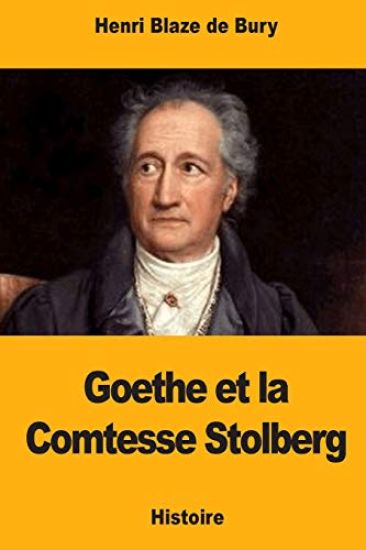
Goethe et la Comtesse Stolberg

Goethe et la Comtesse Stolberg

Henri Blaze De Bury

Createspace Independent Publishing Platform
2018
nidottu
Il existait au XVIIIe si cle un sentiment que nous ne connaissons plus aujourd'hui: on avait alors avec une femme d'esprit une liaison tout intellectuelle, pistolaire, si je puis m'exprimer ainsi, et cela sans que personne songe t le trouver mauvais, pas m me le mari, qu'on admettait tout le premier dans les secrets de la correspondance. C' tait un attachement qu'on ne d finit gu re, de l'amiti si l'on veut, mais plus tendre et plus chaleureuse, de l'amour qui pr tendait n' tre que de l'amiti , quelque chose enfin qui rappelait la chevalerie dans le monde de l'intelligence. On tenait journal l'un pour l'autre, on s' crivait mille bagatelles qui nous font sourire aujourd'hui et qui charmaient. Du reste, tout cela n'emp chait pas d'aimer ailleurs; si la pens e tait prise, le coeur ne l' tait qu' demi, et les sens restaient libres; et puis les vicissitudes de la passion formaient comme autant d' pisodes dont le roman s'embellissait. C'est ce sentiment mixte, qui n'est apr s tout que le sentiment de P trarque pour Laure, d gag du mysticisme du XVe si cle, que nous devons ces lettres de Goethe la comtesse Auguste Stolberg, avec cette circonstance tout originale que Goethe et la comtesse Stolberg ne se connaissaient que par interm diaires, et commenc rent, sans jamais s' tre vus, une correspondance des plus intimes...
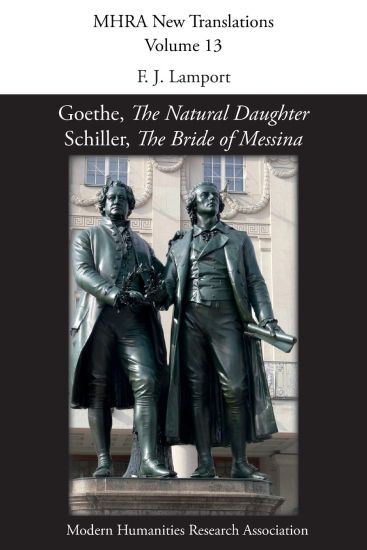
Goethe, 'The Natural Daughter'; Schiller, 'The Bride of Messina'
Written in 1802-03, The Natural Daughter and The Bride of Messina show Goethe and Schiller writing in a neo-classical manner far removed from the Sturm und Drang style of their early works. The plays reflect their authors' reaction to the troubled post-Revolutionary years of their composition -- a counter-Revolutionary one, both in an aesthetic and at least implicitly political sense. Their eponymous heroines embody hopes of restored familial harmony and political order, yet in both plays those hopes are tragically frustrated. Goethe's Eugenia, natural daughter of the Duke, is abducted and threatened with exile by a political conspiracy, and must renounce her aristocratic aspirations. Reduced to bourgeois anonymity, she hopes nevertheless one day to re-emerge and serve King and country, but the ending of the play is at best ambiguous. Schiller's Beatrice is loved by both Manuel and Cesar, brothers whose mutual hatred has plunged Messina into civil strife. Deception, misunderstanding, and a terrible secret weave a fatal web, whose unravelling leaves both brothers dead and Messina rulerless to face an uncertain future.F. J. Lamport's bold new verse translation captures the highly refined, deliberately artificial style of these two unusual plays which, though less well known than some of their authors' other works, represent a remarkable poetic achievement.
Goethe's "Exposure Of Newton's Theory": A Polemic On Newton's Theory Of Light And Colour
Johann Wolfgang von Goethe, although best known for his literary work, was also a keen and outspoken natural scientist. In the second polemic part of Zur Farbenlehre (Theory of Colours), for example, Goethe attacked Isaac Newton's ground-breaking revelation that light is heterogeneous and not immutable, as was previously thought.This polemic was unanimously rejected by the physicists of the day, and has often been omitted from compendia of Goethe's works. Indeed, although Goethe repeated all of Newton's key experiments, he was never able to achieve the same results. Many reasons have been proposed for this, ranging from the psychological — such as a blind hatred of Newtonism, self-deceit and paranoid psychosis — to accusations of incapability — Goethe simply did not understand the experiments. Yet Goethe was never to be dissuaded from this passionate conviction.This translation of Goethe's polemic, published for the first time in English, makes it clear that Goethe did understand the thrust of Newton's logic. It demonstrates that Goethe's resistance to Newton's theory stemmed from something quite different; his pantheism — the belief in the spiritual nature of light. This prevented him from allowing himself to think of light in physical terms and accepting that it is anything other than simple, immutable, and unknowable.This important new translation will be useful to natural scientists, historians, philosophers and theologians alike and will delight anyone hoping to add a further layer of nuance to Goethe's complex portrait.
Goethe's "Exposure Of Newton's Theory": A Polemic On Newton's Theory Of Light And Colour
Johann Wolfgang von Goethe, although best known for his literary work, was also a keen and outspoken natural scientist. In the second polemic part of Zur Farbenlehre (Theory of Colours), for example, Goethe attacked Isaac Newton's ground-breaking revelation that light is heterogeneous and not immutable, as was previously thought.This polemic was unanimously rejected by the physicists of the day, and has often been omitted from compendia of Goethe's works. Indeed, although Goethe repeated all of Newton's key experiments, he was never able to achieve the same results. Many reasons have been proposed for this, ranging from the psychological — such as a blind hatred of Newtonism, self-deceit and paranoid psychosis — to accusations of incapability — Goethe simply did not understand the experiments. Yet Goethe was never to be dissuaded from this passionate conviction.This translation of Goethe's polemic, published for the first time in English, makes it clear that Goethe did understand the thrust of Newton's logic. It demonstrates that Goethe's resistance to Newton's theory stemmed from something quite different; his pantheism — the belief in the spiritual nature of light. This prevented him from allowing himself to think of light in physical terms and accepting that it is anything other than simple, immutable, and unknowable.This important new translation will be useful to natural scientists, historians, philosophers and theologians alike and will delight anyone hoping to add a further layer of nuance to Goethe's complex portrait.
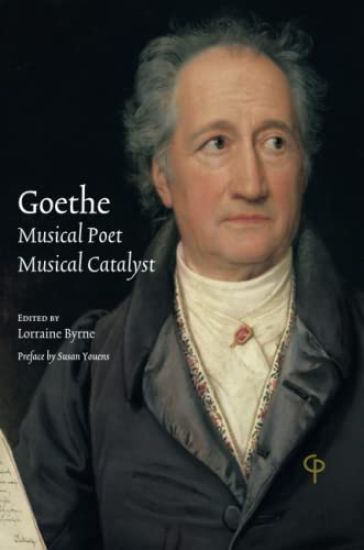
Goethe: Musical Poet, Musical Catalyst

Goethe: Musical Poet, Musical Catalyst

Peter Lang International Academic Publishers
2022
nidottu
«It was a great pleasure both to host and to participate in an international conference that brought together musicologists, composers, performers, and literary artists in stimulating and thought-provoking discourse. The collaboration of our colleagues from Queen’s University, Belfast, was particularly welcome and appreciated; they, together with distinguished international Goethians, contributed much to what was a unique 36 hours of intellectual and artistic dialogue.» Professor Gerard Gillen, Chair of Music, National University of Ireland Maynooth & Titular Organist of Dublin’s Pro-Cathedral «Goethe’s influence on the musical world is far reaching. While it seems impossible to grasp the full extent of his legacy, a sense of optimism was in the air at the Maynooth conference where we were entertained by a series of highly stimulating papers and concerts, exploring some fascinating details of Goethe’s world and his unique contributions to music. It was indeed a rare opportunity to have had such a wonderful mix of scholarly exchanges on a literary giant, Goethe, who continues to enrich our lives through his creative output.» Dr Yo Tomita, Reader in Music, Queen’s University Belfast «I have long been conscious of the modernity of much of Goethe’s writing and aware of the very direct message it can deliver to a 21st century man or woman. In particular the characters of both Mignon and the Harper in Wilhelm Meisters Lehrjahre speak to us of an all-too-familiar sense of fractured identity. It was therefore with especial pleasure that I undertook the musical setting of Goethe’s poems associated with these two vivid characters for performance at the conference. What a wonderful opportunity was afforded me to present a first performance of Goethe settings before an audience that included so many distinguished scholars of the great German writer!» Seóirse Bodley, Composer and Emeritus Professor of Music, University College Dublin «Musical performance is a fundamental part of human existence, yet years of learning and preparation lie behind it. The interpretation of music requires decisions – conscious and/or intuitive – about the meaning of musical features as well as knowledge of the historical context in which the music was written. The unique interaction of theory and practice in this conference offered scholars and performers an opportunity to unravel the complexities of performance together, and to bring to light aspects of learning and playing. Each of the authors in this volume is a leading expert in the field, and the performers, who illustrated their lectures with recitals, were of considerable experience and renown. All of these factors ensure that the essays in this volume are vital, cogent, and musically challenging.» John O’Conor, Pianist and Director of the Royal Irish Academy of Music «Goethe was interested in, and acutely aware of, the place of music in human experience generally – and of its particular role in modern culture. Moreover, his own literary work - especially the poetry and ‘Faust’ – inspired some of the major composers of the European tradition to produce some of their finest works. What is it about Goethe’s texts that invites a transformation into music? Perhaps it is his extraordinary combination of emotional immediacy and intense reflectivity. To that combination, and to the perennially fascinating question of what happens in the interplay between words and music, this volume of essays bears abundant witness.» Martin Swales, Emeritus Professor of German, University College London