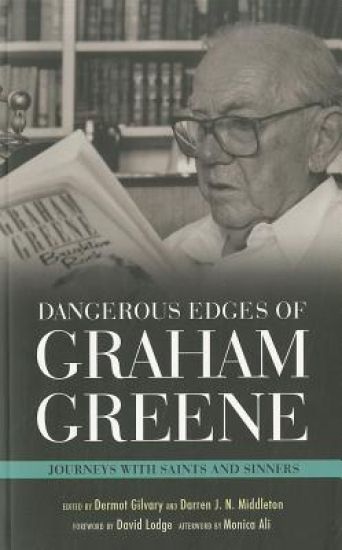
Informative, broad-ranging, this title sheds new light on the life and literary art of one of the last century's most celebrated authors. The first volume to be authorized by the Graham Greene Birthplace Trust, "Dangerous Edges of Graham Greene" brings together writers, journalists and scholars to investigate as well as to assess Greene's prolific oeuvre and intense personal interests. Here the reader may explore everything from Greene's Vienna at the time of the filming of "The Third Man" to his sometimes fraught relationship with Evelyn Waugh, from Greene's unconventional fictional treatment of women to his "believing skepticism". While Greene often informed friends that "a ruling passion gives to a shelf of novels the unity of a system", critics of his literary art have found it extraordinarily difficult to define the content of this "ruling passion". Perhaps this is because Greene's own character seems so paradoxical, ironic even. Moreover, in believing that sin contains within itself the seeds of saintliness, he consistently loiters on what Robert Browning calls "the dangerous edge of things". In exploring this "dangerous edge", this book covers the full breadth of Greene's life and literary career.
This is a complete and up-to-date reference guide to the published writings of Graham Greene, from his literary writings to published letters and interviews. A comprehensive reference guide to the published writings of Graham Greene, this book surveys not only Greene's literary work - including his fiction, poetry and drama - but also his other published writings. Accessibly organised over five central sections, the book provides the most up-to-date listing available of Greene's journalism, his published letters and major interviews. "The Writings of Graham Greene" also includes a bibliography of major secondary writings on Greene and a substantial and fully cross-referenced index to aid scholars and researchers working in the field of 20th Century literature.
Frank Porter Graham (1886–1972) was one of the most consequential white southerners of the twentieth century. Born in Fayetteville and raised in Charlotte, Graham became an active and popular student leader at the University of North Carolina. After earning a graduate degree from Columbia University and serving as a marine during World War I, he taught history at UNC, and in 1930, he became the university's fifteenth president. Affectionately known as "Dr. Frank," Graham spent two decades overseeing UNC's development into a world-class public institution. But he regularly faced controversy, especially as he was increasingly drawn into national leadership on matters such as intellectual freedom and the rights of workers. As a southern liberal, Graham became a prominent New Dealer, negotiator, and briefly a U.S. senator. Graham's reputation for problem solving through compromise led him into service under several presidents as a United Nations mediator, and he was outspoken as a white southerner regarding civil rights. Brimming with fresh insights, this definitive biography reveals how a personally modest public servant took his place on the national and world stage and, along the way, helped transform North Carolina.
Frank Porter Graham (1888 – 1972) was one of the most consequential white southerners of the twentieth century. Born in Fayetteville and raised in Charlotte, Graham became an active and popular student leader at the University of North Carolina. After earning a graduate degree from Columbia University and serving as a marine during World War I, he taught history at UNC, and in 1930, he became the university's fifteenth president. Affectionately known as "Dr. Frank," Graham spent two decades overseeing UNC's development into a world-class public institution. But he regularly faced controversy, especially as he was increasingly drawn into national leadership on matters such as intellectual freedom and the rights of workers. As a southern liberal, Graham became a prominent New Dealer and negotiator and briefly a U.S. senator. Graham's reputation for problem solving through compromise led him into service under several presidents as a United Nations mediator, and he was outspoken as a white southerner regarding civil rights.Brimming with fresh insights, this definitive biography reveals how a personally modest public servant took his place on the national and world stage and, along the way, helped transform North Carolina.
Over a 60-year career, Graham Greene was a prolific writer. While his published works established him as one of the great writers of the twentieth century, much of his writing was never to see the light of day and has been gathered together in a number of archives across the UK, Ireland, USA and Canada The second volume of The Works of Graham Greene is a comprehensive guide to the archives of Greene's writing. The book details archival holdings of unpublished novels, short stories, plays, film scripts, journals, poetry, fragments of writing, and letters, as well as manuscripts and typescripts of published works. Analysing and contextualising the unpublished work, the book is fully cross-referenced throughout and includes a substantial index as well as practical guidance for students, scholars and researchers on accessing and making the most of each of the archives.