Kirjojen hintavertailu. Mukana 11 244 527 kirjaa ja 12 kauppaa.

Kirjahaku

Etsi kirjoja tekijän nimen, kirjan nimen tai ISBN:n perusteella.

1000 tulosta hakusanalla Irene Nemirovsky

Sunrise Reef: A Hope Harbor Novel

Sunrise Reef: A Hope Harbor Novel

Irene Hannon

BAKER PUBLISHING GROUP
2025
sidottu
Sometimes you have to look beneath the surface to find the treasure withinAfter years of searching, Bren Ryan has found her place in Hope Harbor. Working as a barista suits her to a T, as does the laid-back vibe of her adopted town. Nothing is lacking in her life--except romance. But that's okay. Men are a complication she doesn't need. Buttoned-up CPA Noah Ward isn't looking for love, either, when he arrives in town on a mission to convince his father to move closer to him. And he certainly doesn't intend to fall for the quirky, free-spirited woman who's taken up residence in his father's guest cottage. But when Noah finds himself sucked into Bren's quest to help a struggling teen, might the two of them discover there's more to each other than meets the eye?Come home to Hope Harbor--where hearts heal . . . and love blooms.Praise for Sandcastle Inn"A beautiful novel about hope and a second chance."--Interviews & Reviews"Strong characters and positive yet realistic relationships . . . Fans of Debbie Macomber may also enjoy this series."--Booklist

Out of Time

Out of Time

Irene Hannon

BAKER PUBLISHING GROUP
2025
sidottu
A century-old mystery, a hidden treasure, and an isolated estate where danger lurks in every shadow.For historical anthropologist Cara Tucker, the chance to spend a sabbatical semester on a remote country estate--with full access to its vast library and century-old journals--is a dream come true . . . until a series of strange incidents begins to turn her dream into a nightmare. Someone, it seems, does not want anyone diving into the past and unearthing old ghosts. Sheriff Brad Adams has seen his share of suspicious activities during his law enforcement career, but what's happening at the isolated estate is out-of-pattern in his quiet, rural Missouri county. Beset by danger, Cara and Brad work together to try to untangle the clues.But when the peril turns lethal, the situation takes on a new urgency, and their mission is clear: Find out who is behind the string of menacing incidents before the perpetrator strikes another deadly blow. The Queen of Romantic Suspense presents another page-turning, clean thriller in her Undaunted Courage series. Fans of Colleen Coble, Patricia Bradley, and Terri Blackstock will find this shadowy tale electrifying.
Erastus Corning

Erastus Corning

Irene D. Neu

Cornell University Press
2010
pokkari
Creator and first president of the New York Central Railroad, Erastus Corning was one of the outstanding American businessmen of the midnineteenth century. Merchant and manufacturer, railroad promoter, land speculator, financier, and politician, he built a fortune from nothing to eight million dollars. In her skillfully written biographical study, Professor Neu tells the story of this man's varied and highly successful career and, in the telling, traces the pattern of domestic mercantile activity in the early and middle years of the past century. Corning is best remembered as the "architect" of the New York Central Railroad, and the author has been particularly successful in explaining the process by which he lost control of it to Cornelius Vanderbilt. Here also is a unique account of the activities of a state bank in the 1830's, both interesting and important because it was one in "the wave of state bank incorporations" that attended Jackson's attack on the Bank of the United States. Professor Neu has done a thorough job of research in the sources and treated her material with historical detachment. Lucid in organization and style, her able work answers the need for a full-scale treatment of a man whose reputation was nationwide.
Talk Fiction

Talk Fiction

Irene Kacandes

University of Nebraska Press
2002
sidottu
Everywhere you turn today, someone (or something) is talking to you--the television, the radio, cell phones, your computer. If you think some of the novels and stories you read are talking to you too, you're not alone, and you're not mistaken. In this innovative, multidisciplinary work, Irene Kacandes reads contemporary fiction as a form of conversation and as part of the larger conversation that is modern culture. Within a framework of talk as interaction, Kacandes considers texts that can be classified as "statements," that is, texts that wholly or in part ask for their readers to react-- to talk back--to them in certain ways. The works she addresses--from writers as varied as Harriet O. Wilson, Margaret Atwood, William Faulkner, Virginia Woolf, Graham Swift, G nter Grass, John Barth, Julio Cort zar, and Italo Calvino--conduct their interactions in certain modes to accomplish different sorts of cultural work: storytelling, testimony, apostrophe, and interactivity. By focusing on texts within these groupings, Kacandes is able to relate the different modes of talk fiction to extraliterary cultural developments in our oral age--and to show how such interactions, however contrary to the dominant twentieth-century view of literature as art for art's sake, help to keep literature alive and speaking to us.
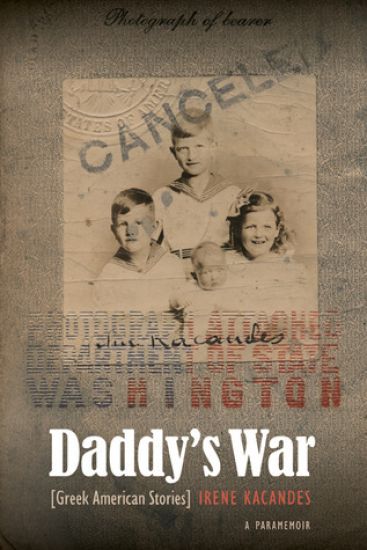
Daddy's War

Daddy's War

Irene Kacandes

University of Nebraska Press
2012
pokkari
When she was very young, Irene Kacandes knew things about her father that had no plot, no narrator, and no audience. To her childhood self these things resembled beings who resided with her family, like the ancestresses who'd thrown themselves off cliffs rather than be taken by the Turks, or the forefathers who'd fought the Trojans. For decades she thought of these cohabitants as Daddy's War Experiences and tried to stay away from them. When tragedy touched the adult life she had constructed for herself, however, she realized she had to confront her family's wartime past. Kacandes begins with what she did know: that her immigrant grandmother returned to Greece with four young children—and without her husband—only to get trapped there by the Nazi occupation. Though still a child himself, her father, John, helped feed his younger siblings by taking up any task possible, including smuggling arms to the Resistance. Kacandes painstakingly uncovers a complex truth her father chose not to tell, a truth inextricably entwined with the Holocaust, discovering, too, a common but little-told story about how the telling of such memories is negotiated between survivors and their children. Daddy's War brings new understanding to how trauma, like the revenge of Greek gods, can visit each generation and offers a model for breaking the cycle.
Talk Fiction

Talk Fiction

Irene Kacandes

University of Nebraska Press
2001
pokkari
Everywhere you turn today, someone (or something) is talking to you—the television, the radio, cell phones, your computer. If you think some of the novels and stories you read are talking to you too, you're not alone, and you're not mistaken. In this innovative, multidisciplinary work, Irene Kacandes reads contemporary fiction as a form of conversation and as part of the larger conversation that is modern culture. Within a framework of talk as interaction, Kacandes considers texts that can be classified as "statements," that is, texts that wholly or in part ask for their readers to react— to talk back—to them in certain ways. The works she addresses—from writers as varied as Harriet O. Wilson, Margaret Atwood, William Faulkner, Virginia Woolf, Graham Swift, Günter Grass, John Barth, Julio Cortázar, and Italo Calvino—conduct their interactions in certain modes to accomplish different sorts of cultural work: storytelling, testimony, apostrophe, and interactivity. By focusing on texts within these groupings, Kacandes is able to relate the different modes of talk fiction to extraliterary cultural developments in our oral age—and to show how such interactions, however contrary to the dominant twentieth-century view of literature as art for art's sake, help to keep literature alive and speaking to us.
Killing Us Quietly

Killing Us Quietly

Irene S. Vernon

University of Nebraska Press
2001
pokkari
Over the past five centuries, waves of diseases have ravaged and sometimes annihilated Native American communities. The latest of these silent killers is HIV/AIDS. The first book to detail the devastating impact of the disease on Native Americans, Killing Us Quietly fully and minutely examines the epidemic and its social and cultural consequences among three groups in three geographical areas. Through a series of personal narratives, the book also vividly conveys the terrible individual and emotional toll the disease is taking on Native lives. Exploring Native urban, reservation, and rural perspectives, as well as the viewpoints of Native youth, women, gay or bisexual men, this study combines statistics, Native demography and histories, and profiles of Native organizations to provide a broad understanding of HIV/AIDS among Native Americans. The book confronts the unique economic and political circumstances and cultural practices that can encourage the spread of the disease in Native settings. And perhaps most important, it discusses prevention strategies and educational resources. A much-needed overview of a national calamity, Killing Us Quietly is an essential resource for Natives and non-Natives alike.
Abolishing Death

Abolishing Death

Irene Masing-Delic

Stanford University Press
1992
sidottu
The idea of abolishing death was one of the most influential myth-making concepts expressed in Russian literature from 1900 to 1930, especially in the works of writers who attributed a "life-modeling" function to art. To them, art was to create a life so aesthetically organized and perfect that immortality would be an inevitable consequence. This idea was mirrored in the thought of some who believed that the political revolution of 1917 would bring about a revolution in basic existential facts: specifically, the belief that communism and the accompanying advance of science would ultimately be able to bestow physical immortality and to resurrect the dead. According to one variant, for example, the dead were to be resurrected by extrapolation from the traces of their labor left in the material world. The author finds the seeds of this extraordinary concept in the erosion of traditional religion in late-nineteenth-century Russia. Influenced by the new power of scientific inquiry, humankind appropriated various divine attributes one after the other, including omnipotence and omniscience, but eventually even aiming toward the realization of individual, physical immortality, and thus aspiring to equality with God. Writers as different as the "decadent" Fyodor Sologub, the "political" Maxim Gorky, and the "gothic" Nikolai Ognyov created works for making mortals into gods, transforming the raw materials of current reality into legend. The book first outlines the ideological context of the immortalization project, notably the impact of the philosophers Fyodorov and Solovyov. The remainder of the book consists of close readings of texts by Sologub, Gorky, Blok, Ognyov, and Zabolotsky. Taken together, the works yield the "salvation program" that tells people how to abolish death and live forever in an eternal, self-created cosmos—gods of a legend that was made possible by creative artists, imaginative scientists, and inspired laborers.
From Iron Fist to Invisible Hand

From Iron Fist to Invisible Hand

Irene S. Wu

Stanford University Press
2008
sidottu
From Iron Fist to Invisible Hand uses telecommunications policy as a window to examine major contradictions in China's growth as an economic and political superpower. While China policy analysts wonder why the government occasionally restrains growth and raises prices, technologists marvel at how the telecommunications industry continues to grow enormously despite constraints and unpredictability in the market. Frustration is pervasive in the business environment, where regulations are constantly changing. This book provides six policy-focused case studies, each centered on a question with implications for telecome stakeholders, such as: Who is the regulator?Who are the regulated? Which foreigners can enter China, thereby regulating wholesale prices, setting consumer prices, and introducing Internet and innovative technologies? These cases explain the government's liberal and conservative approach toward reform, the policies that both promote and constrain business, and the major hurdles that lie ahead in telecommunications reform.
Gospel Sermons for Children

Gospel Sermons for Children

Irene Getz

Augsburg Fortress
1995
pokkari
Gospel Sermons for Children introduces sixty new children's semons featuring gospel messages and interactive activities that help children learn as they participate. It is a valuable resource for anyone seeking to tell the Good News to young people.
Beyond the Mask

Beyond the Mask

Irene Eynat-Confino

Southern Illinois University Press
1987
sidottu
Eynat-Confino goes beyond the usual consideration of Craig's purported theories of the actor, scenery, and the scene painter to get at the heart of Craig's idea of theater.She draws not only on the research of contemporary Craig scholars but on material hitherto unavailable--his writings and daybooks and the writings of friends. She ties Craig's encounter with Isadora Duncan to a decisive modification in his notion of movement. To have an instrument more controllable than the actor, he invented the uber- marionette, a giant puppet. Craig also invented the "Scene," a kinetic stage, the "screens" that brought him worldwide fame were simply an adaptation of this concept.Eynat-Confino argues that a scenario Craig wrote in 1905, here published for the first time, reveals a theosophical system like that of Blake, a system that was the main force motivating Craig's artistic quest. In her final chapter, she carefully examines the psychological, aesthetic, and circumstantial factors that kept Craig from completing his work to bring "friendliness--humor--love--ease--peace" to the world.
Time and the Shared World

Time and the Shared World

Irene McMullin

Northwestern University Press
2013
nidottu
Time and the Shared World challenges the common view that Heidegger offers few resources for understanding humanity’s social nature. The book demonstrates that Heidegger’s reformulation of traditional notions of subjectivity has wide-ranging implications for understanding the nature of human relationships. Contrary to entrenched critiques, Irene McMullin shows that Heidegger’s characterisation of selfhood as fundamentally social presupposes the responsive acknowledgment of each person’s particularity and otherness. In doing so, McMullin argues that Heidegger’s work on the social nature of the self must be located within a philosophical continuum that builds on Kant and Husserl’s work regarding the nature of the a priori and the fundamental structures of human temporality, while also pointing forward to developments of these themes to be found in Heidegger’s later work and in such thinkers as Sartre and Levinas. By developing unrecognised resources in Heidegger’s work, Time and the Shared World is able to provide a Heidegger-inspired account of respect and the intersubjective origins of normativity.
Time and the Shared World

Time and the Shared World

Irene McMullin

Northwestern University Press
2013
sidottu
Time and the Shared World challenges the common view that Heidegger offers few resources for understanding humanity’s social nature. The book demonstrates that Heidegger’s reformulation of traditional notions of subjectivity has wide-ranging implications for understanding the nature of human relationships. Contrary to entrenched critiques, Irene McMullin shows that Heidegger’s characterisation of selfhood as fundamentally social presupposes the responsive acknowledgment of each person’s particularity and otherness. In doing so, McMullin argues that Heidegger’s work on the social nature of the self must be located within a philosophical continuum that builds on Kant and Husserl’s work regarding the nature of the a priori and the fundamental structures of human temporality, while also pointing forward to developments of these themes to be found in Heidegger’s later work and in such thinkers as Sartre and Levinas. By developing unrecognised resources in Heidegger’s work, Time and the Shared World is able to provide a Heidegger-inspired account of respect and the intersubjective origins of normativity.
The A to Z of Sweden

The A to Z of Sweden

Irene Scobbie

Scarecrow Press
2010
nidottu
Once part of the Kalmar Union-along with Denmark and Norway-the Kingdom of Sweden broke free in order to govern itself in the early 1500s, and for more than a century afterwards it was a force to be reckoned with. At its peak, it was twice the size that it is today, but with the secession of Finland in 1809 and the rise of Russia, Sweden changed its path and instead turned toward neutrality and a peaceful existence. Today, Sweden boasts a healthy economy, and it is an important member of the European Union, as well a major contributor to international activities. The A to Z of Sweden relates the history of Sweden through a chronology, a list of acronyms and abbreviations, an introductory essay, a bibliography, appendixes, and hundreds of cross-referenced dictionary entries on significant persons, events, and institutions, this dictionary provides information ranging from politics to economics, from education to religion, and from music to literature.
Francophone African Women Writers

Francophone African Women Writers

Irene Assiba D'Almeida

University Press of Florida
1994
sidottu
This single-author critical study, in English, of French-speaking African women, examines novels and autobiographies by nine writers, all published since 1975. The analysis covers three major aspects of their writings: autobiography; women and the family; and linkage with problems of society.
Papal Justice

Papal Justice

Irene Fosi

The Catholic University of America Press
2011
nidottu
Examines the motley shape of the pope’s territorial domain, the institutions found there, and the relationships between Rome and its outlying cities. Microhistories of how things worked form a clear picture of relations between the sovereign and his subjects.