Kirjojen hintavertailu. Mukana 12 016 292 kirjaa ja 12 kauppaa.

Kirjahaku

Etsi kirjoja tekijän nimen, kirjan nimen tai ISBN:n perusteella.

1000 tulosta hakusanalla John R. Fitzpatrick

Parametrized Relativistic Quantum Theory
Over the past five de-::ades researchers have sought to develop a new framework that would resolve the anomalies attributable to a patchwork formulation of relativistic quantum mechanics. This book chronicles the development of a new paradigm for describing relativistic quantum phenomena. What makes the new paradigm unique is its inclusion of a physically measurable, invariant evolution parameter. The resulting theory has been sufficiently well developed in the refereed literature that it is now possible to present a synthesis of its ideas and techniques. My synthesis is intended to encourage and enhance future research, and is presented in six parts. The environment within which the conventional paradigm exists is described in the Introduction. Part I eases the mainstream reader into the ideas of the new paradigm by providing the reader with a discussion that should look very familiar, but contains subtle nuances. Indeed, I try to provide the mainstream reader with familiar "landmarks" throughout the text. This is possible because the new paradigm contains the conventional paradigm as a subset. The foundation of the new paradigm is presented in Part II, fol!owed by numerous applications in the remaining three parts. The reader should notice that the new paradigm handles not only the broad class of problems typically dealt with in conventional relativistic quantum theory, but also contains fertile research areas for both experimentalists and theorists. To avoid developing a theoretical framework without physical validity, numerous comparisons between theory and experiment are provided, and several predictions are made.
Digital Communication

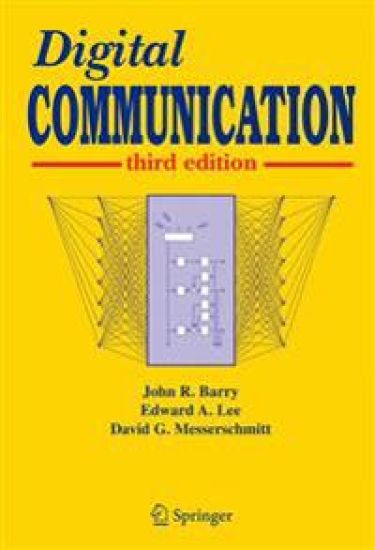
Digital Communication

John R. Barry; Edward A. Lee; David G. Messerschmitt

Springer
2003
sidottu
This book concerns digital communication. Specifically, we treat the transport of bit streams from one geographical location to another over various physical media, such as wire pairs, coaxial cable, optical fiber, and radio. We also treat multiple-access channels, where there are potentially multiple transmitters and receivers sharing a common medium. Ten years have elapsed since the Second Edition, and there have been remarkable advances in wireless communication, including cellular telephony and wireless local-area networks. This Third Edition expands treatment of communication theories underlying wireless, and especially advanced techniques involving multiple antennas, which tum the traditional single-input single-output channel into a multiple-input multiple-output (MIMO) channel. This is more than a trivial advance, as it stimulates many advanced techniques such as adaptive antennas and coding techniques that take advantage of space as well as time. This is reflected in the addition of two new chapters, one on the theory of MIMO channels, and the other on diversity techniques for mitigating fading. The field of error-control coding has similarly undergone tremendous changes in the past decade, brought on by the invention of turbo codes in 1993 and the subsequent rediscovery of Gallager's low-density parity-check codes. Our treatment of error-control coding has been rewritten to reflect the current state of the art. Other materials have been reorganized and reworked, and three chapters from the previous edition have been moved to the book's Web site to make room.
Advanced Media Planning

Advanced Media Planning

John R. Rossiter; Peter J. Danaher

Springer
1998
sidottu
Media planning consists of formulating a media strategy to deliver the creative so as to best meet the brand's advertising objectives, and then implementing that strategy in an accurate and cost-effective manner. Given that approximately ninety percent of advertising dollars are spent in media, a sound understanding of media planning is essential for the researcher and professional media planner alike. Although this book provides a novel and advanced approach to media planning, the basics are covered as well, making the book suitable for trainees. The authors argue that current media planning is still too conventional, that while reach and frequency are not incorrect, they are certainly too simplistic for modern media planning. This book introduces the advanced concept of using reach patterns in making the reach decision, and develops the method of factoring in effective frequency when making the frequency decision. Reach patterns are an entirely new concept. Effective frequency, while not new, needs proper definition and an operational formula for its calculation, both of which are provided here. Other new concepts are introduced and shown to be necessary for choosing an appropriate media strategy. The media planning software, `Media Mania', designed by Peter Danaher, can be downloaded using the following link: http://www.mbs.edu/Media-Mania-Software/.
Wireless Infrared Communications

Wireless Infrared Communications

John R. Barry

Springer
1994
sidottu
The demand for wireless access to network services is growing in virtually all communications and computing applications. Once accustomed to unteathered opera­ tion, users resent being tied to a desk or a fixed location, but will endure it when there is some substantial benefit, such as higher resolution or bandwidth. Recent technolog­ ical advances, however, such as the scaling of VLSI, the development of low-power circuit design techniques and architectures, increasing battery energy capacity, and advanced displays, are rapidly improving the capabilities of wireless devices. Many of the technological advances contributing to this revolution pertain to the wireless medium itself. There are two viable media: radio and optical. In radio, spread-spectrum techniques allow different users and services to coexist in the same bandwidth, and new microwave frequencies with plentiful bandwidth become viable as the speed of the supporting low-cost electronics increases. Radio has the advantage of being available ubiquitously indoors and outdoors, with the possibility of a seam­ less system infrastructure that allows users to move between the two. There are unan­ swered (but likely to be benign) biological effects of microwave radiation at higher power densities. Optical communications is enhanced by advances in photonic devices, such as semiconductor lasers and detectors. Optical is primarily an indoor technology - where it need not compete with sunlight - and offers advantages such as the immediate availability of a broad bandwidth without the need for regulatory approval.
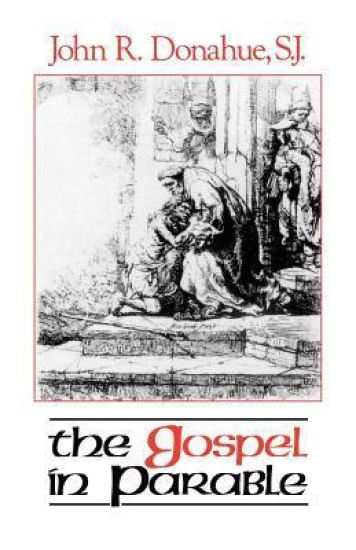
The Gospel in Parable

The Gospel in Parable

John R. Donahue

Augsburg Fortress
1988
pokkari
Professor Donahue here argues that "the parables of Jesus" offer a Gospel in miniature, while at the same time giving shape, direction, and meaning to the Gospels in which they appear. "To study the parables of the Gospels is to study the gospel in parable." After surveying recent discussions of parable, metaphor, and narrative, Donahue examines and interprets the parables of Mark, Matthew, and Luke as texts in the context of the theology of each of these Gospels. Finally, he outlines what "The Gospel in Parable" looks like and offers suggestions for the proclamation of parables today.
The Character of Theology – An Introduction to Its Nature, Task, and Purpose

The Character of Theology – An Introduction to Its Nature, Task, and Purpose

John R. Franke

Baker Academic, Div of Baker Publishing Group
2005
nidottu
Theology done in today's context is strikingly different from past evangelical approaches. In this new project John Franke, writing with our postmodern world in mind, reflects these directions. He offers an introduction to theology that covers the usual territory, but does so attuned to today's ecclesial and cultural context.In contradistinction to more traditional works, Franke:- critiques traditional evangelical theological conceptions- emphasizes the "local" nature of theology- engages the postmodern context- contrasts conservative and postconservative approaches- interacts with the broader faith communitySure to provoke intense discussion, The Character of Theology will help Christians to be faithful in a world in which the spiritual and intellectual landscape is ever changing.
Missional Theology – An Introduction

Missional Theology – An Introduction

John R. Franke

Baker Academic, Div of Baker Publishing Group
2020
nidottu
The notion of missional church and theology has become ubiquitous in the current ecclesial and theological landscape. But what is it all about?In this clear and accessible introduction to missional theology, noted theologian John Franke connects missional Christianity with the life and practice of the local church. He helps readers reenvision theology, showing that it flows from an understanding of the missional character and purposes of God. Franke also explores the implications of missional theology, such as plurality and multiplicity.
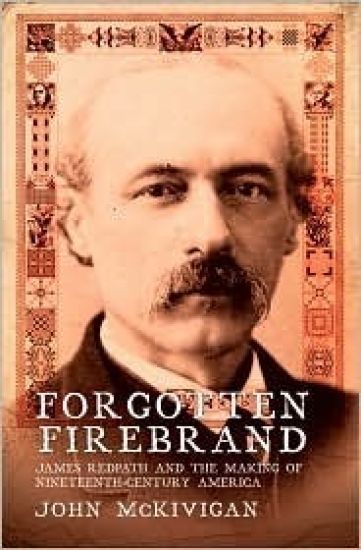
Forgotten Firebrand

Forgotten Firebrand

John R. McKivigan

Cornell University Press
2008
sidottu
The reformer James Redpath (1833–1891) was a focal figure in many of the key developments in nineteenth-century American political and cultural life. He befriended John Brown, Samuel Clemens, and Henry George and, toward the end of his life, was a ghostwriter for Jefferson Davis. He advocated for abolition, civil rights, Irish nationalism, women's suffrage, and labor unions. In Forgotten Firebrand, the first full-length biography of this fascinating American, John R. McKivigan portrays the many facets of Redpath's life, including his stint as a reporter for the New York Tribune, his involvement with the Haitian emigration movement, and his time as a Civil War correspondent. Examining Redpath's varied career enables McKivigan to cast light on the history of journalism, public speaking, and mass entertainment in the United States. Redpath's newspaper writing is credited with popularizing the stenographic interview in the American press, and he can be studied as a prototype for later generations of newspaper writers who blended reportage with participation in reform movements. His influential biography of John Brown justified the use of violent actions in the service of abolitionism. Redpath was an important figure in the emerging professional entertainment industry in this country. Along with his friend P. T. Barnum, Redpath popularized the figure of the "impresario" in American culture. Redpath's unique combination of interests and talents—for politics, for journalism, for public relations—brought an entrepreneurial spirit to reform that blurred traditional lines between business and social activism and helped forge modern concepts of celebrity.
The War Against Proslavery Religion

The War Against Proslavery Religion

John R. McKivigan

Cornell University Press
2009
pokkari
Reflecting a prodigious amount of research in primary and secondary sources, this book examines the efforts of American abolitionists to bring northern religious institutions to the forefront of the antislavery movement. John R. McKivigan employs both conventional and quantitative historical techniques to assess the positions adopted by various churches in the North during the growing conflict over slavery, and to analyze the stratagems adopted by American abolitionists during the 1840s and 1850s to persuade northern churches to condemn slavery and to endorse emancipation. Working for three decades to gain church support for their crusade, the abolitionists were the first to use many of the tactics of later generations of radicals and reformers who were also attempting to enlist conservative institutions in the struggle for social change. To correct what he regards to be significant misperceptions concerning church-oriented abolitionism, McKivigan concentrates on the effects of the abolitionists' frequent failures, the division of their movement, and the changes in their attitudes and tactics in dealing with the churches. By examining the pre-Civil War schisms in the Presbyterian, Baptist, and Methodist denominations, he shows why northern religious bodies refused to embrace abolitionism even after the defection of most southern members. He concludes that despite significant antislavery action by a few small denominations, most American churches resisted committing themselves to abolitionist principles and programs before the Civil War. In a period when attention is again being focused on the role of religious bodies in influencing efforts to solve America's social problems, this book is especially timely.
Democracy and Markets

Democracy and Markets

John R. Freeman

Cornell University Press
1989
pokkari
Events of the 1970s and 1980s have provoked intense controversy about the desirability of existing political and economic institutions. On the basis of an analysis of social welfare in varying types of market systems and in certain democratic political systems, Democracy and Markets illuminates alternative directions for institutional reform. Examining in detail the experiences of several democratic European countries, John R. Freeman considers whether a mixed ownership structure is preferable to a private ownership structure; and whether a pluralist type of democratic politics is preferable to a corporatist type. Freeman compares the benefits of the two economic and two political systems separately, and then analyzes the workings of four basic political economies. This analysis yields a welfare taxonomy for alternative forms of democratic capitalism and more specifically a characterization of the blends of collective gain and distributional equity that can be achieved in the four systems. Freeman demonstrates the validity of this taxonomy through an empirical investigation of the political economies of Britain, Austria, Sweden, and Italy. Under current conditions, he concludes, the corporatist-mixed system produces the most desirable blend of welfare outcomes.
A History of American Higher Education

A History of American Higher Education

John R. Thelin

Johns Hopkins University Press
2004
sidottu
Colleges and universities are among the most cherished institutions in American society-and also among the most controversial. Yet affirmative action and skyrocketing tuition are only the most recent dissonant issues to emerge. Recounting the many crises and triumphs in the long history of American higher education, historian John Thelin provides welcome perspective on this influential aspect of American life. In A History of American Higher Education, Thelin offers a wide-ranging and engaging account of the origins and evolution of America's public and private colleges and universities, emphasizing the notion of saga-the proposition that institutions are heirs to numerous historical strands and numerous attempts to address such volatile topics as institutional cost and effectiveness, admissions and access, and the character of the curriculum. Thelin draws on both official institutional histories and the informal memories that constitute legends and lore to offer a fresh interpretation of an institutional past that reaches back to the colonial era and encompasses both well-known colleges and universities and such understudied institutions as community, women's, and historically black colleges, proprietary schools, and freestanding professional colleges. Thelin's lively history has particular relevance for a society still struggling to determine what constitutes a legitimate field of study, reminding readers that Harvard once used its medical school as a safe place to admit the sons of wealthy alumni who could not pass the undergraduate college admissions examination and that the University of Pennsylvania once considered the study of history, government, and economics unworthy of addition to the liberal arts curriculum. Thelin also addresses the role of local, state, and federal governments in colleges and universities, as well as the influence of private foundations and other organizations. And through imaginative interpretation of films, novels, and popular magazines, he illuminates the convoluted relationship between higher education and American culture. For anyone attempting to understand America's colleges and universities, A History of American Higher Education offers a much-needed challenge to conventional wisdom about how these institutions developed and functioned in the past.
A History of American Higher Education

A History of American Higher Education

John R. Thelin

Johns Hopkins University Press
2004
pokkari
Colleges and universities are among the most cherished institutions in American society-and also among the most controversial. Yet affirmative action and skyrocketing tuition are only the most recent dissonant issues to emerge. Recounting the many crises and triumphs in the long history of American higher education, historian John Thelin provides welcome perspective on this influential aspect of American life. In A History of American Higher Education, Thelin offers a wide-ranging and engaging account of the origins and evolution of America's public and private colleges and universities, emphasizing the notion of saga-the proposition that institutions are heirs to numerous historical strands and numerous attempts to address such volatile topics as institutional cost and effectiveness, admissions and access, and the character of the curriculum. Thelin draws on both official institutional histories and the informal memories that constitute legends and lore to offer a fresh interpretation of an institutional past that reaches back to the colonial era and encompasses both well-known colleges and universities and such understudied institutions as community, women's, and historically black colleges, proprietary schools, and freestanding professional colleges. Thelin's lively history has particular relevance for a society still struggling to determine what constitutes a legitimate field of study, reminding readers that Harvard once used its medical school as a safe place to admit the sons of wealthy alumni who could not pass the undergraduate college admissions examination and that the University of Pennsylvania once considered the study of history, government, and economics unworthy of addition to the liberal arts curriculum. Thelin also addresses the role of local, state, and federal governments in colleges and universities, as well as the influence of private foundations and other organizations. And through imaginative interpretation of films, novels, and popular magazines, he illuminates the convoluted relationship between higher education and American culture. For anyone attempting to understand America's colleges and universities, A History of American Higher Education offers a much-needed challenge to conventional wisdom about how these institutions developed and functioned in the past.
Taking Charge of Your Health

Taking Charge of Your Health

John R. Burton; William J. Hall

Johns Hopkins University Press
2010
sidottu
Frustrated with doctors' visits that last less than fifteen minutes? Unclear about how to best choose a physician? Confused by our complicated health care system? Experienced geriatricians John R. Burton and William J. Hall can help you take charge of your own health and get the best care available. Drs. Burton and Hall have decades of experience helping seniors navigate this country's complex health care system. They distill that knowledge here, providing you with the information you need to skillfully communicate with your health care providers. This book addresses such questions as* Do I need a general physician, or a specialist, or both?* What does a geriatrician do?* How do I prepare for and get the most out of a visit to the doctor?* What screening exams should I undergo?* What is the best way to take my medications? As you grow older, it is more important than ever to maintain good health. To do so, you need to know how to best access the health care system and improve your personal health practices. In Taking Charge of Your Health, you will find practical advice from two senior geriatricians on how to do both. Drs. Burton and Hall emphasize that you are unlikely to receive good health care unless you work for it. They urge older adults to ask questions, become informed, and obtain the care they deserve.
Taking Charge of Your Health

Taking Charge of Your Health

John R. Burton; William J. Hall

Johns Hopkins University Press
2010
pokkari
Frustrated with doctors' visits that last less than fifteen minutes? Unclear about how to best choose a physician? Confused by our complicated health care system? Experienced geriatricians John R. Burton and William J. Hall can help you take charge of your own health and get the best care available. Drs. Burton and Hall have decades of experience helping seniors navigate this country's complex health care system. They distill that knowledge here, providing you with the information you need to skillfully communicate with your health care providers. This book addresses such questions as* Do I need a general physician, or a specialist, or both?* What does a geriatrician do?* How do I prepare for and get the most out of a visit to the doctor?* What screening exams should I undergo?* What is the best way to take my medications? As you grow older, it is more important than ever to maintain good health. To do so, you need to know how to best access the health care system and improve your personal health practices. In Taking Charge of Your Health, you will find practical advice from two senior geriatricians on how to do both. Drs. Burton and Hall emphasize that you are unlikely to receive good health care unless you work for it. They urge older adults to ask questions, become informed, and obtain the care they deserve.
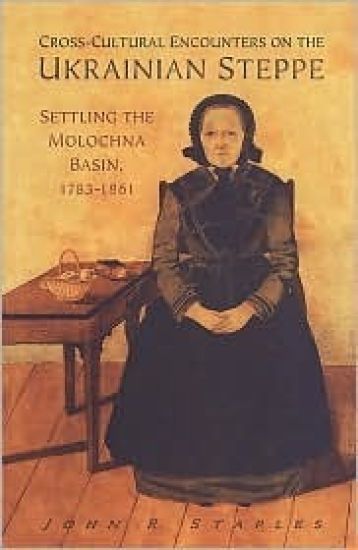
Cross-Cultural Encounters on the Ukrainian Steppe

Cross-Cultural Encounters on the Ukrainian Steppe

John R. Staples

University of Toronto Press
2003
sidottu
A regional history of colonization and adaptation in southern Ukraine, Cross-Cultural Encounters on the Ukrainian Steppe examines how diverse agrarian groups, faced with common environmental, economic, and administrative conditions, followed sharply divergent paths of development. Using a wide variety of sources, including local Ukrainian and Russian archives never before examined by a western scholar, John Staples compares and contrasts how the Mennonites, Nogais, Russians, Ukrainians, and other groups transformed their environments and adapted to life in the Molochna Valley. Staples contends that the allocation and use of land formed a central hub around which public life in Molochna revolved, and determined the success or failure of each group. Ultimately, he concludes, it was the settlers, not the state, who decided how they would adapt to the arid southern Ukrainian steppe. Perhaps most importantly, Staples makes a major contribution to the investigation of how peasant groups can emerge from their traditionalist mentality and life-style as the Mennonites of Molochna did. His thoughtful analysis will be a welcome addition to the study of both Tsarist peasant history and Russian and Ukrainian agricultural and peasant history.
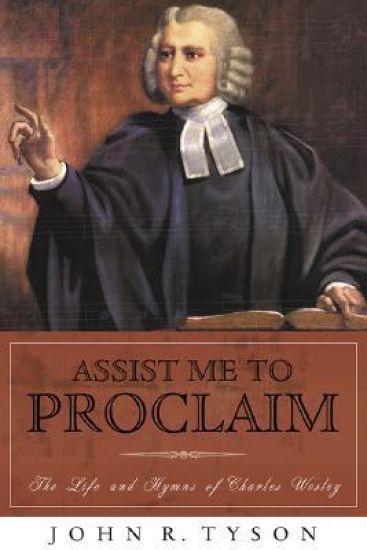
Assist Me to Proclaim

Assist Me to Proclaim

John R. Tyson

William B Eerdmans Publishing Co
2008
nidottu
Charles Wesley (1707-1788) was the cofounder of Methodism and the author of more than 9,000 hymns and sacred poems, including such favorites as -Hark! the Herald Angels Sing, - -O for a Thousand Tongues to Sing, - and -Christ the Lord Is Risen Today.- John Tyson here traces the remarkable life of this influential man from cradle to grave, using rare -- including previously unpublished -- hymns, letters, and journal materials. As the younger brother of John Wesley, Charles was a vital partner in the Methodist revival. While often standing in the shadow of his more famous brother, Charles Wesley was arguably the founder of the Oxford Holy Club, and he actually experienced evangelical conversion three days prior to John. In Assist Me to Proclaim Tyson explores, among other things, behind-the-scenes questions about the brothers' sometimes-stormy relationship. Notwithstanding all his accomplishments as an evangelist and itinerant preacher, Charles is chiefly remembered for his startling facility at writing hymns that show God at work in almost every instance of life. His remarkable legacy endures around the world, as hundreds of Charles Wesley hymns are still sung in churches everywhere today.Assist Me to Proclaim draws a picture of a man whose fidelity to both the Church of England and the original vision of Methodism energized his remarkable abilities as a revivalist and hymn writer. Readers also get a glimpse into Wesley's heart and mind through the window of his hymn texts. This is a biography that any student of church history or hymnody will welcome.
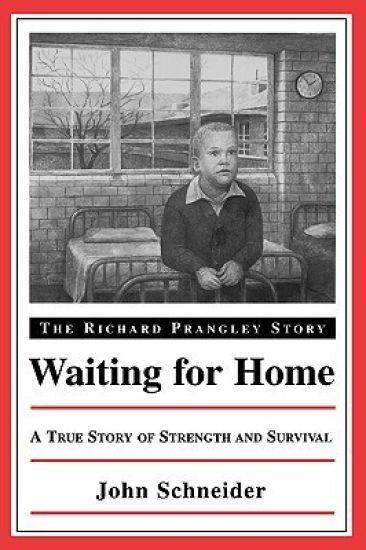
Waiting for Home

Waiting for Home

John R. Schneider

William B Eerdmans Publishing Co
1998
pokkari
Richard Prangley was unjustly institutionalized for fifteen years. Yet he managed to become not only a productive citizen but also an effective advocate for the developmentally disabled. In Waiting for Home, journalist John Schneider chronicles the compelling true story of Richard Prangley. Born prematurely, Richard exhibited delayed development and hyperactivity as a small child. His parents struggled to raise him along with their other 10 children, and they turned to the medical authorities for help. Based on the diagnoses of two psychiatrists, Richard at age 6 was committed to the Coldwater State Home and Training School, an institution for physically and mentally disabled children. He was labeled retarded and his schooling and work experience were limited to manual labor. When he was finally released at age 21, Prangley struggled with socialization as he learned to live on his own. His life today, however, stands in sharp contrast to his early years. Through faith, hope, determination, and a constant yearning for independence, Prangley is self-supporting and works in the Office Services Division of the Michigan Department of Community Health.He is an effective advocate for the developmentally disabled and has been instrumental in creating a successful stand for the rights of the handicapped as a lobbyist in such places as the Michigan State Capitol and the White House. Richard Prangley, whose story has been the focus of a documentary and wide national media coverage, including CBS's Sunday Morning, is an inspirational figure whose life reflects the human spirit at its resilient, triumphant best.
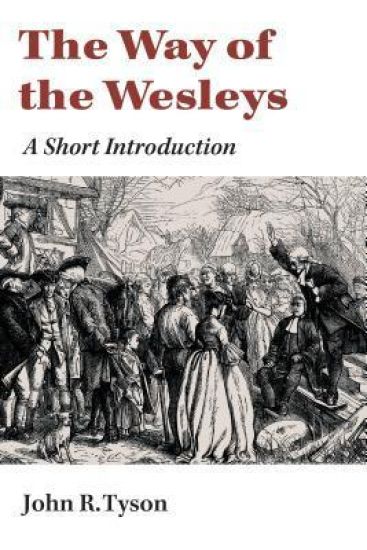
Way of the Wesleys

Way of the Wesleys

John R. Tyson

William B Eerdmans Publishing Co
2014
nidottu
The Wesley brothers - John (1703-1791) and Charles (1707-1788) - are famous as the cofounders of the Wesleyan tradition and the Methodist family of churches. Their impact and legacy have been huge: what began as the excited outpouring of their conversion experiences grew into a transatlantic revival and became a vibrant and significant theological tradition. But what exactly did they believe and teach?In this book John Tyson, an acknowledged authority on Methodist studies, offers a helpful introduction to the main teachings and practices of both John and Charles Wesley. The first book to show how Charles, the younger and lesser-known brother, contributed in particular to Wesleyan theology, The Way of the Wesleys takes readers through main theological points thematically. Tyson also includes suggestions for further reading and questions for reflection at the end of each chapter.Lavishly documented from the Wesleys' own writings, this engaging, accessible book shows why the Wesleys remain relevant to the faith journey of Christians today.