Kirjojen hintavertailu. Mukana 11 699 587 kirjaa ja 12 kauppaa.

Kirjahaku

Etsi kirjoja tekijän nimen, kirjan nimen tai ISBN:n perusteella.

1000 tulosta hakusanalla Kenneth Neill Cameron

Relational Being

Relational Being

Kenneth J. Gergen

Oxford University Press Inc
2011
nidottu
Relational Being first builds on the broad discontent with the individualist tradition in which the rational agent, or autonomous self, is considered the fundamental atom of social life. Speaking to scholars and social practitioners, the work sets out to develop and illustrate a far more radical and potentially exciting landscape of relational thought and practice. It carves out a space of understanding in which relational process stands prior to the very concept of the individual. More broadly, the book attempts to develop a thoroughgoing relational account of human activity. As Gergen proposes, all meaning grows from coordinated action, or coaction, and thus, all that we hold to be real, rational, and valuable depends on the well-being of our relationships. Gergen reconstitutes "the mind" as a manifestation of relationships and bears out these ideas in everyday life and professional practices, including psychotherapy, collaborative classrooms, and organizational development. He questions the idea of mental illness, and focuses on therapy as a means of fostering relational recovery. Gergen also explores the ways in which what we call "knowledge" issues from communities, rather than from individual minds. The volume concludes with an innovative exploration of moral action and spirituality.
Pride and Joy

Pride and Joy

Kenneth Barish

Oxford University Press Inc
2012
nidottu
Pride and Joy provides guidance to parents on how they can preserve and strengthen feelings of joyfulness and pride in their relationships with their children, while also nurturing their children's optimism and resilience in the face of life's inevitable disappointments. Kenneth Barish, a child psychologist with over 30 years of clinical experience, begins with a discussion of the importance of the child's emotions - and our own - in optimal child development. In Part I, he presents a child therapist's understanding, supported by scientific research, of healthy and unhealthy emotional development in childhood - what goes right and what goes wrong in the lives healthy and troubled children and families. In Part II, the author discusses four principles of emotional health and character development: Positiveness, Repair, Getting Along with Others, and the development of A Moral Self. Part III addresses problems of daily family life - rules and limits, doing homework and going to sleep, winning and losing at games, our children's reluctance to talk to us, their tantrums and lack of motivation, and their addiction to television and video games. Barish presents recommendations for solving these common problems that so often erode the joyfulness of children and adults' pleasure in being a parent. Over the course of the book, Barish also tackles some of the major issues and controversies of contemporary parenting: Have we created a "culture of indulgence" that is harmful to our society and to our children? Are we over-protective and over-solicitous? Are our children "over-praised?" How can we balance our concern for our children's achievement with their responsibilities as citizens? How can we strengthen their sense of purpose and their commitment to ideals? How can we provide our children with effective guidance and discipline when children, as they inevitably will, misbehave? Barish also informs parents of recent advances in developmental, clinical, and neuroscience research - research that has important implications for children's emotional health. These include the importance of emotional communication in families, the profound importance of interactive play in children's social and emotional development, and what kind of praise is helpful to children. He also discusses the importance of "doing for others" and recent research on television and video game violence, and new knowledge of what really works when parents must discipline our children. This book is written for parents of young children - those struggling with chronic child behavior problems as well as those who simply wish to parent mindfully and compassionately, and who are interested in how the latest developmental research can inform good parenting practices.
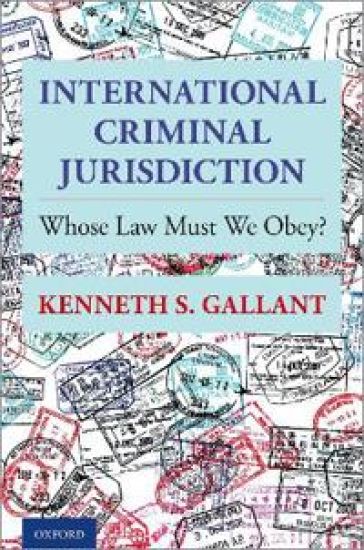
International Criminal Jurisdiction

International Criminal Jurisdiction

Kenneth S. Gallant

Oxford University Press Inc
2022
sidottu
International Criminal Jurisdiction is a treatise for anyone conducting research into how domestic and international regimes create and enforce rules for personal and subject matter jurisdiction in transnational or international criminal cases. It is the only such treatise in English on this topic. Attorneys representing corporate executives in white collar criminal cases will be able to use this book to construct challenges to a foreign court's exercise of jurisdiction over those clients. Legal scholars wishing to critique foreign domestic courts for defying suppression treaties will find in this book information on how and why those courts are doing so. Law students will turn to this book for distinctions between international criminal tribunals and domestic courts in the exercise of personal jurisdiction over government officials. The book provides complete details on how domestic legislatures and the U.N. have created statutory and treaty-based rules expanding or even limiting courts' and tribunals' jurisdiction over certain crimes and certain categories of defendants. This research serves the book's function as a thorough guide to jurisdictional questions that arise when criminal acts or criminals cross borders. Questions include whether a defendant possesses standing to challenge an international tribunal's personal jurisdiction over him, what happens when a given domestic regime neglects to criminalize conduct prohibited by a new treaty, and why some domestic courts choose not to exercise extraterritorial jurisdiction.
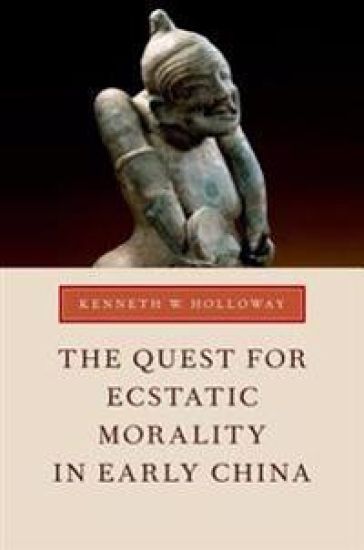
The Quest for Ecstatic Morality in Early China

The Quest for Ecstatic Morality in Early China

Kenneth W. Holloway

Oxford University Press Inc
2013
nidottu
There is an intense love of freedom evident in the "Xing zi mingchu," a text last seen when it was buried in a Chinese tomb in 300 B.C.E. It tells us that both joy and sadness are the ecstatic zenith of what the text terms "qing." Combining emotions into qing allows them to serve as a stepping stone to the Dao, the transcendent source of morality for the world. There is a process one must follow to prepare qing: it must be beautified by learning from the classics written by ancient sages. What is absent from the process is any indication that the emotions themselves need to be suppressed or regulated, as is found in most other texts from this time. The Confucian principles of humanity and righteousness are not rejected, but they are seen as needing our qing and the Dao. Holloway argues that the Dao here is the same Dao of Laozi's Daode jing. As a missing link between what came to be called Confucianism and Daoism, the "Xing zi mingchu" is changing the way we look at the history of religion in early China.
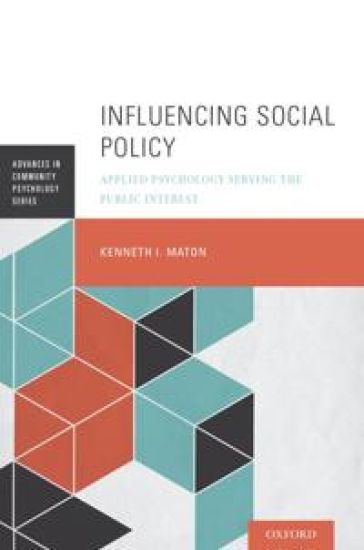
Influencing Social Policy

Influencing Social Policy

Kenneth I. Maton

Oxford University Press Inc
2016
nidottu
Influencing Social Policy synthesizes current knowledge about how psychologists influence social policy to serve the public interest. The volume builds upon interviews with 79 applied psychologists about their experiences in the policy domain, with special focus on the work of applied developmental psychologists, applied social psychologists, and community psychologists. Additional foundations of the volume include a review of social science scholarship across a wide range of disciplines, and author Kenneth Maton's 30 years of teaching on the topic, including frequent interactions with Washington, DC, policy experts. Together, these sources provide in-depth information about how applied psychologists influence social policy, the factors that contribute to their success, the challenges they face, and the approaches used to address those challenges. The policy influences described span all three branches of government: legislative, executive, and judicial. The policy content areas are diverse, including the death penalty prohibition for adolescents, early childhood education, gay marriage, gender discrimination in the workplace, health and mental health care reform, homelessness, home visiting programs, sexually abused child witness treatment, status offender diversion from the juvenile justice system, substance abuse prevention, and many others. Influencing Social Policy is a must-have resource for graduate students and professionals in a wide variety of disciplines with interests in influencing social policy, including psychology, education, public health, social work, policy studies, anthropology, and sociology.
The Arid Zones

The Arid Zones

Kenneth Walton

AldineTransaction
2007
nidottu
The hot and temperate deserts and their marginal steppe lands comprise one-third of the land surface of the world and are an increasingly critical area for the economic wellbeing of world populations. The remarkable mechanisms of floral, faunal, and human adaptation to the distinct and difficult environment of these arid zones, as well as the potential of modern technology for facilitating adaptation, are described and explained by Walton in the light of our most recent knowledge of the phenomena and processes involved.Beginning with a clarification of the definitions of arid and semi-arid regions and with the delineation of techniques for measuring the degree of aridity in these areas, the author shows that there is wide variation among the arid zones in landscape and climate and that there are numerous local and microclimates within any single arid region. The life cycles of the plants and animals of the arid zones are described and the water resources, including problems of salinity, mineral contamination, and the construction of reservoirs, are examined. Extensive treatment is given to potential agricultural adaptations and to pastoralism as the most widespread response to dry land. A final chapter summarizes attempts at adaptation to prevailing drought and discusses the kinds of future development that the author deems most likely in arid zones.Throughout the book emphasis is placed on specific, detailed analysis, with adequate tables and formulas for in-depth understanding of particular aspects of aridity. Examples from both Old and New Worlds are used to demonstrate the spheres in which progress is being made and to show the mistakes in past and present land use in arid areas. An essential supplement for courses in physical geography, the book will be useful in many area studies and in studies of economic development.
Frameworks for Dating Fossil Man

Frameworks for Dating Fossil Man

Kenneth P. Oakley

AldineTransaction
2007
nidottu
This is the first book to appear which correlates within a single volume the relevant data for both archeological and geological dating of human fossil remains. The author was trained both as a geologist and as a prehistorian, and has written this book first to meet the needs of archeologists wishing to learn the stratigraphical frameworks now applied to Quaternary deposits, and second to meet the needs of geologists requiring to know the terminology of Paleolithic and Mesolithic cultures.
Puppet

Puppet

Kenneth Gross

University of Chicago Press
2012
nidottu
The puppet creates delight and fear. It may evoke the innocent play of childhood, or become a tool of ritual magic, able to negotiate with ghosts and gods. Puppets can be creepy things, secretive, inanimate while also full of spirit, alive with gesture and voice. In this eloquent book, Kenneth Gross contemplates the fascination of these unsettling objects - objects that are also actors and images of life. The poetry of the puppet is central here, whether in its blunt grotesquery or symbolic simplicity, and always in its talent for metamorphosis. On a meditative journey to seek the idiosyncratic shapes of puppets on stage, Gross looks at the anarchic Punch and Judy show, the sacred shadow theater of Bali, and experimental theaters in Europe and the United States, where puppets enact everything from Baroque opera and Shakespearean tragedy to Beckettian farce. Throughout, he interweaves accounts of the myriad faces of the puppet in literature - Collodi's cruel, wooden Pinocchio, puppet-like characters in Kafka and Dickens, Rilke's puppet-angels, the dark puppeteering of Philip Roth's Mickey Sabbath - as well as in the work of artists Joseph Cornell and Paul Klee. The puppet emerges here as a hungry creature, seducer and destroyer, demon and clown. It is a test of our experience of things, of the human and inhuman. A book about reseeing what we know, or what we think we know, "Puppet" evokes the startling power of puppets as mirrors of the uncanny in life and art.
Freedom Is a Constant Struggle

Freedom Is a Constant Struggle

Kenneth T. Andrews

University of Chicago Press
2004
nidottu
No part of the United States was more resistant to the civil rights movement and its pursuit of racial equality than Mississippi. Freedom Is a Constant Struggle explores the civil rights movement in that state to consider its emergence before the 1965 Voting Rights Act and its impact long after. Did the civil rights movement have a lasting impact, and, if so, how did it bring about change? Kenneth T. Andrews is the first scholar to examine not only the history of the movement but its social and political legacy as well. His study demonstrates how during the 1970s and '80s, local movements worked to shape electoral politics, increase access to better public schools, and secure the administration of social welfare to needy African Americans.Freedom Is a Constant Struggle is also the first book of its kind to detail the activities of white supremacists in Mississippi, revealing how white repression and intimidation sparked black activism and simultaneously undermined the movement's ability to achieve far-reaching goals. Andrews shows that the federal government's role was important but reactive as federal actors responded to the sustained struggles between local movements and their opponents. He tracks the mobilization of black activists by the NAACP, the creation of Freedom Summer, efforts to galvanize black voters, the momentous desegregation of public schools and the rise of all-white private academies, and struggles over the economic development of black communities. From this complex history, Andrews shows how the civil rights movement built innovative organizations and campaigns that empowered local leadership and had a lasting legacy in Mississippi and beyond.Based on an original and creative research design that combines extensive archival research, interviews with activists, and quantitative historical data, Freedom Is a Constant Struggle provides many new insights into the civil rights struggle, and it presents a much broader theory to explain whether and how movements have enduring impacts on politics and society. What results is a work that will be invaluable to students of social movements, democratic politics, and the struggle for racial freedom in the U.S.
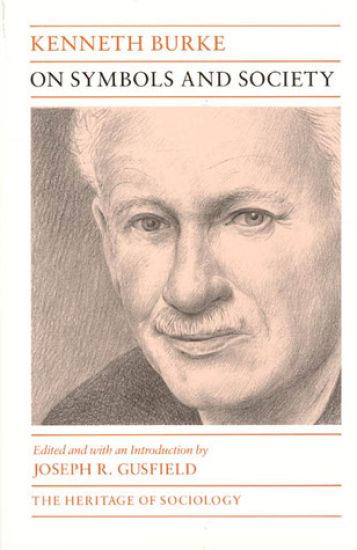
On Symbols and Society

On Symbols and Society

Kenneth Burke

University of Chicago Press
1989
nidottu
Kenneth Burke's innovative use of dramatism and dialectical method have made him a powerful critical force in an extraordinary variety of disciplines—education, philosophy, history, psychology, religion, and others. While most widely acclaimed as a literary critic, Burke has elaborated a perspective toward the study of behavior and society that holds immense significance and rich insights for sociologists. This original anthology brings together for the first time Burke's key writings on symbols and social relations to offer social scientists access to Burke's thought. In his superb introductory essay, Joseph R. Gusfield traces the development of Burke's approach to human action and its relationship to other similar sources of theory and ideas in sociology; he discusses both Burke's influence on sociologists and the limits of his perspective. Burke regards literature as a form of human behavior—and human behavior as embedded in language. His lifework represents a profound attempt to understand the implications for human behavior based on the fact that humans are "symbol-using animals." As this volume demonstrates, the work that Burke produced from the 1930s through the 1960s stands as both precursor and contemporary key to recent intellectual movements such as structuralism, symbolic anthropology, phenomenological and interpretive sociology, critical theory, and the renaissance of symbolic interaction.
Copyright, Fair Use, and the Challenge for Universities

Copyright, Fair Use, and the Challenge for Universities

Kenneth D. Crews

University of Chicago Press
1993
sidottu
The lawsuit against "Kinko's Copies" for copyright infringement has exposed the confusion and heightened the fear of liability surrounding copyright issues in colleges and universities. This volume offers an explanation of copyright and the ambiguous concept of "fair use" as they affect and are affected by higher education. Kenneth D. Crews surveys the copyright policies of 98 American research universities. His analysis reveals a variety of ways in which universities have responded to and how they could better manage-the conflicting goals of copyright policies: avoiding infringements while promoting lawful uses that serve teaching and research. He explains in detail the background of copyright law and congressional guidelines affecting familiar uses of photocopies, videotapes, software, and reserve rooms. Crews concludes that most universities are overly conservative in their interpretation of copyright and law often neglect their own interests, adding unnecessary costs and obstacles, to the lawful dissemination of information. He provides an explanation of copyright law and policy and how it can better serve higher education.
The Rules of the Global Game

The Rules of the Global Game

Kenneth W. Dam

University of Chicago Press
2001
sidottu
In The Rules of the Global Game Kenneth W. Dam provides, in clear and practical language, a comprehensive examination that helps non-economists make sense of the forces that shape U.S. international monetary policies. Elucidating both the internal structures and external ramifications of global economics, this book can be read with pleasure and profit by layperson and economist alike. It allows readers to go beyond the headlines to understand the policies that shape our economy and thus our lives.
The Rules of the Global Game

The Rules of the Global Game

Kenneth W. Dam

University of Chicago Press
2004
nidottu
In The Rules of the Global Game Kenneth W. Dam provides, in clear and practical language, a comprehensive examination that helps non-economists make sense of the forces that shape U.S. international monetary policies. Elucidating both the internal structures and external ramifications of global economics, this book can be read with pleasure and profit by layperson and economist alike. It allows readers to go beyond the headlines to understand the policies that shape our economy and thus our lives.
Classic Rough News

Classic Rough News

Kenneth Fields

University of Chicago Press
2005
sidottu
With a half-dozen books of poetry published to date, Kenneth Fields distills some forty years of teaching and writing about poetry into Classic Rough News, a collection of fresh sonnets and sonnet-like lyrics that attests to both Fields's skills as a writer and the inexhaustible possibilities of the form. Classic Rough News follows a skeptical, cosmopolitan, intelligent, poetic presence aware that its carefully constructed veneer could crumble at any moment. In poems that mine interior dialogue for the discovery of great truths, Fields conveys feelings of awkwardness, incompleteness, conflict, and insanity - all in finely crafted verse. Ironic and skeptical, the voice in these poems records the flux of the mind, ruefully acknowledging how easy it is to deceive oneself with mixed emotions. Fully mature and unconcerned about impressions, Classic Rough News is grounded in erudition and humor, revealing how tradition and talent can push one another in unexpected directions.
Classic Rough News

Classic Rough News

Kenneth Fields

University of Chicago Press
2005
nidottu
With a half-dozen books of poetry published to date, Kenneth Fields distills some forty years of teaching and writing about poetry into Classic Rough News, a collection of fresh sonnets and sonnet-like lyrics that attests to both Fields's skills as a writer and the inexhaustible possibilities of the form. Classic Rough News follows a skeptical, cosmopolitan, intelligent, poetic presence aware that its carefully constructed veneer could crumble at any moment. In poems that mine interior dialogue for the discovery of great truths, Fields conveys feelings of awkwardness, incompleteness, conflict, and insanity - all in finely crafted verse. Ironic and skeptical, the voice in these poems records the flux of the mind, ruefully acknowledging how easy it is to deceive oneself with mixed emotions. Fully mature and unconcerned about impressions, Classic Rough News is grounded in erudition and humor, revealing how tradition and talent can push one another in unexpected directions.
Leo Strauss and the Rediscovery of Maimonides

Leo Strauss and the Rediscovery of Maimonides

Kenneth Hart Green

University of Chicago Press
2013
sidottu
In "Leo Strauss and the Rediscovery of Maimonides", Kenneth Hart Green explores the critical role played by Maimonides in shaping Leo Strauss' thought. In uncovering the esoteric tradition employed in Maimonides' Guide of the Perplexed, Strauss made the radical realization that other ancient and medieval philosophers might be concealing their true thoughts through literary artifice. Maimonides and al-Farabi, he saw, allowed their message to be altered by dogmatic considerations only to the extent required by moral and political imperatives and were in fact avid advocates for enlightenment. Strauss also revealed Maimonides' potential relevance to contemporary concerns, especially his paradoxical conviction that one must confront the conflict between reason and revelation rather than resolve it. An invaluable companion to Green's comprehensive collection of Strauss' writings on Maimonides, this volume shows how Strauss confronted the commonly accepted approaches to the medieval philosopher, resulting in both a new understanding of Maimonides and a new depth and direction for his own thought. It will be welcomed by anyone engaged with the work of either philosopher.
Puppet

Puppet

Kenneth Gross

University of Chicago Press
2011
sidottu
The puppet can entertain or terrify, evoke the innocence of childhood, or become a magical entity, able to negotiate with ghosts and gods. Puppets are often creepy things, inanimate while also full of spirit, alive with gesture and voice. In this haunting and beautiful book, Kenneth Gross takes us on a meditative journey through the world of puppet theater, exploring the mysterious fascination of these unsettling objects. Engaging particular aspects of the puppet, from its blunt grotesquerie to its talent for metamorphosis, Gross teases out their meanings, showing us the puppet in the guise of angel, seducer, demon, and destroyer. On a global tour of puppets onstage, he takes us to the raucous Punch and Judy show, the sacred shadow theater of Bali, and experimental theaters in the United States and Europe where puppets enact everything from Shakespearean tragedy to surrealist fables of discovery and loss. At the same time, he explores the puppet in poetry and fiction-including Collodi's cruel, wooden Pinocchio; puppetlike characters in Dickens and Kafka; Rilke's innocent puppet-angels; and the dark puppeteering of Philip Roth's Micky Sabbath - as well as in the work of artists such as Joseph Cornell and Paul Klee. A lovely, expressive book about re-seeing what we know, or what we think we know, "Puppet" evokes the startling power of puppets as mirrors of the uncanny in art and life.
Shylock Is Shakespeare

Shylock Is Shakespeare

Kenneth Gross

University of Chicago Press
2006
sidottu
Shylock, the Jewish moneylender in The Merchant of Venice who famously demands a pound of flesh as security for a loan to his antisemitic tormentors, is one of Shakespeare’s most complex and idiosyncratic characters. With his unsettling eloquence and his varying voices of protest, play, rage, and refusal, Shylock remains a source of perennial fascination. What explains the strange and enduring force of this character, so unlike that of any other in Shakespeare’s plays? Kenneth Gross posits that the figure of Shylock is so powerful because he is the voice of Shakespeare himself. Marvelously speculative and articulate, Gross’s book argues that Shylock is a breakthrough for Shakespeare the playwright, an early realization of the Bard’s power to create dramatic voices that speak for hidden, unconscious, even inhuman impulses—characters larger than the plays that contain them and ready to escape the author’s control. Shylock is also a mask for Shakespeare’s own need, rage, vulnerability, and generosity, giving form to Shakespeare’s ambition as an author and his uncertain bond with the audience. Gross’s vision of Shylock as Shakespeare’s covert double leads to a probing analysis of the character’s peculiar isolation, ambivalence, opacity, and dark humor. Addressing the broader resonance of Shylock, both historical and artistic, Gross examines the character’s hold on later readers and writers, including Heinrich Heine and Philip Roth, suggesting that Shylock mirrors the ambiguous states of Jewishness in modernity. A bravura critical performance, Shylock Is Shakespeare will fascinate readers with its range of reference, its union of rigor and play, and its conjectural—even fictive—means of coming to terms with the question of Shylock, ultimately taking readers to the very heart of Shakespeare’s humanizing genius.
Shakespeare's Noise

Shakespeare's Noise

Kenneth Gross

University of Chicago Press
2001
sidottu
Kenneth Gross explores Shakespeare's deep fascination with dangerous and disorderly forms of speaking--especially rumor, slander, insult, vituperation, and curse--and through them offers a vision of the work of words in his plays. Coriolanus's taunts or Lear's curses force us to think not just about how Shakespeare's characters speak, but also about how they hear, overhear, and mishear what is spoken, how rumor becomes tragic knowledge for Hamlet, or opens Othello to fantastic jealousies. Gross also shows how Shakespeare's preoccupation with "noisy" speech echoed and transformed a broader cultural obsession with the perils of rumor, slander, and libel in Renaissance England.