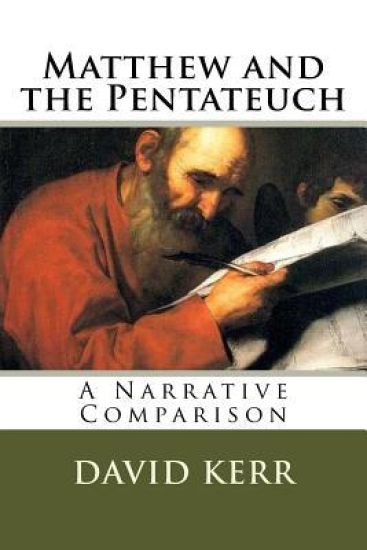
Why are there four Gospels? If we read one, do we really need to read the others? In this book, David Kerr seeks to answer those questions. The four Gospels, particularly the Synoptic Gospels, do not simply rehash the same material in a slightly different order. They each present Jesus in a unique way. In this volume, Kerr attempts to show how Matthew presents Jesus as fulfilling the Old Testament narrative as recorded in the books of Moses, commonly called the Pentateuch. Matthew uses the Pentateuch as his basic structuring device for telling the story of Jesus and his life on earth. Therefore, the Gospel of Matthew and the Pentateuch are mutually interpretive of one another. Jesus' life cannot be truly understood without the illumination of the Old Testament, and the Old Testament always pointed forward to Jesus' coming. In this study, Kerr explores the relationship between Matthew and the Pentateuch.
A well known commentary used by Christians to further understand the Holy Scriptures. Truly an extensive piece of work, this commentary should help you in your pursuit of the Lord when used correctly. This specific book covers Matthew Henry's commentary on the book of Galatians.
"Matthew Arnold (24 December 1822 - 15 April 1888) was an English poet and cultural critic who worked as an inspector of schools.... In 1852, Arnold published his second volume of poems, Empedocles on Etna, and Other Poems. In 1853, he published Poems: A New Edition, a selection from the two earlier volumes famously excluding "Empedocles on Etna", but adding new poems, "Sohrab and Rustum" and "The Scholar Gipsy". In 1854, Poems: Second Series appeared; also a selection, it included the new poem, "Balder Dead". Arnold was elected Professor of Poetry at Oxford in 1857. He was the first to deliver his lectures in English rather than Latin. He was re-elected in 1862. On Translating Homer (1861) and the initial thoughts that Arnold would transform into Culture and Anarchy were among the fruits of the Oxford lectures. In 1859, he conducted the first of three trips to the continent at the behest of parliament to study European educational practices. He self-published The Popular Education of France (1861), the introduction to which was later published under the title "Democracy" (1879).