
Kirjahaku
Etsi kirjoja tekijän nimen, kirjan nimen tai ISBN:n perusteella.
1000 tulosta hakusanalla Nigel 1906- Fitzgerald
Set in South Australia, 1884; this is an epic poem of three Afghan cameleers as they go about delivering supplies along the Birdsville Track. Follow Nak, Shir and Abdul on an adventure across outback Australia, where their pasts catch up to them in many ways. Individual feelings are tested to the limit, insecurities are measured by fear, and desire is outweighed by need. Angry and forgiving, tired and alive, eager and pessimistic. They fight against the conditions, against the hate, and against their pasts. It is a work of fiction, based on the people of the times, where prejudice is very much alive, many Afghans being treated poorly, not just for the colour of their skin, or their religious belief, but because of the expertise that the Afghan cameleers offer the Australian outback, taking work from many Australians. This poem offers an in-depth look at the life of cameleers and the issues surrounding camel strings, shedding a great amount of light on the subject of camels in the outback, opening the eyes of the reader as to the great work that camel strings performed during this time of expansion. Camels were able to out-work bullock teams and horses due to their abilities to adjust to a harsh land and the cameleers were no exception.
This is an epic poem.The orca: they are black and white dolphins, mammals of the sea, warm-blooded creatureswhich are at the top of the food chain for the territory that they hold within their power, manbeing their only predator.Tom is born in the Pacific Ocean, 1862; he is 2.5 metres long and weighs 200kg; a grandspecimen. George Davidson is born of Eden; May, 1863.This is the story of Tom, Killer whale of Twofold Bay, Eden, friend to George Davidson (baywhaler) and others like him: it is based upon a true story that will live in the memory of thecitizens of Eden for eternity, a museum being built in Tom's honour upon his death.For thousands of years, before man recorded such events, killer whales hunted all manner ofbaleen whale in every ocean on this planet, and only once in all that time has it beenwitnessed, and recorded for the prosperity of understanding and knowledge, that they cooperatedwith humans in their hunt for whales. It all took place on the east coast of Australia, Twofold Bay, Eden. And it is here that an extraordinary story unfolds of an unwrittencontract between man and beast, one of nature's most powerful and intelligent, one that ismisunderstood and labelled unkindly.
Epic Poem - Poetry It was a great monopoly and stretched from Holland to Asia - namely Batavia (Jakarta), where the Dutch United East India Company (VOC) headquarters was established - and surrounding countries; a source of great wealth. Trade between these countries was of strategic importance where trade and wealth was concerned, copper, tin, spices, opium and dyes being some of the basic requisites of commerce. From the Cape of Good Hope to Batavia the ships would travel due west for approximately 1,000 Dutch miles before turning north. It was unfortunate for the time, however, that there was no means by which to accurately determine longitude at sea. Eventually land was encountered and this becomes the accepted method of voyage: to seek the sight of land and then head north towards the coast of Sumatra. For almost a hundred years some were lucky enough to cast their eyes upon the west coast of a great mass of land, thought to have been a part of New Guinea. The Zuytdorp departs the Cape of Good Hope, Table Bay, with the ship Kockenge. She pulls ahead of the Kockenge due to her being a much larger and faster vessel. Due to the departure being in April, opposed to the favourable March, the skipper decides to sail until sighting land before turning north for Batavia, to take full benefit of the winds from the west and the voyage then to the north. But catastrophe is all they meet, no success in voyage to be celebrated. The Zuytdorp is shipwrecked. This is the story of the survivors. There is evidence to show that Aboriginals of the Shark Bay area suffer from Porphyria Variegate, a gene mutation that is traceable to the Dutch. It is uncommon and rare, and there is no reason, other than the coupling of an Aboriginal with a survivor of the Zuytdorp, that currently explains the disease being discovered in Australian Aboriginals of WA. I do not declare this to be fact nor fiction: take it as you will.
This is the story of a man on walkabout, trekking the centre of Australia some 60,000 yearsago. The adventures open the door to myths and legends of Aboriginal society as never readbefore. The myths, legends and wonders of Aboriginal society are many and vast, passed onby word of mouth for tens of thousands of years.If we assume that the 'religion' of these people dates back so far then we have to assume thatcreatures such as the diprotodon, megalania, and thylacoleo, just to name a few, are foreverpresent in their myths and legend. But there are indicators to show that the religion does notdate back so far, or in the least, that religion was an on-going form of practice, for the dingo which only dates back some 5,000 years] seems to be rather active in ritual and commonplace amongst some myths and legends.Whether these stories have changed over the years as word mouth is hard to secure as asource of historical worth] or not, I have taken the liberty, whether justly or otherwise, to putit into story form, so that there appears to be a more rudiment meaning to the entiredevelopment of Aboriginal Dreamtime, which is an eternal way of life and carries with itmany sacred meanings.I can only hope that I have created no ill-will, for my intentions are to provide others with thejoy of understanding in a way which is more effortless then simply passing over one mythafter another in a big thick book.Kulinma Ngulakujaku-kula This book might contain names of people who have since departed this world

Build a website with Django 3 is the fourth edition of my popular Django beginners book, fully updated for Django 3.Not only has the book been updated to cover the latest version of Django, but I've added install instructions for macOS users.Your complete introduction to Django 3Build a website with Django 3 covers all the core concepts of Django to get you up and running fast: Why Django is the premier Python framework for developing web applications The big picture - how Django is structured Django Models Django Views Django Templates The Django admin Generic views Simple forms Complex forms and model forms Managing Users Restricted content File uploads Sending email Deploying a Django application Build a real website This book is not about boring theory. You'll be building a fully functioning website as you learn Django. I even show you how to deploy your website to the Internet for free.


SONGS OF AUSTRALIA - A Poetic Trilogy BOOK ONE Set in South Australia, 1884; this is an epic poem of three Afghan cameleers as they go about delivering supplies along the Birdsville Track. Follow Nak, Shir and Abdul on an adventure across outback Australia, where their pasts catch up to them in many ways. Individual feelings are tested to the limit, insecurities are measured by fear, and desire is outweighed by need. Angry and forgiving, tired and alive, eager and pessimistic. They fight against the conditions, against the hate, and against their pasts. BOOK TWO The orca: they are black and white dolphins, mammals of the sea, warm-blooded creatures that are at the top of the food chain for the territory that they hold within their power, man being their only predator. Tom is born in the Pacific Ocean, 1862; he is 2.5 metres long and weighs 200kg; a grand specimen. George Davidson is born of Eden; May, 1863. This is the story of Tom, Killer whale of Twofold Bay, Eden, friend to George Davidson (bay whaler) and others like him: it is based upon a true story that will live in the memory of the citizens of Eden for eternity, a museum being built in Tom's honour upon his death. BOOK THREE It was a great monopoly and stretched from Holland to Asia - namely Batavia (Jakarta), where the Dutch United East India Company (VOC) headquarters was established - and surrounding countries; a source of great wealth. Trade between these countries was of strategic importance where trade and wealth was concerned, copper, tin, spices, opium and dyes being some of the basic requisites of commerce. From the Cape of Good Hope to Batavia the ships would travel due west for approximately 1,000 Dutch miles before turning north. It was unfortunate for the time, however, that there was no means by which to accurately determine longitude at sea. Eventually land was encountered and this becomes the accepted method of voyage: to seek the sight of land and then head north towards the coast of Sumatra. For almost a hundred years some were lucky enough to cast their eyes upon the west coast of a great mass of land, thought to have been a part of New Guinea. The Zuytdorp departs the Cape of Good Hope, Table Bay, with the ship Kockenge. She pulls ahead of the Kockenge due to her being a much larger and faster vessel. Due to the departure being in April, opposed to the favourable March, the skipper decides to sail until sighting land before turning north for Batavia, to take full benefit of the winds from the west and the voyage then to the north. But catastrophe is all they meet, no success in voyage to be celebrated. The Zuytdorp is shipwrecked. This is the story of the survivors. There is evidence to show that Aboriginals of the Shark Bay area suffer from Porphyria Variegate, a gene mutation that is traceable to the Dutch. It is uncommon and rare, and there is no reason, other than the coupling of an Aboriginal with a survivor of the Zuytdorp, that currently explains the disease being discovered in Australian Aboriginals of WA. I do not declare this to be fact nor fiction: take it as you will.
This Omnibus contains the following, the complete series of The Templar: The Templar: and the City of GodThe Templar: and the Temple of K ros Part 2]The Templar: and the Cross of Christ Part 3]Amazon Part 4 of The Templar series]BOOK ONEStephen's epic adventure is proceeded by the final days of Constantinople, 1453, as 7,000 inhabitants defend against an army of over 100,000. The historical value of Book One does well to inform the reader as to the way in which the siege came to be successful, and how the defenders held their position so heroically. The characters of fictional value provide great momentum and interest to the story, doing justice to history, never for an instant depriving it of substance.BOOK TWOJust yesterday, Stephen was fighting to defend The City of God against the Muslim invaders; now, in the pursuing days, where living is as fierce by night, as it is by day, he must fight to preserve that, which he does not fully understand.Will he be delivered salvation? Will he secure a fuller understanding of his place in life? His first step of many is to provide aid to others, but over the coming days he must make decisions that will affect the future of mankind, not just the souls he has pledged to protect. The very religion that he holds so dear to his heart will be questioned, as too will the motives behind his decisions. K ros holds the key, the key to everlasting life, the key to the rules of life, and life's meaning. It is for him to decide what will become of his future, and of the Christian religion. At any cost, he must preserve that which he has been passed onto him; the secret of the chest; and above all, the key must always be protected and never surrendered.BOOK THREEStephen, the Knights of the Hospital, and the thirteen orphans, continue with their harsh voyage to the shores of a town called Barcelona, where a ferocious storm greets them, and tragic events begin to unfold. Something so unbelievable is discovered by Stephen as he befriends Father Ambaedian of Barcelona, a 1500 year-old mystery being discovered for what it is and the truth that it hides. Where is the final resting place of the Cross of Christ? What power does it hold? What other name is it known by? What is to become of the thirteen orphans and the knights so bold?BOOK FOURThis final book is the work of fiction, the story of the creation of the women warriors and El Dorado, and a story of Spanish explorers travelling the Amazon River. Tales of El Dorado and the Amazons have flooded the world. Why is it that the Spanish never encountered the true city of the Amazons, or did they?Stories rose upon the tongue of the Spanish invader of a man covered in gold, the Golden Prince. And what is the link between the Golden Prince and the women warriors of the Amazon? Where did the stories come from? This fictional account of the travels of Orellana and Carvajal offers a simple solution to a puzzle that simply cannot be solved: and for what reason?
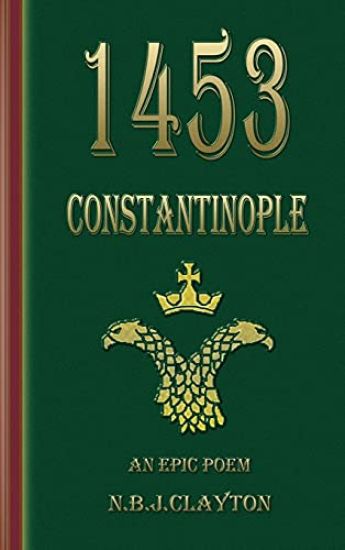
Written as an epic poem in verse, this is a story of a siege and love. Stephen and Clover find each other at the worst of times and hope to savour their newfound love in one another, in a future together, and in peace forever.This tale of epic proportion takes place during the final days of Constantinople, 1453, as 7,000 inhabitants defend against an army of over 100,000. The historical value of this book does well to inform the reader as to the way in which the siege came to be successful, and how the defenders held their position so heroically. The characters of fictional value provide great momentum and interest to the story, doing justice to history, never for an instant depriving it of substance.

With literature waning in the interest of so many, is Shakespeare the only poet the public can still appreciate? John Milton, as this book makes clear, speaks more powerfully to the eternal questions and to the important concerns of our time. The Milton of this volume is an author for all Americans—conservative, liberal, radical—not only because he was a favorite of the founding fathers, his voice echoing through their texts and our very foundation, but also because his visionary writing embodies the aspirations that have guided Americans seeking ideals of ethical and spiritual perfection.Nigel Smith makes a compelling case for Milton’s relevance to our present situation. In direct and accessible terms, he shows how the seventeenth-century poet, while working to write the greatest heroic poem in the English language, also managed to theorize about religious, political, and civil liberty in ways that matter as much today as they did in Puritanical times. Through concise chapters that chart Milton’s life at the center of the English and European literary and political scenes—as well as his key themes of free will, freedom and slavery, love and sexual liberty, the meaning of creation, and the nature of knowledge—Smith’s work brings Milton, his poetry, and his prose home to readers of our day. A provocative and enlightening introduction, for newcomers and informed readers alike, this book rediscovers and redefines Milton for a new generation, one that especially needs and deserves to know him.

For thousands of years we have recorded real lives--the lives of others, and of ourselves. For what purpose and for whom has this universal and timeless pursuit endured? What obstacles have lain in the path of biographers in the past, and what continues to confound biographers today? Above all, how is it that biographies and autobiographies play such a contested, popular role in contemporary Western culture, from biopics to blogs, from memoir to docudrama?Award-winning biographer and teacher Nigel Hamilton addresses these questions in an incisive and vivid narrative that will appeal to students of human nature and self-representation across the arts and sciences. Tracing the remarkable and often ignored historical evolution of biography from the ancient world to the present, this brief and fascinating tour of the genre conveys the passionate quest to capture the lives of individuals and the many difficulties it has entailed through the centuries. From the Epic of Gilgamesh to American Splendor, from cuneiform to the Internet, from commemoration to deconstruction, from fiction to fact--by way of famous biographical artists such as Plutarch, Saint Augustine, Sir Walter Raleigh, Samuel Johnson, Jean-Jacques Rousseau, Lord Byron, Sigmund Freud, Lytton Strachey, Abel Gance, Virginia Woolf, Leni Riefenstahl, Orson Welles, Julian Barnes, Ted Hughes, Frank McCourt, and many others--Nigel Hamilton's Biography: A Brief History will change the way you think about biography and real lives.
It is not surprising that biography is one of the most popular literary genres of our day. What is remarkable is that there is no accessible guide for how to write one. Now, following his recent Biography: A Brief History (from Harvard), award-winning biographer and teacher Nigel Hamilton tackles the practicalities of doing biography in this first succinct primer to elucidate the tools of the biographer’s craft.Hamilton invites the reader to join him on a fascinating journey through the art of biographical composition. Starting with personal motivation, he charts the making of a modern biography from the inside: from conception to fulfillment. He emphasizes the need to know one’s audience, rehearses the excitement and perils of modern research, delves into the secrets of good and great biography, and guides the reader through the essential components of life narrative.With examples taken from the finest modern biographies, Hamilton shows how to portray the ages of man—birth, childhood, love, life’s work, the evening of life, and death. In addition, he suggests effective ways to start and close a life story. He clarifies the difference between autobiography and memoir—and addresses the sometimes awkward ethical, legal, and personal consequences of truth-telling in modern life writing. He concludes with the publication and reception of biography—its afterlife, so to speak.Written with humor, insight, and compassion, How To Do Biography is the manual that would-be biographers have long been awaiting.
The first English translation of the earliest Latin poems about miracles performed by the Virgin Mary, composed in twelfth-century Canterbury by a Benedictine monk who inspired Chaucer.Nigel (ca. 1135–1198), a Benedictine monk at Christ Church in Canterbury, is best known for The Mirror of Fools—a popular satire whose hero Burnellus the Ass is referenced in Chaucer’s Canterbury Tales. Nigel’s oeuvre also includes other important poems and hagiography.The Miracles of the Virgin is the oldest Latin poem about miracles performed by Mary. This collection features seventeen lively tales in which the Virgin rescues a disappointed administrator from a pact with the devil, has a Roman emperor killed by a long-dead martyr, saves a Jewish boy from being burned alive, and shields an abbess from the shame of pregnancy. Each story illustrates the boundlessness of Mary’s mercy. In the Tract on Abuses, a letter that resembles a religious pamphlet, Nigel rails against ecclesiastical corruption and worldly entanglements.Alongside authoritative editions of the Latin texts, this volume offers the first translations of both works into English.
Questions about the nature of money have gained a new urgency in the aftermath of the global financial crisis. Even as many people have less of it, there are more forms and systems of money, from local currencies and social lending to mobile money and Bitcoin. Yet our understanding of what money is--and what it might be--hasn't kept pace. In The Social Life of Money, Nigel Dodd, one of today's leading sociologists of money, reformulates the theory of the subject for a postcrisis world in which new kinds of money are proliferating. What counts as legitimate action by central banks that issue currency and set policy? What underpins the right of nongovernmental actors to create new currencies? And how might new forms of money surpass or subvert government-sanctioned currencies? To answer such questions, The Social Life of Money takes a fresh and wide-ranging look at modern theories of money. One of the book's central concerns is how money can be wrested from the domination and mismanagement of banks and governments and restored to its fundamental position as the "claim upon society" described by Georg Simmel. But rather than advancing yet another critique of the state-based monetary system, The Social Life of Money draws out the utopian aspects of money and the ways in which its transformation could in turn transform society, politics, and economics. The book also identifies the contributions of thinkers who have not previously been thought of as monetary theorists--including Nietzsche, Benjamin, Bataille, Deleuze and Guattari, Baudrillard, Derrida, and Hardt and Negri. The result provides new ways of thinking about money that seek not only to understand it but to change it.