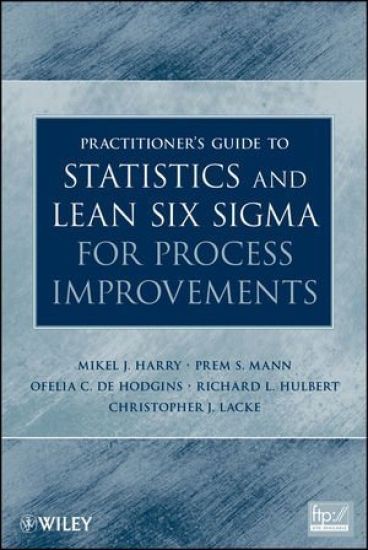
This hands-on book presents a complete understanding of Six Sigma and Lean Six Sigma through data analysis and statistical concepts In today's business world, Six Sigma, or Lean Six Sigma, is a crucial tool utilized by companies to improve customer satisfaction, increase profitability, and enhance productivity. Practitioner's Guide to Statistics and Lean Six Sigma for Process Improvements provides a balanced approach to quantitative and qualitative statistics using Six Sigma and Lean Six Sigma methodologies. Emphasizing applications and the implementation of data analyses as they relate to this strategy for business management, this book introduces readers to the concepts and techniques for solving problems and improving managerial processes using Six Sigma and Lean Six Sigma. Written by knowledgeable professionals working in the field today, the book offers thorough coverage of the statistical topics related to effective Six Sigma and Lean Six Sigma practices, including: Discrete random variables and continuous random variables Sampling distributions Estimation and hypothesis tests Chi-square tests Analysis of variance Linear and multiple regression Measurement analysis Survey methods and sampling techniques The authors provide numerous opportunities for readers to test their understanding of the presented material, as the real data sets, which are incorporated into the treatment of each topic, can be easily worked with using Microsoft Office Excel, Minitab, MindPro, or Oracle's Crystal Ball software packages. Examples of successful, complete Six Sigma and Lean Six Sigma projects are supplied in many chapters along with extensive exercises that range in level of complexity. The book is accompanied by an extensive FTP site that features manuals for working with the discussed software packages along with additional exercises and data sets. In addition, numerous screenshots and figures guide readers through the functional and visual methods of learning Six Sigma and Lean Six Sigma. Practitioner's Guide to Statistics and Lean Six Sigma for Process Improvements is an excellent book for courses on Six Sigma and statistical quality control at the upper-undergraduate and graduate levels. It is also a valuable reference for professionals in the fields of engineering, business, physics, management, and finance.
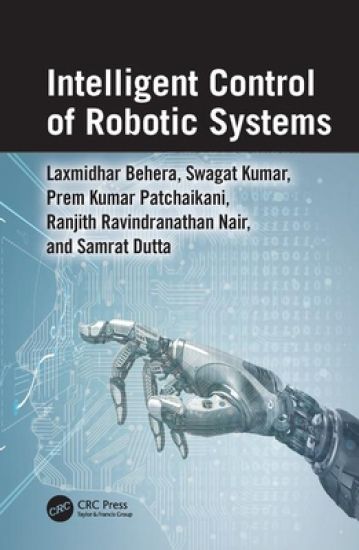
This book illustrates basic principles, along with the development of the advanced algorithms, to realize smart robotic systems. It speaks to strategies by which a robot (manipulators, mobile robot, quadrotor) can learn its own kinematics and dynamics from data. In this context, two major issues have been dealt with; namely, stability of the systems and experimental validations. Learning algorithms and techniques as covered in this book easily extend to other robotic systems as well. The book contains MATLAB- based examples and c-codes under robot operating systems (ROS) for experimental validation so that readers can replicate these algorithms in robotics platforms.
The Elements of Instruction provides a common vocabulary and conceptual schema of teaching and learning that is fully applicable to all forms of instruction in our digital-centric era. This critical examination of educational technology’s contemporary semantics and constructs fills a major gap in the logical foundations of instruction, with special attention to the patterns of communication among facilitators, learners, and resources. The book proposes a new framework for organizing research and theory, clear concepts and definitions for its basic elements, and a new typology of teaching-learning arrangements to simplify the selection of optimal conditions for a variety of learning goals. As trends in media, technology, and methodology continue to evolve, these historically contextual, back-to-basics pedagogical tools will be invaluable to all instructional designers and educational researchers.
The Elements of Instruction provides a common vocabulary and conceptual schema of teaching and learning that is fully applicable to all forms of instruction in our digital-centric era. This critical examination of educational technology’s contemporary semantics and constructs fills a major gap in the logical foundations of instruction, with special attention to the patterns of communication among facilitators, learners, and resources. The book proposes a new framework for organizing research and theory, clear concepts and definitions for its basic elements, and a new typology of teaching-learning arrangements to simplify the selection of optimal conditions for a variety of learning goals. As trends in media, technology, and methodology continue to evolve, these historically contextual, back-to-basics pedagogical tools will be invaluable to all instructional designers and educational researchers.
Engaged Language Policy and Practices re-envisions language policy and planning as an engaged approach, drawing on and portraying theoretical and educational equity perspectives. It calls for the right to language policy-making in which all concerned—communities, parents, students, educators, and advocates—collectively imagine new strategies for resisting global neoliberal marginalization of home languages and cultural identities. This book subsequently emphasizes the means by which engaged dialectic processes can inform and clarify language policy-making decisions that promote equity. In other words, rather than descriptions of outcomes, the authors emphasize the need to detail the means by which local/regional actors resist and transform inequitable policies. These descriptions of processes thereby provide all actors with ideological, pedagogical, and equity policy tools that can inform situated school and community policy-making. This book depicts ways in which engaged language policy embodies the intersection of critical inquiry, participant involvement, and ongoing engaged language planning processes. It further offers an alternative to the traditional top-down approach to language education policy-making. Engaged Language Policy and Practices is essential reading for scholars, teachers, students, communities, and others concerned with worldwide language and identity equity.
Engaged Language Policy and Practices re-envisions language policy and planning as an engaged approach, drawing on and portraying theoretical and educational equity perspectives. It calls for the right to language policy-making in which all concerned—communities, parents, students, educators, and advocates—collectively imagine new strategies for resisting global neoliberal marginalization of home languages and cultural identities. This book subsequently emphasizes the means by which engaged dialectic processes can inform and clarify language policy-making decisions that promote equity. In other words, rather than descriptions of outcomes, the authors emphasize the need to detail the means by which local/regional actors resist and transform inequitable policies. These descriptions of processes thereby provide all actors with ideological, pedagogical, and equity policy tools that can inform situated school and community policy-making. This book depicts ways in which engaged language policy embodies the intersection of critical inquiry, participant involvement, and ongoing engaged language planning processes. It further offers an alternative to the traditional top-down approach to language education policy-making. Engaged Language Policy and Practices is essential reading for scholars, teachers, students, communities, and others concerned with worldwide language and identity equity.
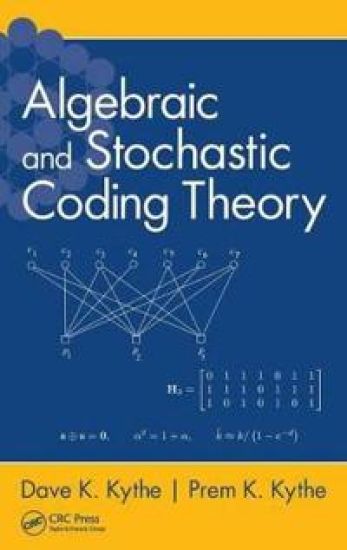
Using a simple yet rigorous approach, Algebraic and Stochastic Coding Theory makes the subject of coding theory easy to understand for readers with a thorough knowledge of digital arithmetic, Boolean and modern algebra, and probability theory. It explains the underlying principles of coding theory and offers a clear, detailed description of each code. More advanced readers will appreciate its coverage of recent developments in coding theory and stochastic processes.After a brief review of coding history and Boolean algebra, the book introduces linear codes, including Hamming and Golay codes. It then examines codes based on the Galois field theory as well as their application in BCH and especially the Reed–Solomon codes that have been used for error correction of data transmissions in space missions.The major outlook in coding theory seems to be geared toward stochastic processes, and this book takes a bold step in this direction. As research focuses on error correction and recovery of erasures, the book discusses belief propagation and distributions. It examines the low-density parity-check and erasure codes that have opened up new approaches to improve wide-area network data transmission. It also describes modern codes, such as the Luby transform and Raptor codes, that are enabling new directions in high-speed transmission of very large data to multiple users.This robust, self-contained text fully explains coding problems, illustrating them with more than 200 examples. Combining theory and computational techniques, it will appeal not only to students but also to industry professionals, researchers, and academics in areas such as coding theory and signal and image processing.
The fully updated Third Edition of Focus Groups: Theory and Practice offers a unique blend of focus group theory and practice in a single, easy-to-read source. It provides systematic treatment to the design, conduct, and interpretation of focus group data within the context of social science research and theory. Known for accessibility and step-by-step guidance, comprehensive treatment, and historical perspective, the book examines every facet of focus group research, from the selection and recruitment of group participants, to the selection of a moderator and conducting of interviews, to the analysis of focus group data. The Third Edition reflects the growing use of focus group research to address an increasingly broad array of issues that have a global span, and also provides more guidance on conducting virtual focus groups.
This book offers a comprehensive introduction to SAP Open UI5. The authors expertly bring readers up to speed on SAP UI5 technology utilizing Java Script, HTML, and CSS, and they explain, step by step, how to transition from traditional systems to handheld and mobile devices. Learn more about key OpenUI5 concepts including bootstrapping, controls, views, models, and data binding. Review your library options including JavaScript and CSS, and learn how to use them to increase available functionality. Walk through how to install the UI development toolkit library and set up the development environment. Learn how to leverage controls and evaluate when to use native JavaScript or the OpenUI5 library. Dive into SAP Fiori for SAP applications and walk through five key design principles. See practical examples of how to create applications using UI5. By using practical examples, tips, and screenshots, the author brings readers who are new to SAP Open UI5 up to speed on the fundamentals. - Fundamental OpenUI5 concepts - How to define controls for an application - SAP Fiori applications and design principles - Real-world examples of how to create applications using UI5