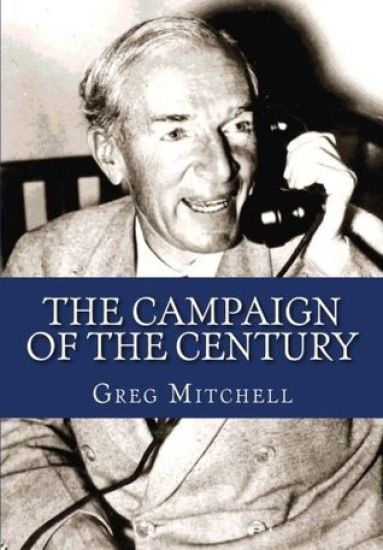
----"One of the five greatest books ever about an American campaign." -- The Wall Street Journal / "A compelling account"-- Jill Lepore, The New Yorker. / Winner of the Goldsmith Book Prize. In 1934, voters hoping to turn the tide of the Great Depression backed an unlikely candidate for governor of California: Upton Sinclair, muckraking author of "The Jungle" and lifelong socialist. Amazingly, Sinclair swept the Democratic primary, leading a mass movement called EPIC (End Poverty in California). More than a thousand EPIC chapters formed. Alarmed, Sinclair's opponents launched an unprecedented public relations blitzkrieg to discredit him. The result was nothing less than a revolution in American politics, and with it, the era of the "spin doctor" was born. The iconic Hollywood producer Irving Thalberg created the first "attack ads" for the screen, the precursor of today's TV travesties. Hollywood took its first all-out plunge into politics and money started to play the tune in our political process. In a riveting, blow-by-blow narrative featuring the likes of Franklin D. Roosevelt, Louis B. Mayer, H. L. Mencken, William Randolph Hearst, Will Rogers, Katharine Hepburn, and a Who's Who of political, literary and entertainment stars, Greg Mitchell brings to life the outrageous campaign that forever transformed the electoral process. A finalist for the Los Angeles Times Book Award, it served as the basis for one episode in the award-winning PBS documentary "The Great Depression" "Sizzling, rambunctiously useful." -Los Angeles Times "Fascinating....a lively, anecdote-filled history." -The New York Times Book Review "To read The Campaign of the Century is to understand how the business of electing officials began to get so colossally out of hand." -Newsweek "America witnessed a transforming experience, as Greg Mitchell makes clearin his vivid chronicle." -Wall Street Journal "There are lessons to be learned herein. Politicians learned them long ago, to the general detriment. Perhaps now Mitchell can help the rest of us learn them." -Washington Post Book World
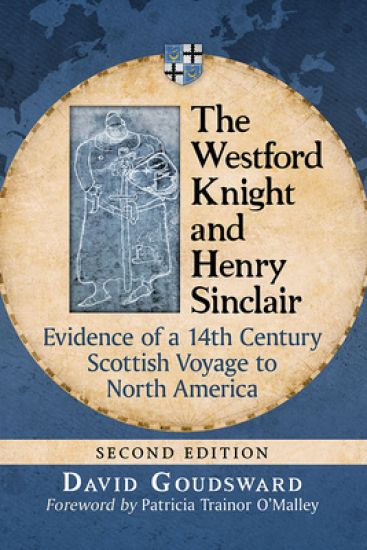
The Westford Knight is a mysterious, controversial stone carving in Massachusetts. Some believe it is an effigy of a 14th century knight, evidence of an early European visit to the New World by Henry Sinclair, the Earl of Orkney and Lord of Roslin. In 1954, an archaeologist encountered the carving, long known to locals and ascribed a variety of origin stories, and proposed it to be a remnant of the Sinclair expedition. The story of the Westford Knight is a mix of history, archaeology, sociology, and Knights Templar lore. This work unravels the threads of the Knight's history, separating fact from fantasy.This revised edition includes a new foreword and four new chapters which add context to the myth-building that has surrounded the Westford Knight and artifacts like it.
June 8, 1921. Ireland.A British Officer is shot dead on a remote hillside south of Dublin.November 22, 2015. United Kingdom.Former police detective, Jayne Sinclair, now working as a genealogical investigator, receives a phone call from an adopted American billionaire asking her to discover the identity of his real father.How are the two events linked?Jayne Sinclair has only three clues to help her: a photocopied birth certificate, a stolen book and an old photograph. And it soon becomes apparent somebody else is on the trail of the mystery. A killer who will stop at nothing to prevent Jayne discovering the secret hidden in the pastThe Irish Inheritance takes us through the Easter Rising of 1916 and the Irish War of Independence, combining a search for the truth of the past with all the tension of a modern-day thriller.It is the first in a series of novels featuring Jayne Sinclair, genealogical detective.
For ages 8 and upIn the second installment of the Sidney Sinclair adventure series, Sidney and her friends head off to Camp Sycamore Streams. On the first day of riding camp, Sidney spots a mysterious rider in the woods. Could it be the ghost of William Kitt, the bank robber who supposedly hid his stolen treasure at Sycamore Streams?Sidney and her friends are determined to find out, even if it means missing out on a few camp activities. The campers team up with their camp counselor, Kelsey, and an old, grizzled riding instructor named Johnny to find Kitt's hidden treasure and solve the mystery of the shadowy rider, deciphering riddles and finding adventure along the way.
July 1, 1916. The Somme, France.A British Officer prepares to go over the top on the first day of the Battle of the Somme.March 28, 2016. Manchester. England.Genealogical investigator Jayne Sinclair, a former police detective, is commissioned by a young teacher to look into the history of his family. The only clues are a medallion with purple, white and green ribbons, and an old drawing of a young woman. Her quest leads to a secret buried in the trenches of World War One for over 100 years.Who was the real heir to the Lappiter millions?From the author of the best selling, The Irish Inheritance, comes a gripping new book revealing family secrets hidden in the fog of war.The Somme Legacy is the second book in the Jayne Sinclair genealogical mystery series, but it can be enjoyed as a stand-alone story.
A comprehensive study guide offering in-depth explanation, essay, and test prep for Upton Sinclair's The Jungle, a novel portraying the harsh conditions and exploitation of immigrants in major US cities in the early twentieth century. As a novel of the turn of the twentieth century, The Jungle reflects not only the American scene of Sinclair's young manhood but also many of his own life circumstances. It becomes important to view the novel in terms of both his life and his times. Moreover, Sinclair's journalistic background provided him with the opportunity to expose corruption in business and government. This Bright Notes Study Guide explores the context and history of Sinclair's classic work, helping students to thoroughly explore the reasons it has stood the literary test of time. Each Bright Notes Study Guide contains: - Introductions to the Author and the Work - Character Summaries - Plot Guides - Section and Chapter Overviews - Test Essay and Study Q&As The Bright Notes Study Guide series offers an in-depth tour of more than 275 classic works of literature, exploring characters, critical commentary, historical background, plots, and themes. This set of study guides encourages readers to dig deeper in their understanding by including essay questions and answers as well as topics for further research.
In a time of war, they discovered peace.When David Wright finds a label, a silver button and a lump of old leather in a chest in the attic, it opens up a window onto the true of joy of Christmas. Jayne Sinclair, genealogical investigator, has just a few days to unravel the mystery and discover the truth of what happened on December 25, 1914.Why did her client's great grandfather keep these objects hidden for so long? What did they mean to him? And will they help bring the joy of Christmas to a young boy stuck in hospital?This is the fifth Jayne Sinclair Genealogical Mystery but it can be read and enjoyed as a stand alone novel.
The book's hero is British secret agent Simon Sinclair, a freelance agent who usually works for Counter Terrorism Intelligence (Operations), or CT3, in conjunction with MI6 and the CIA.The Doomsday Bug is a BW agent developed in Russia's massive BW program and smuggled to Mexico by CABAL, the Confederation Against British-American Logistics, an international group opposed to British and American power and influence.Sinclair follows a global trail of meetings, smuggling, training camps, and weapons storage bases which culminates in four CABAL teams acting as decoys so that others can infect the water supplies and bomb buildings in four Texas cities.Sinclair tracks down the developer of the Doomsday Bug in Russia and learns of an antidote so that there are only circa 50,000 fatalities and spread throughout the USA, if not the world, is avoided.Then two CABAL men attempt to assassinate the President of the USA, reminding Sinclair that CABAL still remains a threat.
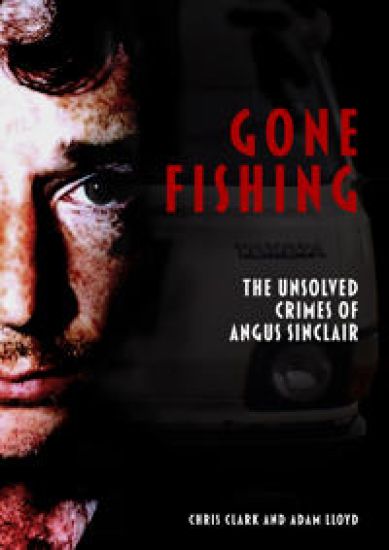
Angus Robertson Sinclair, one of the worst killers the UK has ever seen, was convicted of four murders. His first took place in his home city of Glasgow in 1961, when he raped and murdered his seven-year-old neighbour Catherine Reehill when he was just sixteen. But after spending a mere six years in prison, he was released in his early twenties to kill again. Teenagers Helen Scott and Christine Eadie were last seen at the World's End pub on Edinburgh's Royal Mile in October 1977. The next morning both were found murdered; not together, but a few miles apart on the East Lothian coast. They had both been raped before they were killed. The largest investigation in Scottish police history didn't find their killer. Several years later, in 1982, Sinclair was jailed for life after he was charged with and admitted eleven charges of rape and indecent assault. However, twenty years after this, as Sinclair was beginning to be hopeful about being released on parole, a cold case review showed that Sinclair's DNA had been found on the body of 17-year-old Mary Gallagher, a 1978 Glasgow murder that had been previously unsolved. These discoveries lead detectives to examine the link between Sinclair and several other unsolved cases. Scientific advances put Sinclair and his brother-in law Gordon Hamilton who died in 1996 firmly in the frame for the World's End pub murders of Helen Scott and Christine Eadie. In 2007 Sinclair stood trial for these murders, but a lack of evidence saw the case collapse. But following the change in Scotland's double jeopardy law, Sinclair again faced trial for the World's End murders in 2014, and this time was found guilty. The judge said the words 'evil' and 'monster' were not enough to describe Sinclair, as he sentenced him to a minimum of 37 years in prison for the murders of the two teenagers. This is the longest sentence issued to anyone in a Scottish court, and ensured that Sinclair would die in jail. But there were more victims. Many more. Sinclair was convicted of four murders, but we believe he murdered at least twelve people, maybe fourteen. And in this book, we tell their stories.