Kirjojen hintavertailu. Mukana 11 438 258 kirjaa ja 12 kauppaa.

Kirjahaku

Etsi kirjoja tekijän nimen, kirjan nimen tai ISBN:n perusteella.

1000 tulosta hakusanalla Edgard Auguin

Edward Sapir

Edward Sapir

Regna Darnell

University of Nebraska Press
2010
pokkari
This first full-scale biography of Edward Sapir (1884–1939) does justice to the life and ideas of the most distinguished linguist of Boasian anthropology, who contributed substantially to the professionalization of linguistics as an independent discipline. Sapir was the first to apply comparative Indo-European methods to the study of American Indian languages, pursuing fieldwork on more than twenty of them. His theoretical work on the relationship between the individual personality and culture remains a major part of culture theory in anthropology, as does his insistence on the symbolic nature of culture and the importance of culture as understood and articulated by its members. The first professional anthropologist in Canada and teacher of a whole generation of North American linguists and anthropologists at Chicago and Yale, Sapir also wrote poetry and literary criticism. He insisted on the humanistic nature of anthropology and was the most articulate spokesman for the interdisciplinary social science of the late 1920s and 1930s. All the richness and diversity of Sapir’s relatively short life are conveyed by Regna Darnell in an engrossing narrative that combines profound knowledge of her subject with historical reconstruction.
Edward S. Curtis and the North American Indian Project in the Field
Mick Gidley provides an intimate and informative glimpse of photographer Edward S. Curtis (1868–1952) and his associates as they embarked on their epic quest to document through word and picture the traditional cultures of Native Americans in the western United States—cultures that Curtis believed were inevitably doomed. Curtis's project in the early decades of the twentieth century became the largest anthropological enterprise ever undertaken in this country, yielding the monumental work The North American Indian. Its publication was a watershed in the anthropological study of Native Americans, inspiring the first feature-length documentary film, popular magazine articles, books for young readers, lectures, and photography exhibitions. Housing a wealth of ethnographic information yet steeped in nostalgia and predicated on the assumption that Native Americans were a "vanishing race," Curtis's work has been both influential and controversial, and its vision of Native Americans must still be reckoned with today. Gidley draws on reports and reflections by Curtis and the project's assistants, memoirs by Curtis family members, and eyewitness accounts by newspaper reporters in presenting an unprecedented look at anthropological fieldwork as it was commonly practiced during this period. He also examines the views of Curtis and his contemporaries concerning their enterprise and how both Native Americans and the mainstream American public perceived their efforts.
Edward Eberstadt & Sons

Edward Eberstadt & Sons

Michael Vinson; William Reese

University of Oklahoma Press
2017
nidottu
An unlikely bookseller in New York City became the leading dealer in rare Western Americana for most of the twentieth century. After working in western-U.S. and South American gold mines at the turn of the twentieth century, Edward Eberstadt (1883-1958) returned to his home in New York City in 1907. Through luck and happenstance, he purchased an old book for fifty cents that turned out to be a rare sixteenth-century Mexican imprint. From this bit of serendipity, Eberstadt quickly became one of the leading western Americana rare book dealers. In this book Michael Vinson tells the story of how Edward Eberstadt & Sons developed its legendary book collection, which formed the backbone of many of today's top western Americana archives.Although the firm's business records have not survived, Edward and his sons, Charles and Lindley, were all prodigious letter writers, and nearly every collector kept his or her correspondence. Drawing upon these letters and on his own extensive experience in the rare book trade, Vinson gives the reader a vivid sense of how the commerce in rare books and manuscripts unfolded during the era of the Eberstadts, particularly in the relationships between dealers and customers. He explores the backstory that scholars of art history and museology have pursued in recent decades: the assembling of cultural treasures, their organization for use, and the establishment of institutions to support that use. His work describes the important role this key bookselling firm played in the western Americana trade from the early 1900s to Eberstadt & Sons' dissolution in 1975. From Yale University and the American Antiquarian Society to the Newberry Library and the Huntington Library, the firm of Edward Eberstadt & Sons has left its mark in western Americana repositories across the nation. Told here for the first time, the Eberstadt story reveals how one family's business and legacy have shaped the study of the American West.
Edward Douglass White

Edward Douglass White

Robert B. Highsaw

Louisiana State University Press
1999
nidottu
Elite, personable, and persuasive, Edward Douglass White, a ''large and bearish man from Louisiana,'' served on the United States Supreme Court for twenty-seven years. During his tenure, first as an associate justice (1894-1910) and then as the ninth chief justice (1910-1921), White significantly influenced American public law. Robert Highsaw' s extensive judicial biography stresses White's constitutional thought and philosophy. Several chapters discuss his early years in Louisiana, his training in Jesuit schools there and at Georgetown University, and his early legal career in New Orleans. The emphasis, however, remains on White's theories and applications of the judicial and constitutional processes. Edward Douglass White ""looked upon the American constitutional system as a model for a well-ordered society that must be preserved."" White's concept of a federal system in which the national and state governments each operated within a defined sphere of powers underlay many of his opinions. White considered farm issues that developed after the closing of the western frontier, economic issues precipitated by a growing laboring class, and tense political issues of civil liberties that emerged during World War I. He played an important part in developing administrative law and was, perhaps, most responsible for strengthening dual federalism of commerce and taxing powers. His pragmatism, evidenced in the Insular cases where his doctrine of ""incorporated"" and ""unincorporated"" territories, synthesized American constitutional law with the political reality of American imperialism. White was a conservative, but unlike the conservative justices of the 1920s and 1930s whose intransigence produced the judicial revolution of 1937, he saw that injury to the Constitution might result from its consistent use as a barrier to social progress. Significantly, Edward Douglass White demonstrates that ""the judicial revolution of 1937 and the ensuing decades of the Court's history are meaningless unless we know what happened fifty or so years earlier.
Edgar Allan Poe, Wallace Stevens, and the Poetics of American Privacy

Edgar Allan Poe, Wallace Stevens, and the Poetics of American Privacy

Louis A. Renza

Louisiana State University Press
2002
sidottu
Throughout the history of the United States, a commitment to both democratic political ideals and to capitalist realities has made privacy a persistently controversial issue. Only rarely, however, has privacy attracted the attention of American literary criticism. In his ingeniously argued new study, Louis A. Renza extends the idea of privacy beyond the received wisdom of its popular legal and psychological conceptions and, iconoclastically, beyond its conception in postmodern literary theory to show that the public-private paradigm has import for American literary texts past and present.It is a truism of cultural studies that the interior space of imagination is socially constructed and thus that the private is ineluctably political. But Renza shows, through a brilliantly original analysis of works by Edgar Allan Poe and Wallace Stevens, that as an effect of reading and writing, a real or ""radical"" privacy continually resists appropriation. In admirably close readings of Poe's tales, his long essay Eureka, and Stevens's Harmonium poems, Renza demonstrates that both writers ground the concept of privacy in the possibility of multiple interpretations of their texts. Neither Poe nor Stevens resists meaning or sense, but by thematically engaging in their work the inescapable public/private dichotomy of artistic creation, they create a highly personal idiom that, like Poe's ""purloined letter,"" allows them to ""hide in plain sight"" and in that way to finesse public constructions of meaning. Thus, surprisingly, privacy can always be conceived as something more than what current social-cultural codes urge us to believe.The poetics Renza compellingly elucidates does not deny the insights of current theory but offers a refreshing alternative that allows for the ""radical"" autonomy of authorship without resorting to vague elitist claims of individual genius. His thoughtful readings are a major contribution to traditional Poe and Stevens scholarship, and his challenging thesis will provoke new investigations into the privacy issue in American literature as a whole.
Edgar Snow

Edgar Snow

John Maxwell Hamilton

Louisiana State University Press
2003
nidottu
Edgar Snow (1905--1972) was one of the most notable Western journalists to report on China in both the revolutionary and postrevolutionary periods. He first became famous in the mid-1930s when he broke through a Nationalist blockade and reached the Communists in northwest China. For nearly a decade, no foreign reporter had seen the Communists, who were widely regarded as a ragtag bandit army. Snow took them seriously as a national movement. His reporting in the now-famous book Red Star over China was major news, even to the Chinese, thousands of whom joined the Communists after reading it. It has remained a seminal reference on the early Chinese Communist movement. In this award-winning biography, journalist John Maxwell Hamilton follows Snow from his birth in Kansas City to his rise as a celebrated foreign correspondent for the Saturday Evening Post, his ostracism during the cold war, and his role as a singular journalistic bridge between Communist China and the United States. With a new preface by the author, this revealing portrait of the widely misunderstood Snow firmly establishes him as a model for the kind of committed reporting that is crucial to understanding our interdependent world.
The Cave Girl by Edgar Rice Burroughs, Fiction, Literary
For the twenty-second time since the great wave had washed him from the steamer's deck and hurled him, choking and sputtering, upon this inhospitable shore, Waldo Emerson saw the sun sinking rapidly toward the western horizon. Suddenly Waldo became conscious from the corner of his eye that something was creeping upon him from behind out of the dark cave before which he had fought. Simultaneously with the realization of it he swung his cudgel in a wicked blow at this new enemy as he turned to meet it. The creature dodged back and the blow that would have crushed its skull grazed a hairbreadth from its face. Waldo struck no second blow and the cold sweat sprang to his forehead when he realized how nearly he had come to murdering a young girl. She crouched now in the mouth of the cave, eying him fearfully. Waldo removed his tattered cap, bowing low. "I crave your pardon," he said. "I had no idea that there was a lady here. I am very glad that I did not injure you." But now his attention was required by more pressing affairs -- the cave men were returning to the attack. They carried stones this time, and, while some of them threw the missiles at Waldo, the others attempted to rush his position. It was then that the girl hurried back into the cave, only to reappear a moment later carrying some stone utensils in her arms.
Jungle Tales of Tarzan by Edgar Rice Burroughs, Fiction, Literary, Action & Adventure
. . . . between Tarzan's avenging of his ape foster mother's death and his becoming leader of his ape tribe. In JUNGLE TALES OF TARZAN, Burroughs gives us an Ape-Man who might have fit in a television sitcom or a domestic drama. We see a Tarzan whose character is barely hinted at in the events of Tarzan on the Apes -- this is a collection of stories that take place in the same years as that first novel, but show us a very different aspect of Tarzan. We see "Tarzan's First Love," a tale of a teenage Tarzan with a distracting crush on a big-but-beautiful female gorilla called Teeka. The Ape-Man (well, boy, actually) declares his love for her and battles a childhood friend for her favor. But in the end he comes to understand that some things are Just Not Meant To Be, and forsakes his childhood heart-throb . . . In "The God of Tarzan," the Ape-Man asks himself the meaning of life -- and attempts to track down God in the same way that he would follow the spoor of a wounded deer. In "Tarzan Rescues the Moon," Tarzan sees a lunar eclipse and in his efforts to rescue the moon, shoots arrows into the moon until the moon re-emerges from the eclipse. In the end, it's Tarzan's struggle to find real meanings in the world around him that distinguish him from the apes who are his adoptive kin -- and make him as fascinating today as he was a hundred years ago.
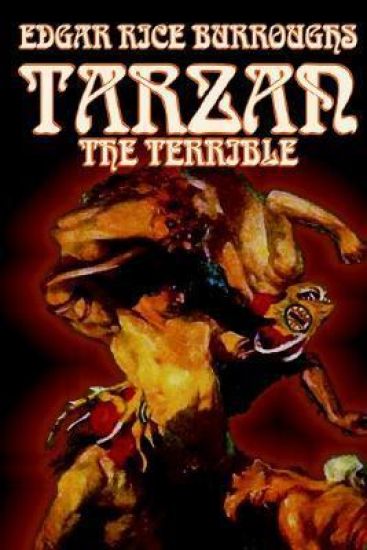
Tarzan the Terrible by Edgar Rice Burroughs, Fiction, Literary, Action & Adventure
In the previous volume, the Lord of the Jungle discovered the burnt corpse of his wife, Jane, after a visit to his African home by German soldiers. (One suspects that Burroughs never did like Jane; this sort of thing happened to her a lot.) In this volume, Tarzan learns that Jane was not murdered by the Germans but kidnaped -- and sets off in pursuit. As the novel begins, Tarzan has spent two months tracking his mate to Pal-ul-don ("Land of Men"), a hidden valley in Zaire, where he finds a land dinosaurs and men even stranger -- humanoids with tails. Ta-den is a hairless, white-skinned, Ho-don warrior; O-mat is a hairy, black skinned, Waz-don, chief of the tribe of Kor-ul-ja. In this new world Tarzan becomes a captive -- but he impresses his captors so well that they name him Tarzan-Jad-Guru ("Tarzan the Terrible"). Meanwhile, a second visitor has come to Pal-ul-don -- wearing only a loin cloth and carrying an Enfield rifle along and a long knife. Pal-ul-don is where Jane is being held captive, of course. . . .