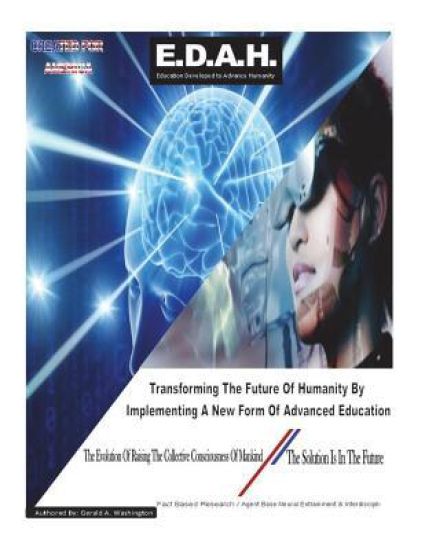
E-D-A-H is an Advanced Education Designed to "The Development of Inner-Genius" 1. To teach children to integrate effectively into society, and to train their minds to be integrated thinkers, to always seek the core of truth by looking past the appearances to what is. 2. Consequentially; discovering and developing the 'Inner-Genius' for the sole purpose to "achieving individual purpose through building societal values". This concept is not doing the least, to get the most; but to put full effort towards building values for society. 3. When this is achieved, the values of each accomplished 'Genius', will empower every aspect of humanity, by the perpetuating intelligible evolution in the cultural paradigm of mankind. 4. The natural progression will dictate that the negative aggressions in the human behavior would cease, and the persistence of harmonious collaboration in a human collective would prevail. 5. The advancement to the genius mind, is being able to know reality effectively, and to become one's own authoritative mind, to never allow another to dictate how to think. A Pervasive School System: The overarching goals; is to provide an Omni-accessible and highly impactful form of education. This design will demonstrate supreme qualities in every area that was once the plight of the old system, by implementing solutions and a completely different systemic process. This become possible, when the opportunity to develop a school system to perfectly fit the contours of the people demographically, geographically, genre or any targeting form. The versatility of available technologies will enhance the accessibility and provide unlimited resources to reach students in any location and create an enormous ability to administer cross-culture and linguistically. The technologies that will make these all possible are; VR- Virtual Reality and circumstantially AR- Augment Reality, these of course with the integration of AI- Artificial Intelligence. The combination of these two technologies will facilitate the development of all pertinent designs, and assist each success, the eventuality to spawn a global design to execute for continuous E-D-A-H expansion. The evolution of humanity will never cease, for the room to grow is infinite. In fact, to compare the quantification of human possibilities for evolutionary growth is equivalent that of the universe. So, we are now at the precipice of the most important milestone of human evolution, than we have ever been in the history of mankind. And we have a blueprint to creating and controlling the narrative of our future for humanity, to give our descendants an inheritable gift that will allow the future of humanity every opportunity to excel in every area of existence. Developing the future of mankind through advance education for children today, will most certainly manifest adult geniuses for tomorrow.
croquet is a game played by men, women and youth on equal terms. The game is easy but can evolve into a highly skilled game. Croquet is inexpensive with mallet, ball and wicker on a lawn which is often readily available.
A Shanghai American: From an American Childhood in Shanghai to Marine Combat Interpreter on the Pacific Island Battlefields of WWII Daniel S. Williams and Gerald A. Meehl Dan Williams, son of Baptist missionary parents, grew up in Shanghai, China, in the 1920s and 1930s. His experiences there as a Shanghai American shaped the rest of his life. Dan returned to the States at age sixteen in 1936 after a memorable journey on the Trans-Siberian railway. With the start of WWII, Dan was recruited by the US Navy and sent to the University of Colorado for a one-year course at the Navy Japanese Language School. After graduation, he became a marine officer with the Fourth Marine Division and participated in the harrowing island invasions of Kwajalein, Saipan, Tinian, and Iwo Jima. While under fire in intense combat, Dans job was to help his fellow marines win battles by finding and translating Japanese documents and interrogating prisoners. This narrative memoir, told in Dans own words, vividly brings to life events that shaped the history of the twentieth century.
Deregulation in banking and finance may hold promise for consumers, but what actually seems to be developing is trouble. Large banks are combining into small clusters of mega-banks with national and global reach, supported by government safety nets premised on fears they are too big to be allowed to fail. One result, among several, is that retail banking suffers. Shull and Hanweck evaluate existing bank merger policy and offer workable proposals for new legislative actions that would enhance the benefits of bank mergers without exacerbating the weaknesses. They review the historical role of governments in protecting banks from competition, then the modern policy that promotes competition, and present a model to explain and highlight the problems that today's policies are causing. In the end they turn to their own research and conclude that while a special bank merger policy is still warranted, it needs to be adapted in ways that would rein in the trend toward bigness and soften the impact this has domestically and internationally. A far reaching study essential for executives in all corners of the banking and financial services industry, academic and government researchers, and teachers of business, finance, and public policy. Many argue that deregulation and technological change have so intensified competition among banks that bank mega-mergers should cause little concern. Shull and Hanweck conclude, however, that a special bank merger policy is still warranted but it needs to be adapted to the way things are today, mainly, the impact that larger banks are having domestically and on the international scene as well. They provide a history of how governments in the U.S. and elsewhere sought to suppress bank competition; then, the unique procompetitive policies that developed in the second half of the Twentieth Century, including the introduction of antitrust standards and deregulation. From their theoretical and empirical evidence they show that the newly combined banks are competitively suspect. From other evidence they find that pricing of retail banking services in local markets does not reflect the improvements that deregulation and rapid technological change have led us to expect. They also describe how current bank merger policy, implemented by the Federal Reserve, other Federal banking agencies and the Justice Department, facilitates the growth of large banks and augments the new structural configuration. Can these problems be solved? Shull and Hanweck believe they can be and propose detailed, workable changes in public policy to do so.
This book provides a comprehensive analysis of social policy in the German Democratic Republic (GDR, 1949-1990), followed by an analysis of the “Social Union”, the transformation of social policy in the process of German unification in 1990. Schmidt’s analysis of the GDR also depicts commonalities and differences between the welfare state in East and West Germany as well as in other East European and Western countries. He concludes that the GDR was unable to cope with the trade-off between ambitious social policy goals and a deteriorating economic performance. Ritter embeds his analysis of the Social Union in a general study of German unification, its international circumstances and its domestic repercussions (1989-1994). He argues that social policy played a pivotal role in German unification, and that there was no alternative to extending the West German welfare state to the East. Ritter, a distinguished historian, bases his contribution on an award-winning study for which he drew on archival sources and interviews with key actors. Schmidt is a distinguished political scientist.
This book provides a comprehensive analysis of social policy in the German Democratic Republic (GDR, 1949-1990), followed by an analysis of the “Social Union”, the transformation of social policy in the process of German unification in 1990. Schmidt’s analysis of the GDR also depicts commonalities and differences between the welfare state in East and West Germany as well as in other East European and Western countries. He concludes that the GDR was unable to cope with the trade-off between ambitious social policy goals and a deteriorating economic performance. Ritter embeds his analysis of the Social Union in a general study of German unification, its international circumstances and its domestic repercussions (1989-1994). He argues that social policy played a pivotal role in German unification, and that there was no alternative to extending the West German welfare state to the East. Ritter, a distinguished historian, bases his contribution on an award-winning study for which he drew on archival sources and interviews with key actors. Schmidt is a distinguished political scientist.
Collaboration, Teamwork, and Networking present a thoughtful and pragmatic blueprint for those who want to maximize their leverage, resources, and opportunities. It's the stuff of real 21st Century empowerment; networking for a cause. The book provides a snapshot of how the existing economic, political, and social systems favor the status quo. It offers a framework for people and organizations to be proactive in combining their resources to create businesses that produce jobs and other services that help communities to thrive and succeed..
School cyberbullying, bullying and violence have reached epidemic levels. One in five school students report being bullied. Youth violence results in more than 475,000 nonfatal injuries per year and is the 3rd leading cause of death for young people ages 10-to-24. School Bullying and Violence: Interventions for School Mental Health Specialists provides critically important assessment and intervention information and strategies. Such information is essential when responding to bullying and school violence survivors. Equally important, and unique to this book, the authors address assessment and intervention protocols for bullying and violence school perpetrators. Suggested assessments and interventions are both practical and proactive. And, the authors skillfully utilize mini-case vignettes to demonstrate how to address survivor and perpetrator pressing issues, concerns, and needs. The text provides a thorough overview of helpful face-to-face clinical interviews and techniques designed to empower and protect survivors and stop perpetrators' bullying and violent behaviors. Mnemonics such as the 2WHO-SCAN and VIOLENT STUdent Scale augment the school mental health specialist's clinical judgement and promote higher probability toward favorable clinical intervention outcomes. Establishment of a school safety and risk committee is also outlined. Later chapters describe how to utilize Motivational Interviewing, Cognitive Behavioral Therapy, Psychological First Aid and Systems of Care to help students and their families address both bullying and violent behaviors. The book serves as a much-needed reference for school mental health specialists who serve both bullying and violence survivors and perpetrators.
The unification of Germany as a prelude to the end of the division of Europe and the termination of the Cold War came as a surprise to the whole world. It was the beginning of a new era in German and European history. The Price of German Unity is the first full-scale analysis of this process, both domestically and in its wider international context, with a particular focus on the social-policy consequences. Gerhard A. Ritter uses a wide range of hitherto inaccessible sources to describe and analyse the dynamics of reunification, including archives from the Chancellor's Office, and the relevant ministries and major parties of both the Federal Republic and the GDR, as well as private papers of leading actors on both sides and a wealth of interview material. As the book convincingly demonstrates, the wholesale transfer of the social system of the Federal Republic of Germany to the territory of the former GDR and the huge drain of economic resources from West to East that this involved, profoundly affected the economic and political framework of the new Germany and greatly intensified the latent crisis of the German welfare state.
With only 54 years of existence, the Constitution of the State of Alaska is in its developmental infancy compared to the constitutional history of the rest of the United States. However, having had the benefit of over 300 years, the Alaskan Constitution is a pioneer and model in--among other things--simplicity, coherence, vision and accessibility. The Alaska State Constitution provides an outstanding constitutional and historical account of the state's governing charter. In addition to an overview of Alaska's constitutional history, it provides an in-depth, section-by-section analysis of the entire constitution, detailing the many significant changes that have been made since its initial drafting. This treatment, along with a table of cases, index, and bibliography provides an unsurpassed reference guide for students, scholars, and practitioners of Alaska's constitution. Previously published by Greenwood, this title has been brought back in to circulation by Oxford University Press with new verve. Re-printed with standardization of content organization in order to facilitate research across the series. This title, as with all titles in the series, is set to join the dynamic revision cycle of The Oxford Commentaries on the State Constitutions of the United States. The Oxford Commentaries on the State Constitutions of the United States is an important new series that reflects a renewed international interest in constitutional history and provides expert insight into each of the 50 state constitutions. Each volume in this innovative series contains a historical overview of the state's constitutional development, a section-by-section analysis of its current constitution, and a comprehensive guide to further research. Under the expert editorship of Professor G. Alan Tarr, Director of the Center on State Constitutional Studies at Rutgers University, this series provides essential reference tools for understanding state constitutional law. Books in the series can be purchased individually or as part of a complete set, giving readers unmatched access to these important political documents.
Formation is a rite of passage or initiation ritual. This book draws on the findings of social anthropological studies of initiation tiruals and contemporary biblical studies of rites of passage. Since initiation rituals are of critical importance in the life journeys of individuals and groups, the book's central theme is relevant to educationalists and ritual leaders in the Church and secular society. Most religious congregations founded since the thirteenth century were formed for prophetic ministry to a world in change, yet for centuries before Vatican II, their candidates were rarely trained explicitly for this task. Through years of quasi-indoctrination and voluntary incarceration they were taught, in a monastic atmosphere of unchanging order, that the world was evil and to be avoided. Conformity to a theological, ecclesiastical and pastoral status quo was the most esteemed value in a candidate. This emphasis was contrary to the very nature of active religious life. Religious must be prophetic challengers of the status quo within the Church and society.Training for membership in active religious congregations, therefore, must now be radically reformed, but there are no road maps available to direct educationalists in developing programmes that would stimulate candidates to be radically creative in ministry. From Chaos to Mission creates a framework for radical thinking and practical action about the critical ussue of formation of religious for mission today.
What is the likelihood that common chemicals such as bisphenol-A, which is found in plastic water bottles, are harming us? Should shoppers be concerned about pesticide residues on fruits and vegetables in the supermarket produce aisle? Are we risking adverse health effects when we use insect repellent that contains DEET or slather on sunscreen? Modern life requires us to navigate an endless sea of chemicals. How do we know whether we need to worry about them?This book is a layperson’s guide to understanding chemical risk. The toxicologist Gerald A. LeBlanc offers a nontechnical overview of the key factors in evaluating whether exposure to chemicals in our daily lives could be harmful. He leads readers through the basic concepts of risk assessment using real-world examples. LeBlanc emphasizes that chemical hazard depends on the level of exposure and provides practical strategies for sensible decision making. The book features a series of accessible case studies describing how we all can reach rational conclusions about the danger of typical chemical exposures we experience every day.Giving nonexpert readers the tools to understand chemical risks, this book shows how critical thinking and science literacy can help us live with less fear and anxiety and make reasonable choices when confronted with potential hazards.
What is the likelihood that common chemicals such as bisphenol-A, which is found in plastic water bottles, are harming us? Should shoppers be concerned about pesticide residues on fruits and vegetables in the supermarket produce aisle? Are we risking adverse health effects when we use insect repellent that contains DEET or slather on sunscreen? Modern life requires us to navigate an endless sea of chemicals. How do we know whether we need to worry about them?This book is a layperson’s guide to understanding chemical risk. The toxicologist Gerald A. LeBlanc offers a nontechnical overview of the key factors in evaluating whether exposure to chemicals in our daily lives could be harmful. He leads readers through the basic concepts of risk assessment using real-world examples. LeBlanc emphasizes that chemical hazard depends on the level of exposure and provides practical strategies for sensible decision making. The book features a series of accessible case studies describing how we all can reach rational conclusions about the danger of typical chemical exposures we experience every day.Giving nonexpert readers the tools to understand chemical risks, this book shows how critical thinking and science literacy can help us live with less fear and anxiety and make reasonable choices when confronted with potential hazards.