
Kirjahaku
Etsi kirjoja tekijän nimen, kirjan nimen tai ISBN:n perusteella.
1000 tulosta hakusanalla J R Sharp










Princess Astel believes she's flying in her dreams. Until the morning when a dragon shows up and tells her she's the Chosen One to be taught magic by the dragons. The castle wizard, Sangdanee, sees things differently. He's been telling the young princess that dragons no longer exist and she must be protected. He locks her in the castle to begin her training in the sciences. Not knowing who is right, she does what she thinks best instead. She gathers her handmaidens and an unwilling suitor and flees the castle. Can the runaway princess save herself before a choice she doesn't want is pushed on her?

The International Thermal Conductivity Conference was started in 1961 with the initiative of Mr. Charles F. Lucks and grew out of the needs of researchers in the field. The Conferences were held annually from 1961 to 1973 and have been held biennially since 1975 when our Center for Informa tion and Numerical Data Analysis and Synthesis (CINDAS) of Purdue University became the Permanent Sponsor of the Conferences. -These Conferences provide a broadly based forum for researchers actively working on the thermal con ductivity and closely related properties to convene on a regular basis to exchange their ideas and experiences and report their findings and results. The Conferences have been self-perpetuating and are an example of how a technical community with a common purpose can transcend the invisible. arti ficial barriers between disciplines and gather together in increasing num bers without the need of national publicity and continuing funding support. when they see something worthwhile going on. It is believed that this ser ies of Conferences not only will grow stronger. but will set an example for researchers in other fields on how to jointly attack their own problem areas.

Of all the many types of machine elements which exist today, gears are among the most commonly used. The basic idea of a wheel with teeth is extremely simple, and dates back several thousand years. It is obvious to any observer that one gear drives another by means of the meshing teeth, and to the person who has never studied gears, it might seem that no further explanation is required. It may therefore come as a surprise to discover the large quantity of geometric theory that exists on the subject of gears, and to find that there is probably no branch of mechanical engineering where theory and practice are more closely linked. Enormous improvements have been made in the performance of gears during the last two hundred years or so, and this has been due principally to the careful attention given to the shape of the teeth. The theoretical shape of the tooth profile used in most modern gears is an involute. When precision gears are cut by modern gear-cutting machines, the accuracy with which the actual teeth conform to their theoretical shape is quite remarkable, and far exceeds the accuracy which is attained in the manufacture of most other types of machine elements. The first part of this book deals with spur gears, which are gears with teeth that are parallel to the gear axis. The second part describes helical gears, whose teeth form helices about the gear axis.

The Sulfate-Reducing Bacteria: Contemporary Perspectives
J.R. Postgate
Springer-Verlag New York Inc.
2011
nidottu
Sulfate-reducing bacteria comprise a diverse and ecologically interactive group of anaerobic prokaryotes which share an extraordinary trait: growth by sulfate respiration with hydrogen sulfide as a major end-product. Sulfate-reducers are found in diverse environments ranging from estuaries to geological oil-bearing formations. They have attracted considerable scientific and commercial interest. These organisms have been actively investigated by researchers in microbial energetics, protein chemistry, ecology and more recently molecular biology. This interest has increased greatly over the past decade, and this volume presents the first book-length summary of our knowledge of sulfate-reducing bacteria in nearly 10 years. Featuring an introduction by the eminent microbiologist John Postgate and comprehensive reviews from recognized authorities, this book will be of interest to microbiologists with interests in physiology, evolution, and ecology.
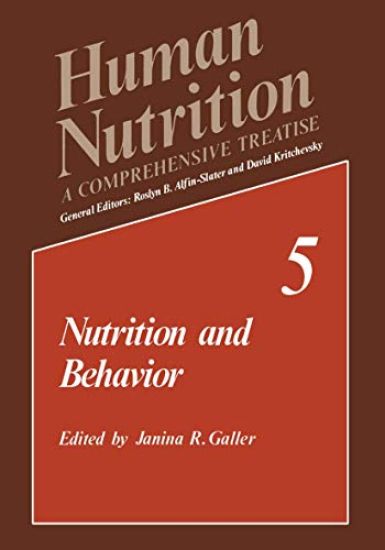
After the appearance of the four-book series Human Nutrition: A Compre hensive Treatise, it became apparent to the editors that an important area of nutrition had been overlooked, namely, behavioral aspects of nutrition. There are two areas in which nutrition and behavior interact. On the one hand, mal nutrition may play a major role in determining behavior; alternatively, often aspects of behavior influence the eating habits of populations and individuals and thus affect their nutritional status. Volume 5 of this series speaks eloquently to both features of this important topic. Various aspects of the influence of behavior modification and nutrition have been explored by a number of qualified investigators. It is hoped that this volume will prove a valuable addition to the subjects covered in the other volumes. Roslyn B. Alfin-Slater David Kritchevsky Los Angeles and Philadelphia ix Contents Introduction: The Challenge of Nutrition and Environment as Determinants of Behavioral Development .................... . Janina R. Galler References ............................................. 5 Part I • Nutritional Deficiencies or Excesses Modifying Behavioral Outcome Chapter 1 Methological Requirements for Conceptually Valid Research Studies on the Behavioral Effects of Malnutrition David E. Barrett 1. Introduction ......................................... 9 2. Statistical-Conclusion Validity. . . . . . . . . . . . . . . . . . . . . 11 . . . . . . . 3. Internal Validity ...................................... 14 4. External Validity ..................................... 16 5. Construct Validity of Putative Causes and Effects . . . . . . . . .. . . . 19 6. Conclusions and Recommendations . . . . . . . . . . . . . . . .. . . . 28 . . . .