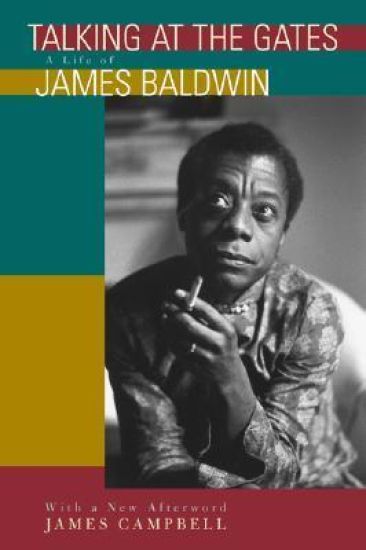
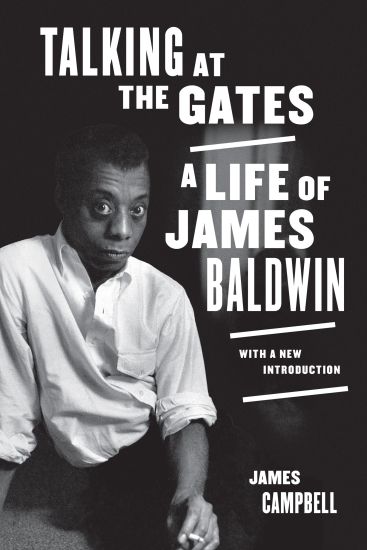
James Baldwin was one of America's finest and most influential writers. By the time he died in 1987, his books, such as The Fire Next Time, Go Tell It on the Mountain, and Giovanni's Room, had become modern classics. James Campbell knew Baldwin for ten years before Baldwin's death. For this book, he interviewed many of Baldwin's friends, and examined several hundred pages of correspondence. He quotes from the vast and disturbing file that the FBI compiled on Baldwin, and he discusses Baldwin's sometimes turbulent relationships with Norman Mailer, Richard Wright, and Marlon Brando, as well as his friendship with Martin Luther King Jr. Elegantly written, candid, and original, Talking at the Gates is a comprehensive account of the life and work of a writer who believed that "the unexamined life is not worth living."
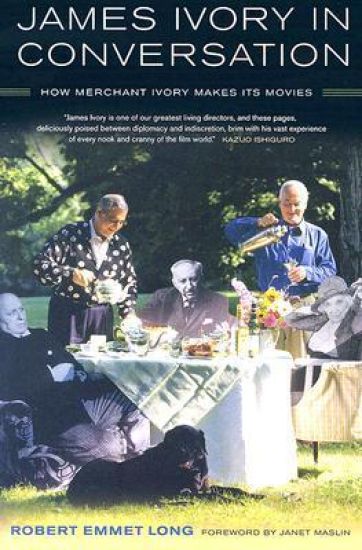
James Ivory in Conversation is an exclusive series of interviews with a director known for the international scope of his filmmaking on several continents. Three-time Academy Award nominee for best director, responsible for such film classics as A Room with a View and The Remains of the Day, Ivory speaks with remarkable candor and wit about his more than forty years as an independent filmmaker. In this deeply engaging book, he comments on the many aspects of his world-traveling career: his growing up in Oregon (he is not an Englishman, as most Europeans and many Americans think), his early involvement with documentary films that first brought attention to him, his discovery of India, his friendships with celebrated figures here and abroad, his skirmishes with the Picasso family and Thomas Jefferson scholars, his usually candid yet at times explosive relations with actors. Supported by seventy illuminating photographs selected by Ivory himself, the book offers a wealth of previously unavailable information about the director's life and the art of making movies. James Ivory on: On the Merchant Ivory Jhabvala partnership: "I've always said that Merchant Ivory is a bit like the U. S. Govenment; I'm the President, Ismail is the Congress, and Ruth is the Supreme Court. Though Ismail and I disagree sometimes, Ruth acts as a referee, or she and I may gang up on him, or vice versa. The main thing is, no one ever truly interferes in the area of work of the other." On Shooting Mr. and Mrs. Bridge: "Who told you we had long 18 hour days? We had a regular schedule, not at all rushed, worked regular hours and had regular two-day weekends, during which the crew shopped in the excellent malls of Kansas City, Paul Newman raced cars somewhere, unknown to us and the insurance company, and I lay on a couch reading The Remains of the Day." On Jessica Tandy as Miss Birdseye in The Bostonians: "Jessica Tandy was seventy-two or something, and she felt she had to 'play' being an old woman, to 'act' an old woman. Unfortunately, I'couldn't say to her, 'You don't have to 'act' this, just 'be,' that will be sufficient.' You can't tell the former Blanche Du Bois that she's an old woman now." On Adapting E. M. Forster's novels "His was a very pleasing voice, and it was easy to follow. Why turn his books into films unless you want to do that? But I suppose my voice was there, too; it was a kind of duet, you could say, and he provided the melody." On India: "If you see my Indian movies then you get some idea of what it was that attracted me about India and Indians...any explanation would sound lamer than the thing warrants. The mood was so great and overwhelming that any explanation of it would seem physically thin...I put all my feeling about India into several Indian films, and if you know those films and like them, you see from these films what it was that attracted me to India." On whether he was influenced by Renoir in filming A Room with a View "I was certainly not influenced by Renoir in that film. But if you put some good looking women in long white dresses in a field dotted with red poppies, andthey're holding parasols, then people will say, 'Renoir.'" On the Critics: "I came to believe that to have a powerful enemy like Pauline Kael only made me stronger. You know, like a kind of voodoo. I wonder if it worked that way in those days for any of her other victims--Woody Allen, for instance, or Stanley Kubrick." On Andy Warhol as a dinner guest: "I met him many times over the last twenty years of his life, but I can't say I knew him, which is what most people say, even those who were his intimates. Once he came to dinner with a group of his Factory friends at my apartment. I remember that he or someone else left a dirty plate, with chicken bones and knife and fork, in my bathroom wash basin. It seemed to be a symbolic gesture, to be a matter of style, and not just bad manners."
An intimate portrait of Baldwin's mythic life. James Baldwin was one of the most incisive and influential American writers of the twentieth century. Active in the civil rights movement and open about his homosexuality, Baldwin was celebrated for eloquent analyses of social unrest in his essays and for daring portrayals of sexuality and interracial relationships in his fiction. By the time of his death in 1987, both his fiction and nonfiction works had achieved the status of modern classics. James Campbell knew James Baldwin for the last ten years of Baldwin's life. For Talking at the Gates, Campbell interviewed many of Baldwin's friends and professional associates and examined several hundred pages of correspondence. Campbell was the first biographer to obtain access to the large file that the FBI and other agencies had compiled on the writer. Examining Baldwin's turbulent relationships with Norman Mailer, Richard Wright, Marlon Brando, Martin Luther King Jr., and others, this candid and original account portrays the life and work of a writer who held to the principle that "the unexamined life is not worth living." This new edition features a fresh introduction addressing recent developments in Baldwin's reputation and his return to a position he occupied in the early 1960s, when Life magazine called him "the monarch of the current literary jungle." It also contains a previously unpublished interview with Norman Mailer about Baldwin, which Campbell conducted in 1987.
In James Joyce and the Politics of Egoism a leading scholar approaches the entire Joycean canon through the concept of ‘egoism’. This concept, Jean-Michel Rabaté argues, runs throughout Joyce’s work, and involves and incorporates its opposite, ‘hospitality’, a term Rabaté understands as meaning an ethical and linguistic opening to ‘the other’. For Rabaté both concepts emerge from the fact that Joyce published crucial texts in the London based review The Egoist and later moved on to forge strong ties with the international Paris avant-garde. Rabaté examines the theoretical debates surrounding these connections, linking Joyce’s engagement with Irish politics with the aesthetic aspects of his texts. Through egoism, he shows, Joyce defined a literary sensibility founded on negation; through hospitality, Joyce postulated the creation of a new, utopian readership. Rabaté explores Joyce’s complex negotiation between these two poles in a study of interest to all Joyceans and scholars of modernism.
In James Joyce, Sexuality and Social Purity, Katherine Mullin offers a richly detailed account of Joyce's lifelong battle against censorship. Through prodigious archival research, Mullin shows Joyce responding to Edwardian ideologies of social purity by accentuating the 'contentious' or 'offensive' elements in his work. The censorious ambitions of the social purity movement, Mullin claims, feed directly into Joyce's writing. Paradoxically, his art becomes dependent on the very forces that seek to constrain and neutralize its revolutionary force. Acutely conscious of the dangers censorship presented to publication, Mullin shows Joyce revenging himself by energetically ridiculing purity campaigns throughout his fiction. Ulysses, A Portrait of the Artist as a Young Man and Dubliners all meticulously subvert purity discourse, as Joyce pastiches both the vice crusaders themselves and the imperilled 'Young Persons' they sought to protect. This important book will change the way Joyce is read and offers crucial insights into the sexual politics of Modernism.
James Joyce and the Difference of Language offers an alternative look at Joyce's writing by placing his language at the intersection of various critical perspectives: linguistics, philosophy, feminism, psychoanalysis, postcolonialism and intertextuality. Combining close textual analysis and theoretically informed readings, an international team of leading scholars explores how Joyce's experiments with language repeatedly challenge our ways of reading. Topics covered include reading Joyce through translations; the role of Dante's literary linguistics in Finnegans Wake; and the place of gender in Joyce's modernism. Two further essays illustrate aspects of Joyce's cultural politics in Ulysses and the ethics of desire in Finnegans Wake. Informed by debates in Joyce scholarship, literary studies and critical theory, and addressing the full range of his writing, this volume comprehensively examines the critical diversity of Joyce's linguistic practices. It is essential reading for all scholars of Joyce and modernism.
This is a comprehensive edition of Maxwell's manuscript papers published virtually complete and largely for the first time. Maxwell's work was of central importance in establishing and developing the major themes of the physics of the nineteenth century: his theory of the electromagnetic field and the electromagnetic theory of light and his special place in the history of physics. His fecundity of imagination and the sophistication of his examination of the foundations of physics give particular interest and importance to his writings. Volume I: 1846–1862 documents Maxwell's education and early scientific work and his major period of scientific innovation - his first formulation of field theory, the electromagnetic theory of light and the statistical theory of gases. Important letters and manuscript drafts illuminate this fundamental early work and the volume includes his letters to friends and family, general essays and lectures and juvenilia.
This is the first full-length study of James Joyce to subject his work to ethical and political analysis. It addresses important issues in contemporary literary and cultural studies surrounding problems of justice, as well as discussions of gender, homosociality and the colonial condition. Valente uses an original theory and psychology of justice through which to explore both the well-known and the more obscure of Joyce's works. He traces the remarkable formal and stylistic evolution that defined Joyce's career, and his progressive attempt to negotiate the context of social difference in racial, colonial, class and sexual terms. By analysing Joyce's verbal strategies within both the psychobiographical and sociohistorical contexts, Valente unlocks the politics of Joyce's unconscious and reveals the legacy of Western political thought.
From its very beginning, psychoanalysis sought to incorporate the aesthetic into its domain. Despite Joyce's deliberate attempt in his writing to resist this powerful hermeneutic, his work has been confronted by a long tradition of psychoanalytic readings. Luke Thurston argues that this very antagonism holds the key to how psychoanalytic thinking can still open up new avenues in Joycean criticism and literary theory. In particular, Thurston shows that Jacques Lacan's response to Joyce goes beyond the 'application' of theory: rather than diagnosing Joyce's writing or claiming to have deciphered its riddles, Lacan seeks to understand how it can entail an unreadable signature, a unique act of social transgression that defies translation into discourse. Thurston imaginatively builds on Lacan's work to illuminate Joyce's place in a wide-ranging literary genealogy that includes Shakespeare, Hogg, Stevenson and Wilde. This study should be essential reading for all students of Joyce, literary theory and psychoanalysis.
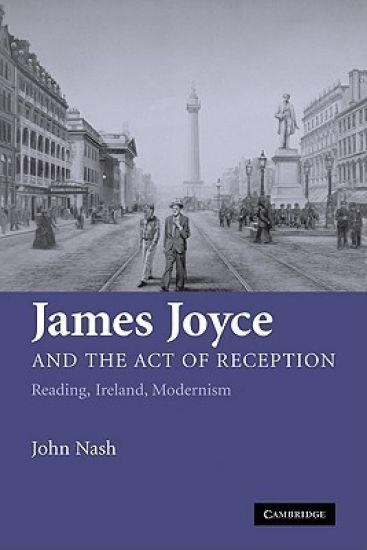
James Joyce and the Act of Reception is a detailed account of Joyce's own engagement with the reception of his work. It shows how Joyce's writing, from the earliest fiction to Finnegans Wake, addresses the social conditions of reading (particularly in Ireland). Most notably, it echoes and transforms the responses of some of Joyce's actual readers, from family and friends to key figures such as Eglinton and Yeats. This study argues that the famous 'unreadable' quality of Joyce's writing is a crucial feature of its historical significance. Not only does Joyce engage with the cultural contexts in which he was read but, by inscribing versions of his own contemporary reception within his writing, he determines that his later readers read through the responses of earlier ones. In its focus on the local and contemporary act of reception, Joyce's work is seen to challenge critical accounts of both modernism and deconstruction.
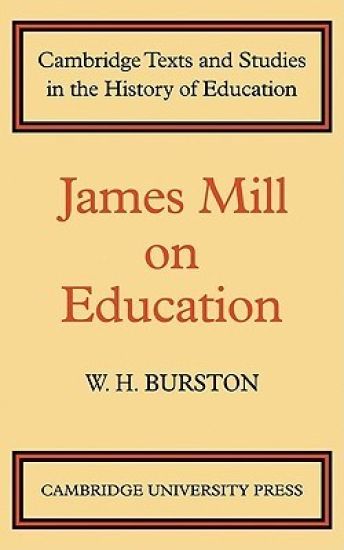
James Mill's two principal published works on education are the article 'Education', for the Encyclopedia Britannica, written in 1815, and the pamphlet Schools for all, in preference to Schools for Churchmen only, written in 1812. The first was general and theoretical, and raises points about the relationship between the aims of education, psychological theory and social life. It is a classic document of utilitarianism. The second was written as part of the debate about the interlocked themes of primary education, monitorial education, and religious education. It is practical and political, and one of the first statements about secularism in education and the need to provide primary schooling for all in England. Mr Burston's introduction relates the two pieces to Mill's general intellectual and philosophical position, and to the historical context in which he wrote. Notes explain allusions in the text, and there is a bibliography.
This is a comprehensive edition of Maxwell's manuscript papers published virtually complete and largely for the first time. Maxwell's work was of central importance in establishing and developing the major themes of the physics of the nineteenth century: his theory of the electromagnetic field and the electromagnetic theory of light and his special place in the history of physics. His fecundity of imagination and the sophistication of his examination of the foundations of physics give particular interest and importance to his writings. Volume III: 1874–1879 covers the period of Maxwell's direction of the Cavendish Laboratory and documents the espousal of his theories by a wider circle of physicists. During this last period of his life his work began to achieve the pre-eminence in the classical physics of the nineteenth century, which it has retained ever since.
James Joyce holds a unique position in literature. No writer has a higher reputation, none attracts more ardent devotees, and none poses so many difficulties for the first-time reader. This book is an original and well-informed survey of the whole of Joyce's work. It offers close readings of his early writings such as Dubliners and A Portrait of the Artist as a Young Man, and an extended examination of his masterpiece, Ulysses, as well as a stimulating introduction to that notoriously difficult work Finnegans Wake. Dr Parrinder stresses Joyce's ambivalent relationship to the Ireland of his youth, and his ability to incorporate the most banal and profane levels of experience and language into profound celebration of the human capacity for survival and regeneration. The Joyce who emerges is a writer of innocence and gusto as well as immense artistic cunning.
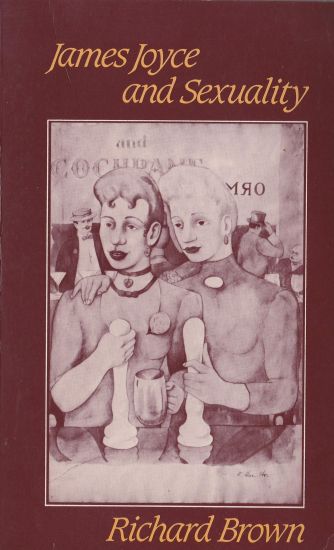
This highly original study seeks to correct the critical misapprehension that James Joyce was a figure who remained aloof and disengaged from the intellectual and social concerns of his time. By exploring Joyce’s interest in sexual questions, Dr Brown shows that, on the contrary, his work represents a more complex and subtle kind of engagement with such concerns. There are four main areas of interest. The first is Joyce’s extensive reading on the question of marriage and its impact on his work, a subject invested with greater interest through Joyce’s elopement with and delayed marriage to Nora Barnacle. The second is Joyce’s responsiveness to the new sexual ideology as expounded in the writings of Freud and Havelock Ellis. Thirdly, Dr Brown considers the feminist dimension of the oeuvre and explores Joyce’s profound concern with twentieth-century discussions of sexual divisions and difference, a topic hitherto neglected in the classic critical treatments. Finally, the book argues for a new type of Joycean aesthetic in which the major works are analysed as responses to readings of other texts. Dr Brown offers a substantial and original account of Joyce’s work as modern in its social ideas as well as in its literary form, and suggests how the stylistic modernity itself may be seen to arise in part as a response to the difficulties of dealing with sex.