

Kirjahaku
Etsi kirjoja tekijän nimen, kirjan nimen tai ISBN:n perusteella.
1000 tulosta hakusanalla Peter J. Fast

European Direct Investment in the U.S.A. before World War I
Peter J. Buckley; Brian R. Roberts
Palgrave Macmillan
1982
nidottu

Direct Investment in the United Kingdom by Smaller European Firms
Peter J. Buckley; Zdenka Berkova; Gerald D. Newbould
Palgrave Macmillan
1983
nidottu

Foreign Direct Investment by Smaller UK Firms: The Success and Failure of First-Time Investors Abroad
Peter J. Buckley; Geral d D. Newbould; Jane Thurwell
Palgrave Macmillan
1988
nidottu
One of the biggest risks any company can take is the setting-up of an overseas production subsidiary. The production subsidiary requires the greatest capital with the possibility of the total investment being lost should the venture fall. It is to reduce that risk that this book has been written.

North-South Direct Investment in the European Communities
Peter J. Buckley; Patri ck F. R. Artisien
Palgrave Macmillan
1987
nidottu

These papers provide an integrated treatment of the theory with its applications for industrial sectors, regions and international business policy. The theory is applied to smaller firms, to co-operative agreements between firms and to exports in the strategy of large multinational firms.

This collection of articles by an internationally recognised authority on the multinational enterprise contains advances in theory, examinations of organisational issues and empirical studies of multinationals in the world economy. The theory section includes an innovative paper on the role of multinationals in less developed countries. The organisational issues examined include strategic alliances. The final section includes analyses of joint ventures and Japan's relationship with multinational firms.

International Strategic Management and Government Policy
Peter J. Buckley
Palgrave Macmillan
1998
nidottu
Spanning diverse current topics in the field of international strategic management, this collection represents the best writings of Peter Buckley, one of the world's leading authorities in the field. The book looks at three main areas in detail: international strategic management and government policy; foreign investment in China, Vietnam and Japan; and trade blocs, foreign market servicing strategies and international transfer pricing. An essential volume for anyone wishing to keep up-to-date with recent developments in international strategic management.

The Multinational Enterprise and the Emergence of the Global Factory
Peter J. Buckley
Palgrave Macmillan
2014
nidottu
The Multinational Enterprise and the Emergence of the Global Factory brings together research papers authored by Peter J. Buckley, focusing on three of the most important empirical and theoretical issues in the global economy: the rise of the 'global factory'; the growth of FDI from emerging economies; recent developments in the theory of IB.
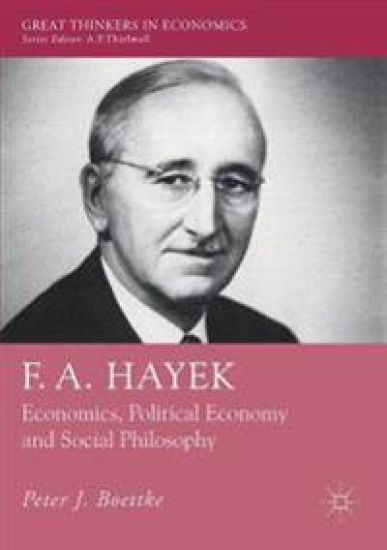
This book explores the life and work of Austrian-British economist, political economist, and social philosopher, Friedrich Hayek. Set within a context of the recent financial crisis, alongside the renewed interest in Hayek and the Hayek-Keynes debate, the book introduces the main themes of Hayek’s thought. These include the division of knowledge, the importance of rules, the problems with planning and economic management, and the role of constitutional constraints in enabling the emergence of unplanned order in the market by limiting the perverse incentives and distortions in information often associated with political discretion. Key to understanding Hayek's development as a thinker is his emphasis on the knowledge problem that economic decision makers face and how alternative institutional arrangements either hinder or assist them in overcoming that epistemic dilemma. Hayek saw order emerging from individual action and responsibility under the appropriate institutional order that itself emerges from actors discovering new and better ways to coordinate their behavior. This book will be of interest to all those keen to gain a deeper understanding of this great 20th century thinker in economics.

Modern sport cannot be understood without ancient sport. Sport saturates contemporary society and the global reach of sport and its intense popularity characterizes the modern world. But, at the same time, sport is one of the most ancient human pursuits. In the globalized sport of today, the type of athletic performance and the ideology of sport and its apparent origins are mostly derived from the model of one pre-modern civilization: Graeco-Roman antiquity. Juxtaposing ancient writers with recent ones, including the modern Olympic founder Pierre de Coubertin and physical fitness impresario Bernarr Macfadden, and by examining the representation of sport in Olympic films, Miller demonstrates the ancient heritage of contemporary sport, and the creative ways in which ancient sport has been adapted, appropriated, mishandled and reimagined. Sport today contains a surprising contradiction: its explicit modernity (from its technological sophistication and integration into capitalist markets to its institutionalization and celebrity culture) and its supposed antiquity (from the mythology of the Olympics to the ancient roots of sporting civic and national pride, and the emotional and near religious fervour of sports fans). This book intervenes in one of the most important of the receptions of classical antiquity by examining how sports personalities, agencies, institutions and movements have consciously connected themselves to the Graeco-Roman past, even as they continue to insist on their own centrality in the modern world.

Modern sport cannot be understood without ancient sport. Sport saturates contemporary society and the global reach of sport and its intense popularity characterizes the modern world. But, at the same time, sport is one of the most ancient human pursuits. In the globalized sport of today, the type of athletic performance and the ideology of sport and its apparent origins are mostly derived from the model of one pre-modern civilization: Graeco-Roman antiquity. Juxtaposing ancient writers with recent ones, including the modern Olympic founder Pierre de Coubertin and physical fitness impresario Bernarr Macfadden, and by examining the representation of sport in Olympic films, Miller demonstrates the ancient heritage of contemporary sport, and the creative ways in which ancient sport has been adapted, appropriated, mishandled and reimagined. Sport today contains a surprising contradiction: its explicit modernity (from its technological sophistication and integration into capitalist markets to its institutionalization and celebrity culture) and its supposed antiquity (from the mythology of the Olympics to the ancient roots of sporting civic and national pride, and the emotional and near religious fervour of sports fans). This book intervenes in one of the most important of the receptions of classical antiquity by examining how sports personalities, agencies, institutions and movements have consciously connected themselves to the Graeco-Roman past, even as they continue to insist on their own centrality in the modern world.




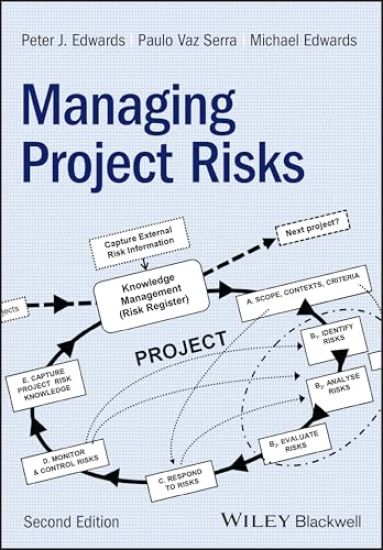
Managing Project Risks
Peter J. Edwards; Paulo Vaz Serra; Michael Edwards
JOHN WILEY SONS INC
2025
sidottu
A comprehensive and highly practical overview of project risk management emphasising pragmatic solutions and user-friendly methods without advanced mathematical techniques Managing Project Risks provides a comprehensive treatment of project risk management, offering a systematic but easy-to-follow approach. This book explores critical topics that influence how risks are managed, but which are rarely found in other books, including risk knowledge management, cultural risk-shaping, project complexity, political risks, and strategic risk management. The book commences with foundational concepts, providing an overview of risk, project definitions, project stakeholders, and risk management systems. Subsequent chapters explore the core processes of project risk management, including risk identification, analysis, evaluation, response strategies, and risk monitoring and control. Additional topics include risk knowledge management, the influence of culture on risk, political risks in projects, and relevant software applications. Experienced readers may choose to navigate directly to the later chapters, which focus on strategic risk management and offer recommendations for planning, building, and maturing a project risk management system. Throughout, the authors impart a practical approach that does not rely on high level expertise or advanced mathematical techniques; the emphasis remains on pragmatic solutions, user-friendly techniques, and reliable communication, enabling readers to seamlessly integrate theory into practice. Updates to the newly revised Second Edition of Managing Project Risks include: Additional tools and techniques for risk identification and an expanded treatment of risk communicationA new tool for early-stage project complexity assessment—the stage where uncertainties, and thus threat and opportunity risks, are at their highest levelA more substantial treatment of planning for crisis response and disaster recovery, taking into consideration climate change and the increasingly prevalent impacts of severe weather phenomenaMore information on strategic risk management, now including public and organizational policy development with respect to risks in projects Managing Project Risks is an essential resource for practitioners of project management across architecture, construction, engineering, and technology disciplines, for undergraduate and postgraduate students, and for public and private sector stakeholders involved in decision-making and policy development. It is useful wherever project-driven activities are undertaken.

Not All Quiet Before the Storm: A Political Study of the West
Peter J. Sandys
Austin Macauley Publishers
2023
nidottu

Not All Quiet Before the Storm: A Political Study of the West
Peter J. Sandys
Austin Macauley Publishers
2023
sidottu