These papers provide an integrated treatment of the theory with its applications for industrial sectors, regions and international business policy. The theory is applied to smaller firms, to co-operative agreements between firms and to exports in the strategy of large multinational firms.
This collection of articles by an internationally recognised authority on the multinational enterprise contains advances in theory, examinations of organisational issues and empirical studies of multinationals in the world economy. The theory section includes an innovative paper on the role of multinationals in less developed countries. The organisational issues examined include strategic alliances. The final section includes analyses of joint ventures and Japan's relationship with multinational firms.
Spanning diverse current topics in the field of international strategic management, this collection represents the best writings of Peter Buckley, one of the world's leading authorities in the field. The book looks at three main areas in detail: international strategic management and government policy; foreign investment in China, Vietnam and Japan; and trade blocs, foreign market servicing strategies and international transfer pricing. An essential volume for anyone wishing to keep up-to-date with recent developments in international strategic management.
The Multinational Enterprise and the Emergence of the Global Factory brings together research papers authored by Peter J. Buckley, focusing on three of the most important empirical and theoretical issues in the global economy: the rise of the 'global factory'; the growth of FDI from emerging economies; recent developments in the theory of IB.
This book explores the life and work of Austrian-British economist, political economist, and social philosopher, Friedrich Hayek. Set within a context of the recent financial crisis, alongside the renewed interest in Hayek and the Hayek-Keynes debate, the book introduces the main themes of Hayek’s thought. These include the division of knowledge, the importance of rules, the problems with planning and economic management, and the role of constitutional constraints in enabling the emergence of unplanned order in the market by limiting the perverse incentives and distortions in information often associated with political discretion. Key to understanding Hayek's development as a thinker is his emphasis on the knowledge problem that economic decision makers face and how alternative institutional arrangements either hinder or assist them in overcoming that epistemic dilemma. Hayek saw order emerging from individual action and responsibility under the appropriate institutional order that itself emerges from actors discovering new and better ways to coordinate their behavior. This book will be of interest to all those keen to gain a deeper understanding of this great 20th century thinker in economics.
Modern sport cannot be understood without ancient sport. Sport saturates contemporary society and the global reach of sport and its intense popularity characterizes the modern world. But, at the same time, sport is one of the most ancient human pursuits. In the globalized sport of today, the type of athletic performance and the ideology of sport and its apparent origins are mostly derived from the model of one pre-modern civilization: Graeco-Roman antiquity. Juxtaposing ancient writers with recent ones, including the modern Olympic founder Pierre de Coubertin and physical fitness impresario Bernarr Macfadden, and by examining the representation of sport in Olympic films, Miller demonstrates the ancient heritage of contemporary sport, and the creative ways in which ancient sport has been adapted, appropriated, mishandled and reimagined. Sport today contains a surprising contradiction: its explicit modernity (from its technological sophistication and integration into capitalist markets to its institutionalization and celebrity culture) and its supposed antiquity (from the mythology of the Olympics to the ancient roots of sporting civic and national pride, and the emotional and near religious fervour of sports fans). This book intervenes in one of the most important of the receptions of classical antiquity by examining how sports personalities, agencies, institutions and movements have consciously connected themselves to the Graeco-Roman past, even as they continue to insist on their own centrality in the modern world.
Modern sport cannot be understood without ancient sport. Sport saturates contemporary society and the global reach of sport and its intense popularity characterizes the modern world. But, at the same time, sport is one of the most ancient human pursuits. In the globalized sport of today, the type of athletic performance and the ideology of sport and its apparent origins are mostly derived from the model of one pre-modern civilization: Graeco-Roman antiquity. Juxtaposing ancient writers with recent ones, including the modern Olympic founder Pierre de Coubertin and physical fitness impresario Bernarr Macfadden, and by examining the representation of sport in Olympic films, Miller demonstrates the ancient heritage of contemporary sport, and the creative ways in which ancient sport has been adapted, appropriated, mishandled and reimagined. Sport today contains a surprising contradiction: its explicit modernity (from its technological sophistication and integration into capitalist markets to its institutionalization and celebrity culture) and its supposed antiquity (from the mythology of the Olympics to the ancient roots of sporting civic and national pride, and the emotional and near religious fervour of sports fans). This book intervenes in one of the most important of the receptions of classical antiquity by examining how sports personalities, agencies, institutions and movements have consciously connected themselves to the Graeco-Roman past, even as they continue to insist on their own centrality in the modern world.
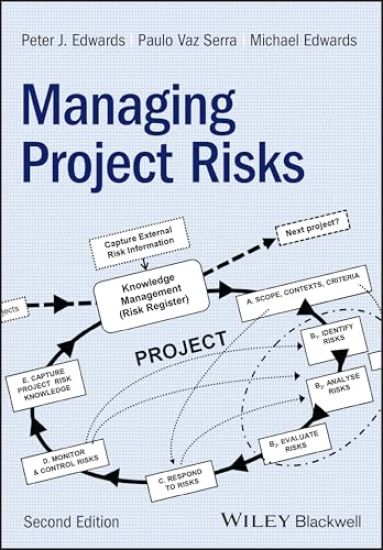
A comprehensive and highly practical overview of project risk management emphasising pragmatic solutions and user-friendly methods without advanced mathematical techniques Managing Project Risks provides a comprehensive treatment of project risk management, offering a systematic but easy-to-follow approach. This book explores critical topics that influence how risks are managed, but which are rarely found in other books, including risk knowledge management, cultural risk-shaping, project complexity, political risks, and strategic risk management. The book commences with foundational concepts, providing an overview of risk, project definitions, project stakeholders, and risk management systems. Subsequent chapters explore the core processes of project risk management, including risk identification, analysis, evaluation, response strategies, and risk monitoring and control. Additional topics include risk knowledge management, the influence of culture on risk, political risks in projects, and relevant software applications. Experienced readers may choose to navigate directly to the later chapters, which focus on strategic risk management and offer recommendations for planning, building, and maturing a project risk management system. Throughout, the authors impart a practical approach that does not rely on high level expertise or advanced mathematical techniques; the emphasis remains on pragmatic solutions, user-friendly techniques, and reliable communication, enabling readers to seamlessly integrate theory into practice. Updates to the newly revised Second Edition of Managing Project Risks include: Additional tools and techniques for risk identification and an expanded treatment of risk communicationA new tool for early-stage project complexity assessment—the stage where uncertainties, and thus threat and opportunity risks, are at their highest levelA more substantial treatment of planning for crisis response and disaster recovery, taking into consideration climate change and the increasingly prevalent impacts of severe weather phenomenaMore information on strategic risk management, now including public and organizational policy development with respect to risks in projects Managing Project Risks is an essential resource for practitioners of project management across architecture, construction, engineering, and technology disciplines, for undergraduate and postgraduate students, and for public and private sector stakeholders involved in decision-making and policy development. It is useful wherever project-driven activities are undertaken.
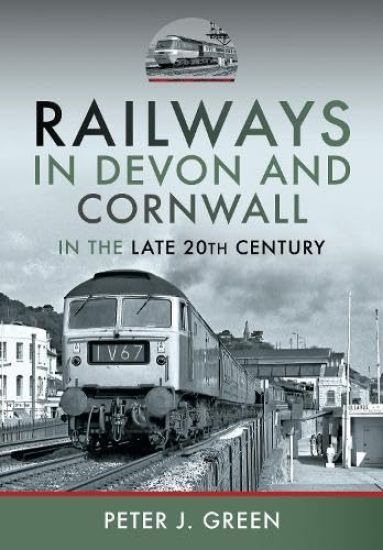
Devon and Cornwall have long been attractive destinations, not only for holidaymakers, but also for railway enthusiasts, and it was in Devon, during a family holiday in 1959 that the author’s passion for railways began. Peter started photographing railways at an early age, mainly concentrating on steam, but he made some visits to Devon in the 1970s, to see the Western Class diesel-hydraulics running along the coast. They were being replaced by Class 50 diesel-electrics at the time. More time was spent in Devon in the 1970s and early 1980s photographing preserved railways as well as the modern scene, and an Easter visit to Goodrington became a regular event for several years. The 1986 West of England resignalling scheme provided a good reason for a further series of visits to Devon to record the mechanical signal boxes, semaphore signalling and associated equipment before it all disappeared. The first of the author’s many trips to Cornwall was in the summer of 1984, when he spent ten days attempting to photograph the entire Cornish railway system. Although an impossible task, the Class 37s on the china clay operations, as well as all the 'Peaks', Class 47s and 50s on the main lines, ensured an enjoyable time. Here, with the help of other contributors, the author has attempted to assemble a comprehensive photographic record of the railways in the two counties in the late 20th Century.
Shrewsbury station, located at the junction of the lines from Chester, Crewe, Wolverhampton, Hereford and Aberystwyth is a busy and interesting railway centre for the enthusiast. Many train movements are still controlled by semaphore signals operated from a number of signal boxes, including the largest remaining operational mechanical signal box in the world at Severn Bridge Junction. Nevertheless, modernisation has been gradually sweeping away much of the railway infrastructure, both at Shrewsbury and in the surrounding area, as it has been everywhere else. This book looks at Shrewsbury itself, the lines that radiate from there, and the trains that ran on them, in the late twentieth and the early part of the twenty-first century. During this time period, much more general railway infrastructure and mechanical signalling was still in use, and locomotive-hauled trains were abundant, using a variety of motive power, including Classes 25, 31, 33, 37 and 47\. The various freight lines that saw traffic are also visited. The railway from Newport through Hereford and Shrewsbury to Chester, in particular, saw regular steam-hauled special trains, a few of which are illustrated here. Preserved railways in the area are not forgotten, including the Severn Valley Railway which once ran from Sutton Bridge Junction at Shrewsbury to Hartlebury, between Kidderminster and Droitwich Spa.
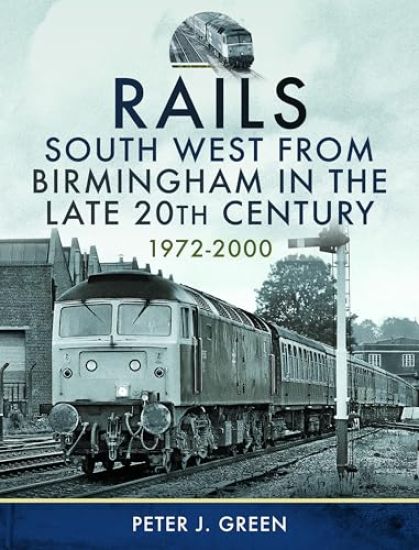
Towards the end of the twentieth century, take a photographic journey along the railway lines to the southwest and south of Birmingham. Starting at Birmingham's main stations, New Street and Snow Hill in the centre of the city, you can travel from the West Midlands through the urban, industrial, and rural landscapes of the counties of Gloucestershire, Herefordshire, Warwickshire and Worcestershire, visiting the branch lines and the various heritage railways and railway centres along the way. As well as the diesel locomotives and railcars that are illustrated in most of the photographs, various steam-hauled special trains are also included. While the railway has gradually improved as a means of transport, for the author it has become increasingly less interesting as it has been modernised. Fortunately, the spectacle of 'Peaks', Class 50s and many other locomotives going about their daily business has been well recorded, and many scenes are captured in these pages. Much railway infrastructure still remained at this time and many older railway stations and mechanical signal boxes, with their associated semaphore signalling, are also featured, adding to the interest of many of the photographs.
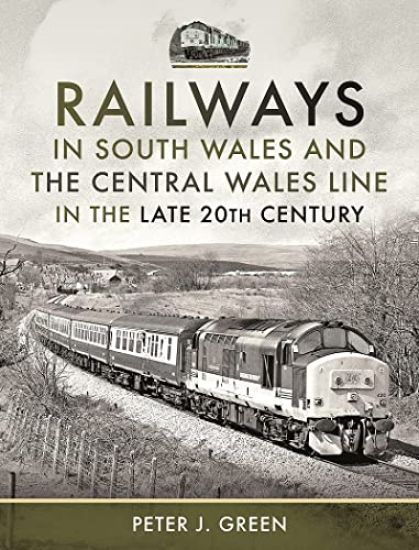
In the early 1980s, I began to visit South Wales on a regular basis to photograph the railway scene. At that time, the collieries and steelworks were generating a lot of rail traffic with Class 37 diesels being the usual motive power. Passenger trains were in the hands of Class 47s and 37s, while 'Peaks' and Class 50s would also appear on occasion. HSTs, DMUs, Sprinters and Pacers were, of course, also common. As time went on, collieries closed and the coal traffic reduced, but there always something new and interesting. Rugby Internationals at Cardiff regularly produced a number of special trains which arrived from various parts of the country, often bringing interesting motive power to the Welsh capital. The Class 37s were slowly replaced by Class 56s, and later Class 60s, on many duties in South Wales, but the Rhymney Valley saw Class 37 diesels working passenger trains into the twenty-first century, and on Rugby International days, privately-owned Class 50s were also used on occasion. I also visited the Central Wales line a number of times and particularly enjoyed the time I spent at the small country stations, before the semaphore signals were replaced. This book contains a selection of photographs taken in the latter part of the 20th and in the very early 21st Century, covering the railways of South Wales and the Welsh section of the Central Wales line. A few photographs of the principal heritage railways in more recent times are also included.
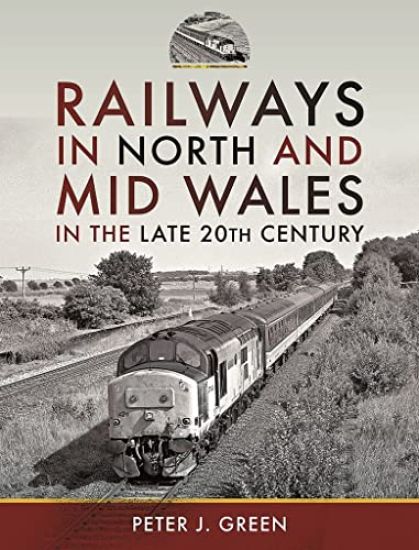
The coastal and mountain scenery around the railway lines of North and Mid Wales is among the best in Great Britain. Here we look at the British Railways lines and the trains that ran on them in the years between 1980 and 2000, as recorded by my cameras during my many visits to the area. A few photographs from earlier years are also included to help to complete the picture. During this period of time, quite a lot of mechanical signalling and many old station buildings still remained, all adding to the railway atmosphere. Featured here are the North Wales Coast line and its branches, the former Cambrian line from Welshpool to Aberystwyth and Pwllheli, and the Welsh section of the Shrewsbury to Chester line. While the emphasis is very much on the main lines, the Welshpool and Llanfair Light Railway, closed by British Railways in 1956 and reopened as a heritage railway, and the Llangollen Railway on a section of the former Ruabon to Barmouth line also feature, as does the Vale of Rheidol Railway, sold by British Rail into private ownership in 1989\. A few photographs of the steam specials that regularly ran on the main lines are also included.