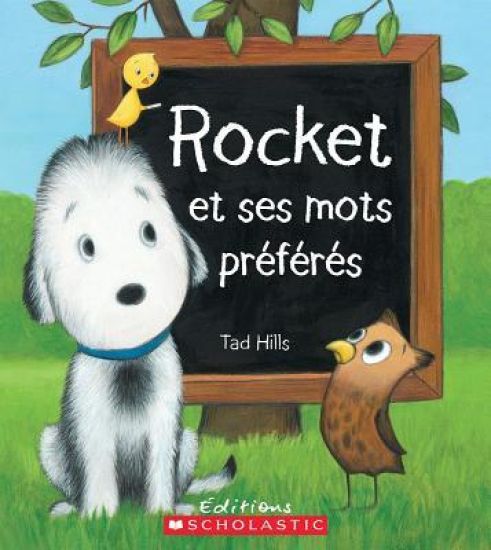
See below for English description. Rocket, l'adorable chiot des albums Rocket veut lire et Rocket ?crit une histoire, meilleurs vendeurs au Palmar's du New York Times, est de retour. En compagnie d'un petit oiseau jaune mignon et sympathique, Rocket pr?sente dans ce bel album tout carton, ses mots pr?f?r?s. Rocket, the beloved dog from the New York Times bestselling picture books How Rocket Learned to Read (Rocket veut lire) and Rocket Writes a Story (Rocket ?crit une histoire), is back in a sturdy big board book for new readers. Preschoolers watch the little yellow bird teach Rocket simple words, like b-e-c and l-u-n-e. And beginning readers will love practicing their new literacy skills alongside another brand new reader - Rocket The larger size of this edition makes it perfect for sharing during storytime or lap time. Original title: Rocket's Mighty Words
This volume considers the highly convoluted relationship between F. R. Leavis and T. S. Eliot, comparing their ideas in literary and cultural criticism, and connecting it to the broader discourse of English Studies as a university subject that developed in the first half of the twentieth century. Comparing and contrasting all the many writings of Leavis on Eliot, and the two on Lawrence, the study examines how Eliot is formative for the theory and practice of Leavis’s literary criticism in both positive and negative ways, and investigates Lawrence’s significance in relation to Leavis’s changing attitude to Eliot. It also examines how profound differences in social, cultural, religious and national thinking strengthened Leavis’s alliance with Lawrence to the detriment of his relationship with Eliot. These differences between the two writers are presented as dichotomies between nationalism and Europeanism/internationalism, ruralism/organicism and industrialism/metropolitanism, and relate to the two men’s views on literary education, the subject of ‘English’ and the position of the Classics in the curriculum. It explores how Leavis’s increasingly conflicted feelings about a figure to whom he owned an enormous critical debt and inspiration, but whose various beliefs and literary affiliations caused him much misgiving, result in a deep sense of division in Leavis himself which he sought to transfer onto Eliot as what he called a pathological ‘case’.
This volume considers the highly convoluted relationship between F. R. Leavis and T. S. Eliot, comparing their ideas in literary and cultural criticism, and connecting it to the broader discourse of English Studies as a university subject that developed in the first half of the twentieth century. Comparing and contrasting all the many writings of Leavis on Eliot, and the two on Lawrence, the study examines how Eliot is formative for the theory and practice of Leavis’s literary criticism in both positive and negative ways, and investigates Lawrence’s significance in relation to Leavis’s changing attitude to Eliot. It also examines how profound differences in social, cultural, religious and national thinking strengthened Leavis’s alliance with Lawrence to the detriment of his relationship with Eliot. These differences between the two writers are presented as dichotomies between nationalism and Europeanism/internationalism, ruralism/organicism and industrialism/metropolitanism, and relate to the two men’s views on literary education, the subject of ‘English’ and the position of the Classics in the curriculum. It explores how Leavis’s increasingly conflicted feelings about a figure to whom he owned an enormous critical debt and inspiration, but whose various beliefs and literary affiliations caused him much misgiving, result in a deep sense of division in Leavis himself which he sought to transfer onto Eliot as what he called a pathological ‘case’.
Millions of people suffer from Burnout each year. Most books regarding the subject are written by mental health professionals from a diagnostic standpoint."Suffer from BURNOUT? Give'em the F.I.N.G.E.R. " is different. It is written from the prospective of someone who actually suffered from this debilitating ailment. The author, Mark Yarbrough, was serving as an elected District Attorney when he suffered from Burnout. In an easy-to-read, first-hand account, Mark tells the readers what caused his Burnout. More importantly, Mark shares his F.I.N.G.E.R. philosophy that he used to overcome his Burnout. If you or someone you know and love are suffering from Burnout, this book is a must read.
This work has been selected by scholars as being culturally important and is part of the knowledge base of civilization as we know it.This work is in the public domain in the United States of America, and possibly other nations. Within the United States, you may freely copy and distribute this work, as no entity (individual or corporate) has a copyright on the body of the work.Scholars believe, and we concur, that this work is important enough to be preserved, reproduced, and made generally available to the public. To ensure a quality reading experience, this work has been proofread and republished using a format that seamlessly blends the original graphical elements with text in an easy-to-read typeface.We appreciate your support of the preservation process, and thank you for being an important part of keeping this knowledge alive and relevant.
Wilfred Trotter was a pioneering British surgeon and psychologist who made significant contributions to our understanding of the human brain and behavior. This collection of his papers, carefully curated by his family and colleagues, offers a comprehensive overview of Trotter's life and work. From his landmark studies of brain injury to his groundbreaking research on human group behavior, Trotter's insights remain influential to this day. This book is a must-read for anyone interested in the history of neuroscience and psychology.This work has been selected by scholars as being culturally important, and is part of the knowledge base of civilization as we know it.This work is in the "public domain in the United States of America, and possibly other nations. Within the United States, you may freely copy and distribute this work, as no entity (individual or corporate) has a copyright on the body of the work.Scholars believe, and we concur, that this work is important enough to be preserved, reproduced, and made generally available to the public. We appreciate your support of the preservation process, and thank you for being an important part of keeping this knowledge alive and relevant.
Henry Cavendish (1731–1810) was an English scientist whose published work was mostly concerned with electricity. He was elected a Fellow of the Royal Society in 1760. Cavendish was a prolific scientific investigator, performing experiments on not only electricity but also magnetism, thermometry, gases, heat potential and the chemical composition of water. Although he published some of his research, including his discovery of hydrogen, the majority of his work remained unpublished until 1879, when James Clerk Maxwell published a collection of Cavendish's electrical experiments. These papers showed that Cavendish had discovered many important electrical concepts which had since been credited to other researchers, including the concept of electric potential. First published in 1921, these volumes are a collection of Cavendish's results from his many experiments. Volume 1 is a revised edition of James Clerk Maxwell's 1879 volume Electrical Researches of Henry Cavendish, also reissued in this series.
Henry Cavendish (1731–1810) was an English scientist whose published work was mostly concerned with electricity. He was elected a Fellow of the Royal Society in 1760. Cavendish was a prolific scientific investigator, performing experiments on not only electricity but also magnetism, thermometry, gases, heat potential and the chemical composition of water. Although he published some of his research, including his discovery of hydrogen, the majority of his work remained unpublished until 1879, when James Clerk Maxwell published a collection of Cavendish's electrical experiments. These papers showed that Cavendish had discovered many important electrical concepts which had since been credited to other researchers, including the concept of electric potential. First published in 1921, these volumes are a collection of Cavendish's results from his many experiments. Volume 2 contains previously unpublished papers showing the results of Cavendish's chemical, magnetic and thermometry experiments.
Albert Hastings Markham (1841–1918) was the cousin of the subject of this biography, published in 1917, and greatly admired his older relative, who had acted as his mentor. Clements R. Markham (1830–1916) is remembered as a prolific writer on historical geography, many of whose works are reissued in the Cambridge Library Collection. As a boy, he showed great enthusiasm for both history and exploration, and after a chance encounter with an admiral, joined the navy as a cadet. After eight years, he determined to leave the service and pursue a career as an explorer and writer. His first expedition was to Peru, but his main interest was in the Arctic. As an active member of both the Royal Geographical Society and the Hakluyt Society, he both published accounts of early voyages and urged further exploration in the polar regions, including the 1901–4 Discovery expedition under Robert Scott.
Title: An Historical Letter from F. Plowden, Esq., to Sir R. Musgrave in reply to his strictures on "An Historical Review of the State of Ireland"].Publisher: British Library, Historical Print EditionsThe British Library is the national library of the United Kingdom. It is one of the world's largest research libraries holding over 150 million items in all known languages and formats: books, journals, newspapers, sound recordings, patents, maps, stamps, prints and much more. Its collections include around 14 million books, along with substantial additional collections of manuscripts and historical items dating back as far as 300 BC.The HISTORY OF BRITAIN & IRELAND collection includes books from the British Library digitised by Microsoft. As well as historical works, this collection includes geographies, travelogues, and titles covering periods of competition and cooperation among the people of Great Britain and Ireland. Works also explore the countries' relations with France, Germany, the Low Countries, Denmark, and Scandinavia. ++++The below data was compiled from various identification fields in the bibliographic record of this title. This data is provided as an additional tool in helping to insure edition identification: ++++ British Library Plowden, Francis LL.D.; Musgrave, Richard; 1805. 113 p.; 8 . G.14849.