Kirjojen hintavertailu. Mukana 12 016 292 kirjaa ja 12 kauppaa.

Kirjahaku

Etsi kirjoja tekijän nimen, kirjan nimen tai ISBN:n perusteella.

1000 tulosta hakusanalla Random House Disney

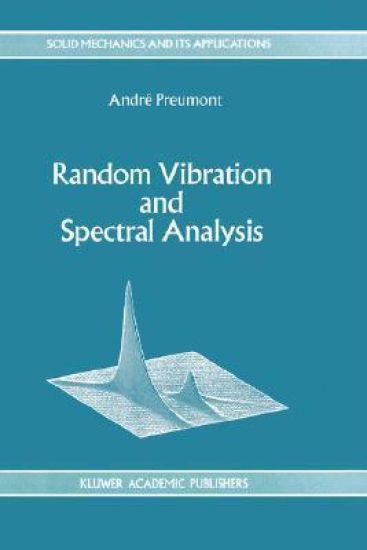
Random Vibration and Spectral Analysis/Vibrations aléatoires et analyse spectral
I became interested in Random Vibration during the preparation of my PhD dissertation, which was concerned with the seismic response of nuclear reactor cores. I was initiated into this field through the cla.ssical books by Y.K.Lin, S.H.Crandall and a few others. After the completion of my PhD, in 1981, my supervisor M.Gera.din encouraged me to prepare a course in Random Vibration for fourth and fifth year students in Aeronautics, at the University of Liege. There was at the time very little material available in French on that subject. A first draft was produced during 1983 and 1984 and revised in 1986. These notes were published by the Presses Poly techniques et Universitaires Romandes (Lausanne, Suisse) in 1990. When Kluwer decided to publish an English translation ofthe book in 1992, I had to choose between letting Kluwer translate the French text in-extenso or doing it myself, which would allow me to carry out a sustantial revision of the book. I took the second option and decided to rewrite or delete some of the original text and include new material, based on my personal experience, or reflecting recent technical advances. Chapter 6, devoted to the response of multi degree offreedom structures, has been completely rewritten, and Chapter 11 on random fatigue is entirely new. The computer programs which have been developed in parallel with these chapters have been incorporated in the general purpose finite element software SAMCEF, developed at the University of Liege.
Random Evolutions and Their Applications
The main purpose of this handbook is to summarize and to put in order the ideas, methods, results and literature on the theory of random evolutions and their applications to the evolutionary stochastic systems in random media, and also to present some new trends in the theory of random evolutions and their applications. In physical language, a random evolution ( RE ) is a model for a dynamical sys­ tem whose state of evolution is subject to random variations. Such systems arise in all branches of science. For example, random Hamiltonian and Schrodinger equations with random potential in quantum mechanics, Maxwell's equation with a random refractive index in electrodynamics, transport equations associated with the trajec­ tory of a particle whose speed and direction change at random, etc. There are the examples of a single abstract situation in which an evolving system changes its "mode of evolution" or "law of motion" because of random changes of the "environment" or in a "medium". So, in mathematical language, a RE is a solution of stochastic operator integral equations in a Banach space. The operator coefficients of such equations depend on random parameters. Of course, in such generality , our equation includes any homogeneous linear evolving system. Particular examples of such equations were studied in physical applications many years ago. A general mathematical theory of such equations has been developed since 1969, the Theory of Random Evolutions.
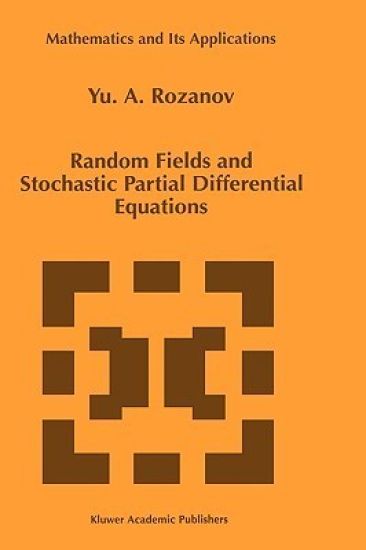
Random Fields and Stochastic Partial Differential Equations
This book considers some models described by means of partial dif­ ferential equations and boundary conditions with chaotic stochastic disturbance. In a framework of stochastic Partial Differential Equa­ tions an approach is suggested to generalize solutions of stochastic Boundary Problems. The main topic concerns probabilistic aspects with applications to well-known Random Fields models which are representative for the corresponding stochastic Sobolev spaces. {The term "stochastic" in general indicates involvement of appropriate random elements. ) It assumes certain knowledge in general Analysis and Probability {Hilbert space methods, Schwartz distributions, Fourier transform) . I A very general description of the main problems considered can be given as follows. Suppose, we are considering a random field ~ in a region T ~ Rd which is associated with a chaotic (stochastic) source"' by means of the differential equation (*) in T. A typical chaotic source can be represented by an appropri­ ate random field"' with independent values, i. e. , generalized random function"' = ( cp, 'TJ), cp E C~(T), with independent random variables ( cp, 'fJ) for any test functions cp with disjoint supports. The property of having independent values implies a certain "roughness" of the ran­ dom field "' which can only be treated functionally as a very irregular Schwarz distribution. With the lack of a proper development of non­ linear analyses for generalized functions, let us limit ourselves to the 1 For related material see, for example, J. L. Lions, E.
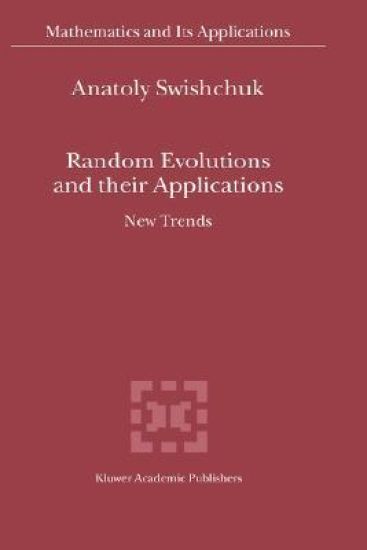
Random Evolutions and their Applications
The book is devoted to the new trends in random evolutions and their various applications to stochastic evolutionary sytems (SES). Such new developments as the analogue of Dynkin's formulae, boundary value problems, stochastic stability and optimal control of random evolutions, stochastic evolutionary equations driven by martingale measures are considered. The book also contains such new trends in applied probability as stochastic models of financial and insurance mathematics in an incomplete market. In the famous classical financial mathematics Black-Scholes model of a (B,S)­ market for securities prices, which is used for the description of the evolution of bonds and stocks prices and also for their derivatives, such as options, futures, forward contracts, etc., it is supposed that the dynamic of bonds and stocks prices are set by a linear differential and linear stochastic differential equations, respectively, with interest rate, appreciation rate and volatility such that they are predictable processes. Also, in the Arrow-Debreu economy, the securities prices which support a Radner dynamic equilibrium are a combination of an Ito process and a random point process, with the all coefficients and jumps being predictable processes.
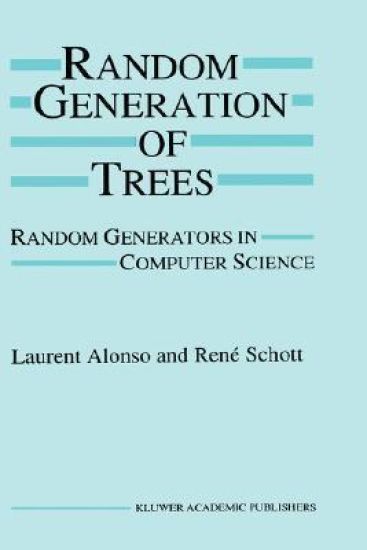
Random Generation of Trees

Random Generation of Trees

Laurent Alonso; René Schott

Springer
1994
sidottu
Random Generation of Trees is about a field on the crossroads between computer science, combinatorics and probability theory. Computer scientists need random generators for performance analysis, simulation, image synthesis, etc. In this context random generation of trees is of particular interest. The algorithms presented here are efficient and easy to code. Some aspects of Horton--Strahler numbers, programs written in C and pictures are presented in the appendices. The complexity analysis is done rigorously both in the worst and average cases. Random Generation of Trees is intended for students in computer science and applied mathematics as well as researchers interested in random generation.
Random Acts of Senseless Violence

Random Acts of Senseless Violence

Jack Womack

Grove Press / Atlantic Monthly Press
1995
nidottu
With his vivid, stylized prose, cyberpunk intensity, and seemingly limitless imagination, Jack Womack has been compared to both William Gibson and Kurt Vonnegut. Random Acts of Senseless Violence, Womack's fifth novel, is a thrilling, hysterical, and eerily disturbing piece of work. Lola Hart is an ordinary twelve-year-old girl. She comes from a comfortable family, attends an exclusive private school, loves her friends Lori and Katherine, teases her sister Boob. But in the increasingly troubled city where she lives (a near-future Manhattan) she is a dying breed. Riots, fire, TB outbreaks, roaming gangs, and civil unrest threaten her way of life, as well as the very fabric of New York City. In her diary, Lola chronicles the changes she and her family make as they attempt to adjust to a city, and a country, that is spinning out of control. Her mother is a teacher, but no one is hiring. Her father is a writer, but no one is buying his scripts. Hounded by creditors and forced to vacate their apartment and move to Harlem, her family, and her life, begins to dissolve. Increasingly estranged from her privileged school friends, Lola soon makes new ones: Iz, Jude, and Weezie--wise veterans of the street.
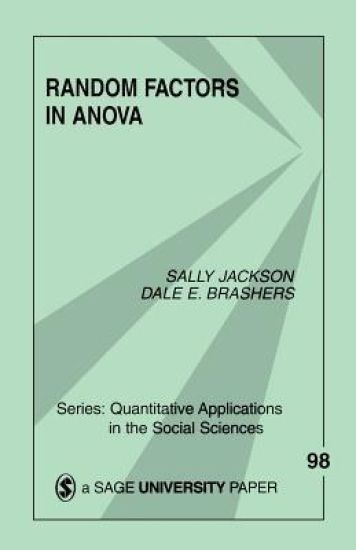
Random Factors in ANOVA

Random Factors in ANOVA

Sally A. Jackson; Dale E. Brashers

SAGE Publications Inc
1994
nidottu
The authors clearly explicate random-effectss analysis of variance (ANOVA) through several well-chosen real-life examples. . . . this is a neat little book. . . --Dayanand N. Naik in Technometrics "The authors offer a motivating discussion of research circumstances for which random factors may be particularly suitable, and they define random factors more broadly and pragmatically than the traditional definition does on the basis of pure statistical sampling. . . . Random Factors in ANOVA will also probably be particularly useful to students who are not terribly quantitative in orientation, because much of it strives to explain intuitively and verbally the relevant issues." --Journal of Marketing Research When and why are random factors other than subjects used? How do you decide whether a factor is fixed or random? Through the use of examples from management, education, political science, and psychology, Jackson and Brashers show the reader how to determine if a factor is random or fixed and how to deal in an analysis of variance (ANOVA) with random factors. In addition, they explore ways to incorporate random factors into an experimental design with other factors and discuss ways to adapt SAS and SPSSX for analyzing designs with random factors.
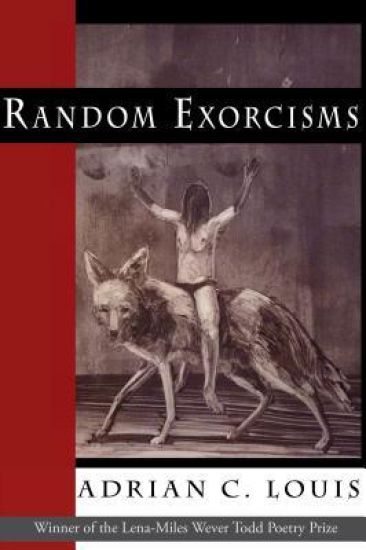
Random Exorcisms

Random Exorcisms

Adrian C. Louis

Louisiana State University Press
2016
nidottu
In his latest collection, Random Exorcisms, Adrian C. Louis writes poems with the rough-edged wit and heart-wrenching sincerity that make him one of the seminal voices in contemporary American poetry. Deeply rooted in Native American traditions and folklore, these poems tackle a broad range of subjects, including Facebook, zombies, horror movies, petty grievances, real grief, and pure political outrage. In a style entirely his own, Louis writes hilarious, genuine, self-deprecating poems that expel a great many demons, including any sense of isolation a reader might feel facing a harsh and lonely world. In the poem ""Necessary Exorcism,"" the speaker exorcises himself, more or less, of his grief for his deceased wife. ""I made my choice so easily & picked red drama, the joyous pain of it all,"" he writes. ""Minor Exorcism: 1984"" is one of a series of poems that contemplates the memories of small, simple mundanes, like catching a fish, until, ""My old heart is thrashing with / long-forgotten boyhood joy."" ""Dog the Bounty Hunter Blogs"" confronts some of the cruel absurdities of reality TV, while ""Naked, Midnight, Sober, Facebooking"" expels a great many fearful things, including the fear of growing older. These are poems that make you laugh and cry, nod appreciatively, and then laugh just a little more.
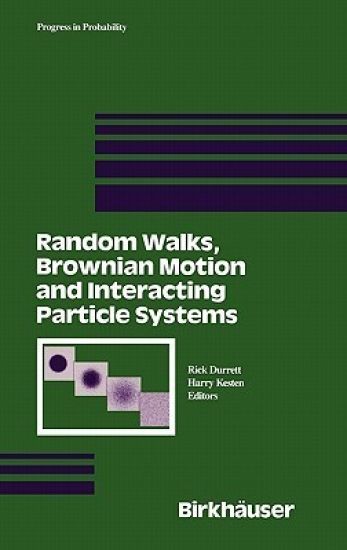
Random Walks, Brownian Motion, and Interacting Particle Systems
This collection of articles is dedicated to Frank Spitzer on the occasion of his 65th birthday. The articles, written by a group of his friends, colleagues, former students and coauthors, are intended to demonstrate the major influence Frank has had on probability theory for the last 30 years and most likely will have for many years to come. Frank has always liked new phenomena, clean formulations and elegant proofs. He has created or opened up several research areas and it is not surprising that many people are still working out the consequences of his inventions. By way of introduction we have reprinted some of Frank's seminal articles so that the reader can easily see for himself the point of origin for much of the research presented here. These articles of Frank's deal with properties of Brownian motion, fluctuation theory and potential theory for random walks, and, of course, interacting particle systems. The last area was started by Frank as part of the general resurgence of treating problems of statistical mechanics with rigorous probabilistic tools.
Random Series and Stochastic Integrals: Single and Multiple

Random Series and Stochastic Integrals: Single and Multiple

Stanislaw Kwapien; Wojbor Woyczynski

Birkhauser Boston Inc
2000
nidottu
This book studies the foundations of the theory of linear and nonlinear forms in single and multiple random variables including the single and multiple random series and stochastic integrals, both Gaussian and non-Gaussian. This subject is intimately connected with a number of classical problems of probability theory such as the summation of independent random variables, martingale theory, and Wiener's theory of polynomial chaos. The book contains a number of older results as well as more recent, or previously unpublished, results. The emphasis is on domination principles for comparison of different sequences of random variables and on decoupling techniques. These tools prove very useful in many areas ofprobability and analysis, and the book contains only their selected applications. On the other hand, the use of the Fourier transform - another classical, but limiting, tool in probability theory - has been practically eliminated. The book is addressed to researchers and graduate students in prob­ ability theory, stochastic processes and theoretical statistics, as well as in several areas oftheoretical physics and engineering. Although the ex­ position is conducted - as much as is possible - for random variables with values in general Banach spaces, we strive to avoid methods that would depend on the intricate geometric properties of normed spaces. As a result, it is possible to read the book in its entirety assuming that all the Banach spaces are simply finite dimensional Euclidean spaces.
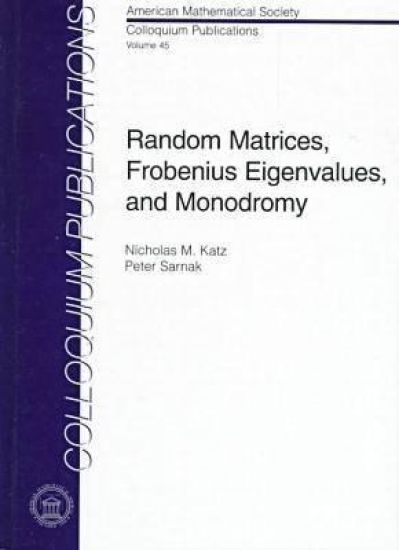
Random Matrices, Frobenius Eigenvalues, and Monodromy

Random Matrices, Frobenius Eigenvalues, and Monodromy

Nicholas M. Katz; Peter Sarnak

Amer Mathematical Society
1998
sidottu
The main topic of this book is the deep relation between the spacings between zeros of zeta and $L$-functions and spacings between eigenvalues of random elements of large compact classical groups. This relation, the Montgomery-Odlyzko law, is shown to hold for wide classes of zeta and $L$-functions over finite fields. The book draws on and gives accessible accounts of many disparate areas of mathematics, from algebraic geometry, moduli spaces, monodromy, equidistribution, and the Weil conjectures, to probability theory on the compact classical groups in the limit as their dimension goes to infinity and related techniques from orthogonal polynomials and Fredholm determinants.
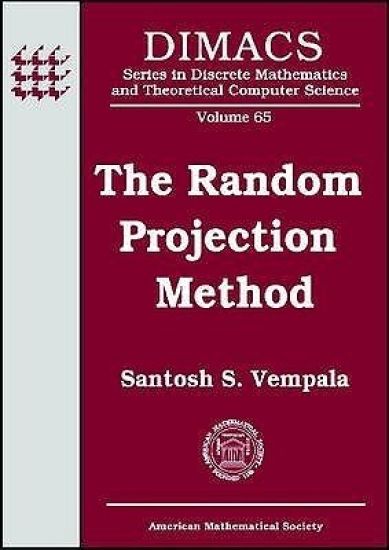
Random Projection Method

Random Projection Method

Santosh S. Vempala

AMERICAN MATHEMATICAL SOCIETY
2005
pokkari
Random projection is a simple geometric technique for reducing the dimensionality of a set of points in Euclidean space while preserving pairwise distances approximately. This book begins with an elementary description of the technique and its basic properties. It then develops the method in the context of applications.
Random Walk and the Heat Equation

Random Walk and the Heat Equation

Gregory F. Lawler

American Mathematical Society
2010
nidottu
The heat equation can be derived by averaging over a very large number of particles. Traditionally, the resulting PDE is studied as a deterministic equation, an approach that has brought many significant results and a deep understanding of the equation and its solutions. By studying the heat equation by considering the individual random particles, however, one gains further intuition into the problem. While this is now standard for many researchers, this approach is generally not presented at the undergraduate level. In this book, Lawler introduces the heat equation and the closely related notion of harmonic functions from a probabilistic perspective. The theme of the first two chapters of the book is the relationship between random walks and the heat equation. The first chapter discusses the discrete case, random walk and the heat equation on the integer lattice; and the second chapter discusses the continuous case, Brownian motion and the usual heat equation. Relationships are shown between the two. For example, solving the heat equation in the discrete setting becomes a problem of diagonalization of symmetric matrices, which becomes a problem in Fourier series in the continuous case. Random walk and Brownian motion are introduced and developed from first principles. The latter two chapters discuss different topics: martingales and fractal dimension, with the chapters tied together by one example, a random Cantor set. The idea of this book is to merge probabilistic and deterministic approaches to heat flow. It is also intended as a bridge from undergraduate analysis to graduate and research perspectives. The book is suitable for advanced undergraduates, particularly those considering graduate work in mathematics or related areas.
Random Harvest

Random Harvest

James T. Flexner

Fordham University Press
1998
sidottu
James Thomas Flexner has been a professional writer for most of his adult life. After several years spent at the City desk at the New York Herald Tribune after graduating from Harvard University, Flexner went on to become one of America's foremost historians. He has written with great distinction in a unique style accessible to and enjoyed by the scholar and general reader, twenty-six books in the fields of American history and art. Although he is principally known for his kistorical books, notably his four-volume biography of George Washington, Flexner has written in many forms and for many outlets. He has written for print and television; he has been a lecturer, columnist, reviewer, andeven a fiction writer. Collected here are samplings of Flexner's literary accomplishments throughout his long career (spanning over 60 years). In Random Harvest you will find pieces that appeared in Esquire Magaine, Time, The New York Times, Travel and Leisure, and even TV Guide. Included is an essay on George Washington and Watergate, on the art of biography, and many more. For the fan of Flexner, American history, and the art of a writer, in Random Harvest there is something to be enjoyed for everyone.
Random Harvest

Random Harvest

James T. Flexner

Fordham University Press
1998
pokkari
James Thomas Flexner has been a professional writer for most of his adult life. After several years spent at the City desk at the New York Herald Tribune after graduating from Harvard University, Flexner went on to become one of America's foremost historians. He has written with great distinction in a unique style accessible to and enjoyed by the scholar and general reader, twenty-six books in the fields of American history and art. Although he is principally known for his kistorical books, notably his four-volume biography of George Washington, Flexner has written in many forms and for many outlets. He has written for print and television; he has been a lecturer, columnist, reviewer, andeven a fiction writer. Collected here are samplings of Flexner's literary accomplishments throughout his long career (spanning over 60 years). In Random Harvest you will find pieces that appeared in Esquire Magaine, Time, The New York Times, Travel and Leisure, and even TV Guide. Included is an essay on George Washington and Watergate, on the art of biography, and many more. For the fan of Flexner, American history, and the art of a writer, in Random Harvest there is something to be enjoyed for everyone.
Random Testing of Digital Circuits

Random Testing of Digital Circuits

Rene David

CRC Press Inc
1998
sidottu
"Introduces a theory of random testing in digital circuits for the first time and offers practical guidance for the implementation of random pattern generators, signature analyzers design for random testability, and testing results. Contains several new and unpublished results. "