Kirjojen hintavertailu. Mukana 12 016 292 kirjaa ja 12 kauppaa.

Kirjahaku

Etsi kirjoja tekijän nimen, kirjan nimen tai ISBN:n perusteella.

1000 tulosta hakusanalla Roberto Podda

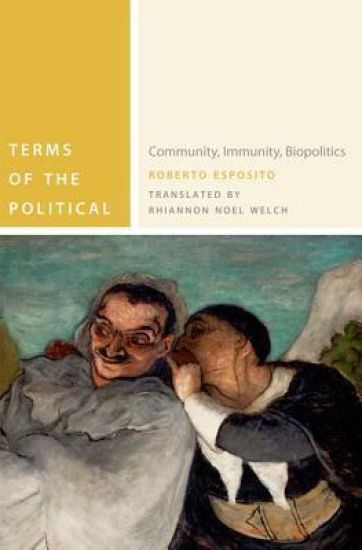
Terms of the Political

Terms of the Political

Roberto Esposito

Fordham University Press
2012
pokkari
Terms of the Political: Community, Immunity, Biopolitics presents a decade of thought about the origins and possibilities of political theory from one of contemporary Italy's most prolific and engaging political theorists, Roberto Esposito. He has coined a number of critical concepts in current debates about the past, present, and future of biopolitics—from his work on the implications of the etymological and philosophical kinship of community (communitas) and immunity (immunitas) to his theorizations of the impolitical and the impersonal. Taking on interlocutors from throughout the Western philosophical tradition, from Aristotle and Augustine to Weil, Arendt, Nancy, Foucault, and Agamben, Esposito announces the eclipse of a modern political lexicon—"freedom," "democracy," "sovereignty," and "law"—that, in its attempt to protect human life, has so often produced its opposite (violence, melancholy, and death). Terms of the Political calls for the opening of political thought toward a resignification of these and other operative terms—such as "community," "immunity," "biopolitics," and "the impersonal"—in ways that affirm rather than negate life. An invaluable introduction to the breadth and rigor of Esposito's thought, the book will also welcome readers already familiar with Esposito's characteristic skill in overturning and breaking open the language of politics.
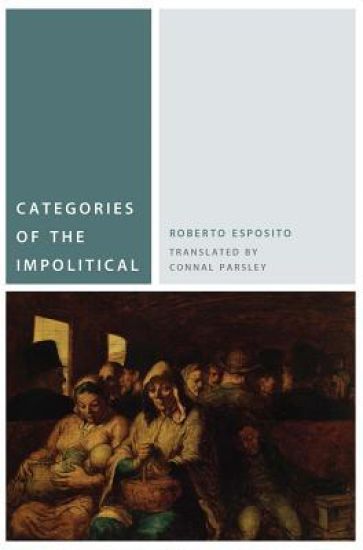
Categories of the Impolitical

Categories of the Impolitical

Roberto Esposito

FORDHAM UNIVERSITY PRESS
2015
sidottu
The notion of the "impolitical" developed in this volume draws its meaning from the exhaustion of modernity's political categories, which have become incapable of giving voice to any genuinely radical perspective. The impolitical is not the opposite of the political but rather its outer limit: the border from which we might glimpse a trajectory away from all forms of political theology and the depoliticizing tendencies of a completed modernity. The book's reconstruction of the impolitical lineage—which is anything but uniform—begins with the extreme conclusions reached by Carl Schmitt and Romano Guardini in their reflections on the political and then moves through a series of encounters between several great twentieth-century texts: from Hannah Arendt's On Revolution to Hermann Broch's The Death of Virgil, to Elias Canetti's Crowds and Power; from Simone Weil's The Need for Roots to Georges Bataille's Sovereignty to Ernst Junger's An der Zeitmauer. The trail forged by this analysis offers a defiant counterpoint to the modern political lexicon, but at the same time a contribution to our understanding of its categories.
Categories of the Impolitical

Categories of the Impolitical

Roberto Esposito

Fordham University Press
2015
pokkari
The notion of the "impolitical" developed in this volume draws its meaning from the exhaustion of modernity's political categories, which have become incapable of giving voice to any genuinely radical perspective. The impolitical is not the opposite of the political but rather its outer limit: the border from which we might glimpse a trajectory away from all forms of political theology and the depoliticizing tendencies of a completed modernity. The book's reconstruction of the impolitical lineage—which is anything but uniform—begins with the extreme conclusions reached by Carl Schmitt and Romano Guardini in their reflections on the political and then moves through a series of encounters between several great twentieth-century texts: from Hannah Arendt's On Revolution to Hermann Broch's The Death of Virgil, to Elias Canetti's Crowds and Power; from Simone Weil's The Need for Roots to Georges Bataille's Sovereignty to Ernst Junger's An der Zeitmauer. The trail forged by this analysis offers a defiant counterpoint to the modern political lexicon, but at the same time a contribution to our understanding of its categories.
Two

Two

Roberto Esposito

Fordham University Press
2015
sidottu
The debate on "political theology" that ran throughout the twentieth century has reached its end, but the ultimate meaning of the notion continues to evade us. Despite all the attempts to resolve the issue, we still speak its language—we remain in its horizon. The reason for this, says Roberto Esposito, lies in the fact that political theology is neither a concept nor an event; rather, it is the pivot around which the machine of Western civilization has revolved for more than 2,000 years. At its heart stands the juncture between universalism and exclusion, unity and separation: the tendency of the Two to make itself into One by subordinating one part to the domination of the other. All the philosophical and political categories that we use, starting with the Roman and Christian notion of "the person," continue to reproduce this exclusionary dispositif. To take our departure from political theology, then—the task of contemporary philosophy—we must radically revise our conceptual lexicon. Only when thought has been returned to its rightful "place"—connected to the human species as a whole rather than to individuals—will we be able to escape from the machine that has imprisoned our lives for far too long.
Two

Two

Roberto Esposito

Fordham University Press
2015
pokkari
The debate on "political theology" that ran throughout the twentieth century has reached its end, but the ultimate meaning of the notion continues to evade us. Despite all the attempts to resolve the issue, we still speak its language—we remain in its horizon. The reason for this, says Roberto Esposito, lies in the fact that political theology is neither a concept nor an event; rather, it is the pivot around which the machine of Western civilization has revolved for more than 2,000 years. At its heart stands the juncture between universalism and exclusion, unity and separation: the tendency of the Two to make itself into One by subordinating one part to the domination of the other. All the philosophical and political categories that we use, starting with the Roman and Christian notion of "the person," continue to reproduce this exclusionary dispositif. To take our departure from political theology, then—the task of contemporary philosophy—we must radically revise our conceptual lexicon. Only when thought has been returned to its rightful "place"—connected to the human species as a whole rather than to individuals—will we be able to escape from the machine that has imprisoned our lives for far too long.
The Origin of the Political

The Origin of the Political

Roberto Esposito

FORDHAM UNIVERSITY PRESS
2017
sidottu
In this book Roberto Esposito explores the conceptual trajectories of two of the twentieth century's most vital thinkers of the political: Hannah Arendt and Simone Weil. Taking Homer's Iliad—that "great prism through which every gesture has the possibility of becoming public, precisely by being observed by others"— as the common origin and point of departure for our understanding of Western philosophical and political traditions, Esposito examines the foundational relation between war and the political. Drawing actively and extensively on Arendt's and Weil's voluminous writings, but also sparring with thinkers from Marx to Heidegger, The Origin of the Political traverses the relation between polemos and polis, between Greece, Rome, God, force, technicity, evil, and the extension of the Christian imperial tradition, while at the same time delineating the conceptual and hermeneutic ground for the development of Esposito's notion and practice of "the impolitical." In Esposito's account Arendt and Weil emerge "in the inverse of the other's thought, in the shadow of the other's light," to "think what the thought of the other excludes not as something that is foreign, but rather as something that appears unthinkable and, for that very reason, remains to be thought." Moving slowly toward their conceptualizations of love and heroism, Esposito unravels the West's illusory metaphysical dream of peace, obliging us to reevaluate ceaselessly what it means to be responsible in the wake of past and contemporary forms of war.
The Origin of the Political

The Origin of the Political

Roberto Esposito

Fordham University Press
2017
pokkari
In this book Roberto Esposito explores the conceptual trajectories of two of the twentieth century's most vital thinkers of the political: Hannah Arendt and Simone Weil. Taking Homer's Iliad—that "great prism through which every gesture has the possibility of becoming public, precisely by being observed by others"— as the common origin and point of departure for our understanding of Western philosophical and political traditions, Esposito examines the foundational relation between war and the political. Drawing actively and extensively on Arendt's and Weil's voluminous writings, but also sparring with thinkers from Marx to Heidegger, The Origin of the Political traverses the relation between polemos and polis, between Greece, Rome, God, force, technicity, evil, and the extension of the Christian imperial tradition, while at the same time delineating the conceptual and hermeneutic ground for the development of Esposito's notion and practice of "the impolitical." In Esposito's account Arendt and Weil emerge "in the inverse of the other's thought, in the shadow of the other's light," to "think what the thought of the other excludes not as something that is foreign, but rather as something that appears unthinkable and, for that very reason, remains to be thought." Moving slowly toward their conceptualizations of love and heroism, Esposito unravels the West's illusory metaphysical dream of peace, obliging us to reevaluate ceaselessly what it means to be responsible in the wake of past and contemporary forms of war.
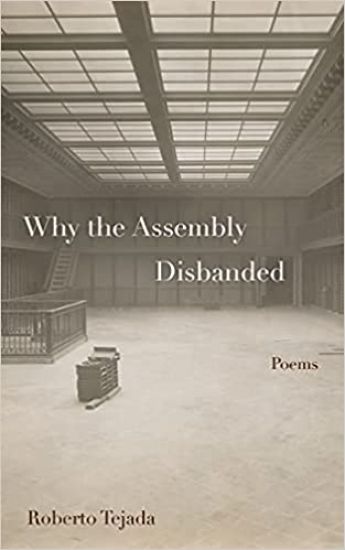
Why the Assembly Disbanded

Why the Assembly Disbanded

Roberto Tejada

FORDHAM UNIVERSITY PRESS
2022
pokkari
Pushing the boundaries of Latinx literature and what constitutes a borderlands poetics. Throughout Roberto Tejada's body of work, the renowned poet and celebrated critic has explored themes of Latinx culture, politics, history, language, and ecologies. In his latest collection, Why the Assembly Disbanded, he presents a unique contribution to Latinx letters that reflects on the relations between the United States and Latin America, especially their real and symbolic borderlands. Immersive, postmodern, and philosophical, Why the Assembly Disbanded provides an associative, critical Latinx aesthetic connecting the Mexico–United States borderlands to Latin America's neo-baroque heritage. Migrants, settlers, tourists, and exiles moving across various hemispheric landscapes are featured in these exuberant, capacious, and self-reflexive poems. Tejada relates the ravages of white supremacy in our culture that, together with immigrant precarity, turn home into a place of foreboding and impending eviction, even as a dream-weather makes room at last for scenes of possibility and attainment in the account of human history. The sweeping futuristic vistas open on to narratives of colonial extraction, human displacement, abuses of capitalism, mass media spectacle, the antagonism of language and technical images in the sensorium of urban and digital life-worlds, and the relations of desire encouraged by pictures and words in the economy of attention. Los Angeles and Mexico City figure prominently in poems committed to voicing modes of formation and community in an intersectional reckoning of personhoods prompted in work by artists Betye Saar, Amiri Baraka, Connie Samaras, and Rubén Ortiz Torres. With language given to pageantry, tonal precision, and a hopeful lyric radiance that can accommodate ecstasy and justice, Roberto Tejada's carnivalesque, borderland imagery pushes the boundaries of Latinx literature. World-building by way of reverie, speculation, and retro-futurist tableaux, and with vivid, sometimes violent particularity, his poems enact hallucinatory realities of the hemisphere: an imagination that triangulates history, lyricism, and art as social practice.
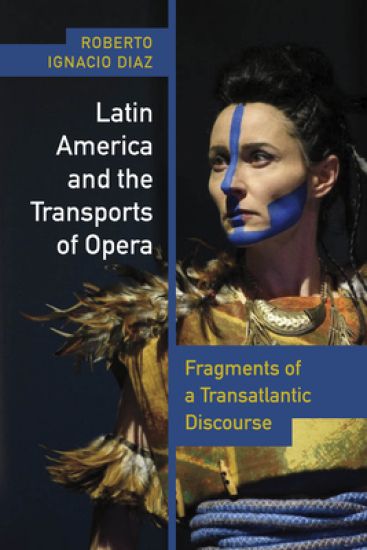
Latin America and the Transports of Opera

Latin America and the Transports of Opera

Roberto Ignacio Díaz

VANDERBILT UNIVERSITY PRESS
2024
nidottu
Latin America and the Transports of Opera studies a series of episodes in the historical and textual convergence of a hallowed art form and a part of the world often regarded as peripheral. Perhaps unexpectedly, the archives of opera generate new arguments about several issues at the heart of the established discussion about Latin America: the allure of European cultural models; the ambivalence of exoticism; the claims of nationalism and cosmopolitanism; and, ultimately, the place of the region in the global circulation of the arts. Opera’s transports concern literal and imagined journeys as well as the emotions that its stories and sounds trigger as they travel back and forth between Europe—the United States, too—and Latin America. Focusing mostly on librettos and other literary forms, the book analyzes CalderÓn de la Barca’s baroque play on the myth of Venus and Adonis, set to music by a Spanish composer at Lima’s viceregal court; Alejo Carpentier’s neobaroque novella on Vivaldi’s opera about Moctezuma; the entanglements of opera with class, gender and ethnicity throughout Cuban history; music dramas about enslaved persons by Carlos Gomes and Hans Werner Henze, staged in Rio de Janeiro and Copenhagen; the uses of Latin American poetry and magical realism in works by John Adams and Daniel CatÁn; and a novel by Manuel Mujica Lainez set in Buenos Aires’s Teatro ColÓn, plus a chamber opera about Victoria Ocampo with a libretto by Beatriz Sarlo. Close readings of these texts underscore the import and meanings of opera in Latin American cultural history.
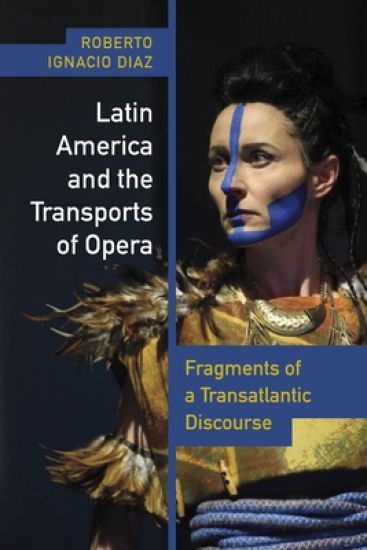
Latin America and the Transports of Opera

Latin America and the Transports of Opera

Roberto Ignacio Díaz

VANDERBILT UNIVERSITY PRESS
2024
sidottu
Latin America and the Transports of Opera studies a series of episodes in the historical and textual convergence of a hallowed art form and a part of the world often regarded as peripheral. Perhaps unexpectedly, the archives of opera generate new arguments about several issues at the heart of the established discussion about Latin America: the allure of European cultural models; the ambivalence of exoticism; the claims of nationalism and cosmopolitanism; and, ultimately, the place of the region in the global circulation of the arts. Opera’s transports concern literal and imagined journeys as well as the emotions that its stories and sounds trigger as they travel back and forth between Europe—the United States, too—and Latin America. Focusing mostly on librettos and other literary forms, the book analyzes CalderÓn de la Barca’s baroque play on the myth of Venus and Adonis, set to music by a Spanish composer at Lima’s viceregal court; Alejo Carpentier’s neobaroque novella on Vivaldi’s opera about Moctezuma; the entanglements of opera with class, gender and ethnicity throughout Cuban history; music dramas about enslaved persons by Carlos Gomes and Hans Werner Henze, staged in Rio de Janeiro and Copenhagen; the uses of Latin American poetry and magical realism in works by John Adams and Daniel CatÁn; and a novel by Manuel Mujica Lainez set in Buenos Aires’s Teatro ColÓn, plus a chamber opera about Victoria Ocampo with a libretto by Beatriz Sarlo. Close readings of these texts underscore the import and meanings of opera in Latin American cultural history.
Grand Tour

Grand Tour

Roberto Peregalli

Rizzoli International Publications
2018
sidottu
Blending nostalgia for the past with curiosity for the present is the essential design philosophy of Studio Peregalli's work. By infusing their work with deep historical research and an unprecedented level of craft, the designers are able to imbue each interior with a unique sense of history and ambience. Grand Tour is a movable visual feast with remarkable photography of grand rooms contrasted with beautiful details and exquisite craftsmanship. Each house presented here is the fullest expression of the Studio Peregalli's design--compelling, spectacular, and unique. If Invention of the Past can be considered to be a taxonomy book of Studio Peregalli's design thinking, Grand Tour is a true monograph: project after gorgeous project from around the world: from Milan to Paris and London to exotic Tangier, St. Moritz, and Beirut. A must collect for all lovers of grand and exquisite interior design.
Optical Wireless Communications

Optical Wireless Communications

Roberto Ramirez-Iniguez; Sevia M. Idrus; Ziran Sun

Auerbach Publishers Inc.
2008
sidottu
Over the last three decades, interest in Infrared (IR) technology as a medium to convey information has grown considerably. This is reflected by the increasing number of devices such as laptops, PDAs, and mobile phones that incorporate optical wireless transceivers and also by the increasing number of optical wireless links available for indoor and outdoor use. The popularity of IR is based on the advantages it has over radio including unregulated bandwidth, immunity to radio interference, and inherent security. Optical Wireless Communications examines some of the most important features of optical wireless communication systems. It considers the benefits and limitations of IR as a medium conveying information wirelessly and compares the advantages and disadvantages of infrared to microwave and other radio systems. It also details the evolution of IR communication systems and describes atmospheric and other types of data transmission limitations. The book presents design fundamentals of optical concentrators, as well as a review of some of the most important receiver optical front-ends (containing imaging or non-imaging concentrators and optical filters), including an explanation of the different sources of infrared noise and an introduction to eye safety. It also describes optical wireless transmitter and receiver design issues, typical modulation, coding, and multiple access techniques, and introduces IrDA protocols and wireless IR networking.
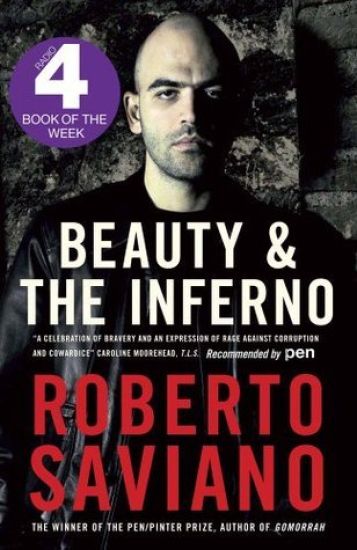
Beauty and the Inferno

Beauty and the Inferno

Roberto Saviano

MacLehose Press
2012
pokkari
Roberto Saviano is best known for his work on the Italian mafia, but Beauty and the Inferno, winner of the European Book Award 2010, also tackles universal themes with great insight and humanity, with urgency, and often with anger. This important collection includes essays across a remarkably wide field of interests, celebrating personal heroes as diverse as Frank Miller and Lionel Messi. However as with the bestselling Gomorrah, his fearless and unflinching condemnation of the mafia takes centre stage. Implicit in Saviano's tributes to writers, musicians, sportsmen and journalists is the message that there is an alternative to living in corruption and fear. Beauty and the Inferno is a searing polemic that encompasses Saviano's vision of life and of art, of the good to be found in humanity and the evil inherent in power. His commitment to truth resonates from every page.
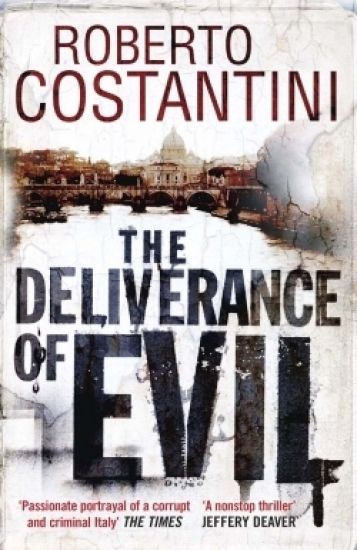
The Deliverance of Evil

The Deliverance of Evil

Roberto Costantini

riverrun
2014
pokkari
On 11 July 1982, Elisa Sordi was beautiful. Commissario Michele Balistreri was fearless. Italy was victorious. A killer was waiting...On 9 July 2006, with Sordi's case twenty-four years cold, and Balistreri haunted by guilt and regret, Italian victory returned. And so did Sordi's killer...But this time Michele Balistreri would be ready. This time he would fear no evil.
The Root of All Evil

The Root of All Evil

Roberto Costantini

riverrun
2015
pokkari
Tripoli, 1960s. During the years in which post-colonial Libya fell prey to the sprawling greed of the West, Michele Balistreri suffered a succession of blows that would scar him for life. The death of his mother; the unspeakable horror that befell his best friend's family; his father's role in Gaddafi's ascent to power; and the innocent blood pact that would corrupt the course of his future. Rome, 1982. In the wake of a ruinous blunder, a ground-down Commissario Balistreri escapes his regrets through sex, alcohol and gambling. His sole responsibilities are now a stilted investigation into the death of a South American student, and a tiresome obligation - as a gratitude to the man who saved his career - to a rising television starlet needing protection from the pitfalls of fame. As the risks to this girl, Claudia Teodori, begin to rise along with her reputation, the sorrows of Balistreri's past also start to push back into his present. Both of their fates are inextricably linked - and this driven, obsessive young woman must help this damaged detective fight a foe that follows her and refuses to forget him.
The Memory of Evil

The Memory of Evil

Roberto Costantini

riverrun
2016
pokkari
Everything started from that day.The memory of 31 August 1969 has been at the back of Commissario Michele Balistreri's mind for over four decades. It was not only the day that preceded Colonel Muammar Gadaffi's seizure of power in Balistreri's birthplace of Libya, drastically altering his and his country's destiny, but that on which his beloved mother Natalia fell to her death, and the resulting suicide verdict that Balistreri - now Head of Homicide in Rome - has always suspected to be a flagrant cover-up for her murder.The memory of 23 July 2006 has been at the front of investigative journalist Linda Nardi's mind for the past five years. Ever since her and Balistreri together thwarted a phantom-like killer stalking Rome, Nardi has been intent on shedding further light on the Vatican Bank's shadowy involvement in the abominations uncovered that summer. But now Linda will find her attention diverted to an equally irresistible assignment: the collapse of Colonel Gadaffi's forty-two year dictatorship.The Memory of Evil is the earth-shattering finale to Roberto Costantini's internationally bestselling trilogy, in which one woman will encounter a long-entombed truth in the rubble of Gadaffi's Tripoli: unearthing a conspiracy neither she, nor the man it was designed to protect, will ever be able to erase from their minds.
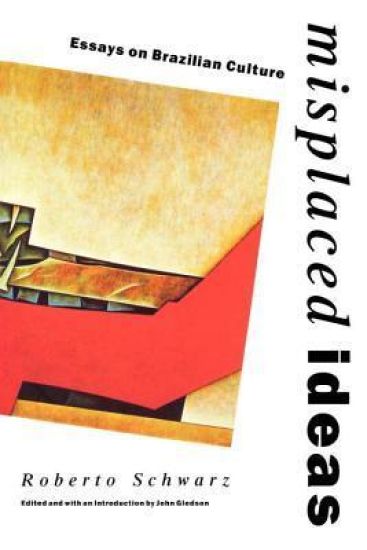
Misplaced Ideas

Misplaced Ideas

Roberto Schwarz

Verso Books
1992
nidottu
How can Latin Americans understand their past? Do ideologies which have been imported from Europe necessarily distort their view, or is that to underrate the power and objectivity of the ideas themselves? These questions are at the heart of this selection of essays, spanning twenty years of critical work on history, culture and identity, by one of the foremost Latin American intellectuals of our time. Roberto Schwarz's writings have had a profound effect throughout Latin America. This is the first volume of those writings to appear in English.Taking its title from what has probably been Schwarz's most influential essay, Misplaced Ideas first examines the slave-owning Brazil of the nineteenth century, to show the persistent gap between liberal ideology based on the free market, and the reality of forced labour. The essays which follow range across the nineteenth and twentieth centuries, and across film and fiction, theatre and music. They include four pieces on the great novelist Machado de Assis, and a powerful essay on the sometimes bizarre ways Brazilian culture reacted to the imposition of military rule. Throughout, Schwarz continually demonstrates the wit and sharpness which make his writings both a challenge and a pleasure to read.