

Kirjahaku
Etsi kirjoja tekijän nimen, kirjan nimen tai ISBN:n perusteella.
1000 tulosta hakusanalla Samir Master
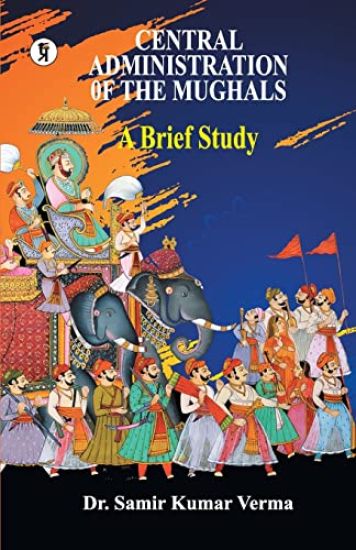
Dr. Samir Kumar Verma is an Associate Professor in the Department of History at the University of Delhi. He has done his graduation and post-graduation from Kirori Mai College, University of Delhi, and M.Phil. in Chinese and Japanese Studies from University of Delhi. He has done his Ph.D. from V. K.S. University, Arrah, Bihar. He has served as a Reader and Convenor of different Committees at Satyawati College Eve., University of Delhi. He teaches courses in Medieval History to undergraduate students at Satyawati College Eve., University of Delhi. He also teaches postgraduate students at IGNOU. Besides teaching, he has a particular interest in taking the students on educational tours to various historical places across India. He has published several articles in various national journals.

In spite of the importance of the Jordan River dispute, there has been no comprehensive and systematic study of the problem. What few articles have been written so far have been fragmentary and essentially dealt with the history of the dispute. M. G. Ionides, in "The Disputed Waters of Jordan," Middle East Journal, Vol. 7 (I953), pp. I53 ff., Georgiana Stevens, in the "Jordan River V alley," International C on ciliation, No. 506 (I956), and more recently, Kathryn B. Doherty, in "The Jordan Waters Conflict," International Conciliation, No. 533 (I965), elaborate this theme. H. A. Smith, in the "Waters of the Jordan: a Problem of International Water Control," International Affairs, Vol. 25 (I949), pp. 4I5 ff. has been the exception. However, his work is outdated in that many other factors have entered the picture since I949. My purpose in writing this study is twofold. First, I have sought to update the writings in this field. Second, it is hoped that the findings of this study will give a clearer and a more objective insight into the problems involved. Primary sources for this study include United Nations documents, Arab and Israeli government publications, federal and international law cases dealing with river disputes, treaties, and newspapers. Sec ondary source materials include books, articles in learned journals, and others.
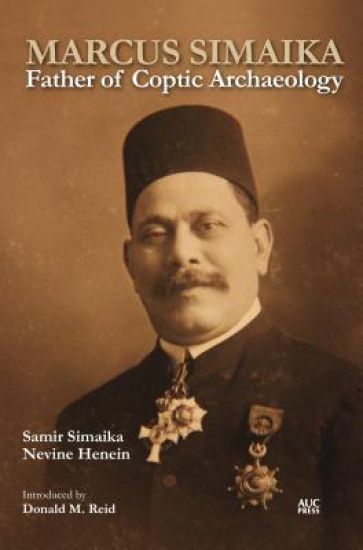
Marcus Pasha Simaika (1864-1944) was born to a prominent Coptic family on the eve of the inauguration of the Suez Canal and the British occupation of Egypt. From a young age, he developed a passion for Coptic heritage and devoted his life to shedding light on centuries of Christian Egyptian history that had been neglected by ignorance or otherwise belittled and despised. He was not a professional archaeologist, an excavator, or a specialist scholar of Coptic language and literature. Rather, his achievement lies in his role as a visionary administrator who used his status to pursue relentlessly his dream of founding a Coptic Museum and preserving endangered monuments. During his lengthy career, first as a civil servant, then as a legislator and member of the Coptic community council, he maneuvered endlessly between the patriarch and the church hierarchy, the Coptic community council, the British authorities, and the government to bring them together in his fight to save Coptic heritage.This fascinating biography draws upon Simaika's unpublished memoirs as well as on other documents and photographs from the Simaika family archive to deepen our understanding of several important themes of modern Egyptian history: the development of Coptic archaeology and heritage studies, Egyptian-British interactions during the colonial and semi-colonial eras, shifting balances in the interaction of clergymen and the lay Coptic community, and the ever-sensitive evolution of relations between Copts and their Muslim countrymen.
The Egyptian Bourse
Samir Raafat; Prince Abbas Hilmi; Youssef Boutros Ghali
American University in Cairo Press
2021
sidottu
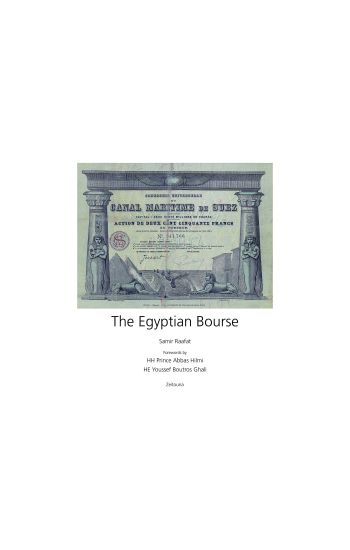
This large-format album of reproduced images of choice stock and bond certificates issued by registered companies through the Egyptian Bourse, or Stock Exchange, in its heyday will be a source of delight and fascination, not only for scripophilists, notaphilists, and economists, but for anyone interested in early twentieth-century Egyptian financial history and memorabilia and the aesthetic value of these beautiful collectors’ items. Each certificate tells a story about the company which issued it, and the fascinating and dynamic business families that drove Egypt’s economy at the time. Founded in 1903 at the behest of Maurice “Moise” Cattaui Bey (1848–1924), scion of one of Cairo’s then most powerful business families, the newly incorporated Bourse and Banking Company of Egypt Limited, also known as the Bourse Khediviale du Caire, was initially housed in the Manuk Building, once home to the Ottoman Bank on Adly (then Maghrabi) Street. It was later moved to a building at the center of Cairo’s downtown district of Ismailia, not far from the National Bank of Egypt (today’s Central Bank). The real-estate boom which began in Cairo around 1895 would end in what became known in the annals of speculative history as the Crash of 1907. In The Egyptian Bourse Samir Raafat tells the story of the rise and fall of the Egyptian Bourse, from the sale of the century by Khedive Ismail of Egypt’s shares in the Suez Canal in 1875 to the Free Officers coup of 1952. Beautifully illustrated with more than fifty vintage stocks and bonds in full color.
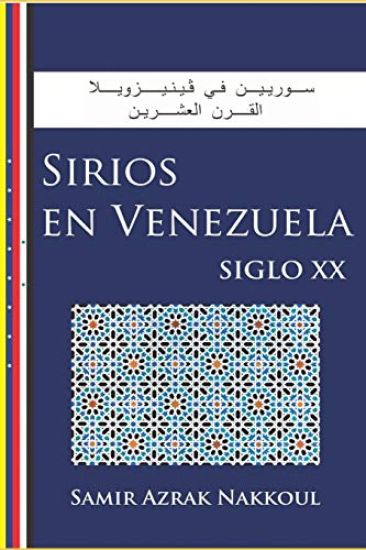
Sirios en Venezuela: Siglo XX
Samir Azrak Nakkoul
Centro Nacional del Libro, Venezuela, No. Rad
2018
nidottu
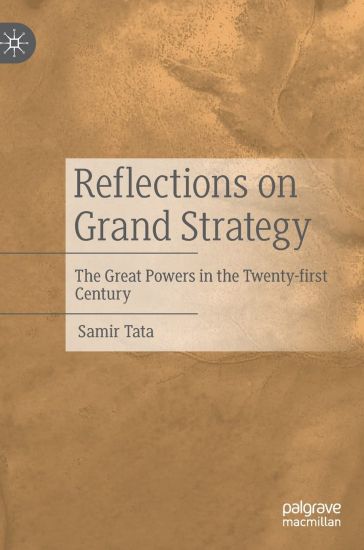
The book provides an analytic framework for grand strategy and applies the framework to illuminate the grand strategies of the Great Powers of the twenty-first century: India, China, Russia, and the United States. The book also uses Coca-Cola as a case study to illustrate the potential influence of grand strategy on business strategy. The analysis is rigorous, logical, fact-based, historically rooted, and well-sourced with abundant endnotes to encourage further exploration by readers.
The book provides an analytic framework for grand strategy and applies the framework to illuminate the grand strategies of the Great Powers of the twenty-first century: India, China, Russia, and the United States. The book also uses Coca-Cola as a case study to illustrate the potential influence of grand strategy on business strategy. The analysis is rigorous, logical, fact-based, historically rooted, and well-sourced with abundant endnotes to encourage further exploration by readers.
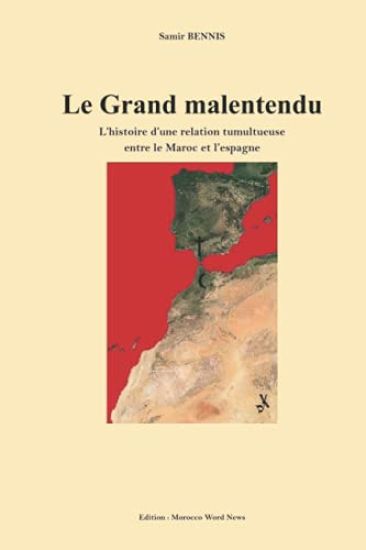
Samir Bennis est un analyste politique et chercheur sp cialiste de la politique trang re du Maroc. Ses publications se focalisent notamment sur la question du Sahara, les relations entre le Maroc et l'Espagne, la politique africaine du Maroc, ainsi que les relations entre le Maroc et les Etats-Unis. Ancien conseiller politique aux Nations Unies entre 2008 et 2017, Bennis est actuellement conseiller politique principale d'une mission diplomatique bas e Washington. Il est l'auteur du livre: Maroc-Espagne: les relations politique, conomique et culturelles entre 1956-2005, publi en 2008. Il est en cours de pr paration d'un livre sur le Sahara en anglais para tre en 2022. Bennis est docteur de l'Universit de Provence o il a soutenu une th se sur les relations entre le Maroc et l'Espagne en novembre 2005. Il est le co-fondateur de Morocco World News. Il publie en anglais, en fran ais, en arabe et en espagnol.La th se principale que d fend Dr. Bennis est que l' tat actuel des relations entre le Maroc et l'Espagne est l'aboutissement logique des si cles d'essentialisation et de stigmatisation du monde arabo-musulman, surtout du Maroc et des Marocains. Que, dans leur d sir de prot ger l'Espagne du cancer qu' taient l'Islam et les musulmans, les intellectuels espagnols des si cles pr c dents (et m me une grande partie de nos jours) ont construit l'imaginaire de l'Espagne autour de la haine et du m pris des Marocains et de leurs valeurs pr tendument r trogrades.L'auteur d montre, entre autres, que l'image du Maroc et des Marocains que v hiculent des manuels d'histoire encore d'usage dans les coles espagnoles a jou un r le crucial dans la diabolisation et l'inf riorisation du Marocain. Et que, par exemple, une telle lecture a rendu possible l' mergence d'un discours qui fait du Maroc soit une menace existentielle pour l'Espagne, soit sa chasse gard eCe livre est donc une plaidoirie pour l'analyse d passionn e et l'objectivit historique. Cela en fait certainement le premier livre de son genre crit par un Marocain sur l' pineuse question de l'imbrication entre le pass , le pr sent et le futur de cette relation conflictuelle avec l'Espagne.Tout en d mystifiant les fondements historico-id ologiques de la mauvaise image des Marocains en Espagne, Bennis conclut qu'il est encore possible de faire merger d'autres fa ons de voir et de narrer l'autre en faisant front commun contre le spectre ambiant de l'essentialisation. Il invite donc prendre l'histoire tr s au s rieux ou tre dans l'histoire - mais sans en tre des prisonniers.

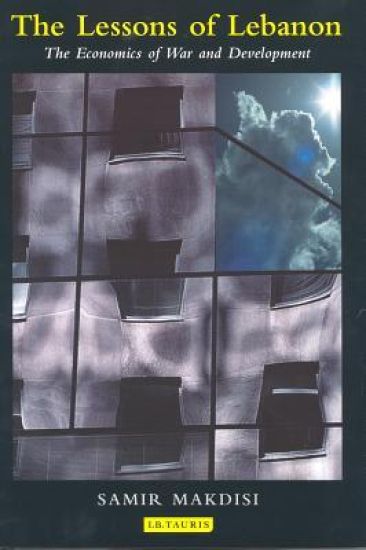
Since 1945, over 200 intrastate conflicts have taken place in countries that achieved independence from colonial rule after the second world war. The case of Lebanon offers a striking illustration of these interlocking influences on projects of national economic development. The persistently sectarian nature of the country's political institutions, the relatively poor quality of governance, and the major civil war that engulfed the country from 1975 to 1990, together define not only the context in which the achievements and failures of Lebanese development must be assessed, but also the continuing challenges that it must face in the era of globalization. This book offers an in-depth analysis of Lebanese economic development during the second half of the twentieth century with special emphasis on the civil war and its aftermath. Makdisi offers a definitive assessment of the principal phases of national development since Lebanese independence in the 1940s, and a study of those conditions requisite for sustainable development for Lebanon, as for many other developing countries

'A novel with the lightness of Agatha Christie's works and the depth of the most important moments in history' - Michel Laub, author of Diary of the Fall A zeppelin leaves Nazi Germany bound for Rio de Janeiro. For those on board it's a luxury holiday, until one of them is murdered. Police Detective Bruno Brückner, travelling on the airship, is immediately asked to investigate - and soon discovers that the murdered man was not the proud Nazi he claimed to be. What's more, he was carrying a stash of banned 'degenerate' material. As Brückner interviews his fellow passengers - a wealthy baroness, an antisemitic doctor, a debonair Englishman - his inquiries will uncover a startling story of fake identities, queer love and revenge, where nothing is as it appears, until finally the secret of the 'good Nazi' is revealed... READERS LOVE The Good Nazi! 'Agatha Christie in the sky! A really interesting combination of crime, intrigue and fraught 1930s politics and opinions. Very well written and paced' 'Such an impressive book, a captivating read that draws you in' 'Nearly nothing goes to waste, and the ending is actually a surprising and unexpected twist'
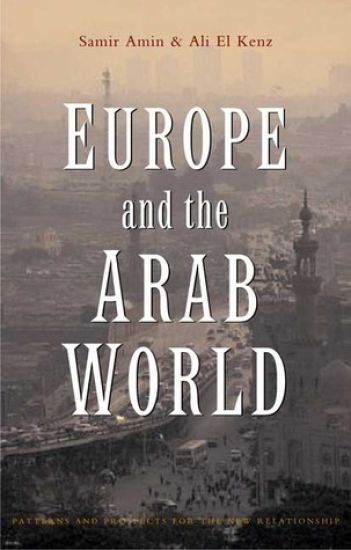
Europe and the Arab World is a wide-ranging assessment of the prospects for a new relationship between Europe and the Arab world in the coming years. Samir Amin and Ali El Kenz take as their starting point the significantly shifting balance of political forces within the various Arab countries, including the rise of both political Islam and civil society. They argue that the strategic global hegemony of the United States constitutes a major element affecting the Euro-Arab relationship. They then focus on the European Union initiative, originally launched in Barcelona, to put its relations with the Arab countries of the Mediterranean and Gulf regions on a new footing of equality and mutually beneficial cooperation. The authors provide a detailed empirical account of the initiative as well as an historically contextualized, intellectually critical and politically perceptive analysis of the various realities impacting on it. Samir Amin and Ali El Kenz conclude that, while considerable dialogue and even institution-building have taken place in order to give substance to this attempt to go beyond the colonial legacy of inequality and dependence, little of a concrete kind has been achieved in transforming the underlying economic and political relationships between the Arab Islamic and European Christian worlds of the Mediterranean. Among the many obstacles identified are the overriding and economically deleterious impact of globalized capitalism, and the determination of the United States to impose its own political objectives on the Middle East. The timeliness of this book's argument is highlighted by the new tensions that have accompanied the U.S. military occupation of Iraq and the Bush administration's political pretensions to 'bring democracy' to the whole region.
Fundamentals of Electrical and Computer Engineering
Samir I Abood; Muna H Fayyadh
Central West Publishing
2026
pokkari
Fundamentals of Electrical and Computer Engineering
Samir I Abood; Muna H Fayyadh
Central West Publishing
2026
pokkari



Les m tamorphoses du Management.Dans une optique de lecture et analyse synth tiques des formes du management, le pr sent manuel - qui regroupe l'essentiel et le plus int ressant de ses th ories et pens es universelles - vient compl ter le premier livre en l'occurrence Management et Leadership, pour constituer ainsi un couple harmonieux de connaissances manag riales.Il s'adresse aussi bien aux tudiants des sciences de gestion et sciences comptables qu'aux professionnels: cadres et dirigeants d'entit s conomiques et sociales soucieux de comprendre les principes et la panoplie d'une direction dynamique et adapt e aux mutations de l'environnement.Le m rite de ce manuel est de r pondre d'une mani re claire et concise quatre qu tes: Eclaircir et d voiler les v rit s du management d'une mani re acad mique. Rappeler chronologiquement les principales approches manag riales du 20i me si cle. Expliciter les quelques approches du management du 21 i me si cle. Pr senter la solution th orique en l'occurrence le Right Management.