Kirjojen hintavertailu. Mukana 12 248 310 kirjaa ja 12 kauppaa.

Kirjahaku

Etsi kirjoja tekijän nimen, kirjan nimen tai ISBN:n perusteella.

1000 tulosta hakusanalla Society Promoting Christian Knowledge

Society, Space, and Social Justice
Society, Space, and Social Justice addresses the social axes of class, disability, gender, race, and “others,” and their intersections with sociocultural and political-economic structures in a variety of geographic scales and settings spanning the globe: Brazil, India, South Africa, Sri Lanka, Uganda and the United States. Collectively, the chapters in this book present social injustice in changing and complex world contexts, each context underpinned by theoretical frameworks that facilitate a greater understanding. Methodologically diverse, the books’ chapters employ both quantitative and qualitative techniques to uncover these forms of (in)justice and the underlying processes that contribute to their genesis and regeneration. Environment and outdoors, employment and labor, health and disease, housing, infrastructure and urban design: the studies in this book span across such varied interests and themes, all woven around and grounded by concepts of place and place so as to transcend disciplinary boundaries and hold relevance for geography as well as related fields. A timely collection in an era where “old isms” find deeper entrenchments or new manifestations, this book provides examples of both social injustices and approaches to social justice, examined through case studies that provide an in-depth understanding of the mechanisms by which social justice might be perverted, thwarted or achieved.
Society, Space, and Social Justice

Society, Space, and Social Justice

BLOOMSBURY PUBLISHING PLC
2023
nidottu
Society, Space, and Social Justice addresses multiple contextual intersectionalities, highlighting the underlying processes and causes contributing to the genesis and regeneration of emergent and extant spaces of (in)justice. Employing quantitative and qualitative techniques underpinned by elucidatory theoretical frameworks, the contributors to this collection investigate intersections of class, disability, gender, race, and “the other” within sociocultural and political-economic structures in varied geographic scales in Brazil, India, South Africa, Sri Lanka, Uganda, and the United States. This book’s thematic diversity—the environment and outdoors, employment and labor, gendered/othered violence, health and disease, housing, infrastructure, and urban design—gives it interdisciplinary appeal. This timely collection examines and unpacks the complex mechanisms by which social justice can be perverted, thwarted, or achieved.
Society After Money

Society After Money

Bloomsbury Academic USA
2019
sidottu
Project Society After Money is an interdisciplinary project between commons theory, evolutionary political economy, media studies and sociology, that enter into a dialogue with one another in order to look at their specific theories and criticisms of money. Conceived as the beginning of a necessary interdisciplinary dialogue, the possibilities of post-monetary forms of organization and production are taken into account and examined. On one hand there is a lot of talk about ‘digital revolution’, ‘mediatized society’, ‘networks‘, ‘Industry 4.0’. On the other hand the present is described in terms of crisis: ‘financial crisis’, ‘economic crisis’, ‘planetary boundaries’. At once there is the description of a media-technological change along with massive social and ecological disruptions. Society After Money is based on the premise that there might be a conflict between digital media/digital technology and the medium of money – and perhaps new digital possibilities that allow alternative forms of economy. It criticizes what is normally seen as self-evident and natural, namely that social coordination has to be done by the medium of money. We're left with a highly innovative collection of contributions that initiates a broader social discourse on the role of money in the global society of the 21st century.
Society After Money

Society After Money

Bloomsbury Academic USA
2020
nidottu
Project Society After Money is an interdisciplinary project between commons theory, evolutionary political economy, media studies and sociology, that enter into a dialogue with one another in order to look at their specific theories and criticisms of money. Conceived as the beginning of a necessary interdisciplinary dialogue, the possibilities of post-monetary forms of organization and production are taken into account and examined. On one hand there is a lot of talk about ‘digital revolution’, ‘mediatized society’, ‘networks‘, ‘Industry 4.0’. On the other hand the present is described in terms of crisis: ‘financial crisis’, ‘economic crisis’, ‘planetary boundaries’. At once there is the description of a media-technological change along with massive social and ecological disruptions. Society After Money is based on the premise that there might be a conflict between digital media/digital technology and the medium of money – and perhaps new digital possibilities that allow alternative forms of economy. It criticizes what is normally seen as self-evident and natural, namely that social coordination has to be done by the medium of money. We're left with a highly innovative collection of contributions that initiates a broader social discourse on the role of money in the global society of the 21st century.
Society of Fear

Society of Fear

Heinz Bude

Polity Press
2017
sidottu
From the rise of terrorism to the uncertainties associated with economic crisis and recession, our age is characterized by fear. Fear is the expression of a society on unstable foundations. Most of us feel that our social status is under threat and our future prospects in jeopardy. We are overwhelmed by a sense of having been catapulted into a world to which we no longer belong.Tracing this experience of fear, Heinz Bude uncovers a society marked by disturbing uncertainty, suppressed anger and quiet resentment. This is as true in our close relationships as it is in the world of work, in how we react to politicians as much as in our attitudes towards bankers and others in the financial sector. Bude shows how this fear is not derived so much from a 'powerful other' but rather from the seemingly endless range of possibilities which we face. While this may seem to offer us greater autonomy and freedom, in reality the unknown impact and meaning of each option creates a vacuum which is filled by fear.What conditions lead people to feel anxious and fearful for themselves and others? How can individuals withstand fear and develop ways of making their fears intelligible? Probing these and other questions, Bude provides a fresh analysis of some of the most fundamental features of our societies today.
Society of Fear

Society of Fear

Heinz Bude

Polity Press
2017
nidottu
From the rise of terrorism to the uncertainties associated with economic crisis and recession, our age is characterized by fear. Fear is the expression of a society on unstable foundations. Most of us feel that our social status is under threat and our future prospects in jeopardy. We are overwhelmed by a sense of having been catapulted into a world to which we no longer belong.Tracing this experience of fear, Heinz Bude uncovers a society marked by disturbing uncertainty, suppressed anger and quiet resentment. This is as true in our close relationships as it is in the world of work, in how we react to politicians as much as in our attitudes towards bankers and others in the financial sector. Bude shows how this fear is not derived so much from a 'powerful other' but rather from the seemingly endless range of possibilities which we face. While this may seem to offer us greater autonomy and freedom, in reality the unknown impact and meaning of each option creates a vacuum which is filled by fear.What conditions lead people to feel anxious and fearful for themselves and others? How can individuals withstand fear and develop ways of making their fears intelligible? Probing these and other questions, Bude provides a fresh analysis of some of the most fundamental features of our societies today.
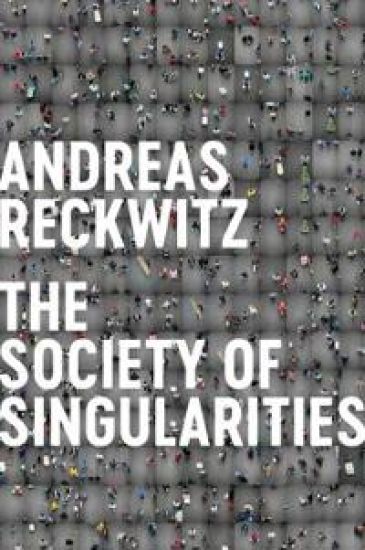
Society of Singularities

Society of Singularities

Andreas Reckwitz

Polity Press
2020
sidottu
Our contemporary societies place more and more emphasis on the singular and the unique. The industrial societies of the early 20th century produced standardized products, cities, subjects and organizations which tended to look the same, but in our late-modern societies, we value the exceptional - unique objects, experiences, places, individuals, events and communities which are beyond the ordinary and which claim a certain authenticity. Industrial society’s logic of the general has been replaced by late modernity’s logic of the particular. In this major new book, Andreas Reckwitz examines the causes, structures and consequences of the society of singularities in which we now live. The transformation from industrial to cultural capitalism, the rise of digital technologies and their ‘culture machine’ and the emergence of an educated, urban new middle class form a powerful engine for the singularization of the social. In late modernity, what is singular is valorized and stirs the emotions, while what is general has to remain in the background, and this has profound social consequences. The society of singularities systematically produces devaluation and inequality: winner-takes-all markets, job polarization, the neglect of rural regions and the alienation of the traditional middle class. The emergence of populism and the rise of aggressive forms of nationalism which emphasize the cultural authenticity of one’s own people thus turn out to be the other side of singularization. This prize-winning book offers a new perspective on how modern societies have changed in recent decades and it will be of great value to anyone interested in the forces that are shaping our world today.
Society & Civility

Society & Civility

Katherine a Cerulean

Createspace Independent Publishing Platform
2022
pokkari
Ann Marshal has spent the first nineteen years of her life happily living in the small village of Dorbeset, where her beloved father and country gentleman Julian raised her to have a curious mind and to look beyond the strict class boundaries in which Regency England puts so much stock. Her provincial yet idyllic existence is upended, however, when she learns she must spend six months with family friends in London, learning the one lesson her father has never been able to teach her: how to be a society lady. Her father's old pals from university take her under their collective wing, but it isn't long before one of them reveals a shocking secret: Julian is not her father, only her guardian. Instead, she is the daughter of Julien's good friend Mr. Ranquest, a successful businessman. Now heir to an enormous fortune and the 'belle of London', Ann struggles with her feelings about her parentage and, although she arrived in London with no intention of seeking out a husband, she is alternately drawn to and pursued by a number of gentlemen. These include a young lawyer seeking a woman with the money to complement his family's good name; Tom Barnes, the kind of foppish dandy Ann has always abhorred, yet whose high spirits and charm Ann is undeniably drawn to; and Tom's father Charles Barnes, a naturalist who shares Ann's love of the outdoors but would rather deny himself happiness than potentially interfere with his son's. Will Ann settle for compatibility and companionship, or risk marrying an inconstant man of little substance? Or will she hold out for a greater love that could actually last a lifetime? Set in the Regency era, "Society & Civility" will appeal to fans of Jane Austen, but its timeless questions about love and identity make it all too relevant to our modern world.