
Kirjahaku
Etsi kirjoja tekijän nimen, kirjan nimen tai ISBN:n perusteella.
747 tulosta hakusanalla Cherokee Randolph

Grand Lake O' the Cherokees Fun Book: A Fun and Educational Book on Grand Lake O' the Cherokees
Jobe Leonard
Createspace Independent Publishing Platform
2014
nidottu
DISCOVER:: FUN on the lake. This body of water is a true gem. Now you can work your way through the majestic shores that make this lake so special. Fun for all ages. Share the gift of Lake Fun with someone you love today. ***Limited Time Discount Offer *** ***Regular Price $12.99*** - -***Plus, As a Special Thank-you for buying this Book Today, You Will Receive FREE puzzles and games inside the book*** - -Do you want to see a side of the lake a child rarely gets to see? Do you or a child you love need to express their creative side while enjoying a fun cultural experience? Read on to find out more about how this book can solve your problem... Buy:: The one and only Lake Fun Coloring Book Here's a preview of what you'll find inside this book: - -Fisherman First Aid Kit Tent Sleeping Bag Beach Towell Fish Net Flippers Boat Paddle Hat Visor Swim Trunks Bikini Radio Playing Music Life jacket Rafts Knee Board Tubes Friends Fire Wood Camp Fire Grill Sun Screen Lotion Money Drinks Goggles Wake board Ski Rope Anchor Bug repellent Beach Chairs Binoculars Book Playing Cards Cooler Coozie Camera Snacks Tackle Box Fishing Rod Worms Cricket Water Shoes Skipping Rocks Water bottle Floaties Swim Noodle Dry Clothes Phone Trash Bag Toilet Paper Paper Towels Watermelon Lantern Flash light Boat light Ski rope Bobber Fishing Hook Catfish Bluegill Turtle Minnow Crickett Water Snake Duck Pelican Seagull Frog Large Mouth Bass Small Mouth Bass Trout Laptop Computer Tablet Swim Cap Nose plug Fish food Bag of ice Dog Pop sickle Marshmallows Chocolate Graham crackers Smores Canoe Kayak Paddlebaord Flip flops Lake Map Swim Noodle And much, much more Want to Know More? Scroll to the top of the page and select the "BUY" button for instant purchase. Buy Your Copy Right Now

Grand Lake O' The Cherokees Safety Book: The Essential Lake Safety Guide For Children
Jobe Leonard
Createspace Independent Publishing Platform
2015
nidottu

Grand Lake O The Cherokees Paddleboarding: A Guide to Flat Water Stand up Paddling
Vie Binga
Createspace Independent Publishing Platform
2016
nidottu
"Walk On Water - A Guide To Flat Water Stand Up Paddling" "Walk On Water - A Guide To Flat Water Stand Up Paddling" is the result of almost a decade of professionally teaching stand up paddling to thousands of people around the globe. Are you looking to try stand up paddling for the first time? Have you already paddled a few times and are now looking to purchase your own stand up paddle board? Do you want to safely introduce paddle boarding to your friends and family? Are you a yoga teacher or fitness instructor wanting to teach SUP Yoga or SUP Fitness? Are you a stand up paddle board retailer or SUP rental facility? Are you a long term stand up paddle boarder and want to learn more about your paddle board and SUP gear? Are you a fitness buff wanting to enhance your exercise regime? Are you an outdoor enthusiast looking for an easy year round activity? Are you an athlete looking to cross train? If you answered yes to any of the above, then "Walk On Water - A Guide To Flat Water Stand Up Paddling" is the answer to all your questions. This book begins by studying the gear that is essential for paddle boarding. If you already own or have otherwise access to a paddleboard and/or other SUP gear, this book will help you understand and appreciate what your gear is best made for. If you do not already have access to a paddleboard/gear, after reading this book you will be able to choose the board and gear that is best suited for your size, skills and needs. The book continues by going over essential skills such as proper stance, paddle strokes and muscle activation. Stand up paddle boarding, if performed right, will serve simultaneously as a great core strengthening and joint rehabilitating activity. We then cover the essential safety principles that you need to follow as a paddle boarder and also the principles that you need to adhere to when taking other people out on the water, whether friends, family or paying clients. The methodologies that we are giving you come from having taught various forms of paddle boarding to thousands of clients throughout the years. While keeping in mind that every one learns differently, we have chosen what we consider the most essential and the most practical. Even though we would like to believe that we have successfully captured the essence of flat water stand up paddling in a very comprehensive manner, we understand that stand up paddling is a continuously evolving and developing sport. Board construction, gear availability, sport etiquette, fitness and exercise science, real life situations are for example some of the parameters that constantly change. Having said that, we would love to hear how this book, "Walk On Water - A Guide To Flat Water Stand Up Paddling", helped you in your own stand up paddle explorations. Is there something you would like to see added to "Walk On Water"? Do you have an inspiring stand up paddle story you wish to share with your fellow paddle boarders? It just so might be featured in our next revision. We can be reached at [email protected] Embrace, Explore, Live Learn... Happy & Safe Journey Tim Ganley & Vie Binga

Grand Lake O the Cherokees Wakeboarding: Learn How to Wakeboard
Charles Whyte
Createspace Independent Publishing Platform
2016
nidottu
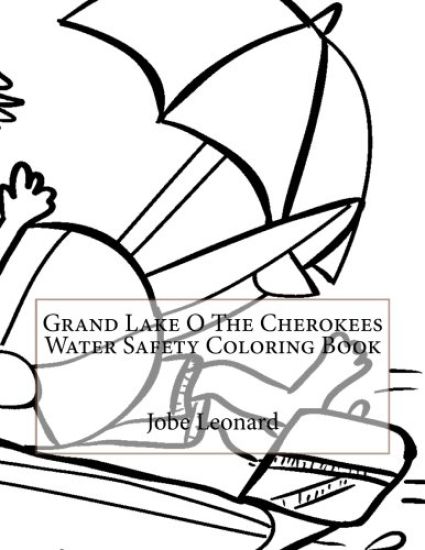
Grand Lake O The Cherokees Water Safety Coloring Book
Jobe Leonard
Createspace Independent Publishing Platform
2016
nidottu

Grand Lake of the Cherokees Vacation Super Coloring Book
Jobe Leonard
Createspace Independent Publishing Platform
2016
nidottu


Over the generations, Cherokee citizens became a conglomerate people. Early in the nineteenth century, tribal leaders adapted their government to mirror the new American model. While accommodating institutional slavery of black people, they abandoned the Cherokee matrilineal clan structure that once determined their citizenship. The 1851 census revealed a total population nearing 18,000, which included 1,844 slaves and 64 free blacks. What it means to be Cherokee has continued to evolve over the past century, yet the histories assembled here by Ty Wilson, Karen Coody Cooper and other contributing authors reveal a meaningful story of identity and survival.



Riding the Trail: Cherokees Remember the Removal
Traci Sorell; Will Chavez
CHARLESBRIDGE PUBLISHING
2026
sidottu
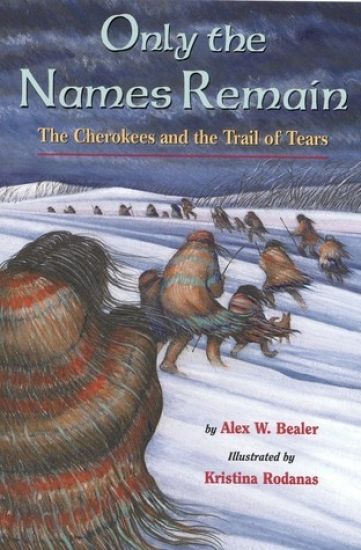
Only the Names Remain: The Cherokees and the Trail of Tears
Alex W. Bealer
Little, Brown Books for Young Readers
1996
nidottu
Describes the life of the Cherokee Indians in Georgia before and after the U.S. government forcibly removed them from their land
The Moravian Springplace Mission to the Cherokees
University of Nebraska Press
2010
pokkari
In 1801 the Moravians, a Pietist German-speaking group from Central Europe, founded the Springplace Mission at a site in present-day northwestern Georgia. The Moravians remained among the Cherokees for more than thirty years, longer than any other Christian group. John and Anna Rosina Gambold served at the mission from 1805 until Anna's death in 1821. Anna, the principal author of the diaries, chronicles the intimate details of Cherokee daily life for seventeen years. Anna describes mission life and what she heard and saw at Springplace: food preparation and consumption, transactions pertaining to land, Cherokee body ornaments, conjuring, Cherokee law and punishment, Green Corn ceremonies, ball play, and matriarchal and marriage traditions. She similarly recounts stories she heard about rainmaking, the origins of the Cherokee people, and how she herself conversed with curious Cherokees about Christian images and fixtures. She also recalls earthquakes, conversions, notable visitors, annuity distributions, and illnesses. This abridged edition offers selected excerpts from the definitive edition of the Springplace diary, enabling significant themes and events of Cherokee culture and history to emerge. Anna's carefully recorded observations reveal the Cherokees' worldview and allow readers a glimpse into a time of change and upheaval for the tribe.
The Moravian Springplace Mission to the Cherokees, 2-volume Set
University of Nebraska Press
2007
sidottu
In 1801 the Moravians, a Pietist German-speaking group from Central Europe, founded the Springplace Mission at a site in present-day northwestern Georgia. The Moravians remained among the Cherokees for more than thirty years, longer than any other Christian group. John and Anna Rosina Gambold served at the mission from 1805 until Anna's death in 1821. The principal author of the diaries, Anna, chronicles the intimate details of Cherokee daily life. This edition of the diary includes the entire text in translation as well as a critical apparatus, contextual introductory material, and extensive notes. Rowena McClinton's translation from German script, an archaic writing convention, makes these primary eyewitness accounts available in English for the first time. These diaries will be of immense value for understanding Cherokee culture and history during the early nineteenth century and missionary efforts in the South during this time. McClinton gained unlimited access to the diaries and other supporting documents for the completion of this project, published with the consent of the Moravian Church of the Southern Province. Volume 1 includes diary entries from 1805–13, a preface, and an introduction. Volume 2 includes diary entries from 1814–21, the editor's epilogue, and a names index and a subject index for both volumes.

Here is the gripping story of the last stand of Chief Philip Bowles of the Chickamauga Cherokee Indians of Texas. Mary Whatley Clarke sets this tale against the stormy background of Anglo-Cherokee-Mexican relations in early nineteenth-century Texas.The Chickamauga Cherokees from Running Water on the Tennessee River were continually forced to relocate-first to Missouri, then to Arkansas, and finally to Texas. They managed to make a home of their new Texas residence. Then, as has happened many times before and since in Anglo-Indian relations, settlers began to look with increasing desire at the rich Indian lands. The Chickamauga Cherokee had had enough of relocation, and, on a blistering July day in 1839, Chief Bowles and his warriors made a tragic and bloody final stand on the battlefield defending their new Texas home. Their stand resulted in defeat and the dispersal of the Chickamauga Cherokees to far-flung homes on reservations.Could this history have taken a different course? Perhaps not, for, as Mary Whatley Clarke observes, the Cherokee had become ""a red island in a white sea,"" and it seems inevitable that the Anglo-American would submerge that island.
Records of the Moravians Among the Cherokees
Cherokee Heritage Press
2011
sidottu
Using original diaries, minutes, reports, and correspondence in the Moravian Archives in North Carolina, the Records of the Moravians among the Cherokees series provides a rare account of daily life among the Cherokees throughout the nineteenth century. Although written by missionaries, the records provide keen insight into Cherokee culture, society, and customs.Volume 3, spanning the years 1805 to 1810, chronicles the arrival of John and Anna Rosina Gambold to the mission. Anna Rosina proved dedicated to the education of Cherokee children, and the mission took on a new life and character. The Gambolds soon won the people's affection and respect, and Chief Chuleoa, who at first opposed the mission, became their friend. These years also witnessed the tragic death of James Vann, the Moravians' benefactor among the Cherokees, and the mission's first successful baptism of a Cherokee into the Moravian Church.
Records of the Moravians Among the Cherokees
Cherokee Heritage Press
2012
sidottu
Using original diaries, minutes, reports, and correspondence in the Moravian Archives in North Carolina, the Records of the Moravians among the Cherokees series provides a rare account of daily life among the Cherokees throughout the nineteenth century. Although written by missionaries, the records provide keen insight into Cherokee culture, society, and customs.Volume 4 continues the story through 1816, when earthquakes ushered in a period of upheaval--from the Cherokees' involvement in the Creek War, to M tis battles in Canada, to Napoleon's conquests in Europe. Meanwhile, the little Moravian mission of Springplace added new members, including Charles Hicks, soon to be elected Second Principal Chief of the Cherokee Nation, while Anna and her husband continued work with their Cherokee students.
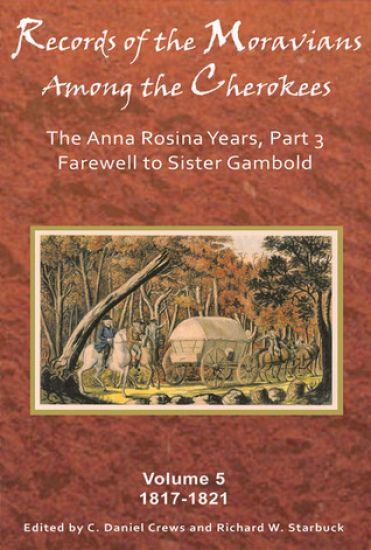
Records of the Moravians Among the Cherokees
Cherokee Heritage Press
2014
sidottu
Must they be removed? Or can they remain in their ancestral land?That is the great question confronting the Cherokee Nation and forming the backdrop to volume 5 of Records of the Moravians among the Cherokees. Subtitled The Anna Rosina Years, Part 3: Farewell to Sister Gambold, volume 5 spans the years 1817 to 1821, years of great change within the Cherokee Nation and the end of an era at the Moravians' Springplace mission. Increasingly the Cherokees see the need to adopt new ways. Long gone is the hunter-gatherer way of life, supplanted by farming for livelihood. A new town, soon to be called New Echota, is begun as the "permanent seat of government," and Abraham Steiner, the Moravians' "Apostle to the Cherokees," is invited to consecrate the council house. And throughout the Nation an awakening has begun, as more and more Cherokees open their hearts to the preaching of missionaries among them.At the Moravians' little Springplace mission, Br. John and Sr. Anna Rosina Gambold have toiled since 1805 and have only two converts for all their labor. But now they too share in the awakening, and a second station, at Oochgeelogy, is proposed. The Springplace school also prospers, and Sr. Gambold sees four of her "brown pupils" go to Cornwall in Connecticut for further education to be-come the next generation of leaders of the Cherokee Nation.But then tragedy strikes. Margaret Ann Scott Crutchfield -- Sr. Peggy, widow of the notorious Chief James Vann -- the "first-fruit" of the Cherokee Nation at Springplace, passes away. And then it's Sr. Gambold's turn, and like her husband John, we are left to stand weeping at the grave of our "unforgettable Anna Rosel."With major financial support from the Cherokee Nation and the Eastern Band of the Cherokees, Records: Cherokees will next turn to the series of volumes subtitled March to Removal.