Title: A Long Vacation in the Argentine Alps; or, where to settle in the River Plate States.Publisher: British Library, Historical Print EditionsThe British Library is the national library of the United Kingdom. It is one of the world's largest research libraries holding over 150 million items in all known languages and formats: books, journals, newspapers, sound recordings, patents, maps, stamps, prints and much more. Its collections include around 14 million books, along with substantial additional collections of manuscripts and historical items dating back as far as 300 BC.The HISTORY OF TRAVEL collection includes books from the British Library digitised by Microsoft. This collection contains personal narratives, travel guides and documentary accounts by Victorian travelers, male and female. Also included are pamphlets, travel guides, and personal narratives of trips to and around the Americas, the Indies, Europe, Africa and the Middle East. ++++The below data was compiled from various identification fields in the bibliographic record of this title. This data is provided as an additional tool in helping to insure edition identification: ++++ British Library Johnson, Henry Charles Ross; 1868. 8 . 10481.e.26.
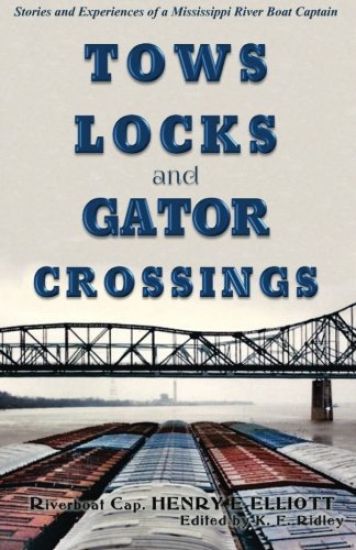
With a list of tows, locks, and "Gator Crossings" three pages long, Riverboat Captain Henry E. Elliott has more life stories than could possibly fit in one 200-page book. In TOWS, LOCKS AND GATOR CROSSINGS, Captain Elliott picks his favorite riverboat tales, covering 40+ years on the water. You will laugh, and sometimes cry, but by the end, you will feel as if you, too, had sailed the country's great rivers with the captain.Summary of Contents: List of Tows, Locks, and Gator Crossings1. Moving the River and Barges2. Live and Learn3. Northers, Banks, and Being Henry4. Alligators and Snakes5. Bosses & People with Money6. Bad Crews and Tiny Shirts7. Tankerman License8. Any Great Ideas?9. Steamed10. Opportunities11. Tomfoolery12. Shenanigans13. Great Ideas14. The Proper Authorities15. Frozen16. Accidents, Bridges & Teamwork17. Family18. "Old" New Boats19. Riverboat Cooks20. Accidents Happen21. Locks and Veggies22. Sixty-Two Years to Sum it UpGlossary
This book has been considered by academicians and scholars of great significance and value to literature. This forms a part of the knowledge base for future generations. So that the book is never forgotten we have represented this book in a print format as the same form as it was originally first published. Hence any marks or annotations seen are left intentionally to preserve its true nature.
*Includes pictures. *Includes actors' quotes about their careers. *Includes bibliographies. In 1999, the American Film Institute released its list of the 50 greatest Hollywood stars of the 20th century, and selecting the 10 best actors out of the bunch was certainly a tall task. The competition was so stacked that men like Gary Cooper and John Wayne were not even among the Top 10. So who were the Top 10 men selected by the AFI? One man has long been considered the greatest male star. From the time he first became a leading man, Humphrey Bogart's screen image has resonated with viewers more than perhaps any other actor. His persona as a tough guy who manages to maintain his sense of virtue no matter how compromising the situation features in some of the most famous films ever made, including Casablanca (1942), The Maltese Falcon (1941), and Key Largo (1949). Movie stars are revered for their ability to captivate audiences, and perhaps no actor has done it as well as Cary Grant, the epitome of the suave, debonair actor who may have been rivaled only by dancer extraordinaire Fred Astaire. Grant offered a version of the male actor that stood in stark contrast with the gangster heroes and hard-boiled film noir detectives that populated the screen throughout his career. If the list was reconstructed today, it is entirely possible that Stewart would rank first. Not only have movies such as It's a Wonderful Life (1946) and Vertigo (1958) continued to gain in popularity even into the 21st century, but Stewart has come to embody an accessible image of American values that is easy for everyone to embrace. Over the course of his long, prolific career, Marlon Brando was considered perhaps the greatest actor of the 20th century as well as one of the most complicated and misunderstood. Uniquely able to be both emotionally charged and technically constrained in the same performance, he single-handedly changed the direction of not only the American style of acting, influencing successors such as Robert De Niro, Al Pacino and even Johnny Depp, but the acting profession on a global scale. Virtually all famous actors are regaled by the public, but even still, Fred Astaire occupies a privileged position in American pop culture. The specific films in which Astaire acted may not be especially famous in their own right, but Astaire's dancing prowess invariably creates a lasting impact on viewers. Among all of Hollywood's iconic leading men, arguably none proved as versatile at acting as Henry Fonda, whose career spanned six decades and earned him Academy Awards for roles in various genres. A lot of Fonda's success could be attributed to the fact that he could convincingly play the all-American man that everybody in the nation adored and/or wanted to be. Best known for his role in Gone with the Wind (1939), Clark Gable had a unique appeal that captivated Depression-era audiences; while Cary Grant offered a sophisticated charm and Fred Astaire was tied to the musical genre, Gable brought an air of sophistication that was less comical than that of Grant and appealed to both genders, unlike Astaire. Ultimately, it was portraying tough guys and gangsters in the 1930s that turned James Cagney into a massive Hollywood star. In movies like The Public Enemy (which included the infamous "grapefruit scene") and White Heat, Cagney convincingly played criminals that brought Warner to the forefront of Hollywood After joining MGM in 1935, Tracy catapulted to fame with one of the most impressive runs in Hollywood history, winning Oscars for Best Actor in 1938 and 1939 after already being nominated in 1937. Charlie Chaplin was the first true film star, and he managed to do so even when films were still silent. He has been honored with too many awards to count, and the fact that his name remains instantly recognizable nearly a century after his first film is a testament to his influence
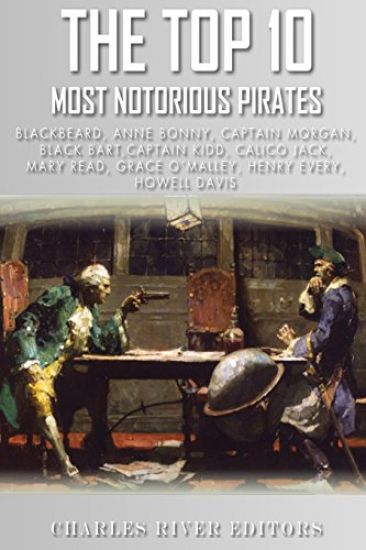
*Examines the lives, legends and legacies of 10 of history's most famous pirates. *Explains how the myths and legends of pirates like Blackbeard created the instantly recognizable pirate stereotypes today. *Includes pictures depicting the pirates and important people, places, and events in their lives. *Includes contemporary accounts of the pirates written by Captain Charles Johnson *Includes Bibliographies The people who have lived outside the boundaries of normal societies and refused to play by the rules have long fascinated the world, and nowhere is this more evident than the continuing interest in the pirates of centuries past. As the subjects of books, movies, and even theme park rides, people continue to let their imaginations go when it comes to pirates, with buried treasure, parrots, and walking the plank all ingrained in pop culture's perception of them. While there is no question that the myths and legends surrounding history's most famous pirates are colorful, in some instances their actual lives made for even better stories. Before the Golden Age of Piracy, men and women like Sir Francis Drake and Grace O'Malley straddled the line between pirate and privateer, with Drake being knighted for fighting the Spanish and O'Malley representing many things to the Irish, including queen, legend, pirate, and folk hero. While Captain Morgan's ruthless piracy has actually been forgotten due to his association with the spiced rum company using his name, Captain William Kidd insisted he wasn't a pirate at all, and his entire reputation is based on the most notorious trial in the history of piracy. The Golden Age of Piracy generally refers to the era when history's most famous pirates roamed the seas of the West Indies from 1670-1720, and it is no coincidence that the beginning of it was marked by the rise of Henry Every. In his day Every was the "King of Pirates", and in addition to popularizing the famous skull and crossbones logo that would become the most famous pirate flag, Every conducted what is considered the most profitable pirate raid in history, leading to what is considered the first worldwide manhunt in history when the English put a large bounty on his head. It would be an understatement to say that pop culture's perception of piracy and pirates has been primarily influenced by Captain Edward Teach, known to the world as Blackbeard. Blackbeard is remembered today based more on myths than reality. People continue to let their imaginations go when it comes to Blackbeard, picturing a pirate who captured more booty than any other pirate, hid buried treasure, and lit his hair on fire before battle. People have long claimed that his ghost still haunts the Atlantic Ocean, and his contemporaries were so scared of him that they claimed to have seen his headless body swim around his pirate boat three times. Fittingly, some of history's most famous pirates sailed together. Black Bart Roberts is considered the most successful pirate in history, managing to capture about 500 ships before meeting his fate, but he learned the tricks of the trade from Howell Davis, whose cunning and courage led to some of the most spectacular acts of piracy in history. Then there are history's two most famous female pirates, Anne Bonny and Mary Read, who actually sailed together on Calico Jack's pirate ship. Together the three became history's most famous pirate crew and had one of the most colorful years of the Golden Age of Piracy before being captured. This book looks at all of these notorious pirates, examining their careers and analyzing their legacies. Along with pictures, contemporary accounts, bibliographies, and a Table of Contents, you will learn about history's most famous pirates like never before.
*Examines the lives, legends and legacies of the Caribbean's most famous and successful pirates. *Explains how the myths and legends of pirates like Blackbeard created the instantly recognizable pirate stereotypes today. *Includes pictures depicting the pirates and important people, places, and events in their lives. *Includes contemporary accounts of the pirates written by Captain Charles Johnson. *Includes Bibliographies Over the past decade, few movie franchises have been as successful as Pirates of the Caribbean, starring Johnny Depp as the stereotypical pirate Jack Sparrow, a flamboyant, colorful and cunning pirate of questionable morality. The popularity of the movies and the character Jack Sparrow demonstrate how the people who have lived outside the boundaries of normal societies and refused to play by the rules have long fascinated the world. Nowhere is this more evident than the continuing interest in the pirates of centuries past. As the subjects of books, movies, and even theme park rides, people continue to let their imaginations go when it comes to pirates, with buried treasure, parrots, and walking the plank all ingrained in pop culture's perception of them. While there is no question that the myths and legends surrounding history's most famous pirates are colorful, in some instances their actual lives made for even better stories. Before the Golden Age of Piracy, men like Sir Francis Drake straddled the line between pirate and privateer, and Drake was knighted for fighting the Spanish. While Captain Morgan's ruthless piracy has actually been overlooked due to his association with the spiced rum company using his name, he was a remarkably successful pirate, and one of history's best documented pirates. The Golden Age of Piracy generally refers to the era when history's most famous pirates roamed the seas of the West Indies from 1670-1720, and it is no coincidence that the beginning of it was marked by the rise of Henry Every. In his day Every was the "King of Pirates", and in addition to popularizing the famous skull and crossbones logo that would become the most famous pirate flag, Every conducted what is considered the most profitable pirate raid in history, leading to what is considered the first worldwide manhunt in history when the English put a large bounty on his head. It would be an understatement to say that pop culture's perception of piracy and pirates has been primarily influenced by Captain Edward Teach, known to the world as Blackbeard. Blackbeard is remembered today based more on myths than reality. People continue to let their imaginations go when it comes to Blackbeard, picturing a pirate who captured more booty than any other pirate, hid buried treasure, and lit his hair on fire before battle. People have long claimed that his ghost still haunts the Atlantic Ocean, and his contemporaries were so scared of him that they claimed to have seen his headless body swim around his pirate boat three times. Fittingly, some of history's most famous pirates sailed together. Black Bart Roberts is considered the most successful pirate in history, managing to capture about 500 ships before meeting his fate, but he learned the tricks of the trade from Howell Davis, whose cunning and courage led to some of the most spectacular acts of piracy in history. Then there are history's two most famous female pirates, Anne Bonny and Mary Read, who actually sailed together on Calico Jack's pirate ship. Together the three became history's most famous pirate crew and had one of the most colorful years of the Golden Age of Piracy before being captured. Real Pirates of the Caribbean looks at all of these notorious pirates, examining their careers and analyzing their legacies. Along with pictures, contemporary accounts, bibliographies, and a Table of Contents, you will learn about these famous pirates like never before.











![A Narrative of the Expedition sent by Her Majestys Government to the River Niger in 1841, under the command of Capt. H. D. Trotter. [With plates.]](/covers/9781241492854.jpg)