Kirjojen hintavertailu. Mukana 12 390 323 kirjaa ja 12 kauppaa.

Kirjahaku

Etsi kirjoja tekijän nimen, kirjan nimen tai ISBN:n perusteella.

1000 tulosta hakusanalla John Class

Social Actions for Classroom Language Learning

Social Actions for Classroom Language Learning

John Hellermann

Multilingual Matters
2008
sidottu
Drawing on recent socio-cultural approaches to research on language learning and an extensive corpus of classroom video recording made over four years, the book documents language learning as an epiphenomenon of peer face-to-face interaction. Advanced technology for recording classroom interaction (6 cameras per classroom) allows the research to move the focus for analysis off the teacher and onto learners as they engage in dyadic interaction. The research uses methods from conversation analysis with longitudinal data to document practices for interaction between learners and how those practices change over time. Language learning is seen in learners’ change in participation in their in social actions that occur around and within teacher-assigned language learning tasks (starting the task, non-elicited story tellings within tasks, and ending tasks). Web links are provided so the reader can see the data from the classroom that is the subject of the analyses.
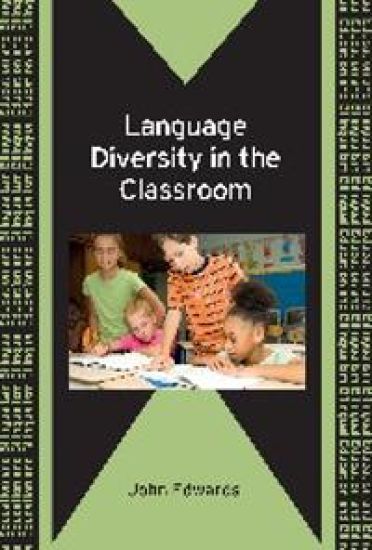
Language Diversity in the Classroom

Language Diversity in the Classroom

John Edwards

Multilingual Matters
2009
nidottu
This book provides comprehensive coverage of language contact in classroom settings. A thorough analysis of the sources and implications of social “disadvantage” is presented first, since the nonstandard dialects that children bring with them to school – and the unfavourable perceptions of these dialects – have traditionally given rise to educational difficulties. The persistence of these perceptions is particularly highlighted. More general issues surrounding the range and implications of language attitudes are dealt with, as is the important “test case” of Black English. The book also discusses foreign-language teaching and learning, as well as the assumptions and intentions underpinning bilingual and multicultural education. Given its breadth and its style, this book should be of interest and value to all teachers, as well as to students and researchers concerned with any aspect of the social life of language.
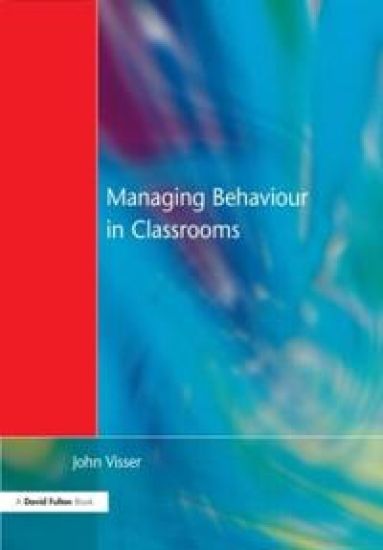
Managing Behaviour in Classrooms

Managing Behaviour in Classrooms

John Visser

David Fulton Publishers Ltd
2000
nidottu
First Published in 2001. This book is based upon a perspective which suggests that there are no easy answers to achieving the well-managed classroom and to working with pupils with emotional and behavioural difficulties, whether these are ‘mild’ or ‘severe’. Nor are there any ready-made prescriptive ones. Rather there are some underlying principles which can be applied in a variety of ways, to meet the diversity of situations and learning needs to be found in classrooms. This book is a personal perspective based upon the author’s experience in primary, secondary and specialist provision as teacher, researcher and consultant.
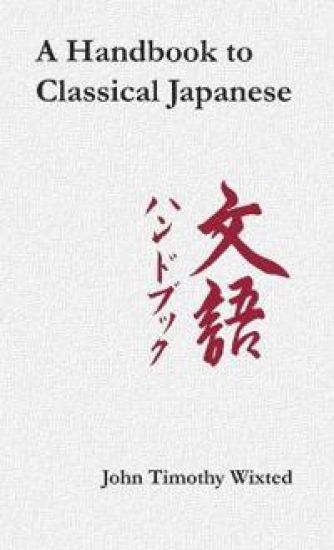
A Handbook to Classical Japanese

A Handbook to Classical Japanese

John Timothy Wixted

Cornell University East Asia Program
2010
sidottu
Emerging from materials the author developed while teaching, A Handbook to Classical Japanese draws on twenty-five years of experience in addressing problem areas for those learning the language. The work deals with the central issue of classical language, namely, 'verb'-endings: specifically, the endings of verbs, verbal adjectives, pseudo-adjectives, and verb-suffixes. The Handbook treats the issue systematically, presenting 670 real-language examples, nearly 400 of which are discretely different quotations. The work's extensive Introduction walks the reader through key problem areas, with sections on "Which Verbs Belong to Which Conjugation?" "How to 'Unpack' Bungo Verbs," "Nari Headaches," "Namu/nan Trouble," "Items Easily Confused: Apparent Ambiguity," "Respect Language," and the like. The body of the Handbook, with its hundreds of examples, serves as a kind of reader; thirty-two verb-suffixes are illustrated in all of their forms or functions (with at least two examples of each). The book's seven appendices introduce a wide range of Western-language material, including comprehensive information about other translations into English, French, German, and Spanish of all texts cited—especially helpful for potential comparative translation study. For those unfamiliar with the topic, the section on Orthography is a model of clarity. Throughout the Handbook, highlighted items in Japanese are printed in bright red and their romanization in dark-black small capitals, to repeat and reinforce material at both conscious and unconscious levels via complementary graphic features. The volume can be used as an introduction to classical Japanese, an initial textbook, a companion text, a review text, and/or a reference work.
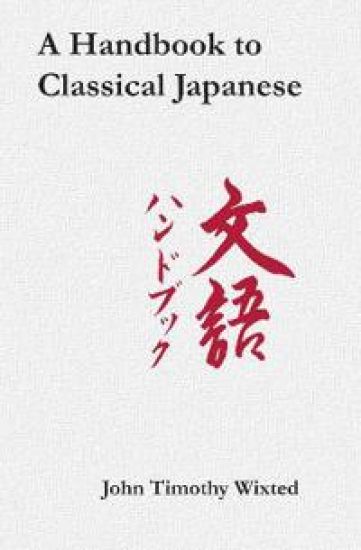
A Handbook to Classical Japanese

A Handbook to Classical Japanese

John Timothy Wixted

Cornell University East Asia Program
2010
pokkari
Emerging from materials the author developed while teaching, A Handbook to Classical Japanese draws on twenty-five years of experience in addressing problem areas for those learning the language. The work deals with the central issue of classical language, namely, 'verb'-endings: specifically, the endings of verbs, verbal adjectives, pseudo-adjectives, and verb-suffixes. The Handbook treats the issue systematically, presenting 670 real-language examples, nearly 400 of which are discretely different quotations. The work's extensive Introduction walks the reader through key problem areas, with sections on "Which Verbs Belong to Which Conjugation?" "How to 'Unpack' Bungo Verbs," "Nari Headaches," "Namu/nan Trouble," "Items Easily Confused: Apparent Ambiguity," "Respect Language," and the like. The body of the Handbook, with its hundreds of examples, serves as a kind of reader; thirty-two verb-suffixes are illustrated in all of their forms or functions (with at least two examples of each). The book's seven appendices introduce a wide range of Western-language material, including comprehensive information about other translations into English, French, German, and Spanish of all texts cited—especially helpful for potential comparative translation study. For those unfamiliar with the topic, the section on Orthography is a model of clarity. Throughout the Handbook, highlighted items in Japanese are printed in bright red and their romanization in dark-black small capitals, to repeat and reinforce material at both conscious and unconscious levels via complementary graphic features. The volume can be used as an introduction to classical Japanese, an initial textbook, a companion text, a review text, and/or a reference work.
Questions for Humans: Elementary Classroom
Building a safe, connected classroom can feel impossible at times.But mental health expert Dr. John Delony wants to help you navigate conversations and improve your relationships That's why he developed Questions for Humans. These 52 conversation starters for the classroom will help you actually connect.The questions were made to promote a learning environment where every student is invited and excited to speak up. (Oh, and the cards have been vetted by real students--and they had a blast using them.Whether this is a get-to-know-you activity at the start of the year or what you use to fill downtime, encourage your students to take turns, listen well, ask why, and laugh a lot.What to expect when you play: You'll learn something unexpected.You'll have some laughs.You'll find it much, much easier to build trust.You'll spend meaningful (and fun) quality time together. Here's a look at a few of the questions: If you could change our school mascot, what would it be?What would you want to be famous for?If animals could talk, which one would be the funniest? Sometimes you can be sitting right next to someone but still feel 1,000 miles apart. These conversation starters can change that Spend a few minutes on one question or go through five or six questions in one sitting. The important part is to have some fun and connect.
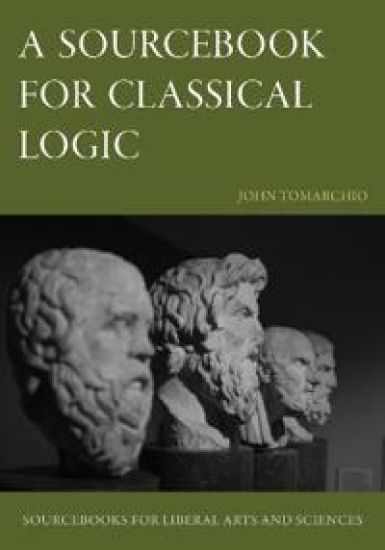
A Sourcebook for Classical Logic

A Sourcebook for Classical Logic

John Tomarchio

THE CATHOLIC UNIVERSITY OF AMERICA PRESS
2023
nidottu
In A Sourcebook for Classical Logic John Tomarchio offers a brief sequence in classical Logic befitting an unspecialized study for students of liberal arts and sciences. The sequence is made up of select texts of the Aristotelian Organon, mostly the opening chapters of each treatise, in the traditional order, where Aristotle lays out the primary elements of reasoning. Study aids accompany these primary texts, providing students with mnemonics and diagrams developed in his classroom at St. John's College, Annapolis. The culmination of this Aristotelian Logic sequence is selections from the Posterior Analytics where Aristotle offers an account of the demonstrative reasoning of theoretical sciences. The interest of this Sourcebook, as of Aristotelian Logic, is search for such knowledge.Tomarchio prefaces this Aristotelian sequence with a sequence of readings in Medieval grammatica speculative, or philosophy of language. This propaedeutic sequence begins with an ancient source to which that metaphysically minded 'grammar' recurred, namely Augustine's De magistro, or On the Teacher. It is a dialogue between Augustine and his son about the triadic relation of the spoken word to the word thought and the thing thought about. This aporetic dialectic is effective in awakening students to the theoretical stakes of Logic. Similarly, from later theological inquiries into language for purposes of scriptural interpretation more general theories of language emerged. The theoretical uses made of Aristotelian Logic by the Jewish theologian Maimonides and the Catholic Thomas Aquinas whet student appetite for the technical matter of the Organon sequence to follow.
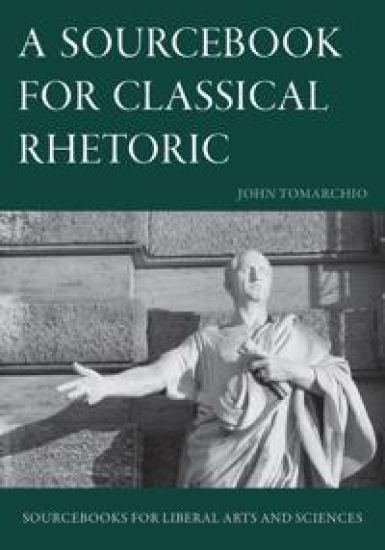
A Sourcebook for Classical Rhetoric

A Sourcebook for Classical Rhetoric

John Tomarchio

THE CATHOLIC UNIVERSITY OF AMERICA PRESS
2024
nidottu
This Sourcebook is intended for students of liberal arts and great books. It treats such books as primary sources for inquiring into the nature of human speech because they clarify the terms and stakes of perennial questions thinking human beings ask themselves about persuasive speaking. By crystallizing viable claims about the nature of what we confront in politics and society--live claims for us to confront in our own, with the stakes of that confrontation being live as well--they originate a dialectic with one another and with us their readers.Cicero called rhetoric a liberal art necessary for every citizen of a free republic. In the polities of ancient Greece and Rome, rhetoric was politically potent because oratory was the regular means of political decision. Words were decisive, often a matter of life and death, not merely for individuals but for peoples. In human milieux where human speech is so politically decisive, reflection upon its nature became keen.The selections of this sourcebook have been arranged in three sequences. The first two sequences comprise philosophical dialogues on the ends of rhetoric. Selections from Plato's Gorgias, Phaedrus, and Apology examine the rhetorician or teacher of rhetoric, and then Cicero's De oratore offers us a dialectic among practitioners about its practice. The philosophical dialogues on the art's intended ends and causative effects provide the theoretical and ethical context for examining its means. These philosophical dialogues are thus propaedeutic to the third sequence, which focusses on the art itself with selections from Aristotle's treatise On Rhetoric, paired with orations from Thucydides' History of the Peloponnesian War.
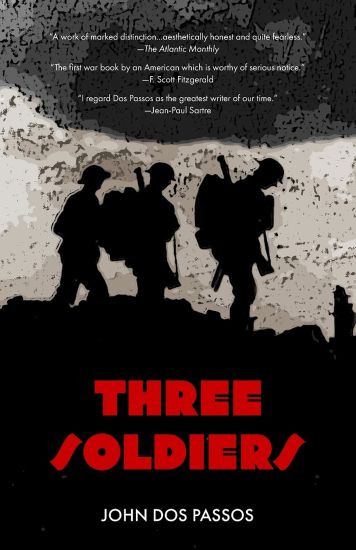
Three Soldiers (Warbler Classics)

Three Soldiers (Warbler Classics)

John Dos Passos

Mary Bahr Inc.
2021
pokkari
John Dos Passos's second novel, Three Soldiers, was published in 1921 after many rejections from publishers and censorship squabbles. The novel, which was hailed as a masterpiece on its original publication, stands as one of the most grimly honest portraits of World War I. This anti-war novel focuses on three soldiers- Fuselli, an Italian American store clerk from San Francisco; Chrisfield, a farm boy from Indiana; and Andrews, a musically gifted Harvard graduate from New York-who endure long waits in the trenches punctuated by terrifying firefights filled with poison gas. The military strategy of the direct frontal assault combined with the use of airplanes, grenades, and mustard gas as military weapons assures mutual destruction. Three Soldiers explores fear and ambition, conformity and rebellion, desertion and violence in the context of impossible circumstances. The book remains a towering testament to the brutal and dehumanizing effects of a regimented war machine on ordinary soldiers. This Warbler Classics edition includes a detailed biographical timeline.
Manhattan Transfer (Warbler Classics)

Manhattan Transfer (Warbler Classics)

John Dos Passos

Warbler Classics
2021
pokkari
John Dos Passos's Manhattan Transfer follows the overlapping lives of four principal characters in a sweeping multi-faceted tale set to the soundtrack of the booming, rhythmic pulse of New York City in the 1920s. Peopled with wealthy professionals, struggling immigrants, actors, cab drivers, chefs, and shopkeepers, a portrait of New York City bursts into view with all the force of the city itself. Through a narrative collage of descriptions, snatches of conversations, music, flashbacks, streams of consciousness, and shifting perspectives, Dos Passos vividly portrays the profits and perils of the American dream. Considered by many to be his greatest novel, Manhattan Transfer is a landmark work of modernist fiction and a masterpiece of American literature.
The Thirty-Nine Steps (Warbler Classics Annotated Edition)
As war looms in Europe, Richard Hannay returns from Rhodesia to his home in London. His neighbor, an American freelance spy named Franklin Scudder, claims to know of an assassination plot to destabilize Europe. When Hannay finds Scudder dead in his flat he is drawn into a fast-paced labyrinthine adventure that takes him from the hills of Scotland to an unassuming location by the sea. The progenitor of the classic man-on-the-run thriller, The Thirty-Nine Steps first appeared as a serial adventure story in Blackwood's Magazine from August to September 1915 and in book form in October of that year. Since its publication it has never been out of print and has been frequently adapted for television, radio, theater, and film, including, quite famously, a 1935 film directed by Alfred Hitchcock.
Classical Statistical Mechanics with Nested Sampling

Classical Statistical Mechanics with Nested Sampling

Robert John Nicholas Baldock

Springer International Publishing AG
2017
sidottu
This thesis develops a nested sampling algorithm into a black box tool for directly calculating the partition function, and thus the complete phase diagram of a material, from the interatomic potential energy function. It represents a significant step forward in our ability to accurately describe the finite temperature properties of materials. In principle, the macroscopic phases of matter are related to the microscopic interactions of atoms by statistical mechanics and the partition function. In practice, direct calculation of the partition function has proved infeasible for realistic models of atomic interactions, even with modern atomistic simulation methods. The thesis also shows how the output of nested sampling calculations can be processed to calculate the complete PVT (pressure–volume–temperature) equation of state for a material, and applies the nested sampling algorithm to calculate the pressure–temperature phase diagrams of aluminium and a model binary alloy.
Classical Statistical Mechanics with Nested Sampling

Classical Statistical Mechanics with Nested Sampling

Robert John Nicholas Baldock

Springer International Publishing AG
2018
nidottu
This thesis develops a nested sampling algorithm into a black box tool for directly calculating the partition function, and thus the complete phase diagram of a material, from the interatomic potential energy function. It represents a significant step forward in our ability to accurately describe the finite temperature properties of materials. In principle, the macroscopic phases of matter are related to the microscopic interactions of atoms by statistical mechanics and the partition function. In practice, direct calculation of the partition function has proved infeasible for realistic models of atomic interactions, even with modern atomistic simulation methods. The thesis also shows how the output of nested sampling calculations can be processed to calculate the complete PVT (pressure–volume–temperature) equation of state for a material, and applies the nested sampling algorithm to calculate the pressure–temperature phase diagrams of aluminium and a model binary alloy.
Engraved Gems of classical Times

Engraved Gems of classical Times

John Henry Middleton

Hansebooks
2017
pokkari
Engraved Gems of classical Times - With a Catalogue of the Gems in the Fitzwilliam Museum is an unchanged, high-quality reprint of the original edition of 1891. Hansebooks is editor of the literature on different topic areas such as research and science, travel and expeditions, cooking and nutrition, medicine, and other genres. As a publisher we focus on the preservation of historical literature. Many works of historical writers and scientists are available today as antiques only. Hansebooks newly publishes these books and contributes to the preservation of literature which has become rare and historical knowledge for the future.