Kirjojen hintavertailu. Mukana 12 016 292 kirjaa ja 12 kauppaa.

Kirjahaku

Etsi kirjoja tekijän nimen, kirjan nimen tai ISBN:n perusteella.

1000 tulosta hakusanalla John Neff

John Stearne’s Confirmation and Discovery of Witchcraft
Between 1645-7, John Stearne led the most significant outbreak of witch-hunting in England. As accusations of witchcraft spread across East Anglia, Stearne and Matthew Hopkins were enlisted by villagers to identify and eradicate witches. After the trials finally subsided in 1648, Stearne wrote his only publication, A confirmation and discovery of witchcraft, but it had a limited readership. Consequently, Stearne and his work fell into obscurity until the 1800s, and were greatly overshadowed by Hopkins and his text. This book is the first study which analyses Stearne’s publication and contextualises his ideas within early modern intellectual cultures of religion, demonology, gender, science, and print in order to better understand the witch-finder’s beliefs and motives. The book argues that Stearne was a key player in the trials, that he was not a mainstream ‘puritan’, and that his witch-finding availed from contemporary science. It traces A confirmation’s reception history from 1648 to modern day and argues that the lack of research focusing on Stearne has resulted in misrepresentations of the witch-finder in the historiography of witchcraft. This book redresses the imbalance and seeks to provide an alternative reading of the East Anglian witch-hunt and of England’s premier witch-hunter, John Stearne.
John Leighton Stuart's Missionary-Educator's Career in China
In China, John Leighton Stuart (1876-1962) is a controversial figure occupying an important position in the history of modern China and Sino-U.S. relations. As a scholar and educator, Stuart loved Chinese culture and contributed much to the development of Chinese education. While as a missionary, he was inherently prejudiced against Marxism. As the U.S. ambassador to China, Stuart executed U.S. government's policy, and was finally stereotyped as a symbol of "American imperialism". This book is a comprehensive and systematic study of Stuart's missionary-educator's career in China. It gives a detailed account of Stuart's missionary activities and contribution to the establishment and development of Yenching University as the founding president in China. Yenching, founded in 1919, left a significant and lasting legacy to Chinese education. It also contributed much to western studies on Asian culture with the Harvard-Yenching Institute established in 1928. By collecting substantial relevant materials both at home and abroad, both published and unpublished, this book reveals the multidimensional and complex features of Stuart, getting rid of the stereotype. Academic and general readers interested in Stuart, missionary education in modern China and modern Chinese history will be attracted by this book.
John Leighton Stuart’s Political Career in China
In China, John Leighton Stuart (1876-1962) is a controversial figure occupying an important position in the history of modern China and Sino-U.S. relations. As a scholar and educator, Stuart loved Chinese culture and contributed much to the development of Chinese education. While as a missionary, he was inherently prejudiced against Marxism. As the U.S. ambassador to China, Stuart executed U.S. government's policy, and was finally stereotyped as a symbol of "American imperialism". This book gives a detailed account of Stuart's complicated and deep political involvement in modern China. Stuart had close relationships with Chiang Kai-shek and other high-ranking officials of Kuomingtang (KMT), while he was also an honored guest of Mao Tse-tung and Chinese Communist Party (CCP). During his tenure as the U.S. Ambassador to China, Stuart did implement U.S. government's policy of supporting KMT. But when the CCP's gaining power became inevitable, he took a pragmatic attitude and urged the U.S. government to normalize its diplomatic relations with the Communist Government. These seemingly contradictory behaviors reveal Stuart's complex features and the changeable era. By collecting substantial relevant materials both at home and abroad, both published and unpublished, this book reveals Stuart's multidimensional characters, getting rid of the stereotype. Academic and general readers interested in Stuart, modern Chinese history and Sino-U.S. relations will be attracted by this book.
John Dewey's Democracy and Education in an Era of Globalization
2016 marked the hundred-year anniversary of John Dewey’s seminal work Democracy and Education. This centennial presented philosophers and educators with an opportunity to reexamine and evaluate its impact on various aspects of education in democratic societies. This volume brings together some of the leading scholars on John Dewey and education from around the world in order to reflect on the legacy of Democracy and Education, and, more generally, to consider the influence of Dewey’s ideas on education in the twenty-first century. John Dewey’s Democracy and Education in an Era of Globalization is unique in that it explores some important tensions and relationships among Dewey’s ideas on democracy, education, and human flourishing in an era of globalization. The contributors make sense of how Dewey would have interpreted and responded to the phenomenon of globalization. This book was originally published as a special issue of Educational Philosophy and Theory.
John Dewey’s Ethical Theory
This book provides a wide-ranging, systematic, and comprehensive approach to the moral philosophy of John Dewey, one of the most important philosophers of the 20th century. It does so by focusing on his greatest achievement in this field: the Ethics he jointly published with James Hayden Tufts in 1908 and then republished in a heavily revised version in 1932.The essays in this volume are divided into two distinct parts. The first features essays that provide a running commentary on the chapters of the 1932 Ethics written by Dewey. Each chapter is introduced, situated within a historical perspective, and then its main achievements are highlighted and discussed. The second part of the book interprets the Ethics and demonstrates its contemporary relevance and vitality. The essays in this part situate the Ethics in the broader interpretive frameworks of Dewey’s philosophy, American pragmatism, and 20th-century moral theory at large. Taken together, these essays show that, far from being a mere survey of moral theories, the 1932 Ethics presents the theoretical highpoint in Dewey’s thinking about moral philosophy.This book features contributions by some of the most influential Dewey scholars from North America and Europe. It will be of keen interest to scholars and students of American pragmatism, ethics and moral philosophy, and the history of 20th-century philosophy.
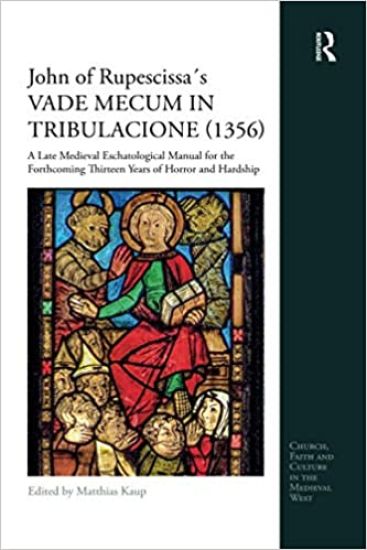
John of Rupescissa´s VADE MECUM IN TRIBULACIONE (1356)
The VADE MECUM IN TRIBULACIONE was meant as an eschatological manual for the thirteen catastrophic years between its composition in December 1356 and the Thousand-Year Reign of Christ expected to begin in 1370. This manual, permeated by passion for clerical reform, was intended to give righteous Christians practical and spiritual advice on how to survive this period of tribulation. Likewise, it aimed to inform them about what to expect from the envoys of Satan, the Western and the Eastern Antichrists, but also from Christ’s warriors, the papal restorer and his secular assistant, the French-Roman Emperor. Moreover, it offered a brief outline of Christ’s Thousand-Year Reign and of Armageddon.The VADE MECUM was written by John of Rupescissa OFM (c. 1310-1366), the most prolific apocalyptic author of the Middle Ages, as the central work of in all three manuals designed to prepare Christendom for the impending crises. As a completely new text type and summary of the late Rupescissa’s doctrines, this eschatological manual fascinated numerous readers in the Late Middle Ages, who copied, reworked and translated it and made it thus a pivotal text of medieval apocalypticism: ten versions of the Latin VADE MECUM in more than forty manuscripts have come down to us.Rupescissa’s eschatological manual is his last known and most widely distributed work; the present study provides an annotated critical edition equipped with an English translation. It inducts in the manual’s contents, places them in the context of Rupescissa’s work and medieval prophetic literature, investigates important aspects of its reception and clarifies the relationships between its different versions. Furthermore, it ends with a critical edition of the VENI MECUM IN TRIBULACIONE, the most influential compendious version of the VADE MECUM. Thus this book offers an indispensable fundamental contribution to the flourishing studies of Rupescissa and medieval apocalypticism.
John of Damascus

John of Damascus

Vassa Kontouma

Routledge
2020
nidottu
For more than five hundred years the life and work of John of Damascus (c. 655-c.745) have been the subject of a very extensive literature, scholarly and popular, in which it is often difficult to get one’s bearings. Through the studies included here (of which 6 appear in a translation into English made specially for this volume), Vassa Kontouma provides a critical review of this literature and attempts to answer several open questions: the author and date of composition of the official Life of John, the philosophical significance of the Dialectica (a study which has its first publication here), the original structure of the Exposition of the Orthodox faith, the identity of ps.-Cyril, the authenticity of the Letter on Great Lent, and questions of Mariology. She also opens new vistas for research along four main lines: the life of John of Damascus and its sources, Neochalcedonian philosophy, systematic theology in Byzantium, and Christian practices under the Umayyads.
John Rawls and Environmental Justice

John Rawls and Environmental Justice

John Töns

TAYLOR FRANCIS LTD
2021
sidottu
Using the principles of John Rawls’ theory of justice, this book offers an alternative political vision, one which describes a mode of governance that will enable communities to implement a sustainable and socially just future.Rawls described a theory of justice that not only describes the sort of society in which anyone would like to live but that any society can create a society based on just institutions. While philosophers have demonstrated that Rawls’s theory can provide a framework for the discussion of questions of environmental justice, the problem for many philosophical theories is that discussions of sustainable development open the need to address questions of ecological interdependence, historical inequality in past resource use and the recognition that we cannot afford to ignore the limitations of growth. These ideas do not fit in comfortably in standard discourse about theories of justice. In contrast, this book frames the discussion of global justice in terms of environmental sustainability. The author argues that these ideas can be used to develop a coherent political theory that reconciles cosmopolitan arguments and the non-cosmopolitan or nationalist arguments concerning social and environmental justice.This book will be of great interest to students and scholars of environmental philosophy and ethics, moral and political philosophy, global studies and sustainable development.
John Rawls and Environmental Justice

John Rawls and Environmental Justice

John Töns

TAYLOR FRANCIS LTD
2023
nidottu
Using the principles of John Rawls’ theory of justice, this book offers an alternative political vision, one which describes a mode of governance that will enable communities to implement a sustainable and socially just future.Rawls described a theory of justice that not only describes the sort of society in which anyone would like to live but that any society can create a society based on just institutions. While philosophers have demonstrated that Rawls’s theory can provide a framework for the discussion of questions of environmental justice, the problem for many philosophical theories is that discussions of sustainable development open the need to address questions of ecological interdependence, historical inequality in past resource use and the recognition that we cannot afford to ignore the limitations of growth. These ideas do not fit in comfortably in standard discourse about theories of justice. In contrast, this book frames the discussion of global justice in terms of environmental sustainability. The author argues that these ideas can be used to develop a coherent political theory that reconciles cosmopolitan arguments and the non-cosmopolitan or nationalist arguments concerning social and environmental justice.This book will be of great interest to students and scholars of environmental philosophy and ethics, moral and political philosophy, global studies and sustainable development.
John Wallis: Writings on Music

John Wallis: Writings on Music

Benjamin Wardhaugh

Routledge
2020
nidottu
John Wallis (1616-1703), was one of the foremost British mathematicians of the seventeenth century, and is also remembered for his important writings on grammar and logic. An interest in music theory led him to produce translations into Latin of three ancient Greek texts - those of Ptolemy, Porphyry and Bryennius - and involved him in discussions with Henry Oldenburg, the Secretary of the Royal Society, Thomas Salmon and other individuals as his ideas developed. The texts presented in this volume cover the relationship of ancient and modern tuning theory, the building of organs, the phenomena of resonance, and other musical topics.
John Rawls and the Common Good
The chapters in this book analyze the relationship between core concepts of the common good and the work of American political philosopher John Rawls.One of the main criticisms that has been made of Rawls is his supposed neglect of central aspects of collective life. The contributors to this book explore the possibility of a substantive and community-oriented interpretation of Rawls’s thought. The chapters investigate Rawls’s views on values such as community, faith, fraternity, friendship, gender equality, love, political liberty, reciprocity, respect, sense of justice, and virtue. They demonstrate that Rawls finds a balance between certain individualistic aspects of his theory of justice and the value of community. In doing so, the book offers insightful new readings of Rawls.John Rawls and the Common Good will be of interest to scholars and advanced students working in political, moral, and legal philosophy.
John Rawls and the Common Good
The chapters in this book analyze the relationship between core concepts of the common good and the work of American political philosopher John Rawls.One of the main criticisms that has been made of Rawls is his supposed neglect of central aspects of collective life. The contributors to this book explore the possibility of a substantive and community-oriented interpretation of Rawls’s thought. The chapters investigate Rawls’s views on values such as community, faith, fraternity, friendship, gender equality, love, political liberty, reciprocity, respect, sense of justice, and virtue. They demonstrate that Rawls finds a balance between certain individualistic aspects of his theory of justice and the value of community. In doing so, the book offers insightful new readings of Rawls.John Rawls and the Common Good will be of interest to scholars and advanced students working in political, moral, and legal philosophy.
John the Baptist as a Rewritten Figure in Luke-Acts

John the Baptist as a Rewritten Figure in Luke-Acts

Christina Michelsen Chauchot

TAYLOR FRANCIS LTD
2024
nidottu
John the Baptist as a Rewritten Figure in Luke-Acts compares the Gospel of Luke’s account of John’s ministry with those of Matthew, Mark, and John to make the case for the hypertextual relationship between the synoptic gospels.The book is divided into three parts. Part I situates the Gospel of Luke within the broader context of biblical rewritings and makes the general case that a rewriting strategy can be detected in Luke, while Parts II and III combined offer a more detailed and specific argument for Luke’s refiguring of the public ministry of John the Baptist through the use of omitted, new, adapted, and reserved material. While the "two source hypothesis" typically presupposes the independence of Luke and Matthew in their rewritings of Mark and Q, Chauchot argues that Luke was heavily reliant on Matthew as suggested by the "L/M hypothesis". Approaching the Baptist figure in the synoptic gospels from a literary-critical perspective, Chauchot examines "test cases" of detailed comparative analysis between them to argue that the Gospel of Luke makes thematic changes upon John the Baptist and is best characterized as a highly creative reshaping of Matthew and Mark.Making a contribution to current research in the field of New Testament exegesis, the book is key reading for students, scholars, and clergy interested in New Testament hermeneutics and Gospel writing.
John Williams: Changing the Culture of the Classical Guitar
This book assesses the influence and reception of many different forms of guitar playing upon the classical guitar and more specifically through the prism of John Williams. Beginning with an examination of Andrés Segovia and his influence upon Williams’ life’s work, a further three incisive chapters cover key areas such as performance, perception, education and construction, considering social and cultural contexts of the guitar over the past century. A final chapter on new directions in classical guitar examines the change in reception of the instrument from the mid-1970s to the present day, and Williams’ impact upon what might be termed ‘standard classical guitar repertoire’.With in-depth discussion of the cultural and perceptual impact of Williams’ more daring crossover projects and numerous musical examples, this is an informative reference for all classical guitar practitioners, as well as scholars and researchers of guitar studies, reception studies, cultural musicology and performance studies. An online lecture by the author and a transcript of the author’s interview with John Williams are also available as e-resources.
John Locke and the Bank of England

John Locke and the Bank of England

Claude Roche

TAYLOR FRANCIS LTD
2023
nidottu
John Locke was one of the first shareholders of the Bank of England and participated in parliamentary debates surrounding its creation. He had a key role in the monetary reform of 1696. This book examines Locke’s thought in relation to credit, banking regulation, the monetary and financial system, the gold standard and the principles of Natural Right. It also establishes a link between Locke’s economic and financial ideas and his political philosophy.John Locke and the Bank of England will be of interest to advanced students and researchers of central banking, financial history, the history of economic thought and political economy.
John Dowland

John Dowland

K. Dawn Grapes

Routledge
2021
nidottu
John Dowland: A Research and Information Guide offers the first comprehensive guide to the musical works and literature on one of the major composers of the English Renaissance. Including a catalog of works, discography of recordings, extensive annotated bibliography of secondary sources, and substantial indexes, this volume is a major reference tool for all those interested in Dowland's works and place in music history, and a valuable resource for researchers of Renaissance and English music.
John Locke and the Bank of England
John Locke was one of the first shareholders of the Bank of England and participated in parliamentary debates surrounding its creation. He had a key role in the monetary reform of 1696. This book examines Locke’s thought in relation to credit, banking regulation, the monetary and financial system, the gold standard and the principles of Natural Right. It also establishes a link between Locke’s economic and financial ideas and his political philosophy.John Locke and the Bank of England will be of interest to advanced students and researchers of central banking, financial history, the history of economic thought and political economy.
John Cage

John Cage

Sara Haefeli

Routledge
2019
nidottu
This annotated bibliography uncovers the wealth of resources available on the life and music of John Cage, one of the most influential and fascinating composers of the twentieth-century. The guide will focus on documentary studies, archival resources, scholarly research, and autobiographical materials, and place the composer and his work in a larger context of postmodern philosophy, art and theater movements, and contemporary politics. It will support emerging scholarship and inquiry for future research on Cage, with carefully selected sources and useful annotations.
John II Komnenos, Emperor of Byzantium
The Emperor John II Komnenos (1118–1143) has been overshadowed by both his father Alexios I and his son Manuel I. Written sources have not left us much evidence regarding his reign, although authors agree that he was an excellent emperor. However, the period witnessed territorial expansion in Asia Minor as well as the construction of the most important monastic complex of twelfth-century Constantinople. What else do we know about John’s rule and its period? This volume opens up new perspectives on John’s reign and clearly demonstrates that many innovations generally attributed to the genius of Manuel Komnenos had already been fostered during the reign of the second great Komnenos. Leading experts on twelfth-century Byzantium (Jeffreys, Magdalino, Ousterhout) are joined by representatives of a new generation of Byzantinists to produce a timely and invaluable study of the unjustly neglected figure of John Komnenos.
John Bunyan?s Imaginary Writings in Context
Within the last half-century, early scholarly approaches and analysis of John Bunyan’s Pilgrim’s Progress have seen siginificant advances in mandating and enabling a more contextualized view of Bunyan’s oeuvre. Utilizing this fresh examination of context, John Bunyan’s Imaginary Writings in Context explores Bunyan’s writings in a double context: his fictional works vis-à-vis his own non-fictional writings, and his fictional writings in the context of written materials by other authors – books, tracts, spiritual biographies, and poems available to Bunyan. This volumepresents these recent developments by blurring the boundaries between fiction and non-fiction, between literature and history, and in the case of Bunyan, between imaginative literatures in fiction and theological writing. Moreover, this book aims to delineate the imaginary world underlying Bunyan’s fictional writings by viewing Bunyan’s own fictional works in tandem with his non-fiction writings. Simultaneously it situates aspects of Bunyan’s fiction in the context of writings available to him, whether these be Holy Scripture, religious tracts by other authors, or ballads and short texts current in the wider culture of the time.