Kirjojen hintavertailu. Mukana 12 016 292 kirjaa ja 12 kauppaa.

Kirjahaku

Etsi kirjoja tekijän nimen, kirjan nimen tai ISBN:n perusteella.

1000 tulosta hakusanalla Jon F. Merz

Vicious

Vicious

Jon T. Coleman

Yale University Press
2006
pokkari
A provocative history of wolves in America and of the humans who first destroyed them and now offer them protection“A shocking cultural study of our long, sadistic crusade against wolves. Moving brilliantly through history, economics, and biology, Coleman...explains America’s fevered obsession with these animals."—Ron Charles, Washington Post Book Club Over a continent and three centuries, American livestock owners destroyed wolves to protect the beasts that supplied them with food, clothing, mobility, and wealth. The brutality of the campaign soon exceeded wolves’ misdeeds. Wolves menaced property, not people, but storytellers often depicted the animals as ravenous threats to human safety. Subjects of nightmares and legends, wolves fell prey not only to Americans’ thirst for land and resources but also to their deeper anxieties about the untamed frontier.Now Americans study and protect wolves and jail hunters who shoot them without authorization. Wolves have become the poster beasts of the great American wilderness, and the federal government has paid millions of dollars to reintroduce them to scenic habitats like Yellowstone National Park.Why did Americans hate wolves for centuries? And, given the ferocity of this loathing, why are Americans now so protective of the animals? In this ambitious history of wolves in America—and of the humans who have hated and then loved them—Jon Coleman investigates a fraught relationship between two species and uncovers striking similarities, deadly differences, and, all too frequently, tragic misunderstanding.

Resurrection and the Restoration of Israel

Resurrection and the Restoration of Israel

Jon D. Levenson

Yale University Press
2008
pokkari
This provocative volume explores the origins of the Jewish doctrine of the resurrection of the dead. Jon D. Levenson argues that, contrary to a very widespread misconception, the ancient rabbis were keenly committed to the belief that at the end of time, God would restore the deserving dead to life. In fact, Levenson points out, the rabbis saw the Hebrew Bible itself as committed to that idea.The author meticulously traces the belief in resurrection backward from its undoubted attestations in rabbinic literature and in the Book of Daniel, showing where the belief stands in continuity with earlier Israelite culture and where it departs from that culture. Focusing on the biblical roots of resurrection, Levenson challenges the notion that it was a foreign import into Judaism, and in the process he develops a neglected continuity between Judaism and Christianity. His book will shake the thinking of scholars and lay readers alike, revising the way we understand the history of Jewish ideas about life, death, and the destiny of the Jewish people.
Resurrection

Resurrection

Jon D. Levenson; Kevin Madigan

Yale University Press
2009
pokkari
Two scholars—one a Christian and the other a Jew—find deep and meaningful connections between their two faiths This book, written for religious and nonreligious people alike in clear and accessible language, Although this expectation, known as the resurrection of the dead, is widely understood to have been a part of Christianity from its beginnings nearly two thousand years ago, many people are surprised to learn that the Jews believed in resurrection long before the emergence of Christianity. In this sensitively written and historically accurate book, religious scholars Kevin J. Madigan and Jon D. Levenson aim to clarify confusion and dispel misconceptions about Judaism, Jesus, and Christian origins.Madigan and Levenson tell the fascinating but little-known story of the origins of the belief in resurrection, investigating why some Christians and some Jews opposed the idea in ancient times while others believed it was essential to their faith. The authors also discuss how the two religious traditions relate their respective practices in the here and now to the new life they believe will follow resurrection. Making the rich insights of contemporary scholars of antiquity available to a wide readership, Madigan and Levenson offer a new understanding of Jewish-Christian relations and of the profound connections that tie the faiths together.
All These Worlds Are Yours

All These Worlds Are Yours

Jon Willis

Yale University Press
2016
sidottu
Where would you look for alien life? An astronomer and science popularizer explains the basics of astrobiology to outline five plausible scenarios for finding extraterrestrials Long before space travel was possible, the idea of life beyond Earth transfixed humans. In this fascinating book, astronomer Jon Willis explores the science of astrobiology and the possibility of locating other life in our own galaxy. Describing the most recent discoveries by space exploration missions, including the Kepler space telescope, the Mars Curiosity rover, and the New Horizons probe, Willis asks readers to imagine—and choose among—five scenarios for finding life. He encourages us to wonder whether life might exist within Mars’s subsoil ice. He reveals the vital possibilities on the water-ice moons Europa and Enceladus. He views Saturn’s moon Titan through the lens of our own planet’s ancient past. And, he even looks beyond our solar system, investigating the top candidates for a “second Earth” in a myriad of exoplanets and imagining the case of a radio signal arriving from deep space. Covering the most up-to-date research, this accessibly written book provides readers with the basic knowledge necessary to decide where they would look for alien life.
The Great Pox

The Great Pox

Jon Arrizabalaga; John Henderson; Roger French

Yale University Press
2014
pokkari
One hundred and fifty years after the Black Death killed a third of the population of Western Europe, a new plague swept across the continent. The Great Pox—commonly known as the French disease—brought a different kind of horror: instead of killing its victims rapidly, it endured in their bodies for years, causing acute pain, disfigurement, and ultimately an agonizing death.In this new study, three experts explore the impact of the new plague and society's reaction to its challenge. Using a range of contemporary sources, from the archives of charitable and sanitary institutions that coped with the sick to the medical tracts of those who sought to cure it, they provide the first detailed account of the experience of the disease across Renaissance Italy as well as in France and Germany.The authors analyze the symptoms of the Great Pox and the identity of patients, richly documented in the records of the massive hospital for "incurables" established in early sixteenth-century Rome. They show how it challenged accepted medical theory and practice and provoked public disputations among university teachers. And at the most practical level, they reveal the plight of its victims at all levels of society, from ecclesiastical lords to the diseased poor who begged in the streets. Examining a range of contexts from princely courts and republics to university faculties, confraternities, and hospitals, the authors argue powerfully for a historical understanding of the Great Pox based on contemporary perceptions rather than a retrospective diagnosis of what later generations came to know as "syphilis."
Nature Shock

Nature Shock

Jon T. Coleman

Yale University Press
2020
sidottu
An award-winning environmental historian explores American history through wrenching, tragic, and sometimes humorous stories of getting lost"Fascinating. . . . Underlying . . . is a deep belief in the importance of collaboration and cooperation between humans and their environments, as well as between humans and other humans."—Robert Macfarlane, New York Review of Books The human species has a propensity for getting lost. The American people, inhabiting a mental landscape shaped by their attempts to plant roots and to break free, are no exception. In this engaging book, environmental historian Jon Coleman bypasses the trailblazers so often described in American history to follow instead the strays and drifters who went missing. From Hernando de Soto’s failed quest for riches in the American southeast to the recent trend of getting lost as a therapeutic escape from modernity, this book details a unique history of location and movement as well as the confrontations that occur when our physical and mental conceptions of space become disjointed. Whether we get lost in the woods, the plains, or the digital grid, Coleman argues that getting lost allows us to see wilderness anew and connect with generations across five centuries to discover a surprising and edgy American identity.
Futureproof

Futureproof

Jon Coaffee

Yale University Press
2019
sidottu
A compelling and definitive account of why we need to radically rethink our approach to dealing with catastrophic events Catastrophic events such as 9/11, Hurricane Katrina, and the Tohoku "Triple Disaster" of earthquake, tsunami, and nuclear meltdown that hit the eastern seaboard of Japan in 2012 are seen as surprises that have a low probability of occurring but have a debilitating impact when they do. In this eye-opening journey through modern and ancient risk management practices, Jon Coaffee explains why we need to find a new way to navigate the deeply uncertain world that we live in. Examining how governments have responded to terrorist threats, climate change, and natural hazards, Coaffee shows how and why these measures have proven inadequate and what should be done to make us more resilient. While conventional approaches have focused on planning and preparing for disruptions and enhanced our ability to "bounce back," our focus should be on anticipating future challenges and enhancing our capacity to adapt to new threats.
The Illusion of Control

The Illusion of Control

Jon Danielsson

YALE UNIVERSITY PRESS
2022
sidottu
A challenge to the conventional wisdom surrounding financial risk, providing insight into why easy solutions to control the financial system are doomed to fail Finance plays a key role in the prosperity of the modern world, but it also brings grave dangers. We seek to manage those threats with a vast array of sophisticated mathematical tools and techniques of financial risk management. Too often, though, we fail to address the greatest risk—the peril posed by our own behavior. Jón Daníelsson argues that critical risk is generated from within, through the interactions of individuals and perpetuated by their beliefs, objectives, abilities, and prejudices. He asserts that the widespread belief that risk originates outside the financial system frustrates our ability to measure and manage it, and the likely consequences of new regulations will help alleviate small-scale risks but, perversely, encourage excessive risk taking. Daníelsson uses lessons from past and recent crises to show that diversity is the best way to safeguard our financial system.
Early Hunter-Gatherers of the California Coast

Early Hunter-Gatherers of the California Coast

Jon M. Erlandson

Kluwer Academic/Plenum Publishers
1994
sidottu
Based on detailed excavation data, the author reconstructs the paleography of the Santa Barbara coast ca. 8500 years ago, makes comparisons to other early California sites, and applies his findings to current theories of hunter-gatherers and coastal environments. With an emphasis on paleographic reconstructions, site formation processes, chronological studies, and integrated faunal analyses, the work will be of interest to a wide range of scholars working in shell middens, hunter-gatherer ecology, geoarchaeology, and coatal or aquatic adaptations.
Mississippian Political Economy

Mississippian Political Economy

Jon Muller

Kluwer Academic/Plenum Publishers
1997
sidottu
This book is written from a particular theoretical and practical postnon. The first chapter outlines some of these issues, but a few issues requireemphasis. The first is what is meant by "political economy. " The concept of political econ- omy used here derives from common economic and social science usage. Sometimes, however, a few individuals seem to consider political economy to consist only of power relationships, especially in regard to distribution and consumption, often excluding or ignoring social reproduction or production. Although power and its uses are important issues, this is a very incomplete view of political economy from my perspective, one that ignores arguably eentral issues. Another issue is that of historieal eomparisons. Some of the ehapters that follow have mueh historieal data. The historical eomparisons are not the point of this volume, however. Testing of historieal "models" is important, but the reader should not be distraeted by them. I have long preaehed against misuse of historieal analogy. I do argue that the historie and prehistorie Southeastem societies have been misunderstood so as to make an artifieial gap between them, but this is a seeondary issue. In any ease, the thesis of similarity is being tested against empirieal evidenee. The historieal data are absolutely not being used to interpret the prehistorie data.
Mississippian Political Economy

Mississippian Political Economy

Jon Muller

Kluwer Academic/Plenum Publishers
1997
nidottu
This book is written from a particular theoretical and practical postnon. The first chapter outlines some of these issues, but a few issues requireemphasis. The first is what is meant by "political economy. " The concept of political econ- omy used here derives from common economic and social science usage. Sometimes, however, a few individuals seem to consider political economy to consist only of power relationships, especially in regard to distribution and consumption, often excluding or ignoring social reproduction or production. Although power and its uses are important issues, this is a very incomplete view of political economy from my perspective, one that ignores arguably eentral issues. Another issue is that of historieal eomparisons. Some of the ehapters that follow have mueh historieal data. The historical eomparisons are not the point of this volume, however. Testing of historieal "models" is important, but the reader should not be distraeted by them. I have long preaehed against misuse of historieal analogy. I do argue that the historie and prehistorie Southeastem societies have been misunderstood so as to make an artifieial gap between them, but this is a seeondary issue. In any ease, the thesis of similarity is being tested against empirieal evidenee. The historieal data are absolutely not being used to interpret the prehistorie data.
High Resolution Focused Ion Beams: FIB and its Applications

High Resolution Focused Ion Beams: FIB and its Applications

Jon Orloff; Lynwood Swanson; Mark Utlaut

Kluwer Academic/Plenum Publishers
2002
sidottu
In this book, we have attempted to produce a reference on high resolution focused ion beams (FIBs) that will be useful for both the user and the designer of FIB instrumentation. We have included a mix of theory and applications that seemed most useful to us. The field of FIBs has advanced rapidly since the application of the first field emission ion sources in the early 1970s. The development of the liquid metal ion source (LMIS) in the late 1960s and early 1970s and its application for FIBs in the late 1970s have resulted in a powerful tool for research and for industry. There have been hundreds of papers written on many aspects of LMIS and FIBs, and a useful and informative book on these subjects was published in 1991 by Phil Prewett and Grame Mair. Because there have been so many new applications and uses found for FIBs in the last ten years we felt that it was time for another book on the subject.
Wherever You Go, There You Are: Mindfulness Meditation in Everyday Life
Find quiet reflective moments in your life--and reduce your stress levels drastically--with this classic bestselling guide updated and featuring a new introduction and afterword. When Wherever You Go, There You Are was first published in 1994, no one could have predicted that the book would launch itself onto bestseller lists nationwide and sell over 1 million copies to date. Thirty years later, Wherever You Go, There You Are remains a foundational guide to mindfulness and meditation, introducing readers to the practice and guiding them through the process. The author of over half a dozen books on mindfulness, Jon Kabat-Zinn combines his research and medical background with his spiritual knowledge to help readers find peace and change their lives. In this new edition, readers will find a new introduction and afterword from Kabat-Zinn, as well as factual updates throughout to address changes in research and knowledge since it was originally published. After the special tumult of the last few years, as well as the promise of more unrest in the future, Wherever You Go, There You Are serves as an anchor for a whole new generation of readers looking to find their center and achieve their true self.
The Monster at the End of This Book (Sesame Street)
By all accounts, this book is a favorite among toddlers and adults alike. Generations will recall their first time reading along as lovable, furry old Grover begs the reader not to turn the page . . . for a monster is at the end of the book But, of course, the monster is none other than Grover himself. A classic, not to be missed.
Where Men Win Glory: The Odyssey of Pat Tillman
NATIONAL BESTSELLER - A "gripping book about this extraordinary man who lived passionately and died unnecessarily" (USA Today) in post-9/11 Afghanistan, from the bestselling author of Into the Wild and Into Thin Air.In 2002, Pat Tillman walked away from a multimillion-dollar NFL contract to join the Army and became an icon of American patriotism. When he was killed in Afghanistan two years later, a legend was born. But the real Pat Tillman was much more remarkable, and considerably more complicated than the public knew. Sent first to Iraq--a war he would openly declare was "illegal as hell" --and eventually to Afghanistan, Tillman was driven by emotionally charged, sometimes contradictory notions of duty, honor, justice, and masculine pride, and he was determined to serve his entire three-year commitment. But on April 22, 2004, his life would end in a barrage of bullets fired by his fellow soldiers. Though obvious to most of the two dozen soldiers on the scene that a ranger in Tillman's own platoon had fired the fatal shots, the Army aggressively maneuvered to keep this information from Tillman's family and the American public for five weeks following his death. During this time, President Bush used Tillman's name to promote his administration' s foreign policy. Long after Tillman's nationally televised memorial service, the Army grudgingly notified his closest relatives that he had "probably" been killed by friendly fire while it continued to dissemble about the details of his death and who was responsible. Drawing on Tillman's journals and letters and countless interviews with those who knew him and extensive research in Afghanistan, Jon Krakauer chronicles Tillman's riveting, tragic odyssey in engrossing detail highlighting his remarkable character and personality while closely examining the murky, heartbreaking circumstances of his death. Infused with the power and authenticity readers have come to expect from Krakauer's storytelling, Where Men Win Glory exposes shattering truths about men and war. This edition has been updated to reflect new developments and includes new material obtained through the Freedom of Information Act.
Three Cups of Deceit

Three Cups of Deceit

Jon Krakauer

Anchor Books
2011
pokkari
Greg Mortenson, the bestselling author of Three Cups of Tea, is a man who has built a global reputation as a selfless humanitarian and children's crusader, and he's been nominated for the Nobel Peace Prize. But, as Jon Krakauer demonstrates in this extensively researched and penetrating book, he is not all that he appears to be. Based on wide-ranging interviews with former employees, board members, and others who have intimate knowledge of Mortenson and his charity, the Central Asia Institute, Three Cups of Deceit uncovers multiple layers of deception behind Mortenson's public image. Was his crusade really inspired by a desire to repay the kindness of villagers who nursed him back to health when he became lost on his descent down K2? Was he abducted and held for eight days by the Taliban? Has his charity built all of the schools that he has claimed? This book is a passionately argued plea for the truth, and a tragic tale of good intentions gone very wrong. 100% of Jon Krakauer's proceeds from the sale of Three Cups of Deceit will be donated to the "Stop Girl Trafficking" project at the American Himalayan Foundation (www.himalayan-foundation.org/live/project/stopgirltrafficking).
Another Monster at the End of This Book (Sesame Street)

Another Monster at the End of This Book (Sesame Street)

Jon Stone

Golden Books Publishing Company, Inc.
1999
sidottu
In this beautifully illustrated sequel to the much-loved classic The Monster at the End of This Book, Grover, now with pal Elmo by his side, has heard that there's something lurking on the last page of the book. Grover tries his best in all sorts of hilarious ways to stop the reader from turning the pages. But, Elmo, curious as always, slips by every wacky barrier. Toddlers will find it hard to resist turning the pages too.
Stuff Christians Like

Stuff Christians Like

Jon Acuff

Zondervan
2020
sidottu
Using the same humor and honesty that galvanized more than a million online readers from more than 200 countries, speaker Jon Acuff brings his insightful take on Christianity to the book world with this new edition of Stuff Christians Like. Do you constantly find yourself towing the fine line between praying before certain types of meals and not others? This book is for you. Have you fallen in love on a mission trip, just to break up when you get home? This book is for you. Are you a unicorn of purity who ranks honeymoon sex slightly higher than the second coming of Christ? Guess what – this book is for you, too.It’s time to shake off Somber Christian Syndrome and embrace the quirks of being a member of God’s kingdom. This book will teach you how to:Break up with your small groupSubtly find out if your new Christian friends drink beer tooRecognize the shame grenade that is a Jesus JukeAvoid a prayer handholding faux pasSay something Christian-y without looking like a snake handlerFrom prayer shot blocks to metro worship leaders, no stone is left unturned in this hilarious look at faith.“I never knew how much I needed Jesus until I found out I was judging people who use the table of contents in their Bible. This book saved me from looking like a bad Christian.” – Sister Mary Francis, Rhode Island.“It’s such a time saver to know that my Chick-fil-a from the drive-thru comes pre-blessed. I always knew I was making the right choice by choosing the Lord’s chicken.” – Dave L., South Carolina.
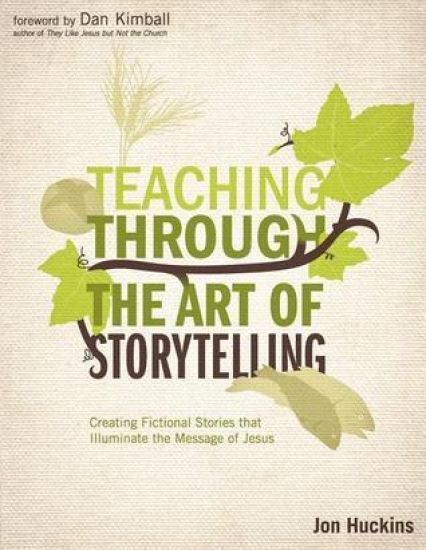
Teaching Through the Art of Storytelling

Teaching Through the Art of Storytelling

Jon Huckins; Dan Kimball

Zondervan
2011
nidottu
As communicators in a culture saturated with storylines, we have the profound opportunity to invite our students into the masterful Story of God. There are a variety of ways to invite our students into this Story, but this book discusses and explores how to teach through one of Jesus' most powerful modes of communication--fictional storytelling. Rabbinical storytelling (otherwise known as Jewish Agada) embraces the narrative of Scripture and invites its listeners into understanding and participation. Our Rabbi, Jesus, employed this mode of communication through his parables. Approaching the topic as a theologian, philosopher and artist, Jon invites and teaches how to create modern-day parables that illuminate the message of Jesus. These stories do not simply illustrate the message; they are, in fact, the message. Whether hoping to articulate deep theological concepts or relevant topics, teaching through the art of fictional storytelling has the potential to engage and invite our students into The Story. In this book: •You will learn how to create your own fictional stories (modern day parables) that use a realistic setting, engaging characters and a thought provoking plot to communicate a specific topic. •You are given practical worksheets that offer guidance in developing such stories •Jon includes a variety of stories he has developed over his years of youth ministry and offers them as a resource to any youth pastor/communicator. "I found myself wrapped up in its pages and receiving personal learning. It's a rarity in youth ministry as it has the potential of impacting not only youth but also their youth leaders." --Dan Kimball - author of They Like Jesus but Not the Church